






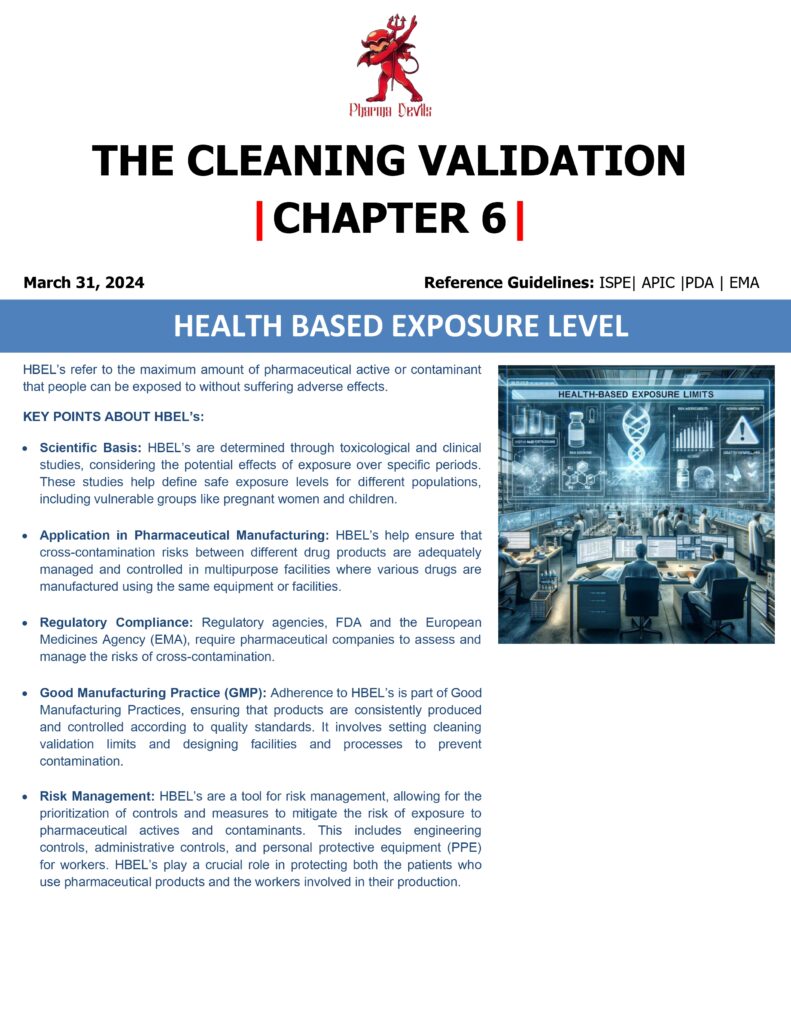
The HBEL (Health-Based Exposure Limit) approach in cleaning validation sets acceptance limits using a science-based estimate of how much of a residue a patient can safely be exposed to per day without appreciable health risk. HBELs are typically expressed as a PDE (Permitted Daily Exposure) or equivalent value and are now the preferred basis for carryover limits instead of older fixed limits (e.g., 10 ppm or 1/1000 dose), except where scientifically justified.
1) Build the toxicological basis (PDE/HBEL)
A qualified toxicologist (or trained SME per procedure) reviews:
- Pharmacology and toxicity data (NOAEL/LOAEL, clinical safety data)
- Genotoxicity/carcinogenicity, reproductive toxicity, sensitization
- Route of administration (oral, parenteral, inhalation), duration, special populations
Using recognized methodology, a PDE is derived by applying adjustment factors (e.g., interspecies, variability, duration).
2) Convert HBEL into a carryover limit (MACO)
Once PDE is available, calculate MACO (Maximum Allowable Carryover) into the next product, considering:
- Minimum daily dose of the next product (worst-case patient exposure)
- Maximum batch size of the next product (dilution effect)
A common expression is:
MACO (mg) = PDE (mg/day) × Batch size of next product (mg) ÷ Minimum daily dose of next product (mg/day)
3) Convert MACO to practical sampling limits
Translate MACO into:
- Surface residue limits (e.g., µg/cm²) using total shared product-contact surface area
- Rinse limits (e.g., mg/L) using final rinse volume, if rinse sampling is used
Include swab recovery factors when justified and ensure method LOQ is below limits.
4) Apply to equipment and worst-case selection
Use HBELs to select worst-case products (lowest PDE/high potency, poor solubility, sticky matrices) and worst-case equipment locations (gaskets, valves, dead legs). Group products into families when justified, but document rationale.
5) Control strategy and lifecycle
Execute PQ (often 3 successful runs), trend routine verification data, and manage changes (new product, new PDE, equipment changes, cleaning agent changes) through change control. HBEL-based limits provide defensible, patient-safety-focused cleaning validation across the product lifecycle.