




Brief Description
The Cleaning Validation of Glassware SOP defines a standardized procedure to ensure that laboratory glassware used in the Quality Control Department is effectively cleaned and free from residues that could interfere with subsequent analytical testing. The procedure includes initial rinsing with potable water, treatment with 1% lanoline solution, washing with potable water followed by DM water, and drying the cleaned glassware in an oven at 60 ± 5°C. Cleaning effectiveness is verified analytically by checking the solubility of the previously analyzed sample, adding a suitable solvent to the glassware, swirling it, and measuring the solution’s absorbance using a UV-Visible spectrophotometer at the specified wavelength. The acceptance criterion stated in the SOP is NMT ±0.005 absorbance. The SOP also defines personnel responsibilities, training requirements, document distribution, revision history, and an Annexure-I Cleaning Validation Test Report for recording glassware name, observed clarity, absorbance result, checking, and approval.
Skip to PDF content1. Flow Diagram:
The flow diagram illustrates the complete sequence for Cleaning Validation of Glassware used in the Quality Control laboratory. The process starts with collection of used or unclean glassware, followed by rinsing with potable water, dipping in 1% lanoline solution, washing with potable water and then DM water, and drying in an oven at 60 ± 5°C. After drying, the glassware is removed from the oven for analytical verification.
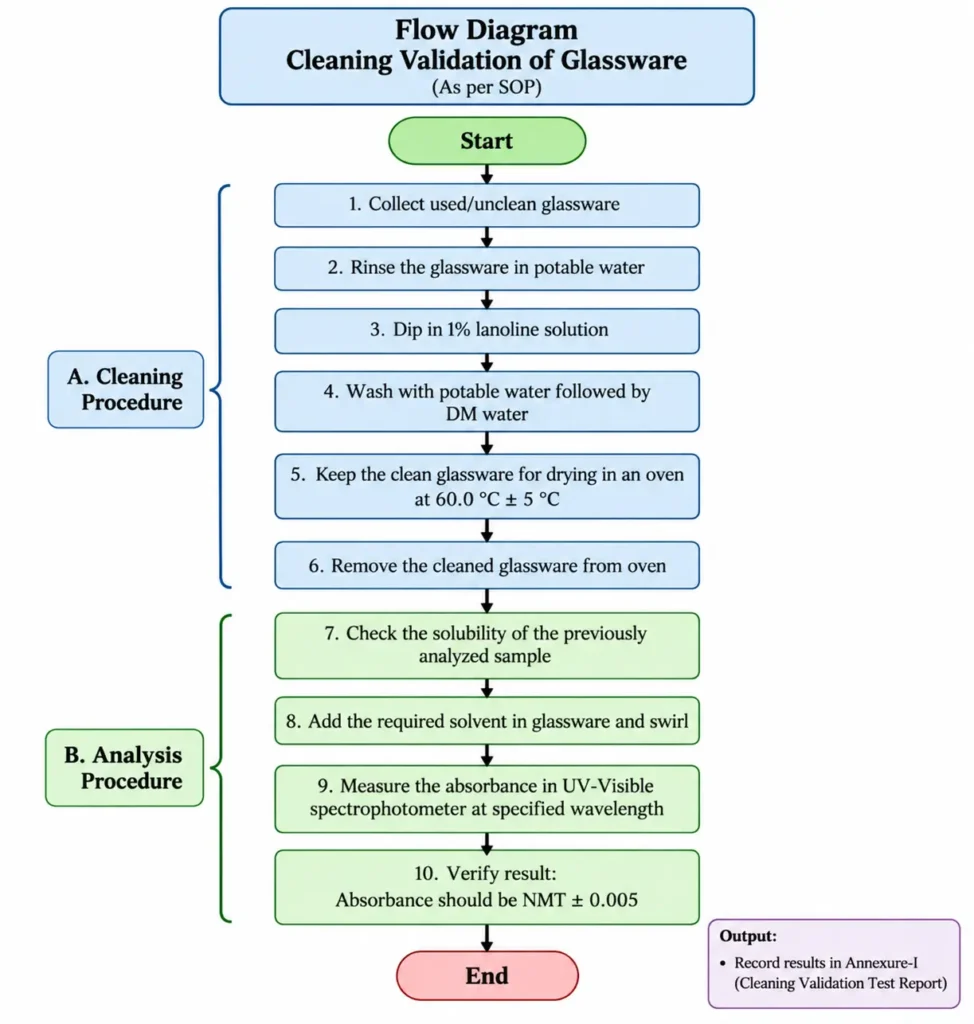
For cleaning verification, the solubility of the previously analyzed sample is checked, a suitable solvent is added to the glassware and swirled, and the resulting solution is analyzed using a UV-Visible spectrophotometer at the specified wavelength. The acceptance criterion stated in the SOP is NMT ±0.005 absorbance. Results are documented in the Cleaning Validation Test Report (Annexure-I) for review and approval.
2. Brainstorming for SOP Failure:
The brainstorming diagram identifies potential reasons for failure in implementing the Cleaning Validation of Glassware SOP within a pharmaceutical manufacturing environment. The possible causes include inadequate personnel training, poor understanding of the SOP, incorrect execution of cleaning steps, improper preparation of the 1% lanoline solution, inadequate potable-water and DM-water rinsing, and failure to maintain the required oven drying conditions.
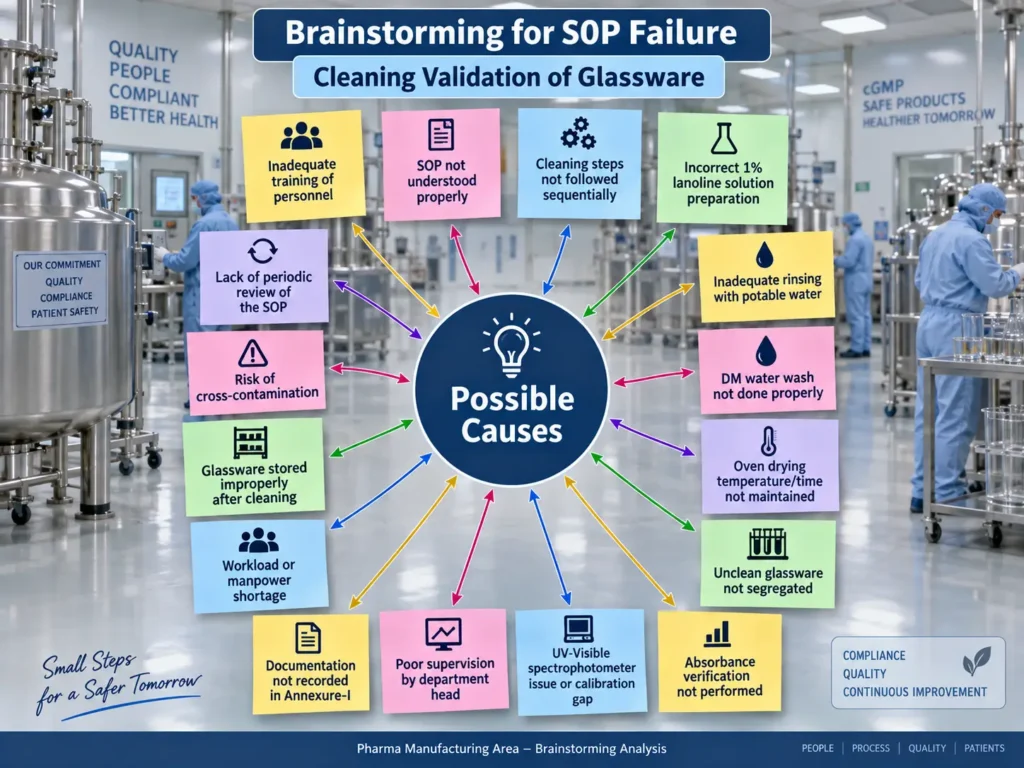
The diagram also highlights supporting system weaknesses such as poor supervision, insufficient manpower, improper segregation or storage of cleaned and unclean glassware, incomplete documentation in Annexure-I, and lack of periodic SOP review. Analytical verification failures may also arise from UV-Visible spectrophotometer calibration issues or omission of absorbance testing. Overall, the brainstorming exercise helps identify people, procedure, equipment, documentation, supervision, and compliance-related factors that may contribute to ineffective cleaning validation and increase the risk of residue carryover or cross-contamination.
3. 5-Why Analysis for SOP Failure:
The 5-Why Analysis for SOP Failure evaluates the underlying reasons why the Cleaning Validation of Glassware SOP may not be followed effectively in a pharmaceutical manufacturing or injectable area. The analysis begins with the failure to perform glassware cleaning validation as required and progressively examines operator awareness, adequacy of training, implementation of the training plan, and effectiveness of departmental supervision.
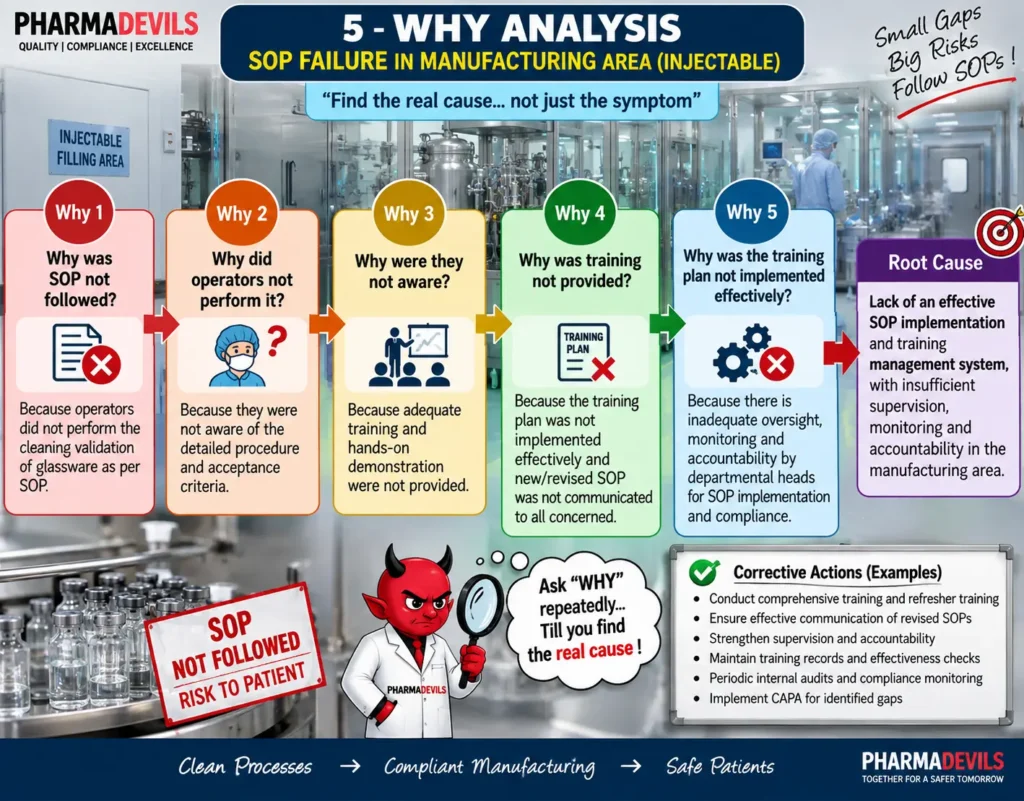
The investigation identifies inadequate SOP implementation and training management as the principal root cause, supported by weaknesses in communication, monitoring, accountability, and periodic compliance verification. Since the SOP requires defined cleaning steps, controlled drying, solvent rinsing, and UV-Visible absorbance verification, failure to follow these requirements can compromise the reliability of laboratory glassware cleaning verification. The analysis supports corrective actions such as refresher training, effective communication of revised SOPs, stronger supervision, training effectiveness checks, periodic internal audits, and CAPA implementation to prevent recurrence and strengthen GMP compliance.
4. Fishbone Analysis for SOP Failure:
The Fishbone Analysis for SOP Failure identifies potential causes that may lead to ineffective implementation of the Cleaning Validation of Glassware SOP in a pharmaceutical manufacturing environment. The causes are systematically grouped under six major categories: Man, Method, Machine, Material, Measurement, and Environment.
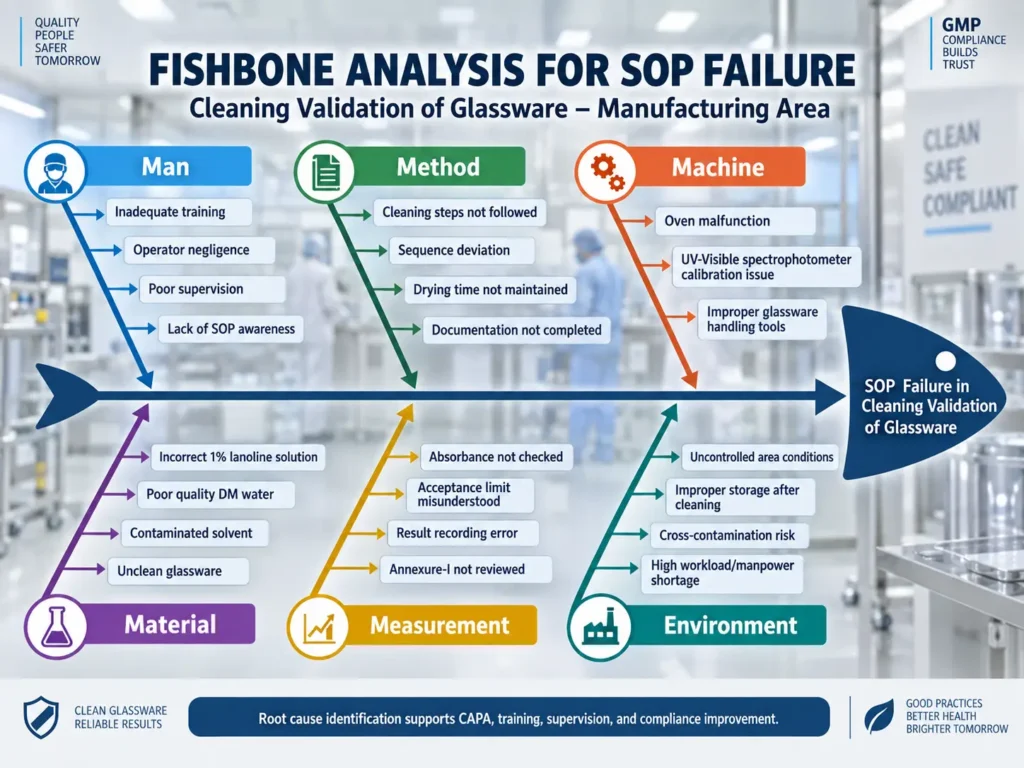
Under Man, key issues include inadequate training, poor supervision, operator negligence, and lack of SOP awareness. Method-related causes include failure to follow the defined cleaning sequence, inadequate drying control, and incomplete documentation. Machine-related causes may involve oven malfunction, UV-Visible spectrophotometer calibration problems, or unsuitable glassware-handling tools. Material factors include incorrect preparation of the 1% lanoline solution, poor-quality DM water, or contaminated solvent. Measurement issues include failure to check absorbance, misunderstanding of acceptance criteria, and recording errors. Environmental factors such as improper storage, cross-contamination risk, uncontrolled area conditions, or manpower shortages may further contribute to SOP failure. This structured analysis supports effective root-cause identification, CAPA development, training improvement, supervision, and GMP compliance.
5. Fault Tree Analysis for SOP Failure:
The Fault Tree Analysis (FTA) for SOP Failure systematically evaluates the potential pathways that can lead to failure of the Cleaning Validation of Glassware SOP in a pharmaceutical manufacturing environment. The top event is defined as SOP failure, which may arise from a combination of human, procedure/method, equipment/utility, material, and management/system-related factors.
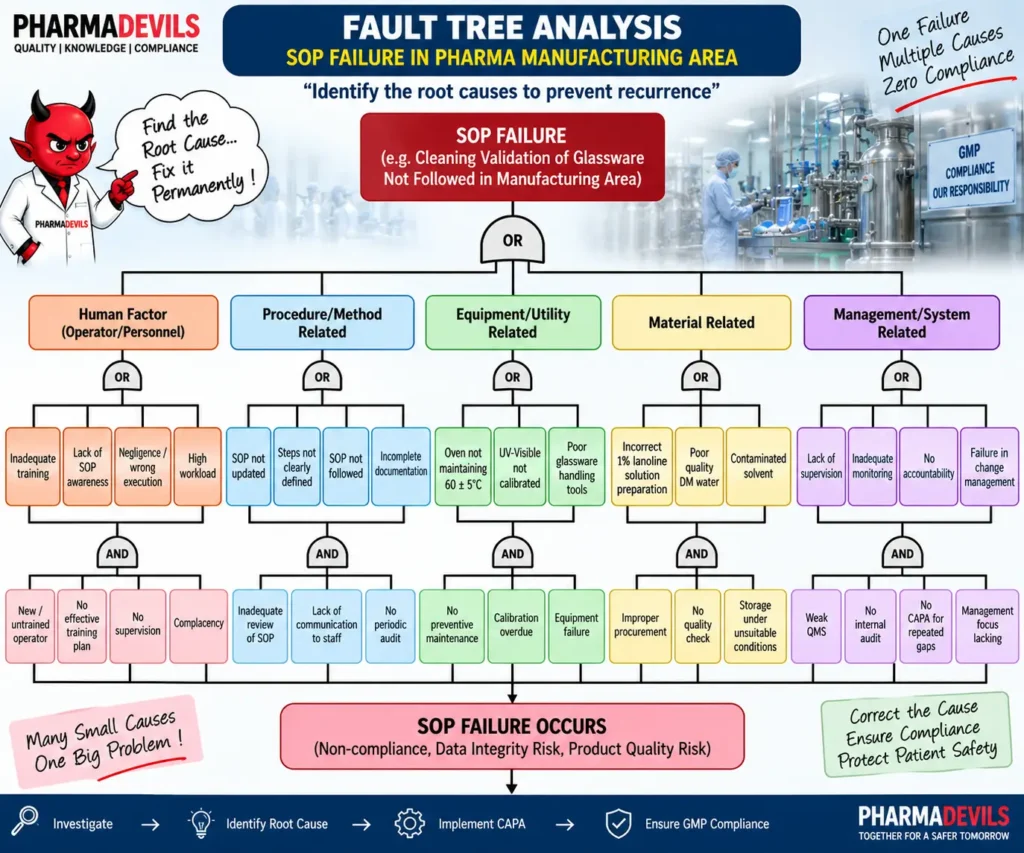
Human causes include inadequate training, poor SOP awareness, operator negligence, and excessive workload. Procedure-related causes include unclear instructions, incomplete documentation, and failure to follow the specified cleaning sequence. Equipment-related causes include oven temperature control problems and UV-Visible spectrophotometer calibration gaps. Material-related causes include incorrect preparation of the 1% lanoline solution, poor-quality DM water, and contaminated solvent. Management-related causes include inadequate supervision, weak monitoring, poor accountability, ineffective change management, and absence of suitable CAPA. The FTA helps identify both immediate and underlying causes so that appropriate root-cause investigation, corrective and preventive actions, periodic audits, training, and GMP compliance controls can be implemented to prevent recurrence.
Questions & Answers – Cleaning Validation of Glassware SOP
- Q: What is the objective of this SOP?
A: To establish a procedure for cleaning validation of glassware. - Q: Where is this SOP applicable?
A: It is applicable to cleaning validation of glassware used in the Quality Control laboratory. - Q: Who is responsible for carrying out this SOP?
A: Chemist QC, Sr. Chemist QC, and all concerned personnel are responsible. - Q: What is the first cleaning step for unclear/unclean glassware?
A: The glassware is rinsed with potable water. - Q: Which solution is used after the initial rinsing?
A: The glassware is dipped in 1% lanoline solution. - Q: What water sequence is used for washing the glassware?
A: The glassware is washed with potable water followed by DM water. - Q: At what temperature is the cleaned glassware dried?
A: It is dried in an oven at 60.0°C ± 5°C. - Q: How is cleaning effectiveness analytically verified?
A: The solubility of the previously analyzed sample is checked, the required solvent is added to the glassware and swirled, and the absorbance is checked using a UV-Visible spectrophotometer at the specified wavelength. - Q: What absorbance acceptance criterion is specified in the SOP?
A: The SOP states that absorbance at the specified wavelength should be NMT ±0.005. - Q: Who is designated as the trainer for this SOP?
A: Head QA/QC is designated as the trainer. - Q: What is the training duration specified in the SOP?
A: The training period is one and a half hours. - Q: What annexure is provided with the SOP?
A: Annexure-I – Cleaning Validation Test Report is provided for documentation of the cleaning validation results. - Q: What information is recorded in the Cleaning Validation Test Report?
A: The report records the name of glassware, observed clarity, absorbance limit/result, checked by/date, and approved by/date. - Q: What is the purpose of cleaning validation of laboratory glassware?
A: According to this SOP, the purpose is to establish and verify the defined cleaning procedure for QC glassware so that cleaning performance can be checked and documented.
Reference Guidelines:
- WHO TRS 1052, Annex 4 – Good Practices for Pharmaceutical Quality Control Laboratories (2024). Relevant for QC laboratory quality systems, equipment/instrument control, reagents, analytical procedures, records, and laboratory practices. (World Health Organization)
WHO TRS 1052 – Annex 4 - EU GMP – EudraLex Volume 4, Chapter 6: Quality Control. Covers appropriate laboratory facilities, equipment, procedures, documentation, testing, and control of QC activities. (Public Health)
EU GMP Volume 4 – Chapter 6 - US FDA – 21 CFR 211.67, Equipment Cleaning and Maintenance. Requires written cleaning procedures, defined responsibilities, cleaning methods, protection of cleaned items from contamination, inspection for cleanliness, and appropriate records. (eCFR.io)
21 CFR 211.67 - US FDA – Questions and Answers on CGMP Requirements: Equipment. FDA specifically discusses laboratory glassware cleaning, noting that laboratory procedures may use repetitive solvent rinsing and oven drying, and that residual-contamination testing may be appropriate for sensitive analyses or difficult-to-clean compounds. FDA also states that acceptance limits should have a scientifically justified basis. (U.S. Food and Drug Administration)
FDA CGMP Equipment Q&A - 21 CFR 211.160 – Laboratory Controls. Requires scientifically sound specifications, standards, test procedures and laboratory controls, with appropriate documentation and calibrated analytical instruments. This is especially relevant to the SOP’s UV-Visible absorbance verification. (eCFR.io)
- ICH Q2(R2) – Validation of Analytical Procedures. Useful when the UV/absorbance method used to demonstrate absence of residue is treated as an analytical procedure requiring demonstration of fitness for intended purpose, including appropriate performance characteristics. (ICH Database)
ICH Q2(R2) Guideline