






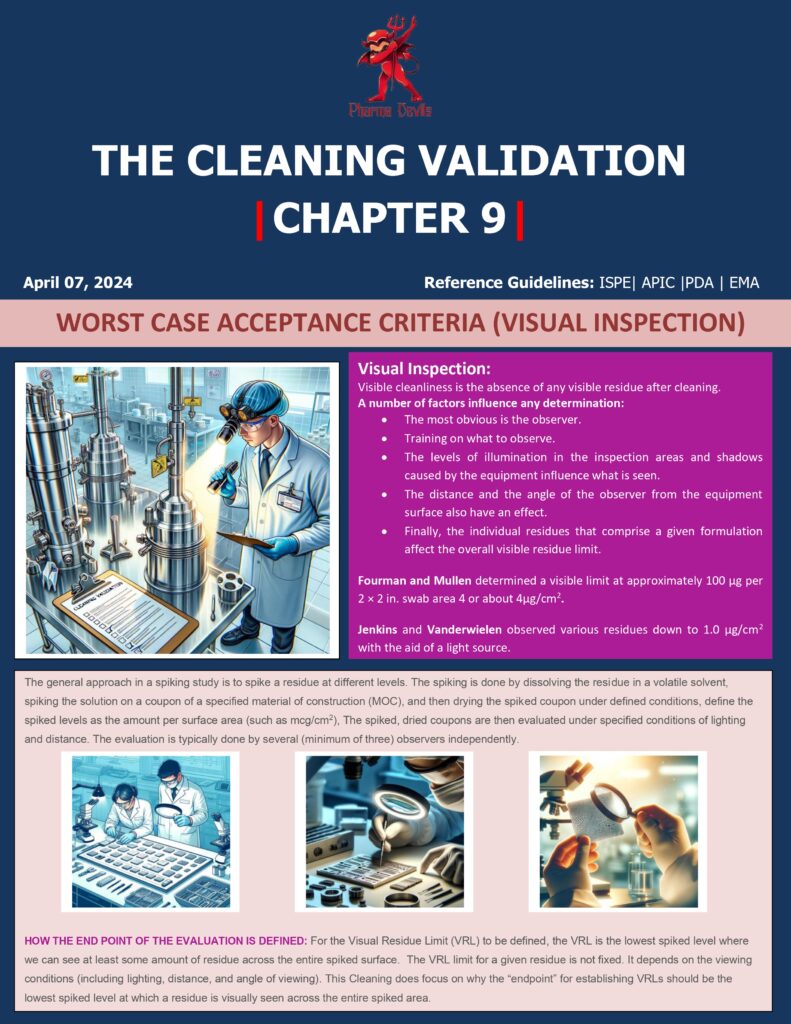
Worst-case acceptance criteria for visual inspection in cleaning validation defines what “visually clean” means and how you prove the inspection can reliably detect residues under the hardest conditions. Visual inspection is a verification tool, not a replacement for HBEL/MACO limits, but it is a powerful control when standardized and qualified.
1) Define “visually clean” (objective, not subjective)
Write a clear criterion such as: “No visible product, film, streaks, spots, powder, droplets, or discoloration on product-contact surfaces when inspected under defined conditions.” Include examples/pictures of acceptable vs unacceptable residue where possible.
2) Select worst-case residue and worst-case surfaces
Worst-case residues are typically:
- Sticky/oily (ointments, syrups), poorly soluble APIs, colored/staining formulations
- Dried residues after maximum dirty hold time
Worst-case surfaces/locations include: - Gaskets, valve seats, spray shadows, low points, dead legs, rough finishes, filters, and transfer lines.
3) Establish a Visible Residue Limit (VRL) to qualify capability
Develop VRL by spiking known residue loads onto coupons (e.g., SS316L and representative non-metal parts), drying/aging, and having trained inspectors detect the lowest consistently visible level. Express VRL as µg/cm² and use it to justify that visual inspection can detect residues at or below a defined threshold.
4) Standardize inspection conditions (critical)
Define and control:
- Lighting type and intensity (lux), angle, and shadow control
- Viewing distance, inspection time per area, and surface access (mirrors/borescopes if needed)
- Clean, dry surfaces (wet surfaces can mask films)
5) Qualify and maintain inspectors
Train inspectors on technique and defect recognition; document qualification (initial and periodic). Include eyesight requirements per SOP and manage operator variability.
6) Decision rules and actions
If any visible residue is found: fail, reclean, investigate (cause: procedure, parameters, equipment design, hold time), document deviation/CAPA, and assess product impact if equipment was released. Visual pass is required for release, while analytical limits govern patient-safety acceptance.