







1. Brief Description:
The Design Qualification for the Air Jet Machine is prepared to ensure that the equipment design meets cGMP, safety, operational, and user requirements before installation and use. The machine is intended for cleaning bottles to prevent contamination and operates using air jets, an ionizing unit, motors, AC drives, an air-pressure switch, and a dust collector. It is designed for a maximum capacity of 240 bottles per minute. Product-contact parts are specified as SS-316 with mirror finish, while non-contact parts are SS-304 with matt finish. The protocol also defines utility requirements, including 415 V three-phase electrical supply and compressed air at 6 kg/cm². It covers training, FAT, technical documentation, safety alarms, emergency stop, maintenance, installation, commissioning, SAT, IQ, and OQ requirements. The protocol further ensures proper documentation, calibration, supplier support, and final approval before the equipment is accepted for production use. This supports reliable, controlled, and compliant bottle-cleaning operations.
Skip to PDF content2. Flow Chart:
The flow chart explains the complete Design Qualification process for the Air Jet Machine from initial requirement to final approval for routine use. The process starts with identifying the machine requirement and preparing the DQ according to cGMP, safety, and operational requirements. The document is then reviewed by Engineering, Production, and Quality Assurance and approved by the responsible department heads.
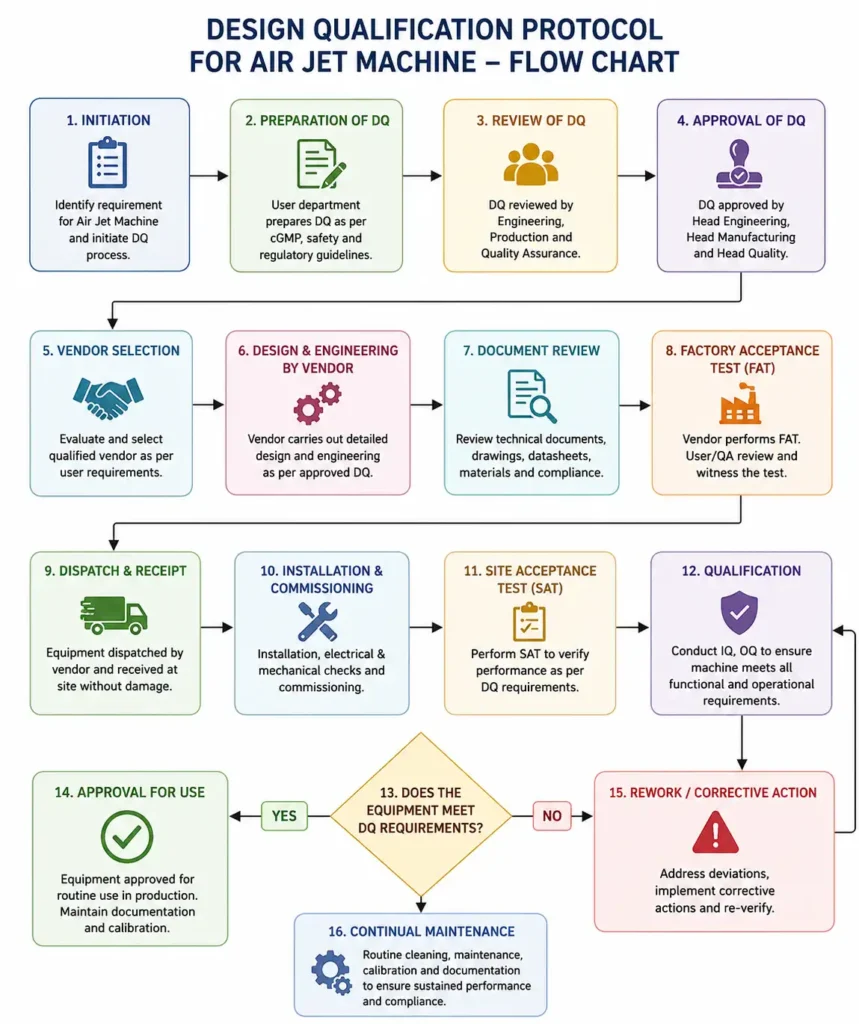
After approval, a suitable vendor is selected, detailed design documents are reviewed, and the Factory Acceptance Test (FAT) is performed. The equipment is then dispatched, installed, commissioned, and subjected to Site Acceptance Testing. The machine subsequently undergoes IQ and OQ to confirm correct installation and operation. If requirements are met, the machine is approved for use; otherwise, corrective actions and re-verification are performed. Routine maintenance, calibration, cleaning, and documentation help ensure continued compliance and reliable performance.
3. Brainstorming:
Brainstorming for the Design Qualification of the Air Jet Machine is used to identify all important requirements before the equipment is finalized. The discussion covers user needs, equipment capacity, material of construction, operating principle, utilities, safety features, documentation, maintenance, and regulatory compliance. The machine is intended for bottle cleaning, with a maximum capacity of 240 bottles per minute, using an air-jet system, ionized unit, and dust collector to reduce contamination risk.
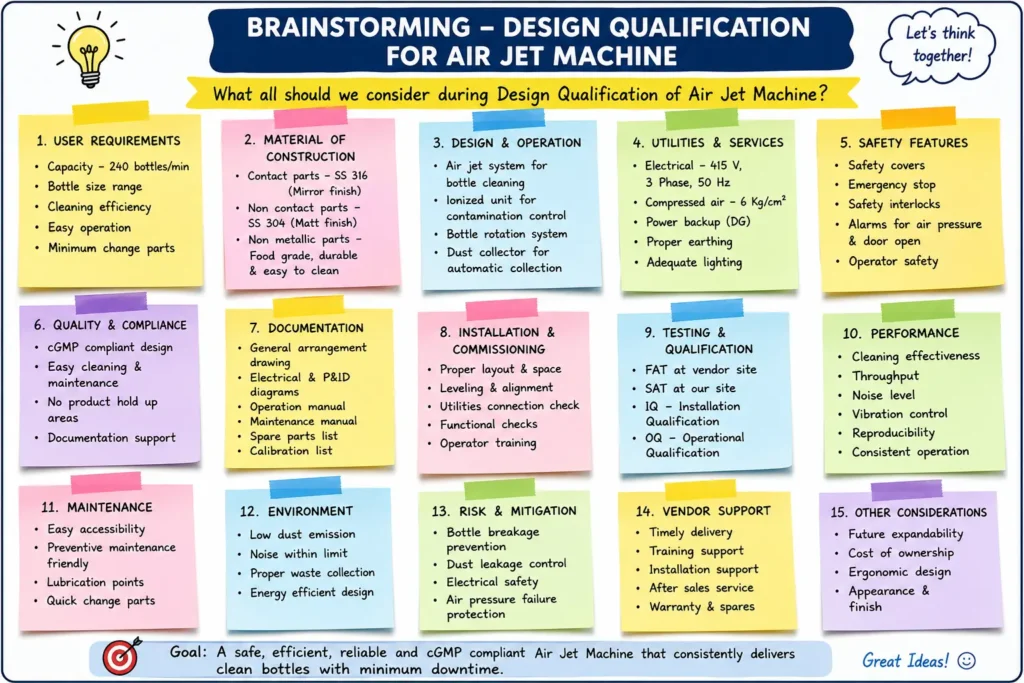
The brainstorming also considers electrical supply, compressed air, emergency stop, alarms, interlocks, operator training, FAT, SAT, IQ, and OQ requirements. Vendor support, spare parts, calibration, easy cleaning, and preventive maintenance are also reviewed. The main purpose of brainstorming is to identify possible risks and design needs early, so the Air Jet Machine can be safe, reliable, easy to operate, and compliant with cGMP requirements.
4. 5-Why Analysis:
The 5-Why Analysis is a simple root-cause investigation tool used to find the basic reason behind a problem by repeatedly asking “Why?”. In the illustrated example, the problem is ineffective bottle cleaning by the Air Jet Machine. The analysis moves step-by-step from low air pressure to a clogged air filter, irregular filter cleaning, inadequate preventive maintenance, and finally to the absence of a proper maintenance schedule and monitoring system.
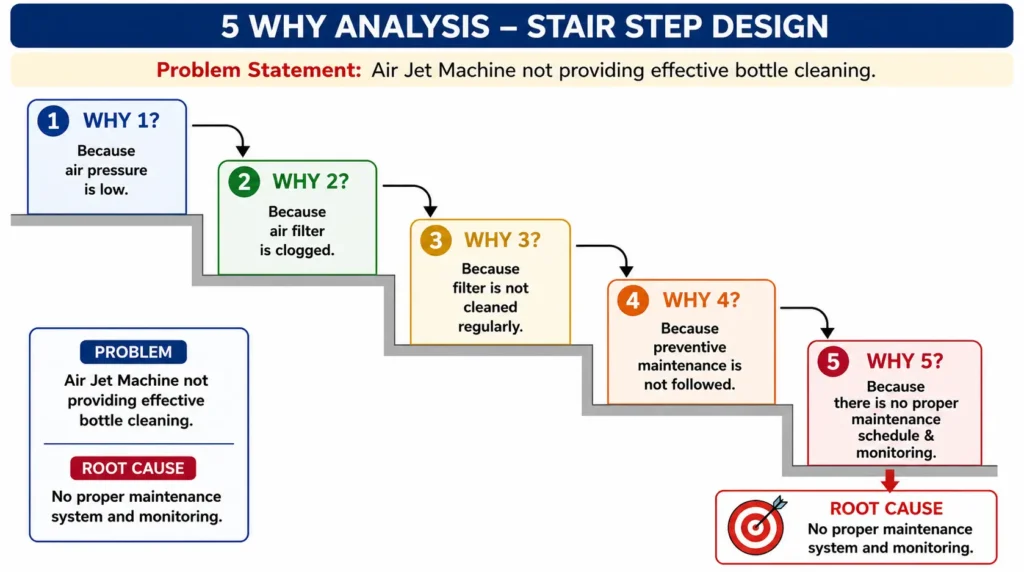
This type of analysis helps the investigation team move beyond the immediate symptom and identify the underlying system-level cause. The attached DQ protocol requires the Air Jet Machine to be designed for easy cleaning, maintenance, inspection, and servicing, supporting the importance of a controlled maintenance program.
Note: The above 5-Why chain is an illustrative investigation example; these specific failure causes are not stated in the DQ protocol.
5. Heat Map (FMEA):
The FMEA Heat Map is a risk-assessment tool used to identify and prioritize possible failures associated with the design and operation of the Air Jet Machine. It reviews important functions such as bottle cleaning, air filtration, ionization, dust collection, bottle rotation, electrical controls, safety systems, and documentation. The DQ protocol confirms that the machine uses an air-jet cleaning system, ionized unit, dust collector, motors, and air-pressure controls for bottle cleaning and contamination prevention.
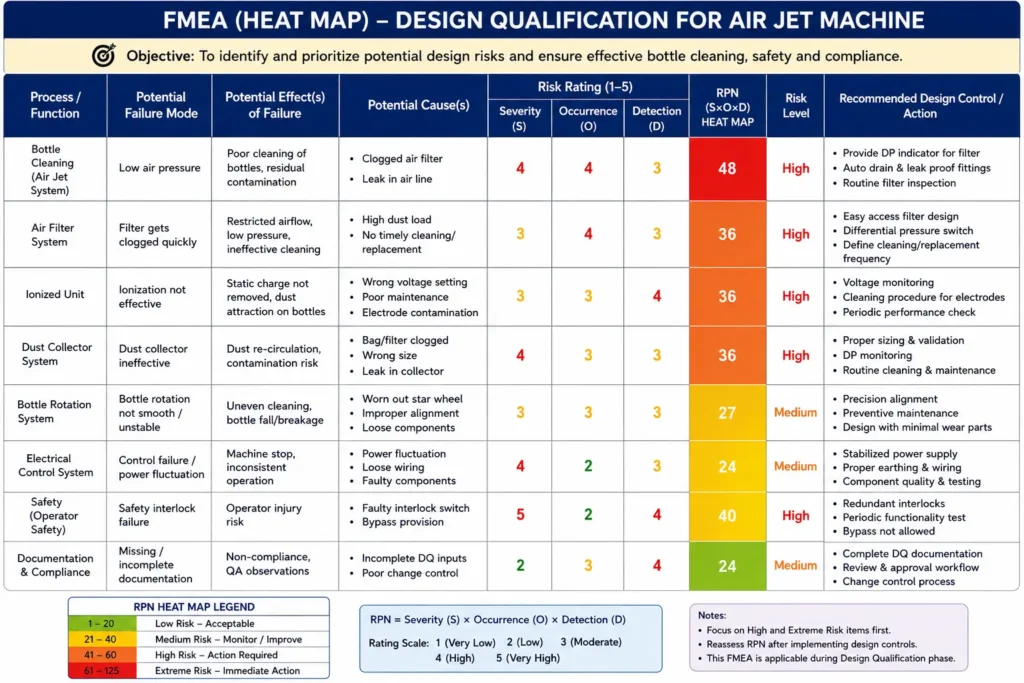
Each potential failure is evaluated using Severity (S), Occurrence (O), and Detection (D). These values are multiplied to calculate the Risk Priority Number (RPN = S × O × D). Heat-map colors help visually classify risks from low to high priority so that important risks can receive corrective or preventive controls first. Safety alarms and interlocks, including emergency stop, low-air-pressure and power-failure alarms, are also important design controls.
The specific FMEA scores and RPN values shown in the diagram are illustrative and are not specified in the DQ protocol.
Critical Process Parameters (CPPs) & Critical Quality Attributes (CQAs) – Air Jet Machine:
The DQ protocol does not explicitly label parameters as CPPs or CQAs. Based on the equipment requirements stated in the protocol, the following can be considered key process parameters and quality attributes for the Air Jet Machine.
| Critical Process Parameters (CPPs) | Requirement / Importance |
|---|---|
| Compressed Air Pressure | 6 kg/cm²; required for effective air-jet bottle cleaning. |
| Compressed Air Quality | Air should be oil, water and dust free to prevent contamination. |
| Air Consumption | Approximately 200 LPM free air. |
| Air Dew Point | –20°C or lower as specified in the utility requirement. |
| Machine Speed / Capacity | Maximum 240 bottles per minute. |
| Bottle Rotation / Air-Jet Operation | Bottle rotation and air cleaning are essential for proper cleaning. |
| Ionized Unit Operation | Ionization/high voltage is used to assist contamination control during bottle cleaning. |
| Dust Collector Performance | Dust generated during cleaning should be automatically collected. |
| Electrical Supply | 415 V AC, 3 Phase, 50 Hz for stable operation. |
Critical Quality Attributes (CQAs)
| Critical Quality Attribute | Expected Quality Requirement |
|---|---|
| Bottle Cleanliness | Bottles should be effectively cleaned by the air-jet system. |
| Contamination Control | Cleaning should minimize/prevent contamination of bottles. |
| Freedom from Dust | Dust should be removed and captured through the dust collector. |
| Consistent Cleaning | Cleaning performance should remain consistent during machine operation. |
| Product-Contact Material Suitability | Contact parts are specified as SS-316 mirror finish; non-contact parts are SS-304 matt finish. |
| cGMP Compliance | Machine design and operation should meet cGMP requirements and support contamination prevention. |
Questions & Answers:
Q1. What is the purpose of the Air Jet Machine?
Answer: The Air Jet Machine is used for cleaning bottles to help prevent contamination before further processing.
Q2. What is the objective of the Design Qualification Protocol?
Answer: The objective is to ensure that critical equipment, cGMP, and safety requirements are considered in the machine design and properly documented.
Q3. What is the maximum capacity of the Air Jet Machine?
Answer: The maximum capacity is 240 bottles per minute.
Q4. What is the material of construction for contact parts?
Answer: Contact parts are specified as SS-316 with mirror finish.
Q5. What material is used for non-contact parts?
Answer: Non-contact parts are made of SS-304 with matt finish.
Q6. How does the Air Jet Machine clean bottles?
Answer: The system rotates the bottles and uses air jets for cleaning. An ionized unit assists contamination control, while dust is collected by the dust collector.
Q7. What compressed-air pressure is required?
Answer: The specified compressed-air pressure is 6 kg/cm².
Q8. What should be the quality of compressed air?
Answer: The compressed air should be free from oil, water, and dust.
Q9. What electrical supply is required for the machine?
Answer: The machine requires 415 V AC, 3 Phase, 50 Hz electrical supply.
Q10. What safety features are provided in the Air Jet Machine?
Answer: Safety provisions include emergency stop, door-related controls, low-air-pressure indication, power-failure indication, alarms, and interlocks.
Q11. What documents are expected from the supplier?
Answer: Documents include FAT, IQ, OQ, electrical drawings, P&ID, GA drawing, calibration certificates, MOC certificates, and other technical records.
Q12. What is FAT?
Answer: Factory Acceptance Testing is performed at the vendor’s site before delivery to confirm that the equipment is properly assembled and meets specified requirements.
Q13. What is SAT?
Answer: Site Acceptance Testing is carried out after commissioning to verify equipment performance and functionality when integrated with the factory system.
Q14. When can OQ start?
Answer: OQ can start only after IQ has been approved.
Q15. Why is maintenance important for the Air Jet Machine?
Answer: Maintenance helps keep the machine clean, serviceable, calibrated, and reliable. The design should allow easy cleaning, removal of parts, inspection, and maintenance.