





1. Brief Description:
The Post Risk Assessment for Automatic Air Jet Bottle Air and Vacuum Cleaning Machine evaluates risks associated with the equipment used for automatic bottle cleaning before filling. The machine uses a turntable for smooth container transfer, air-jet cleaning, vacuum cleaning, and conveyor transfer of cleaned bottles to the filling stage, supporting product safety and process reliability. The assessment covers the design, installation, operation, performance, and safety of the equipment and applies the Failure Mode and Effects Analysis (FMEA) methodology in accordance with ICH Q9 principles. Risks are evaluated using Severity, Occurrence, and Detection, with the resulting Risk Priority Number used to classify risks as minor, moderate, major, or critical. Major failure areas considered include inadequate DQ/IQ/OQ documentation, calibration and instrumentation issues, improper MOC verification, insufficient safety provisions, equipment malfunction, inadequate cleaning, process monitoring failures, and unauthorized changes. Existing controls, qualification procedures, SOPs, trained personnel, and change control measures are used to reduce and manage identified risks throughout the equipment lifecycle.
Skip to PDF content2. Flow Diagram:
The Flow Diagram for Post Risk Assessment of the Automatic Air Jet Bottle Air and Vacuum Cleaning Machine illustrates the systematic sequence used to identify, evaluate, control, and review equipment-related risks. The process begins with defining the equipment and assessment scope, followed by formation of a cross-functional team comprising QA, Production, QC, Engineering, and Store. Relevant qualification documents, SOPs, manuals, and previous risk information are reviewed before identifying potential failure modes.
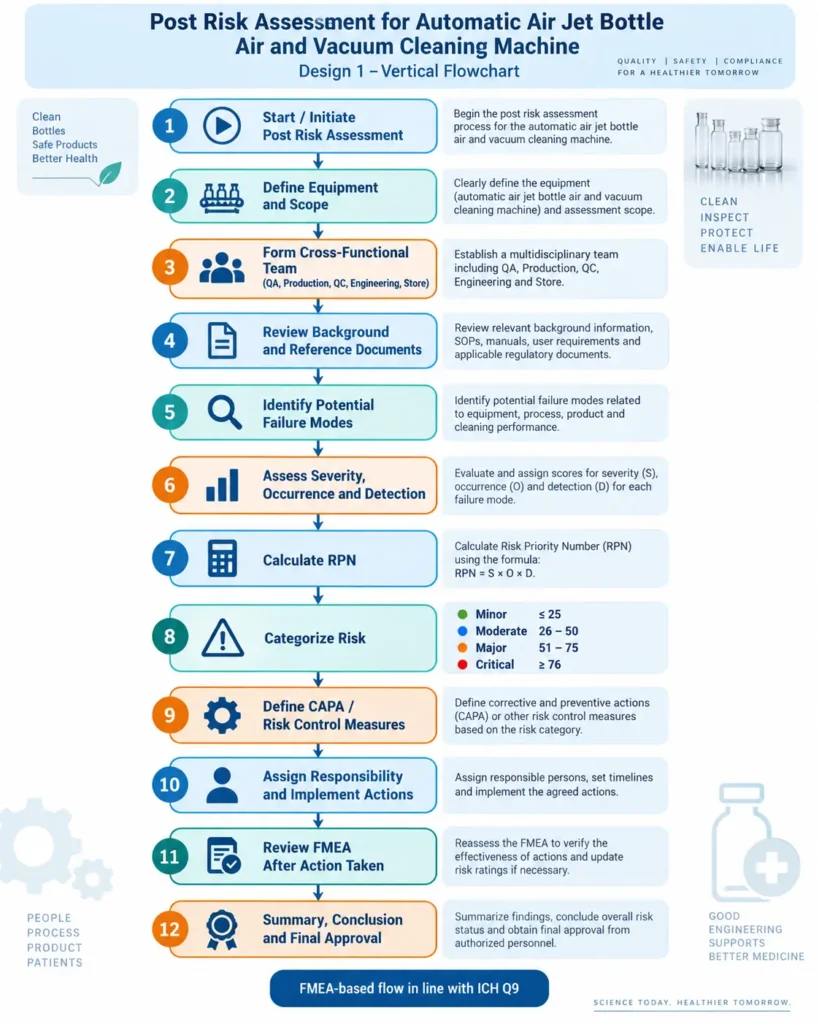
Each identified failure is evaluated using Severity (S), Occurrence (O), and Detection (D), and the Risk Priority Number (RPN = S × O × D) is calculated. Risks are categorized as Minor, Moderate, Major, or Critical according to the defined acceptance criteria. Appropriate CAPA or risk-control measures are then implemented, responsibilities are assigned, and the FMEA is reassessed after completion of actions. The process concludes with documentation of the results, summary, conclusion, and final approval to confirm that identified risks are adequately controlled.
3. Brainstorming:
The Brainstorming Diagram for Post Risk Assessment of the Automatic Air Jet Bottle Air & Vacuum Cleaning Machine identifies key risk areas that may affect equipment performance, product quality, safety, and GMP compliance. The brainstorming points are grouped into major categories such as Documentation, Qualification, Operation, Safety, Cleaning/Product Quality, and Control Measures/Follow-up. Important concerns include inadequate DQ, IQ, and OQ documentation; incomplete qualification checks; missing MOC verification; unavailable calibration instruments; inadequate safety features; motor and emergency-stop issues; insufficient process monitoring; improper reassembly after cleaning or maintenance; and failure to follow change control. The diagram also highlights risks related to improper cleaning and potential product contamination.
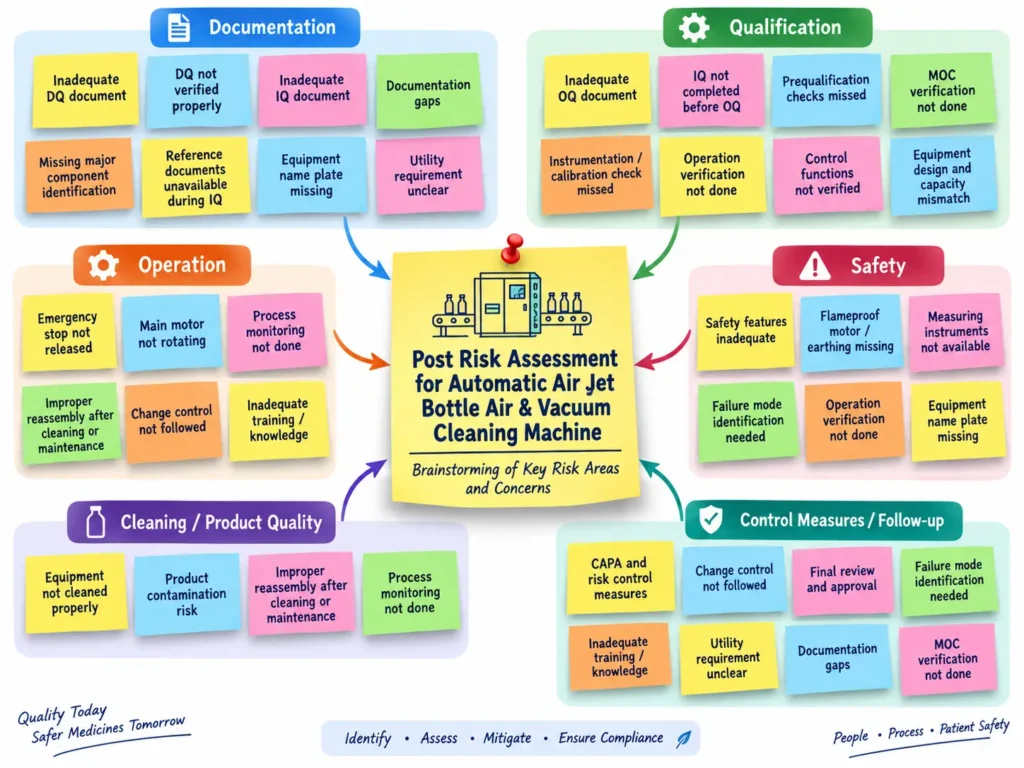
The brainstorming exercise supports systematic identification of possible failure modes before final risk evaluation. It helps the cross-functional team focus on training, documentation, qualification, CAPA, control measures, and final review so that equipment risks can be effectively reduced and maintained within acceptable limits.
4. 5 Why Analysis:
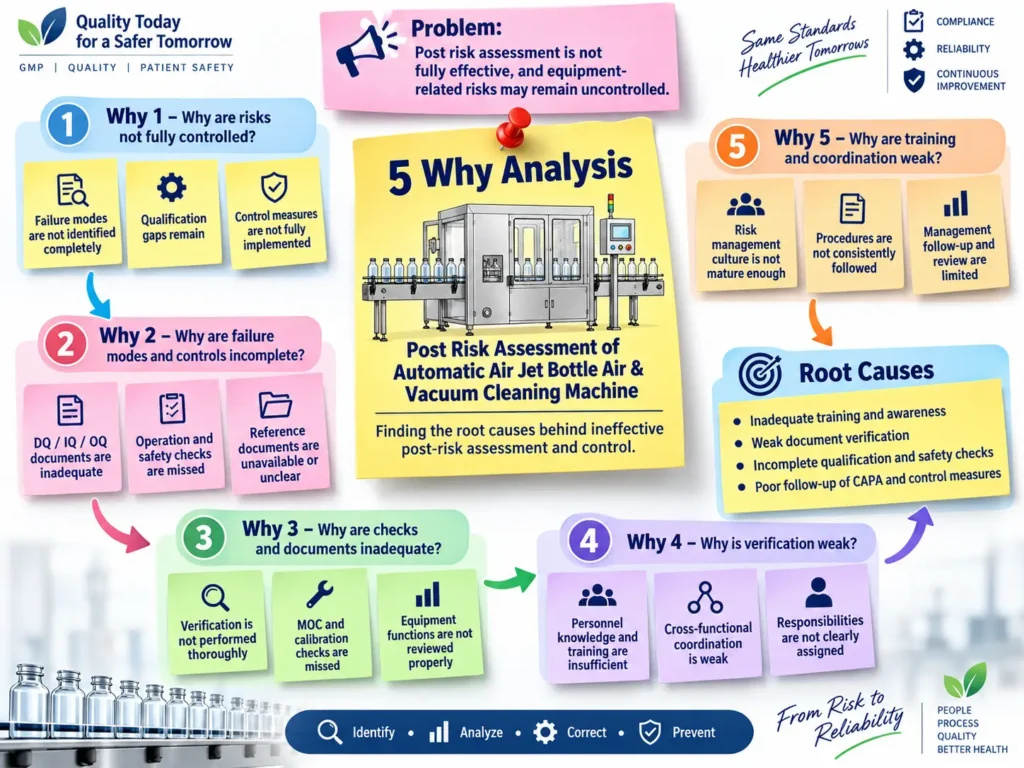
The 5 Why Analysis for Post Risk Assessment of the Automatic Air Jet Bottle Air & Vacuum Cleaning Machine is used to identify the underlying causes that may make the post-risk assessment ineffective. The analysis begins with the problem that equipment-related risks may remain insufficiently controlled. The first level identifies incomplete failure-mode identification, qualification gaps, and inadequate implementation of control measures. The second level links these issues to inadequate DQ, IQ, and OQ documentation, missed operation and safety checks, and unavailable or unclear reference documents. The third level highlights weak verification, missed MOC and calibration checks, and insufficient review of equipment functions. The fourth level identifies inadequate personnel knowledge, training, coordination, and unclear responsibilities. Finally, the fifth Why points toward weaknesses in risk-management culture, inconsistent procedure compliance, and limited management follow-up. The analysis concludes that training, document verification, qualification checks, CAPA follow-up, and management oversight are the key areas requiring improvement.
5. Heat Map:
The Heat Map for Post Risk Assessment of the Automatic Air Jet Bottle Air & Vacuum Cleaning Machine provides a visual method for prioritizing identified equipment risks according to their severity and likelihood of occurrence. Risks are positioned within color-coded zones ranging from green for low risk, yellow for moderate risk, orange for high risk, and red for critical risk. The heat map highlights important concerns such as inadequate cleaning, vacuum-system failure, air-pressure variation, incomplete DQ/IQ/OQ documentation, calibration failures, equipment malfunction, inadequate safety provisions, and poor change control. Several of these concerns are consistent with the FMEA in the source document, which identifies risks related to qualification documents, MOC verification, calibration checks, equipment operation, safety features, change control, process monitoring, and cleaning.
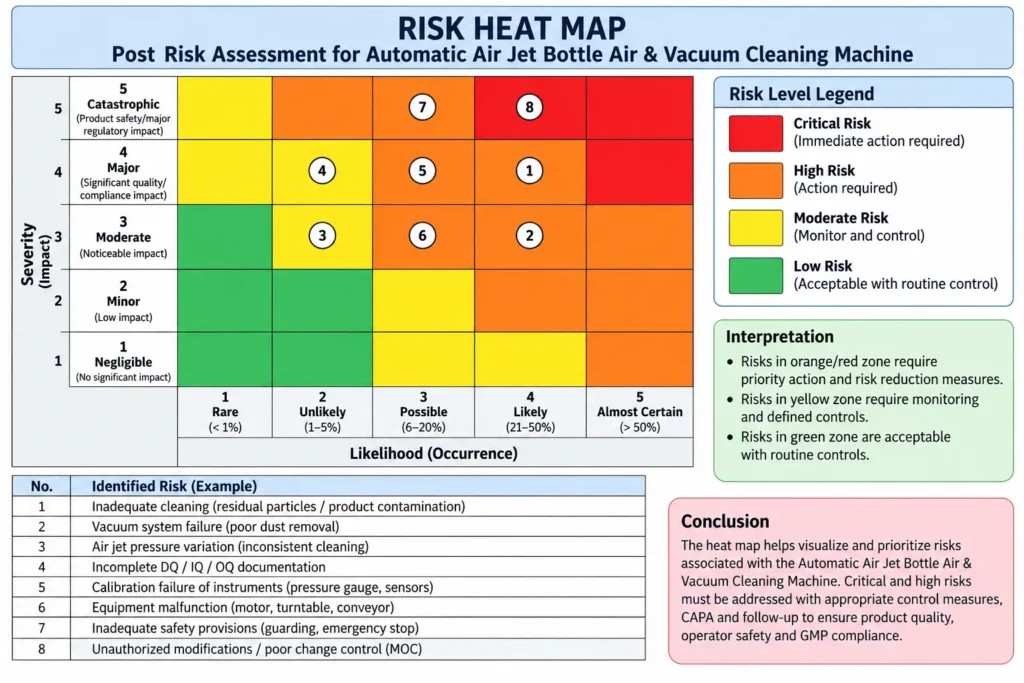
The diagram helps the team quickly identify which risks require immediate CAPA, enhanced controls, monitoring, or routine management, supporting equipment reliability, product quality, operator safety, and GMP compliance.
Impact Assessment
The Post Risk Assessment for the Automatic Air Jet Bottle Air & Vacuum Cleaning Machine evaluates how identified equipment and process failures could affect product quality, equipment performance, operator safety, and GMP compliance. The assessment covers risks associated with design and qualification documentation, installation, operation, calibration, material-of-construction verification, safety features, equipment functionality, change control, process monitoring, and cleaning. Potential impacts include improper equipment installation, failure of the machine to operate as intended, incomplete qualification, product contamination, inability to identify or verify equipment components, and safety incidents. The document specifically identifies contamination risk where MOC verification is not performed and where equipment cleaning is inadequate. Operational and safety failures such as motor malfunction, missing safety provisions, inadequate earthing, improper reassembly, and undocumented changes may also affect equipment reliability and product quality. Overall, the assessment shows that documented procedures, trained personnel, qualification controls, monitoring, cleaning procedures, and change control are essential to maintain risks within acceptable limits.
Questions & Answers – Post Risk Assessment for Automatic Air Jet Bottle Air & Vacuum Cleaning Machine
- What is the purpose of this Post Risk Assessment?
The purpose is to assess risks associated with the Automatic Air Jet Bottle Air and Vacuum Cleaning Machine after implementation and confirm that its design, installation, operation, performance, and safety remain adequately controlled. - Which risk assessment methodology is used?
The document uses FMEA – Failure Mode and Effects Analysis for systematic risk identification and evaluation. - Which guideline is referenced for Quality Risk Management?
The assessment references ICH Q9 – Quality Risk Management. - How is the Risk Priority Number calculated?
RPN is calculated using Severity × Occurrence × Detection (S × O × D). - What are the FMEA risk categories?
RPN up to 25 is Minor, 26–50 is Moderate, 51–75 is Major, and ≥76 is Critical. CAPA is required for moderate, major, and critical risks according to the document. - What can happen if Design Qualification documentation is inadequate?
The equipment may not function as intended, cGMP requirements may not be met, safety requirements may be unclear, and major components or utility requirements may be missed. - What is the impact of inadequate Installation Qualification?
Improper installation can result in equipment not performing as intended and important installation requirements or components being missed. - Why is MOC verification important during IQ?
Failure to verify the Material of Construction (MOC) for contact and non-contact parts may create a product contamination risk. - Why should calibration and instrumentation checks be performed?
Instrumentation and calibration verification are required to support proper execution of IQ and confirm that measurement-related controls are available and suitable. - Why must IQ be completed before OQ?
If IQ is not successfully completed, OQ cannot properly proceed because installation and associated documentation may remain incomplete. - What safety-related risks are identified during OQ?
The assessment considers risks such as tools remaining on the equipment, external equipment not being disconnected, emergency STOP conditions, inadequate safety features, missing flame-proof motors, and inadequate earthing. - What happens if the main motor does not rotate?
The equipment will not operate. Potential causes include inadequate operator knowledge/training or unsuitable input supply/frequency to the motor. - Why is proper reassembly after cleaning or maintenance important?
Improper reassembly after cleaning, preventive maintenance, breakdown, or calibration may cause equipment malfunction and could potentially result in an accident. - What is the impact of making major changes without documentation?
Equipment performance may no longer be assured, and product quality may be affected. The document identifies an established Change Control SOP as the control. - What is the risk if the equipment is not cleaned properly?
Improper cleaning may result in product contamination. The stated controls include line clearance and an established cleaning procedure. - What happens after risk-control actions are implemented?
The FMEA is reviewed again after action completion by reassessing Severity, Occurrence, Detectability, and RPN, followed by documentation of investigation findings and corrective actions. - Who participates in the risk assessment?
The responsible functions include Quality Assurance, Engineering, Production, Quality Control, and Store. - What is required before final report approval?
Identified risks and critical control parameters must be reviewed, supporting documents attached where applicable, and implemented control measures documented and found acceptable before final approval.