






1. Brief Description:
The Design Qualification (DQ) Protocol cum Report for the Nitrogen Gas Generation and Distribution System is prepared to confirm that the proposed system design meets the User Requirement Specification (URS), cGMP, process, safety, and operational requirements. The system is a PSA-based nitrogen plant with a capacity of 10 Nm³/hr, designed to generate nitrogen from atmospheric compressed air using activated alumina and Carbon Molecular Sieves (CMS). Moisture, oxygen, and carbon dioxide are selectively removed, producing nitrogen with purity up to 99.5%. The design includes an air receiver, PSA module, surge vessel, nitrogen receiver, oxygen analyzer, filters, control panel, and distribution arrangement. Critical variables such as pressure, flow, utility requirements, materials of construction, safety features, and vendor suitability are verified during DQ. The protocol also requires review of engineering drawings, approved specifications, purchase documents, and supplier information to ensure the system is suitable before installation and further qualification and routine intended operation.
Skip to PDF content2. Flow Diagram:
The flow diagram represents the working sequence of the Nitrogen Gas Generation and Distribution System based on Pressure Swing Adsorption (PSA) technology. Atmospheric air is compressed and collected in the air receiver, which helps maintain stable pressure and flow. The compressed air is then passed through filtration stages to remove moisture, oil, and particulate contamination before entering the PSA module.
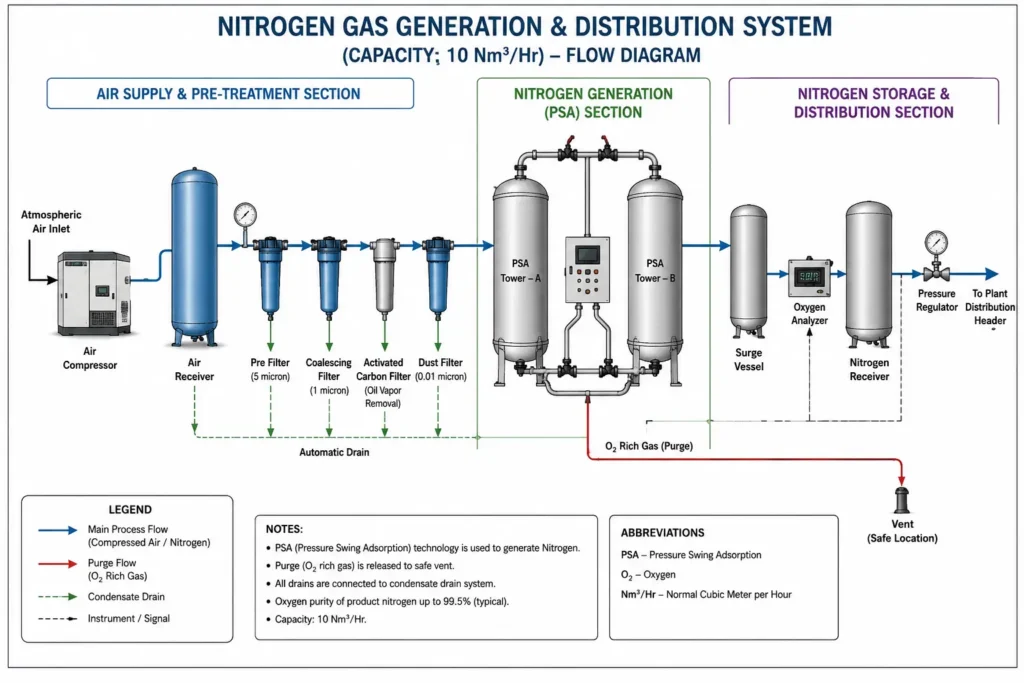
Inside the PSA system, activated alumina and Carbon Molecular Sieves (CMS) selectively remove moisture, oxygen, and carbon dioxide, allowing nitrogen to be produced at a purity of up to 99.5%. The generated nitrogen is collected in the surge vessel and its oxygen content is monitored by an oxygen analyzer. Nitrogen meeting the required purity is transferred to the receiver tank and distributed to user points at the required pressure and flow. If oxygen content exceeds the specified limit, the gas is automatically vented until acceptable purity is restored.
3. Brainstorming:
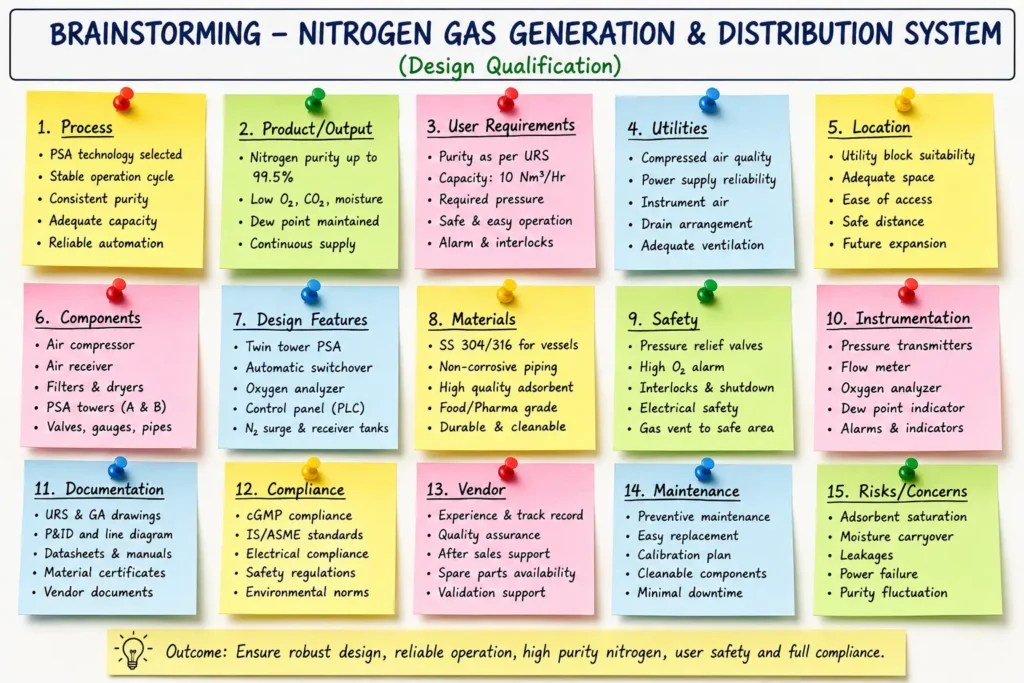
Brainstorming for the Design Qualification of the Nitrogen Gas Generation and Distribution System is used to identify all important design, operational, safety, and compliance requirements before final approval. The discussion focuses on PSA technology, nitrogen purity, required capacity, compressed-air quality, utilities, installation location, major system components, instrumentation, materials of construction, safety provisions, documentation, vendor capability, maintenance, and potential risks. The objective is to ensure that the proposed system is capable of consistently generating nitrogen of the required quality and supplying it safely to user points. Particular attention is given to critical components such as the PSA towers, filters, receiver vessels, oxygen analyzer, pressure gauges, control system, valves, and distribution piping. Brainstorming also helps identify possible concerns such as gas leakage, purity fluctuation, moisture carryover, utility failure, and inadequate controls. The output supports a more complete and risk-based Design Qualification review.
4. 5-Why Analysis:
The 5-Why Analysis – Tree Root Design is used to identify the underlying cause of failure or non-approval of the Design Qualification of the Nitrogen Gas Generation and Distribution System. The analysis starts with the problem and progressively examines why the DQ failed. It highlights issues such as incomplete verification of critical design points, gaps or mismatch in URS, GA drawings and vendor specifications, inadequate review of nitrogen purity, capacity, pressure, utilities and safety interlocks, and insufficient cross-functional review by QA, Engineering and Production.
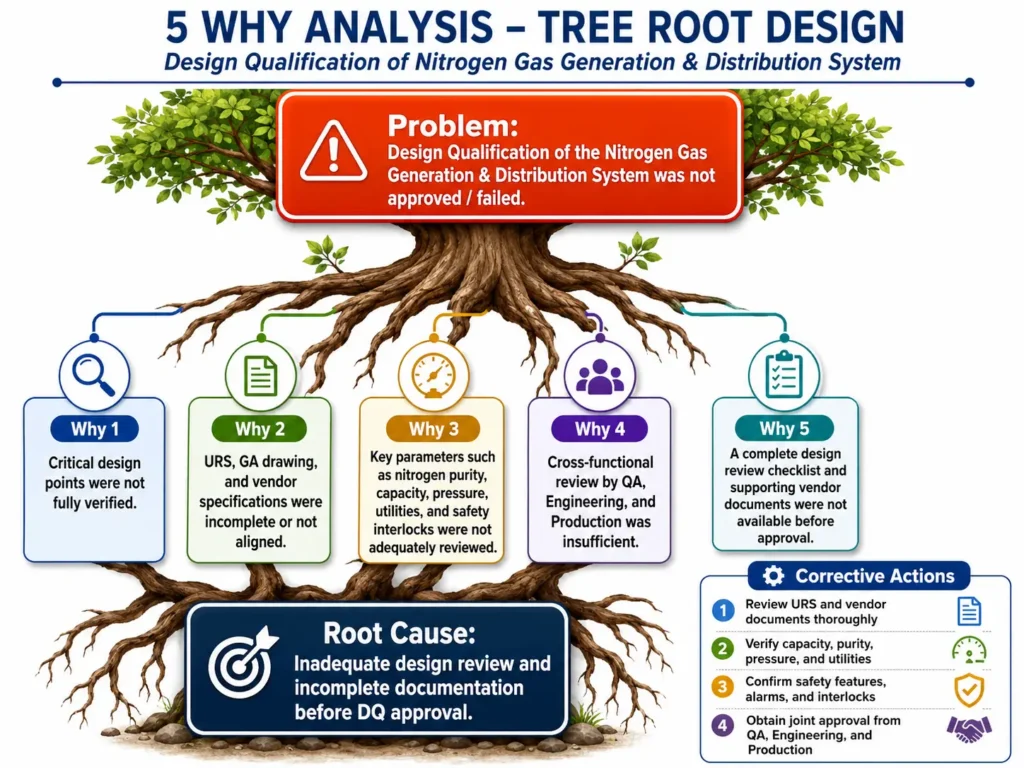
The final “Why” indicates that a complete design-review checklist and supporting vendor documents were not available before approval. The identified root cause is inadequate design review and incomplete documentation before DQ approval. Corrective actions include thorough document review, verification of critical parameters and safety features, and joint approval by concerned departments.
5. Heat Map (FMEA):
The Heat Map FMEA for Design Failure is used to evaluate and prioritize potential risks associated with the Design Qualification of the Nitrogen Gas Generation and Distribution System. The heat map combines Severity and Occurrence ratings to visually classify risks as low, moderate, high, or critical. Key failure modes include incomplete URS review, incorrect capacity or nitrogen purity specification, utility mismatch, inadequate safety interlocks or oxygen analyzer review, incorrect material of construction, and incomplete vendor documentation or GA drawing review.
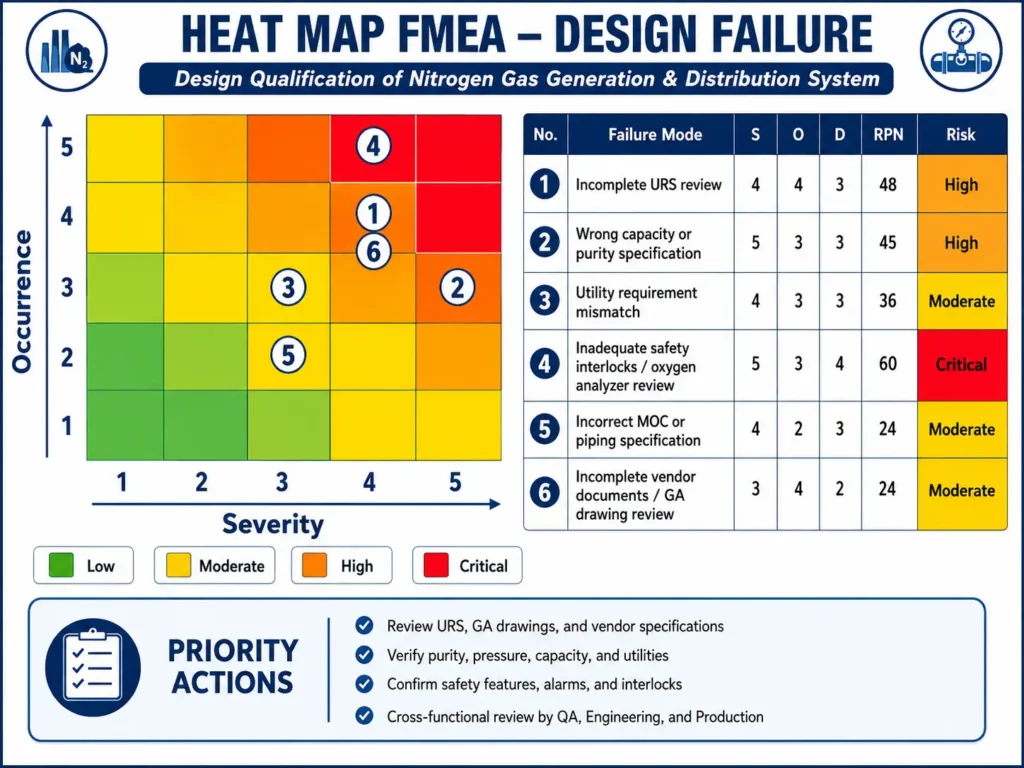
The highest-priority risk is related to inadequate safety controls and oxygen monitoring, while other design issues are categorized according to their calculated RPN values. The analysis helps the team focus corrective actions on the most significant risks. Priority actions include reviewing URS and vendor specifications, confirming purity, pressure, capacity and utilities, verifying safety features and interlocks, and ensuring cross-functional review by QA, Engineering, and Production.
Critical Process Parameters (CPP) & Critical Quality Attributes (CQA)
Nitrogen Gas Generation & Distribution System
Based on the Design Qualification document, the following parameters are critical for assuring proper nitrogen generation, purity, pressure, and distribution performance.
| Category | Critical Parameter / Attribute | Typical Requirement / Importance |
|---|---|---|
| CPP | Compressed air pressure | Approx. 7.0 kg/cm²g at air receiver / PSA inlet |
| CPP | Compressed air flow | 40 CFM as specified utility requirement |
| CPP | PSA adsorption cycle | Proper switching of PSA towers is required for continuous nitrogen generation |
| CPP | Activated alumina performance | Removes moisture from incoming compressed air |
| CPP | CMS adsorption performance | Removes oxygen and carbon dioxide from compressed air |
| CPP | Nitrogen outlet pressure | About 5.5 kg/cm²g for distribution |
| CPP | Oxygen analyzer performance | Continuously verifies oxygen impurity before nitrogen is accepted |
| CPP | Filtration efficiency | Filters protect the PSA system and downstream nitrogen quality |
| CPP | Vent/interlock operation | Off-specification nitrogen must be diverted until acceptable purity is achieved |
| CPP | Electrical supply | 230 V, single phase, 100 W as specified |
| CQA | Nitrogen purity | Up to 99.5% nitrogen at generation point |
| CQA | Oxygen content | Must remain within the established nitrogen purity requirement |
| CQA | Moisture content | Should be adequately controlled by the alumina adsorption system |
| CQA | Carbon dioxide content | Should be minimized through CMS adsorption |
| CQA | Nitrogen pressure | Adequate and stable pressure must be maintained at distribution/user points |
| CQA | Nitrogen flow | Sufficient flow must be available to meet process/user-point requirements |
| CQA | Particulate / microbiological control | The design includes 1 µm, 0.01 µm and 0.22 µm filtration stages |
| CQA | Continuous availability | Nitrogen supply should remain reliable and consistent during operation |
The DQ specifies that the PSA system should be capable of producing nitrogen up to 99.5% purity, with activated alumina and CMS beds serving as key separation components. Utility requirements include 230 V single-phase electrical supply and dry compressed air at approximately 40 CFM and 7.0 kg/cm²g.
The design also specifies a 10 Nm³/hr capacity, nitrogen storage at approximately 5.5 kg/cm²g, an oxygen analyzer, filtration stages, and defined working/design pressures.
Frequently Asked Questions – Design Qualification of Nitrogen Gas Generation & Distribution System
Q1. What is the purpose of Design Qualification for the nitrogen system?
The purpose is to verify that the proposed nitrogen generation and distribution system design meets the URS, process requirements, cGMP expectations, and safety requirements.
Q2. Which technology is used for nitrogen generation?
The system uses Pressure Swing Adsorption (PSA) technology with activated alumina and Carbon Molecular Sieves (CMS).
Q3. What is the capacity of the nitrogen generation system?
The design capacity is 10 Nm³/hr.
Q4. What nitrogen purity is specified in the DQ?
The system is designed to produce nitrogen with purity up to 99.5% at the generation point.
Q5. What is the function of activated alumina?
Activated alumina is used to trap moisture from the incoming compressed air.
Q6. What is the function of Carbon Molecular Sieves?
CMS is used to selectively adsorb oxygen and carbon dioxide from compressed air during nitrogen generation.
Q7. Why is an oxygen analyzer provided?
The oxygen analyzer measures oxygen impurity in generated nitrogen before it is accepted for storage and distribution.
Q8. What happens when nitrogen purity is outside the required limit?
The system is designed to vent off-specification nitrogen through a three-way valve until the required purity is achieved.
Q9. What compressed-air requirement is specified?
The DQ specifies non-lubricated dry compressed air at approximately 40 CFM and 7.0 kg/cm²g.
Q10. What is the nitrogen outlet pressure?
The specified outlet pressure is approximately 5.5 kg/cm²g.
Q11. What are the major components of the system?
Major components include the air receiver, PSA module, activated alumina bed, CMS tower, surge vessel, nitrogen receiver, oxygen analyzer, filters, pressure gauges, and control system.
Q12. Which departments are responsible for DQ review and execution?
Quality Assurance, Production, and Engineering are responsible for review, verification, coordination, monitoring, and approval-related activities.
Q13. What documents should be reviewed during DQ?
Technical equipment details, engineering drawings, approved design specifications, supplier meeting records, purchase order copies, and other relevant supporting documents should be reviewed.
Q14. Why is vendor selection important?
Vendor selection should consider technical capability, quality standards, experience, site inspection, cost, and feedback from existing users.
Q15. What is the final outcome of successful Design Qualification?
Successful DQ confirms that the proposed nitrogen system design is suitable for installation and can proceed to subsequent qualification stages, subject to satisfactory review and approval.