







1. Introduction – Diclofenac Diethylamine, Linseed Oil, Methyl Salicylate and Menthol Gel:
The Batch Manufacturing Record (BMR) of Diclofenac Diethylamine, Linseed Oil, Methyl Salicylate and Menthol Gel is an essential pharmaceutical document that provides detailed instructions for manufacturing, processing, quality control, and documentation of this topical gel formulation. The product is designed for external application and contains ingredients commonly used for the symptomatic relief of muscular pain, joint discomfort, inflammation, and stiffness. The formulation contains Diclofenac, equivalent to Diclofenac Sodium 1% w/w, Linseed Oil 3% w/w, Methyl Salicylate 10% w/w, Menthol 5% w/w, and Benzyl Alcohol 1% w/w in a water-washable gel base. The manufacturing process involves raw material dispensing, equipment clearance, preparation of aqueous and oil phases, mixing, homogenization, pH adjustment, cooling, and in-process quality control. Critical manufacturing parameters, including temperature, mixing time, stirring speed, filtration, and pH, are monitored to ensure consistent product quality. The BMR also includes equipment details, material reconciliation, production documentation, quality assurance verification, and yield calculations. Maintaining accurate records throughout manufacturing supports Good Manufacturing Practices (GMP), batch traceability, regulatory compliance, and consistent product quality, safety, and performance before subsequent filling and packaging operations.
Skip to PDF content1. Flow Diagram – Diclofenac Diethylamine, Linseed Oil, Methyl Salicylate and Menthol Gel (BMR):
The flow diagram illustrates the manufacturing process of Diclofenac Diethylamine, Linseed Oil, Methyl Salicylate and Menthol Gel in accordance with the Batch Manufacturing Record (BMR) and Good Manufacturing Practices (GMP). The process begins with raw material dispensing, verification, and equipment line clearance. The aqueous phase is prepared using purified water, Carbomer 934, and other specified excipients under controlled heating and stirring conditions. Separately, the oil phase is prepared using linseed oil and other formulation ingredients.
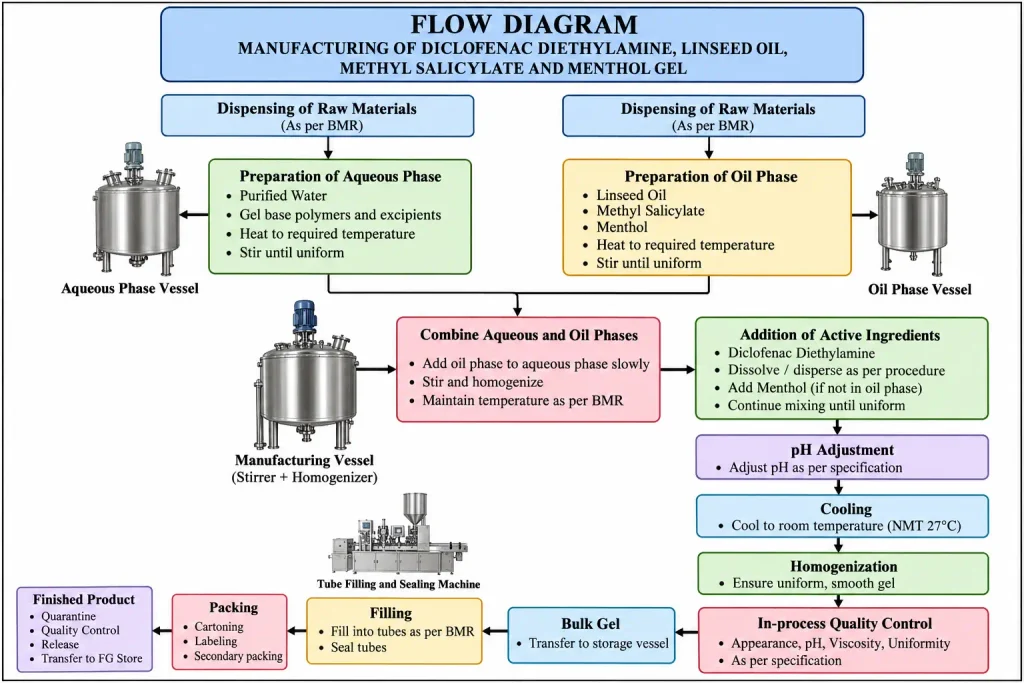
The manufacturing process continues with the preparation and addition of Diclofenac solution, followed by incorporation of Methyl Salicylate and Menthol under controlled mixing conditions. Homogenization ensures uniform distribution of ingredients and consistent gel formation. Critical process parameters include temperature, mixing time, stirring speed, filtration, pH adjustment, and cooling. The specified pH range is 7.0–8.0. After manufacturing, the bulk gel undergoes in-process quality control testing, followed by transfer into stainless steel storage containers. Subsequent filling, sealing, packaging, and finished product quality control activities are performed according to approved procedures to ensure product consistency, traceability, and regulatory compliance.
Critical Process Parameters (CPP) and Critical Quality Attributes (CQA) of Diclofenac Diethylamine, Linseed Oil, Methyl Salicylate and Menthol Gel
Critical Process Parameters (CPP) and Critical Quality Attributes (CQA) play an essential role in ensuring the consistent quality, safety, and effectiveness of Diclofenac Diethylamine, Linseed Oil, Methyl Salicylate and Menthol Gel during pharmaceutical manufacturing. Critical Process Parameters (CPP) include aqueous phase heating temperature (75–80°C), oil phase heating temperature (70–72°C), mixing time, stirring speed, ingredient addition sequence, filtration, homogenization, pH adjustment, and cooling temperature. The Batch Manufacturing Record (BMR) specifies a final pH range of 7.0–8.0 and cooling of the manufactured gel to 30–35°C.Critical Quality Attributes (CQA) include appearance, homogeneity, viscosity, pH, active ingredient content, microbial quality, and physical stability. These attributes help establish whether the gel meets predefined product quality requirements.
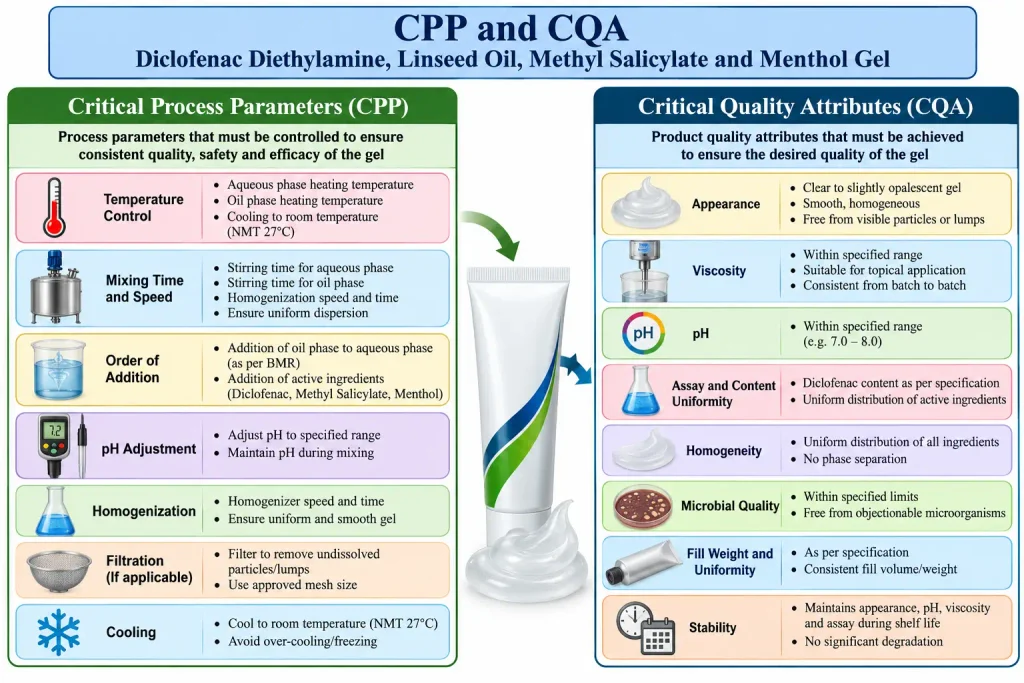
Effective monitoring of CPPs supports uniform ingredient distribution, appropriate gel consistency, and reproducible manufacturing performance. In-process quality control testing and Quality Assurance verification help identify process variations and ensure compliance with approved specifications. The CPP and CQA framework supports Good Manufacturing Practices (GMP), process validation, quality risk management, batch consistency, and regulatory compliance throughout the product lifecycle.
Note: The parameters shown are potential CPPs and CQAs. Their criticality and acceptance criteria should be established through documented risk assessment, development studies, and process validation.