







1. Introduction:
The Batch Manufacturing Record (BMR) for Diclofenac Potassium, Paracetamol & Chlorzoxazone Tablets is a comprehensive pharmaceutical documentation system designed to ensure the systematic manufacturing, monitoring, and quality control of combination tablets in accordance with Good Manufacturing Practices (GMP).
This combination formulation contains three active pharmaceutical ingredients (APIs), each providing a specific therapeutic action:
- Diclofenac Potassium IP – 50 mg: A non-steroidal anti-inflammatory drug (NSAID) used to reduce pain and inflammation.
- Paracetamol IP – 325 mg: An analgesic and antipyretic agent that helps relieve pain and reduce fever.
- Chlorzoxazone USP – 250 mg: A centrally acting skeletal muscle relaxant used in the management of painful musculoskeletal conditions.
The BMR provides a structured framework for documenting critical manufacturing activities, including raw material dispensing, material verification, granulation, drying, blending, lubrication, tablet compression, in-process quality checks, and packaging operations. The manufacturing process involves equipment such as a Vibro Sifter, Rapid Mass Granulator (RMG), Fluid Bed Dryer (FBD), Multimill, Blender, Tablet Compression Machine, and Blister Packing Machine. Special attention is given to raw material assay adjustment, loss on drying (LOD), material reconciliation, equipment cleanliness, line clearance, and process monitoring to maintain consistency throughout production. The record also provides designated sections for recording batch details, processing dates, manufacturing observations, quality control results, deviations, and authorization by responsible personnel. Proper preparation, execution, and review of the BMR ensure batch traceability, manufacturing accountability, and reliable documentation of production activities. The BMR serves as an essential reference for Production, Quality Assurance (QA), and Quality Control (QC) personnel during manufacturing, batch review, and product release. The primary purpose of this Batch Manufacturing Record is to establish a documented and controlled manufacturing process for Diclofenac Potassium, Paracetamol & Chlorzoxazone Tablets, ensuring product quality, consistency, traceability, and compliance with applicable GMP requirements.
Skip to PDF content2. Manufacturing Process Flow Diagram of Diclofenac Potassium, Paracetamol & Chlorzoxazone Tablets (BMR):
The manufacturing flow diagram of Diclofenac Potassium, Paracetamol & Chlorzoxazone Tablets illustrates the sequential stages involved in pharmaceutical tablet production in accordance with Good Manufacturing Practices (GMP). The manufacturing process begins with raw material dispensing and verification, ensuring that all active pharmaceutical ingredients (APIs) and excipients are accurately weighed according to the approved Batch Manufacturing Record (BMR). The dispensed materials undergo sifting using a Vibro Sifter, followed by granulation using a Rapid Mass Granulator (RMG). The prepared granules are dried in a Fluid Bed Dryer (FBD) to achieve the specified moisture content. Subsequently, the dried granules are processed through a Multimill to obtain the required particle-size distribution. The sized granules are transferred for blending and lubrication, ensuring uniform distribution of the ingredients and suitable flow characteristics before compression.
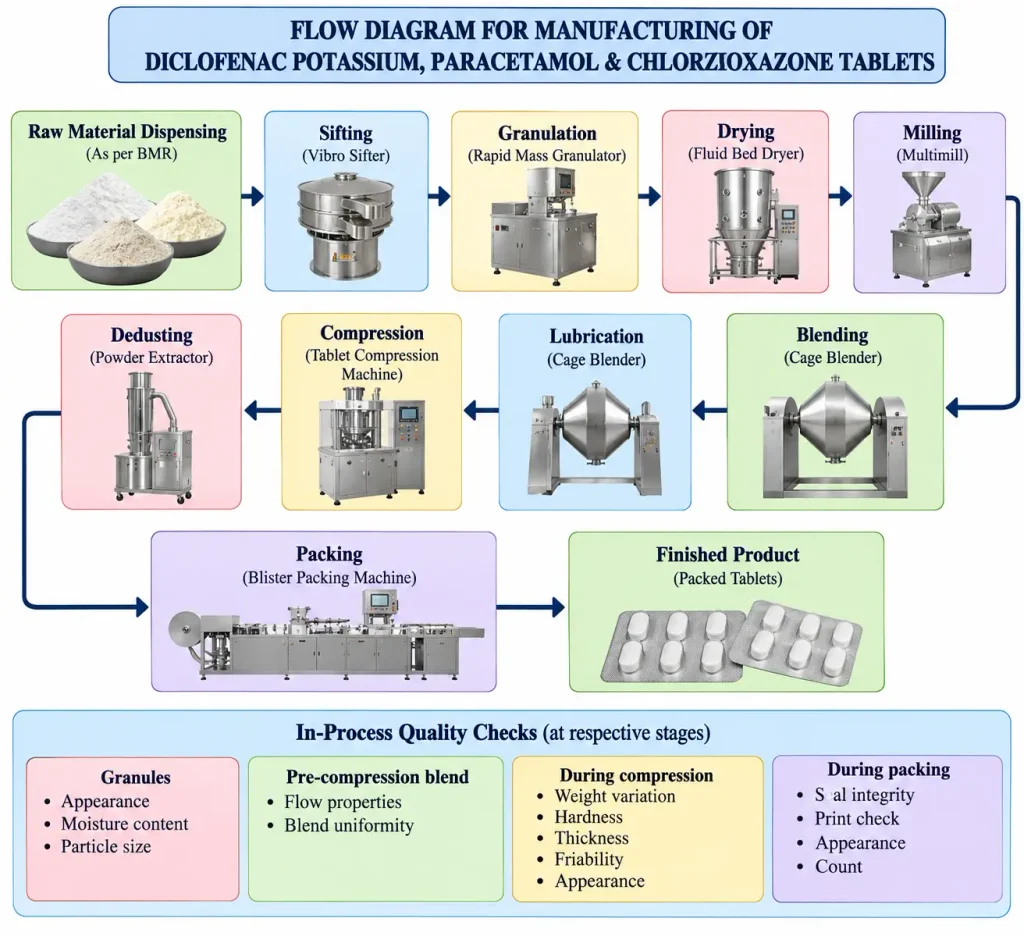
During tablet compression, the lubricated blend is compressed into tablets using a tablet compression machine equipped with suitable punches and dies. Critical quality parameters, including tablet weight, hardness, thickness, friability, disintegration, and appearance, are monitored according to approved specifications. Following compression, tablets undergo dedusting and are transferred for blister packing, where packaging integrity, sealing quality, printed information, and product identification are verified. Throughout the manufacturing process, in-process quality control checks, equipment clearance, material reconciliation, and documentation are maintained to ensure traceability and consistent product quality. The completed tablets undergo the required finished-product quality testing and Quality Assurance review before batch release.
Note: The flow diagram is an illustrative representation of the manufacturing process. Actual processing sequences, operating parameters, and acceptance criteria must follow the approved BMR and validated manufacturing procedures.
3. Critical Process Parameters (CPP) and Critical Quality Attributes (CQA) of Diclofenac Potassium, Paracetamol & Chlorzoxazone Tablets
The Critical Process Parameters (CPP) and Critical Quality Attributes (CQA) of Diclofenac Potassium, Paracetamol & Chlorzoxazone Tablets play an important role in ensuring consistent product quality, manufacturing efficiency, and compliance with Good Manufacturing Practices (GMP).
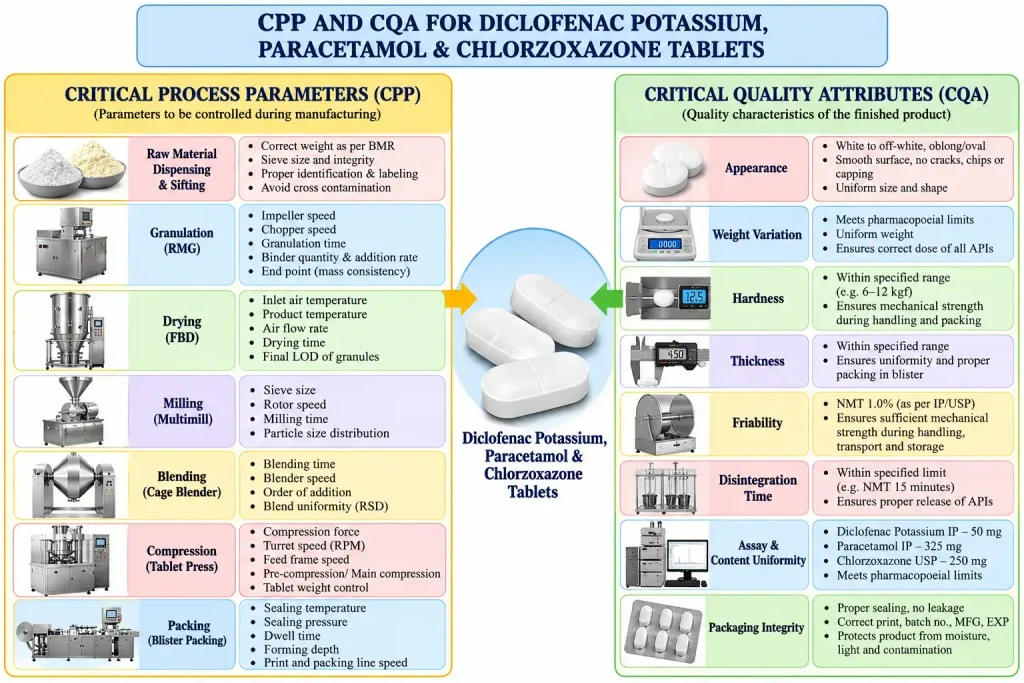
Critical Process Parameters (CPPs) are manufacturing variables that must be monitored or controlled because their variability can influence the Critical Quality Attributes of the finished product. During raw material dispensing and sifting, accurate weighing, material identification, and sieve integrity are essential. In the granulation stage, impeller speed, chopper speed, binder addition, granulation time, and endpoint determination influence granule characteristics. During Fluid Bed Drying (FBD), inlet air temperature, product temperature, airflow, drying time, and Loss on Drying (LOD) require appropriate control. Milling parameters, including screen size and rotor speed, influence particle-size distribution. The blending and lubrication stages require control of mixing time, blender speed, and ingredient distribution to achieve a uniform blend. During tablet compression, compression force, turret speed, feeder settings, and tablet weight are monitored to maintain consistent tablet characteristics. Critical Quality Attributes (CQAs) represent the physical, chemical, and performance characteristics that must meet predefined acceptance criteria to ensure the required product quality. Important quality attributes include tablet appearance, weight variation, hardness, thickness, friability, disintegration time, assay, content uniformity, and packaging integrity, as applicable to the approved specifications. Each tablet contains:
- Diclofenac Potassium IP: 50 mg
- Paracetamol IP: 325 mg
- Chlorzoxazone USP: 250 mg
The relationship between CPPs and CQAs supports pharmaceutical process validation, quality risk management, and continuous process improvement. Effective monitoring of these parameters helps minimize manufacturing variability, prevent quality defects, and maintain batch-to-batch consistency.
Note: The illustrated CPPs and CQAs are potential control parameters and quality attributes. Their criticality and numerical acceptance limits must be established through product-specific risk assessment, development studies, process validation, and approved specifications. The infographic’s example limits should not automatically be treated as approved BMR limits.