







1. Introduction to Disodium Hydrogen Citrate Syrup – Batch Packing Record (BPR):
Disodium Hydrogen Citrate Syrup is a pharmaceutical oral liquid formulation commonly used as a urinary alkalinizing agent to help reduce urine acidity. It is frequently prescribed for managing conditions associated with acidic urine, including certain urinary tract disorders and kidney stones. The formulation contains Disodium Hydrogen Citrate BP 1.53 g per 5 mL, along with a flavored syrup base and Tartrazine as a coloring agent. The Batch Packing Record (BPR) is an essential document in pharmaceutical manufacturing that ensures the systematic documentation, monitoring, and verification of all packaging activities. It provides comprehensive information regarding batch identification, packaging material dispensing, line clearance, filling, sealing, labeling, coding, inspection, and final packing operations. During the packaging process, critical parameters such as fill volume, container integrity, cap sealing, label accuracy, batch coding, and packaging material reconciliation must be carefully monitored to maintain product quality and patient safety. The BPR also ensures compliance with Good Manufacturing Practices (GMP) by maintaining traceability, accountability, and documentation integrity throughout packaging operations. Proper implementation of the Batch Packing Record helps minimize packaging errors, prevent product mix-ups, ensure regulatory compliance, and maintain consistent product quality before final batch release and distribution to the market.
Skip to PDF content2. Disodium Hydrogen Citrate Syrup – Packaging Process Flow Diagram:
The Disodium Hydrogen Citrate Syrup Packaging Process Flow Diagram illustrates the systematic sequence of packaging operations performed under Good Manufacturing Practices (GMP) to ensure product quality, safety, traceability, and regulatory compliance. The packaging process begins with the receipt and verification of approved bulk syrup, followed by dispensing and verification of packaging materials. Before initiating packaging activities, line clearance is performed to prevent contamination, product mix-ups, and packaging errors. The next stages involve bottle cleaning and inspection, followed by syrup filling under controlled conditions. Critical parameters such as fill volume, filling accuracy, container cleanliness, and closure integrity are monitored through appropriate in-process quality checks.
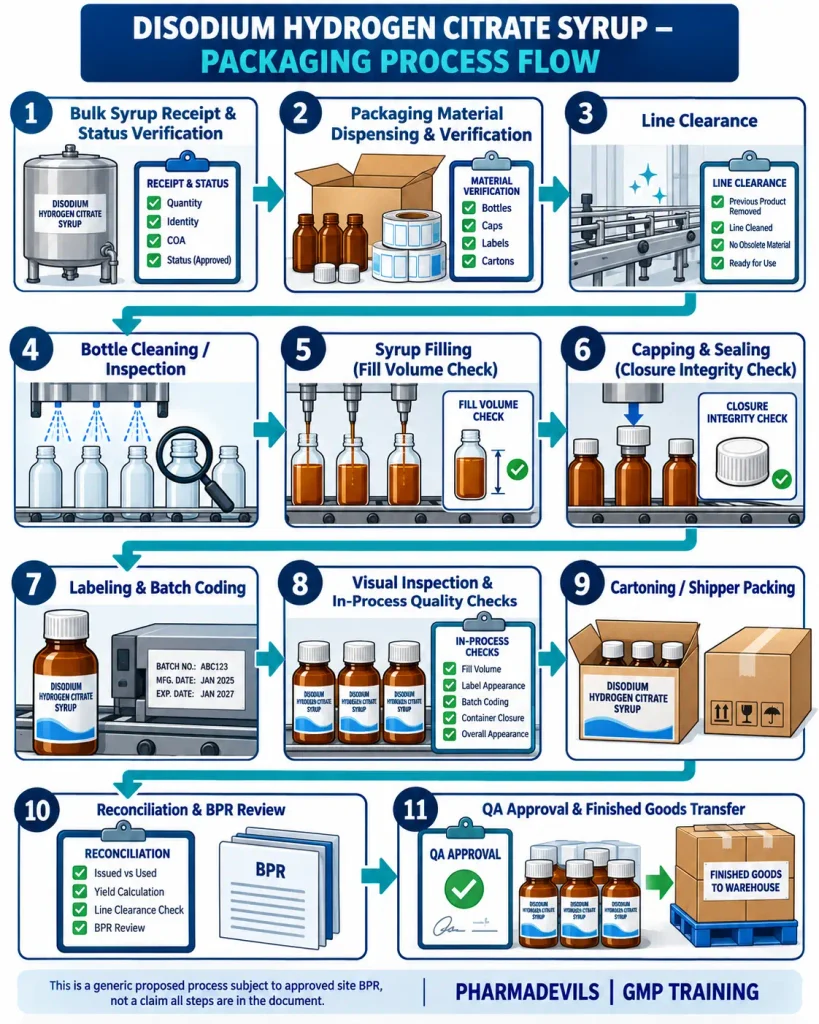
After filling, bottles undergo capping and sealing to ensure proper container closure. Subsequently, labeling and batch coding are performed to provide accurate product identification, manufacturing details, expiry dates, and traceability information. Visual inspection ensures that filled bottles meet established packaging quality requirements. Accepted bottles are transferred for cartoning and shipper packing. Finally, packaging material reconciliation, yield verification, Batch Packing Record (BPR) review, and Quality Assurance approval are completed before finished goods are transferred to the designated storage area. This structured packaging process supports consistent product quality and GMP compliance.
Critical Process Parameters (CPPs) and Critical Quality Attributes (CQAs) of Disodium Hydrogen Citrate Syrup
The Critical Process Parameters (CPPs) and Critical Quality Attributes (CQAs) of Disodium Hydrogen Citrate Syrup play an essential role in ensuring consistent product quality, packaging integrity, patient safety, and compliance with Good Manufacturing Practices (GMP). During the packaging process, important CPPs include filling machine settings, filling speed, fill volume controls, capping torque, sealing parameters, labeling accuracy, and in-process inspection frequency. These parameters must be appropriately established, monitored, and controlled to prevent packaging defects and maintain process consistency.
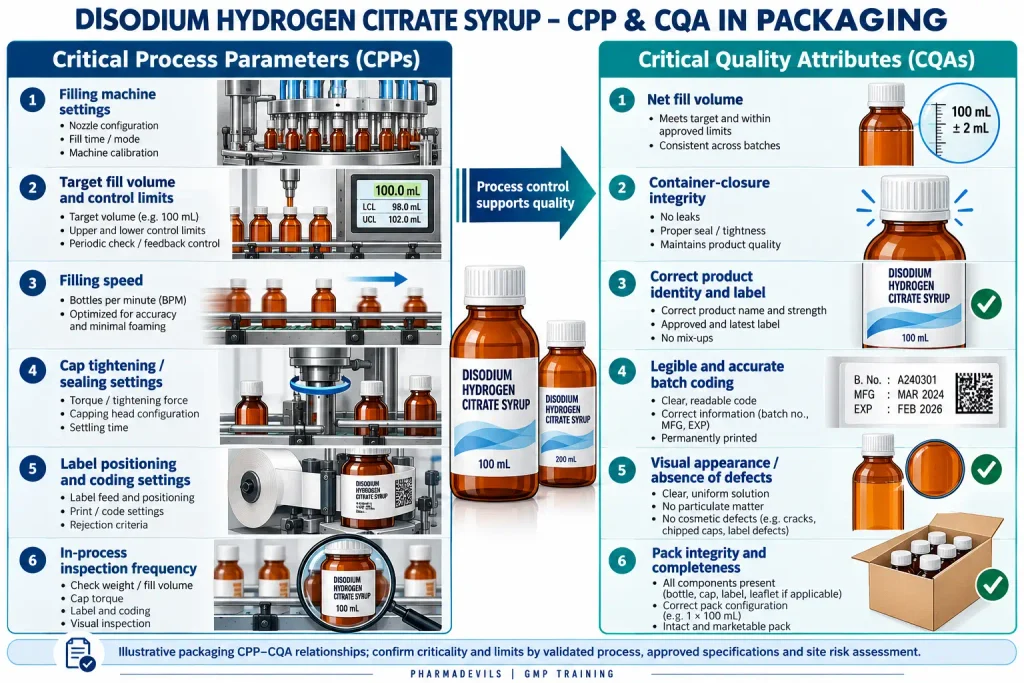
The major CQAs include accurate fill volume, container-closure integrity, correct product identification, legible batch coding, visual appearance, and packaging completeness. These attributes ensure that the finished product meets approved quality specifications and regulatory requirements. Proper control of filling operations prevents underfilling, overfilling, and product wastage. Effective capping and sealing help prevent leakage and contamination, while accurate labeling and batch coding maintain product identification and traceability. Regular in-process quality checks, equipment calibration, and documented inspections support early detection of packaging deviations. Finally, packaging material reconciliation, Batch Packing Record (BPR) verification, and Quality Assurance review provide additional assurance of packaging compliance. Systematic monitoring of CPPs and verification of CQAs help maintain product quality, minimize packaging errors, and support consistent pharmaceutical manufacturing standards.