







1. Introduction to Disodium Hydrogen Citrate Syrup – Batch Packing Record (BPR):
Disodium Hydrogen Citrate Syrup is a pharmaceutical formulation commonly used as a urinary alkalinizing agent to help reduce urine acidity. It is frequently prescribed for conditions requiring urinary pH adjustment, including certain urinary tract disorders and the management of specific types of urinary stones. The Batch Packing Record (BPR) is an essential component of pharmaceutical documentation that provides comprehensive information regarding the filling, sealing, labelling, packaging, and reconciliation of Disodium Hydrogen Citrate Syrup in accordance with Good Manufacturing Practices (GMP). The BPR ensures that every packaging operation is performed systematically under controlled conditions using approved Standard Operating Procedures (SOPs). It includes details of batch identification, packaging material issuance, equipment identification, line clearance, in-process quality checks, packaging reconciliation, and personnel responsibilities. Critical packaging operations include bottle washing, syrup filling, capping, sealing, visual inspection, labelling, cartoning, and shipper packing. These activities are carefully monitored to maintain product quality, prevent contamination, and minimize packaging errors. The record also supports data integrity, batch traceability, deviation investigations, and regulatory compliance. Effective implementation of the BPR ensures consistent packaging quality, proper documentation, product identification, and accountability throughout the packaging process, supporting Quality Assurance review and final batch release.
Skip to PDF content2. Manufacturing and Packing Process Flow of Disodium Hydrogen Citrate Syrup (BPR):
The Batch Packing Record (BPR) of Disodium Hydrogen Citrate Syrup provides a systematic approach to pharmaceutical filling, sealing, labelling, and packaging operations in accordance with Good Manufacturing Practices (GMP). The process ensures product quality, safety, traceability, and compliance with established pharmaceutical standards. The packing process begins with the receipt and verification of approved bulk syrup, followed by the dispensing and inspection of packaging materials. Line clearance is performed to prevent product mix-ups, contamination, and packaging errors. Bottles are washed and inspected according to approved Standard Operating Procedures (SOPs).
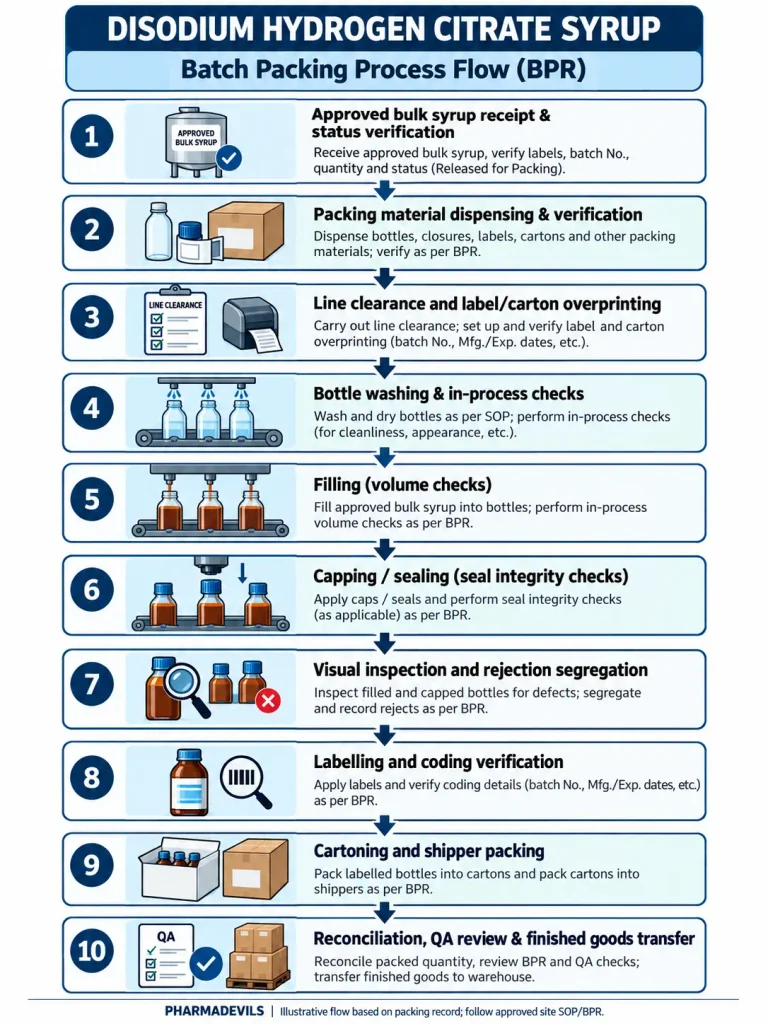
The approved syrup is filled into clean bottles using calibrated filling equipment. Critical process parameters, including filling volume, machine settings, and sealing integrity, are monitored through in-process quality checks. After filling, bottles undergo capping, sealing, and visual inspection to identify defects, leakage, or improper closures. Accepted bottles are labelled with verified product information, batch numbers, manufacturing dates, and expiry dates. The labelled bottles are packed into secondary cartons and tertiary shippers according to approved packaging specifications. Finally, packaging material reconciliation, yield verification, documentation review, and Quality Assurance (QA) checks are completed before finished goods are released for storage and distribution, ensuring consistent product quality and regulatory compliance.
3. Critical Process Parameters (CPPs) and Critical Quality Attributes (CQAs) of Disodium Hydrogen Citrate Syrup:
Critical Process Parameters (CPPs) and Critical Quality Attributes (CQAs) play an essential role in ensuring the quality, safety, consistency, and regulatory compliance of Disodium Hydrogen Citrate Syrup during pharmaceutical filling and packaging operations. Critical Process Parameters (CPPs) are process variables that require monitoring and control because their variability may affect product quality. Important parameters include bottle washing conditions, filling volume, filling machine speed, capping torque, sealing temperature or pressure, and labelling machine settings, as applicable.

Proper control of these parameters helps prevent underfilling, overfilling, leakage, contamination, and packaging defects. Line clearance, equipment cleanliness, and packaging material verification further support GMP compliance and prevent product mix-ups. Critical Quality Attributes (CQAs) are physical, chemical, biological, or microbiological characteristics that must remain within approved limits to ensure product quality. Important quality attributes include product identity, assay, appearance, fill volume, microbial quality, container closure integrity, label accuracy, and packaging correctness. In-process quality control checks are performed at predefined intervals to verify compliance with established specifications. Effective CPP monitoring and CQA evaluation support process validation, batch consistency, deviation prevention, and continuous improvement. Final CPP classification and acceptance criteria should be justified through quality risk assessment, validation studies, and approved product specifications.