






Brief Description
This SOP describes the procedure for the safe disposal of toxic and hazardous samples handled in the Quality Control Department. Its objective is to ensure that such samples are properly treated and detoxified after completion of testing. The procedure applies to all toxic and hazardous samples, with the Executive-QC responsible for execution and the Manager-QC and Head QC/QA responsible for effective implementation.After testing, the hazardous sample is diluted with water and treated with 5% sodium hypochlorite solution while stirring. Treatment is continued until excess hypochlorite is confirmed by a definite blue colour on starch iodide paper. Additional hypochlorite is added and the solution is kept for 24 hours. The excess hypochlorite is then rechecked; if positive, the treated solution is washed away with a large quantity of water. If negative, the treatment is repeated until detoxification is completed. Used gloves are also washed with hypochlorite solution before disposal.The SOP also specifies one-hour training for QC chemists and controlled-document distribution between QC and QA.
Skip to PDF content1. Flow Diagram:
The flow diagram presents the safe disposal process for toxic and hazardous samples in a clear, step-by-step manner. The process begins after completion of sample testing, when the toxic or hazardous sample is diluted with water. 5% sodium hypochlorite solution is then added with continuous stirring until excess hypochlorite is confirmed by a definite blue colour on starch iodide paper. Additional hypochlorite is added, and the treated solution is allowed to stand for 24 hours.
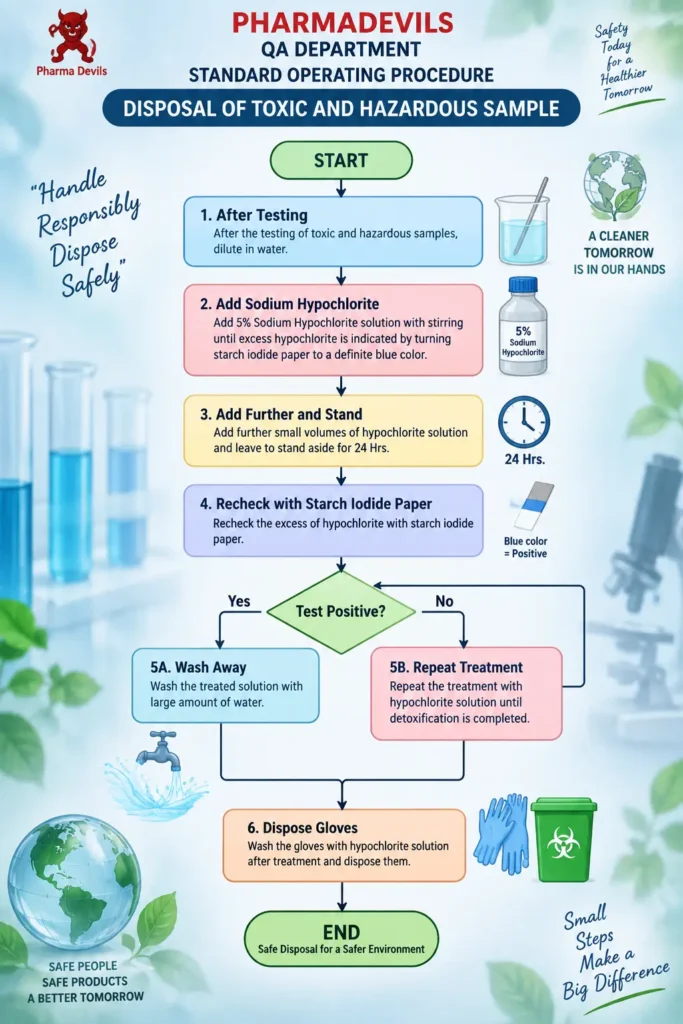
After the holding period, the solution is rechecked using starch iodide paper. If the test is positive, confirming excess hypochlorite, the treated solution is washed away with a large quantity of water. If the test is negative, hypochlorite treatment is repeated until detoxification is complete. Finally, used gloves are washed with hypochlorite solution and disposed of safely.The wallpaper-style presentation makes the SOP visually attractive and easy for QC personnel to understand and follow.
2. Brainstorming For SOP Failure:
The brainstorming diagram presents possible reasons for failure of the SOP for Disposal of Toxic and Hazardous Samples using a colorful market-style status board. The purpose is to help QC and QA personnel identify potential weaknesses before they lead to unsafe disposal, incomplete detoxification, or environmental non-compliance. Key brainstorming points include lack of training, SOP not being properly understood, incorrect hypochlorite concentration, insufficient 24-hour contact time, improper use of starch iodide paper, inadequate dilution or washing, poor glove handling, lack of supervision, high workload, inadequate documentation, human error, poor communication between QA and QC, and lack of suitable equipment or reagents.
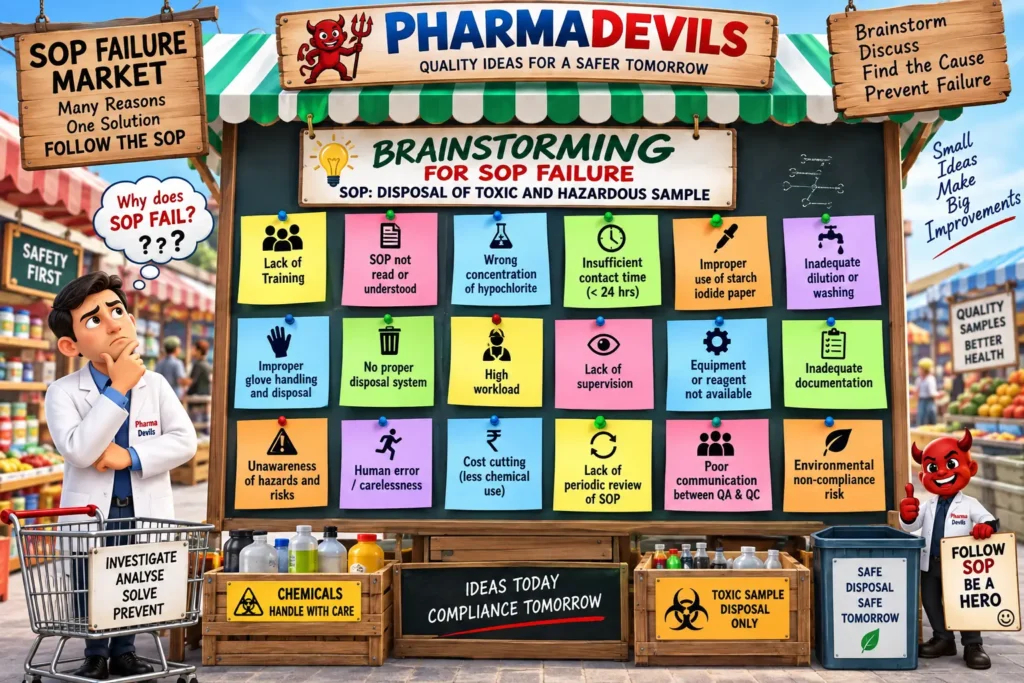
These potential failures relate directly to critical SOP activities such as treatment with 5% sodium hypochlorite, 24-hour standing time, rechecking with starch iodide paper, repeat treatment when required, and safe disposal of treated materials and gloves.The market-board concept encourages teamwork, open discussion, root-cause identification, and preventive action to strengthen SOP compliance and promote safer laboratory practices.
3. 5-Why Analysis For SOP Failure:
The 5-Why analysis identifies the underlying causes of failure in the SOP for Disposal of Toxic and Hazardous Samples. The analysis starts with the main problem: improper or unsafe disposal of toxic and hazardous samples. The first why indicates that the sample was not properly treated with 5% sodium hypochlorite or washing was inadequate. The second why points to incorrect execution of the SOP, such as wrong concentration, inadequate stirring, or failure to maintain the required 24-hour standing period.
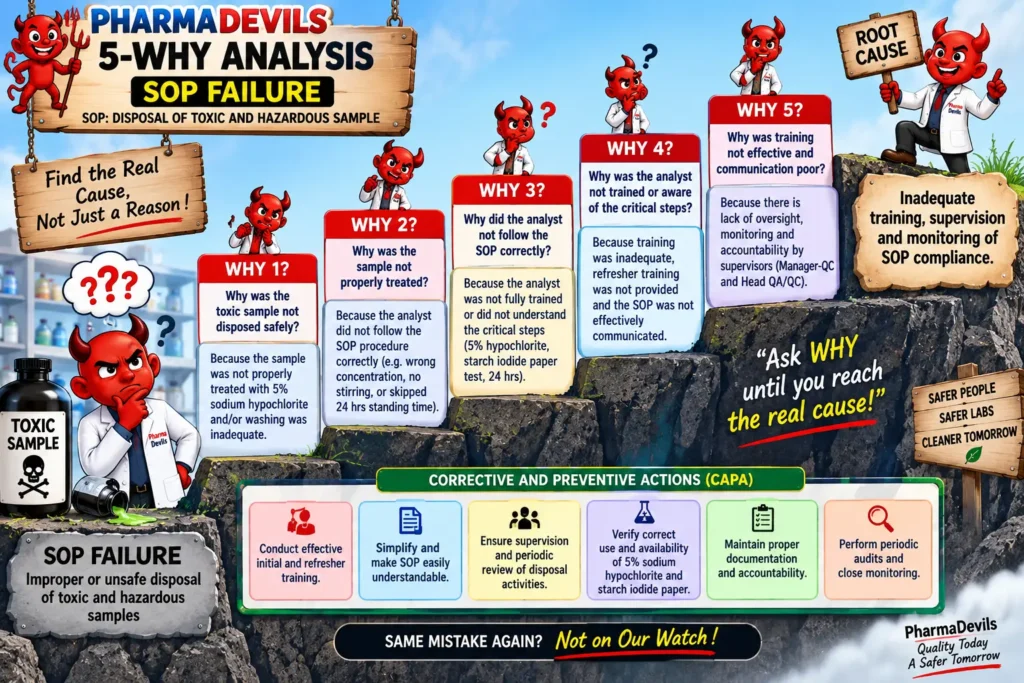
The third why links the failure to insufficient understanding of critical steps, including hypochlorite treatment and starch iodide paper verification. The fourth why identifies inadequate training and poor communication, while the fifth why highlights weak supervision, monitoring, and accountability. The likely root cause is therefore inadequate training, supervision, and monitoring of SOP compliance. The analysis supports CAPA actions such as refresher training, stronger supervision, correct reagent use, proper documentation, and periodic compliance review.
4. Fishbone Analysis For SOP Failure:
The Fishbone Analysis illustrates the possible causes of failure in the SOP for Disposal of Toxic and Hazardous Samples. The diagram organizes potential causes into major categories such as Man (People), Method (Procedure), Material (Reagents), Machine (Equipment), Measurement, Environment, and Management. It highlights issues including inadequate training, human error, poor supervision, incorrect use or concentration of sodium hypochlorite, insufficient 24-hour standing time, improper use of starch iodide paper, inadequate washing, unavailable reagents or equipment, weak documentation, poor waste handling, and insufficient management monitoring.
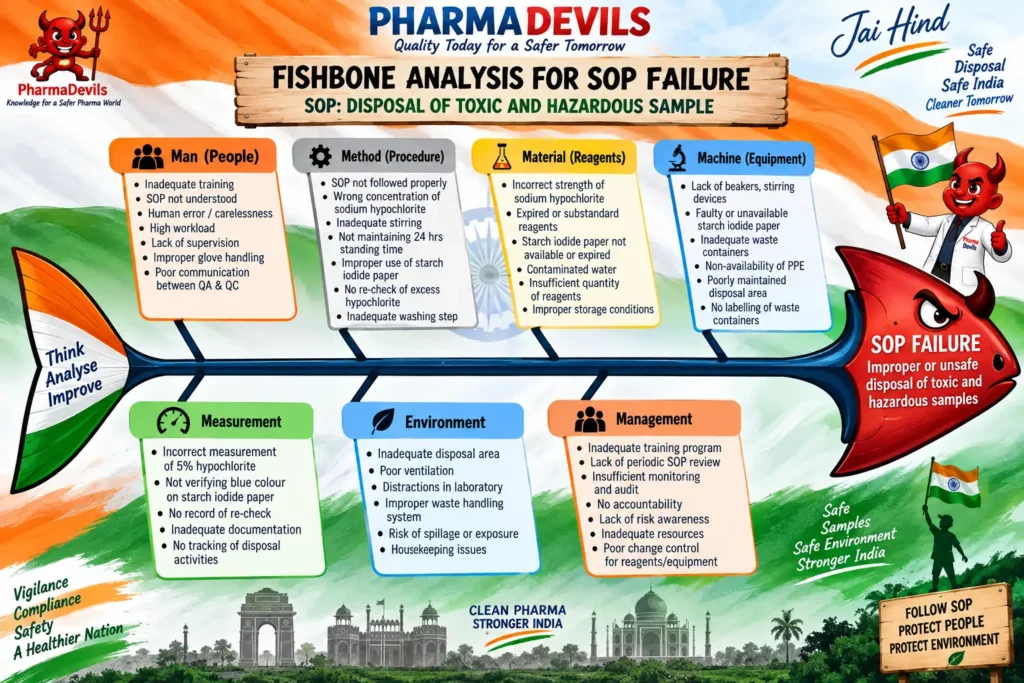
These causes are directly linked to critical SOP activities such as treatment with 5% sodium hypochlorite, verification using starch iodide paper, repeat treatment when detoxification is incomplete, washing with large quantities of water, and safe disposal of gloves.The Indian-flag themed fishbone makes the analysis visually engaging while emphasizing safety, compliance, environmental protection, and continuous improvement.
5. Fault Tree Analysis For SOP failure:
The Fault Tree Analysis illustrates how failure of the SOP for Disposal of Toxic and Hazardous Samples can result in improper or unsafe disposal. The top event is SOP failure, which branches into major contributing events such as sample not being properly treated, treated solution not being adequately washed, and used gloves or materials not being correctly disposed of.
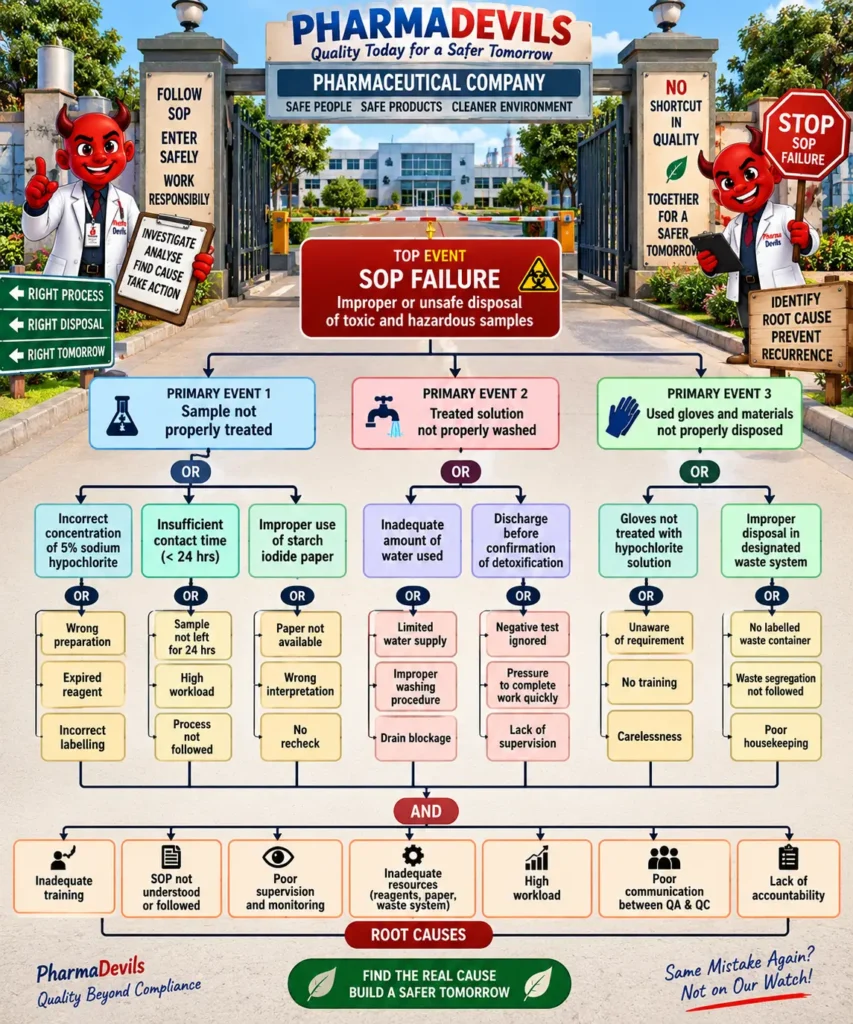
Possible causes include incorrect use or concentration of 5% sodium hypochlorite, insufficient 24-hour contact time, improper use of starch iodide paper, inadequate washing with water, failure to confirm detoxification, and improper handling of gloves. These steps are directly related to the SOP procedure.The lower branches identify broader root causes such as inadequate training, poor understanding of the SOP, weak supervision, insufficient resources, high workload, poor QA–QC communication, and lack of accountability. The pharma entry-gate design with devils makes the analysis visually engaging while emphasizing prevention, investigation, and continuous GMP improvement.
Questions & Answers – SOP for Disposal of Toxic and Hazardous Samples
Q1. What is the objective of this SOP?
Answer: The objective is to establish a procedure for the safe disposal of toxic and hazardous samples.
Q2. What is the scope of this SOP?
Answer: This SOP applies to the disposal of all toxic and hazardous samples.
Q3. Who is responsible for executing this SOP?
Answer: The Executive-QC is responsible for execution of the SOP.
Q4. Who is responsible for effective implementation of this SOP?
Answer: The Manager-QC and Head QC/QA are responsible for effective implementation.
Q5. What should be done with toxic and hazardous samples after testing?
Answer: After testing, the samples should be diluted with water and treated with 5% sodium hypochlorite solution with stirring.
Q6. How is excess sodium hypochlorite confirmed?
Answer: Excess hypochlorite is confirmed when starch iodide paper turns a definite blue colour.
Q7. How long should the treated sample be allowed to stand?
Answer: After adding further small volumes of hypochlorite solution, the sample should be allowed to stand for 24 hours.
Q8. What should be done after the 24-hour holding period?
Answer: The excess hypochlorite should be rechecked using starch iodide paper.
Q9. What should be done if the starch iodide paper test is positive after treatment?
Answer: If the test is positive, the treated solution should be washed away with a large amount of water.
Q10. What should be done if the starch iodide paper test is negative?
Answer: The treatment with hypochlorite solution should be repeated until detoxification is completed.
Q11. How should gloves be handled after treatment?
Answer: The gloves should be washed with hypochlorite solution after treatment and then disposed of.
Q12. Who provides training for this SOP?
Answer: The trainer is the Head QA/QC.
Q13. Who are the trainees for this SOP?
Answer: The trainees are QC Chemists.
Q14. What is the duration of SOP training?
Answer: The training duration is one hour.
Q15. Where are the controlled copy and master copy maintained?
Answer: The controlled copy is maintained with the Head of Quality Control, while the master copy is maintained with the Head of Quality Assurance.