







Brief Description
This SOP describes the system for proper documentation, maintenance, storage, retention, and destruction of Quality Control records and reports. Accurate and well-maintained records are essential for product traceability and for supporting investigations related to product quality. The procedure applies to QC records and reports generated for raw materials, packing materials, bulk products, and finished products.All applicable QC reports shall be retained for a minimum of five years from the date of manufacture or for 12 months after product expiry, whichever is later. Older records are transferred to the designated record room, arranged in serial order, and maintained securely under lock and key.Obsolete records may be destroyed only after obtaining written permission from the Unit Head. Destruction is performed by shredding or burning under the supervision of an authorized responsible person such as the QA Manager or Management Representative.
Skip to PDF content1. Flow Diagram:
The flow diagram explains the systematic process for documentation, maintenance, retention, storage, and destruction of QC records and reports. It begins with generation of reports for raw materials, packing materials, bulk products, and finished products, followed by proper documentation and record maintenance. Records are retained for five years from the date of manufacture or 12 months after expiry, whichever is later.
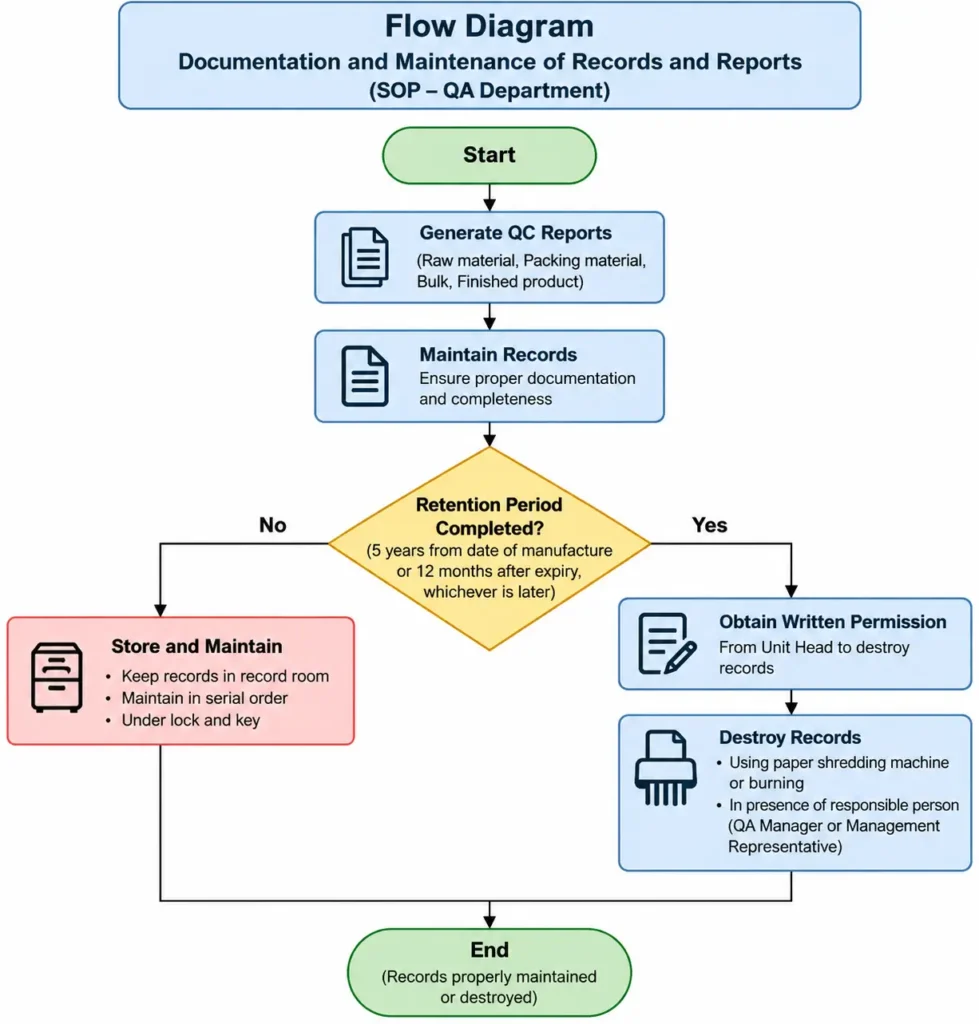
If the retention period is not completed, records are stored in the record room in serial order under lock and key. Once the retention period is completed, written permission from the Unit Head is obtained before destruction. Records are then destroyed by shredding or burning under the supervision of an authorized responsible person.
2. Brainstorming for SOP Failure:
The brainstorming diagram identifies potential causes for failure in the SOP for Documentation and Maintenance of Records and Reports. Major concerns include inadequate training, incomplete or improper documentation, poor filing and indexing, lack of awareness of the required retention period, insufficient record-room controls, inadequate storage space, absence of periodic record review, weak management oversight, unauthorized destruction of records, workload pressure, personnel changes without proper handover, and failure to follow the SOP consistently.

These brainstorming points help the Quality Unit identify weaknesses across people, process, system, training, awareness, and compliance so that appropriate corrective and preventive actions can be developed. This supports the SOP requirement that QC records be properly retained, securely stored, and destroyed only after written authorization.
3. 5-Why Analysis for SOP Failure:
The 5-Why analysis identifies the underlying causes of failure in the SOP for Documentation and Maintenance of Records and Reports. The problem starts with records being incomplete, unavailable, or not properly maintained, which may occur because documentation and filing practices were not followed as required.
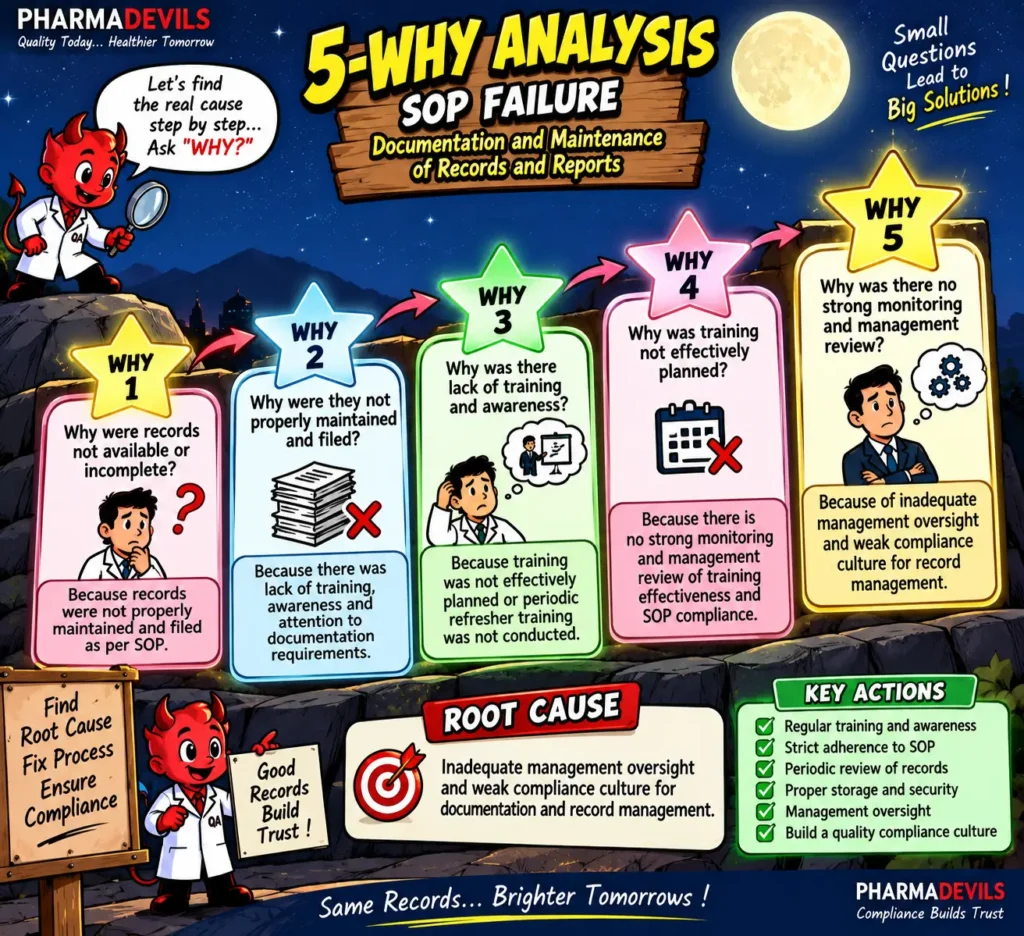
Further analysis points to insufficient training and awareness, lack of effective refresher training, and inadequate monitoring of SOP compliance. The final root cause is linked to weak management oversight and an insufficient compliance culture for record management.The analysis highlights the need for regular training, strict adherence to documentation procedures, periodic review of records, secure storage, and stronger management supervision. These controls support the SOP requirement that records be properly maintained, securely stored, and appropriately retained.
4. Fishbone Analysis for SOP Failure:
The Fishbone Analysis evaluates possible causes of failure in the SOP for Documentation and Maintenance of Records and Reports using five major pillars: People, Procedure, Training, System, and Management.
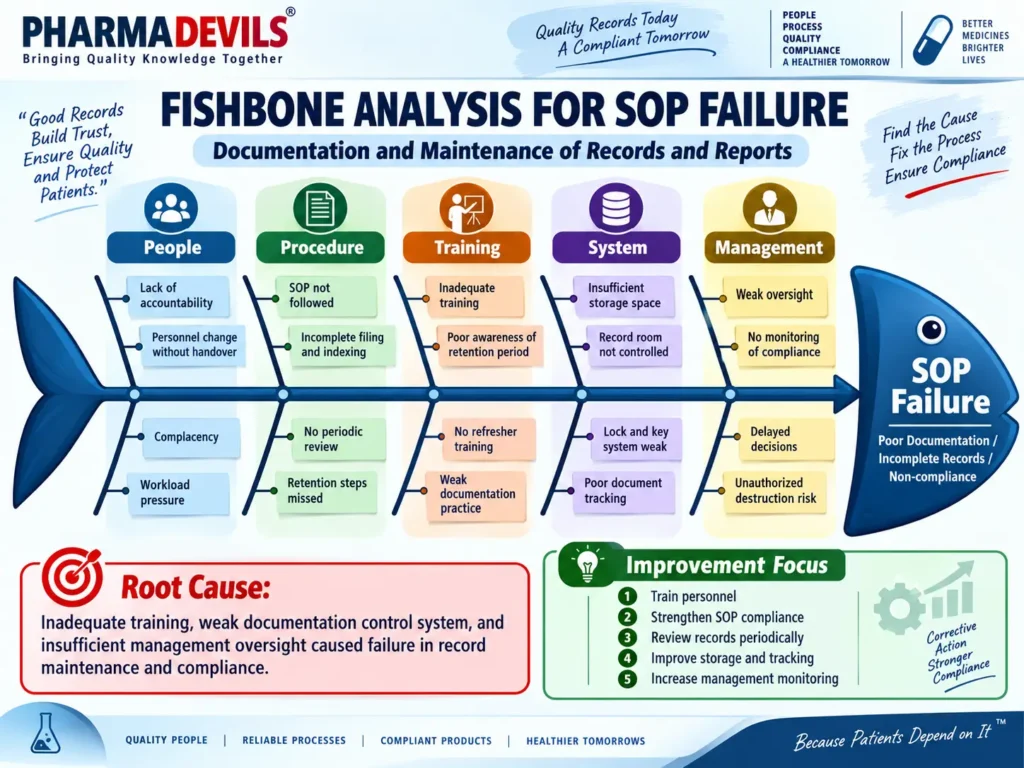
The analysis highlights potential contributors such as lack of accountability, workload pressure, incomplete filing and indexing, missed retention activities, inadequate training, poor awareness of retention requirements, weak document tracking, insufficient storage controls, and inadequate management monitoring. These factors can lead to poor documentation, incomplete records, improper record maintenance, and regulatory non-compliance.The analysis indicates that the primary root causes are inadequate training, weak documentation control systems, ineffective SOP implementation, and insufficient management oversight. Improvement should therefore focus on personnel training, periodic record review, stronger storage and tracking controls, and enhanced management supervision. These controls support the SOP requirements for proper retention, secure storage, and authorized destruction of records.
5. Fault Tree Analysis for SOP Failure:
The Fault Tree Analysis illustrates how failure of the SOP for Documentation and Maintenance of Records and Reports can result from three main pathways: records being unavailable or incomplete, records not being properly maintained or stored, and unauthorized or improper destruction of records.
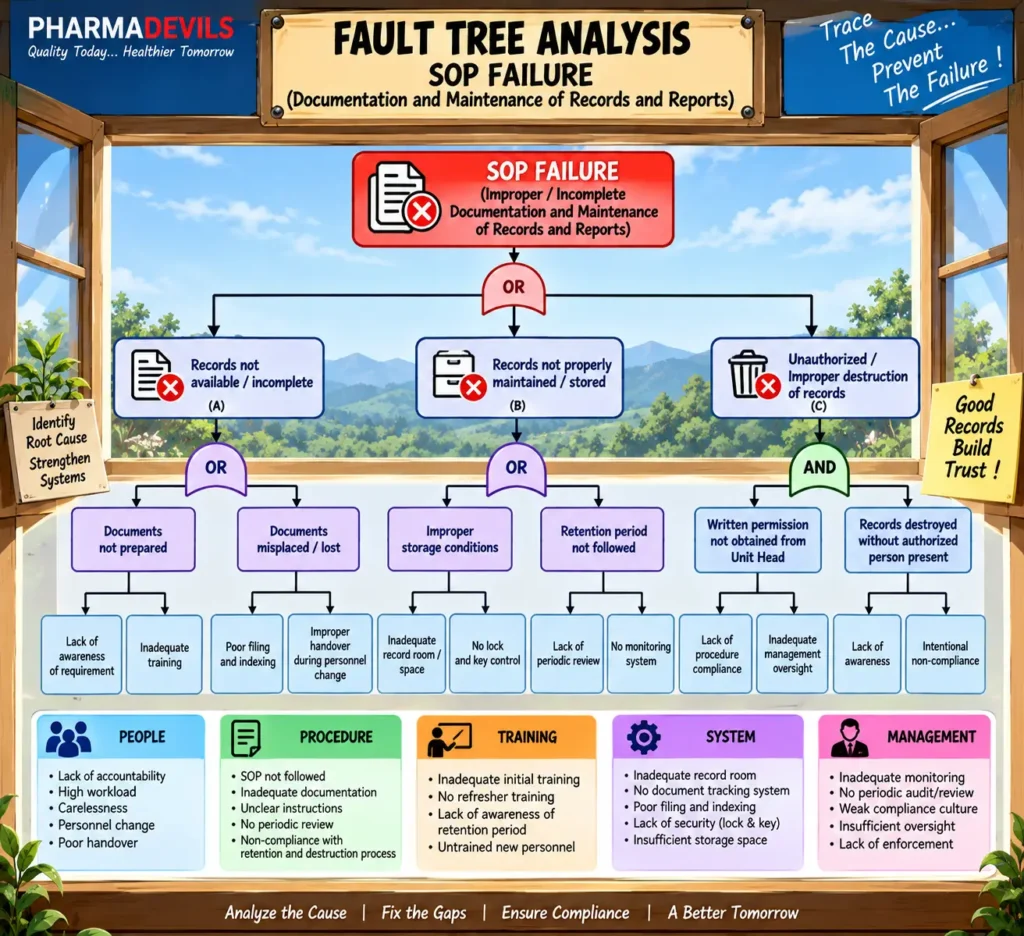
The analysis further links these failures to causes such as poor filing and indexing, inadequate handover, improper storage conditions, failure to follow the required retention period, absence of periodic review, lack of monitoring, inadequate management oversight, insufficient training, and weak awareness of record-control requirements.The diagram also highlights five contributing areas—People, Procedure, Training, System, and Management—to support identification of root causes and development of corrective actions. The SOP specifically requires records to be stored in serial order under lock and key and permits destruction only after written approval from the Unit Head and under authorized supervision.
Questions & Answers – Documentation and Maintenance of Records and Reports
Q1. What is the objective of this SOP?
Answer: The objective is to ensure proper documentation and maintenance of records so that information is readily available for investigation related to a product.
Q2. What is the scope of this SOP?
Answer: This SOP is applicable to the maintenance of records and reports.
Q3. Who is responsible for implementation of this SOP?
Answer: Chemist-QC, Executive QC, and the Quality Assurance Manager are responsible for activities covered by this SOP.
Q4. Which QC reports are required to be retained?
Answer: QC reports related to raw materials, packing materials, bulk products, and finished products are required to be retained.
Q5. What is the retention period for QC reports?
Answer: Reports shall be retained for a minimum of 5 years from the date of manufacture or 12 months after expiry, whichever is later.
Q6. Where should records from earlier years be stored?
Answer: Earlier-year records shall be stored in the designated record room.
Q7. How should old records be arranged and secured?
Answer: Records shall be maintained in serial order and stored under lock and key.
Q8. Who gives permission for destruction of old records?
Answer: Written permission from the Unit Head must be obtained before records are destroyed.
Q9. How can old records be destroyed?
Answer: Records may be destroyed using a paper shredding machine or by burning, as specified in the SOP.
Q10. Who should be present during destruction of records?
Answer: A responsible person such as the QA Manager or Management Representative should be present during destruction.
Q11. Who provides training for this SOP?
Answer: The Head-QC/QA acts as the trainer.
Q12. Who are the trainees and what is the training duration?
Answer: Quality Control personnel are the trainees, and the specified training duration is half an hour.
Q13. Who retains the controlled copy of this SOP?
Answer: The controlled copy is retained by the Head of Department – Quality Control.
Q14. Who retains the master copy of this SOP?
Answer: The master copy is retained by the Head of Department – Quality Assurance.
Q15. What does SOP stand for?
Answer: SOP stands for Standard Operating Procedure.
Q16. What does QC stand for?
Answer: QC stands for Quality Control.
Reference Guidelines:
- Drugs Rules, 1945 – Revised Schedule M, G.S.R. 922(E), dated 28 December 2023 – Good Manufacturing Practices and requirements relating to documentation, traceability, records, storage and retention. CDSCO lists the revised Schedule M notification officially. (CDSCO)
CDSCO Gazette Notifications – Schedule M - WHO Technical Report Series No. 1052, Annex 4 – Good Practices for Pharmaceutical Quality Control Laboratories – applicable to QC laboratory documentation, records, raw data, review, storage and traceability. (World Health Organization)
WHO – Good Practices for Pharmaceutical Quality Control Laboratories - WHO TRS 986, Annex 2 – WHO GMP for Pharmaceutical Products: Main Principles – covers GMP documentation, records and quality-system requirements. (World Health Organization)
WHO GMP Main Principles - EU GMP – EudraLex Volume 4, Part I, Chapter 4: Documentation – specifically addresses generation and control of documents, good documentation practices and retention of documents. (Public Health)
EU GMP Chapter 4 – Documentation - US FDA – 21 CFR Part 211, Subpart J: Records and Reports, particularly §211.180 – General Requirements and §211.194 – Laboratory Records. §211.180 addresses record retention and accessibility, while §211.194 specifies the data that must be maintained in laboratory records. (eCFR)
Official eCFR – 21 CFR Part 211 Subpart J - PIC/S GMP Guide PE 009-17, Part I – Chapter 4: Documentation and Chapter 6: Quality Control – relevant for GMP documentation and QC record-management systems. (PIC/S)
PIC/S Publications – GMP Guide PE 009-17