





1. Introduction for SOP for Preparation of Cleaning Validation and Hold time shelf life study Protocol & reports:
This SOP establishes a controlled procedure for preparing, reviewing, approving, numbering, issuing, and maintaining cleaning validation and hold-time/shelf-life study protocols and reports within the Quality Control department. It defines responsibilities for QC personnel, department heads, and Quality Assurance, ensuring documents are accurate, complete, traceable, and appropriately authorized. The procedure specifies required protocol and report contents, including objectives, scope, methodology, sampling, acceptance criteria, observations, deviations, change controls, investigations, corrective actions, summaries, conclusions, and references. It also provides unique document numbering systems, standard specimen formats, approval requirements, revalidation criteria, revision controls, and annexures to support consistent execution, regulatory compliance, and reliable documentation.
Skip to PDF content2. Flow Diagram for SOP for Preparation of Cleaning Validation and Hold time study Protocol & reports:
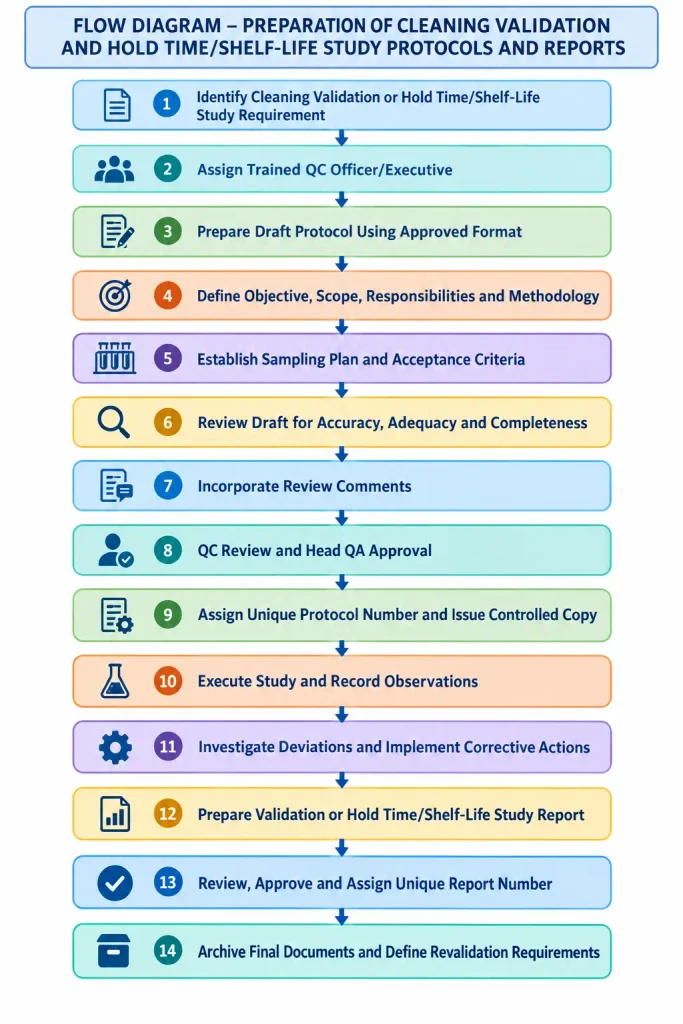
The flow diagram presents the complete lifecycle for preparing Cleaning Validation and Hold Time Study protocols and reports. It begins with identifying the study requirement and assigning a trained QC officer. The protocol is drafted using the approved format, with defined objectives, scope, responsibilities, methodology, sampling plans, and acceptance criteria. After review, comments are incorporated, and QC and QA provide approval. A unique protocol number and controlled copy are issued before study execution. Observations and deviations are documented, corrective actions implemented, and the final report is prepared, reviewed, approved, numbered, archived, and assessed for revalidation requirements to ensure compliance and traceability.
3. Brainstorming Analysis for SOP for Preparation of Cleaning Validation and Hold time study Protocol & reports not performed:
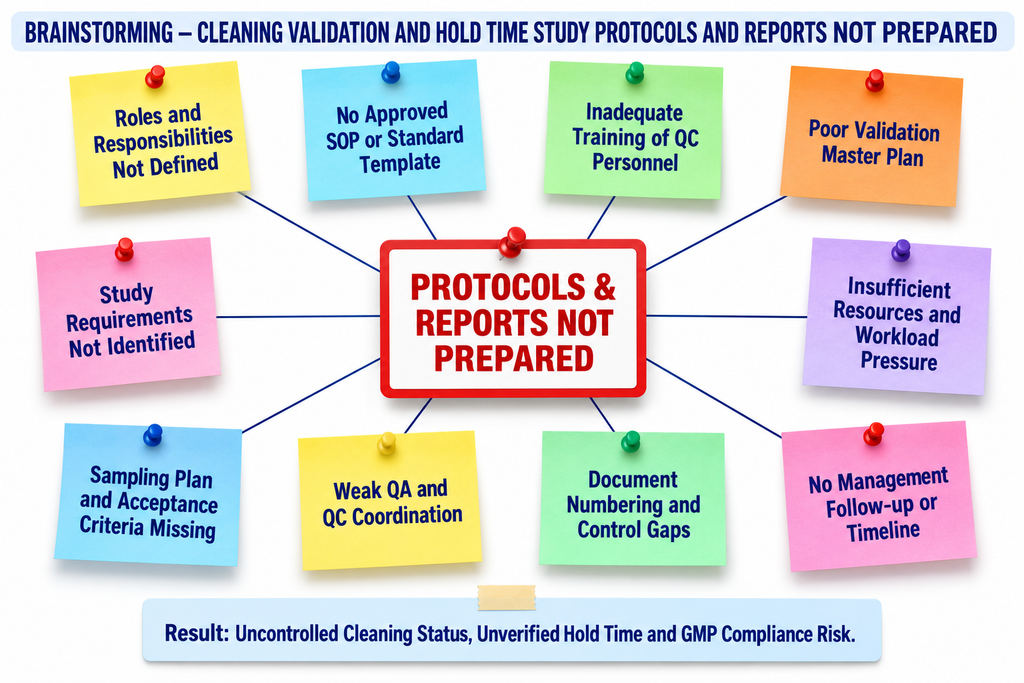
The brainstorming diagram identifies possible reasons why Cleaning Validation and Hold-Time Study protocols and reports were not prepared. Key concerns include undefined responsibilities, absence of an approved SOP or standard template, insufficient QC training, weak validation planning, and failure to identify study requirements. It also highlights workload pressure, inadequate resources, missing sampling plans and acceptance criteria, poor QA-QC coordination, document numbering gaps, and lack of management follow-up. Collectively, these weaknesses can leave equipment cleaning status uncontrolled, hold-time limits unverified, and study conclusions unsupported. Structured ownership, training, templates, timelines, QA oversight, and document control are therefore essential for GMP compliance assurance.
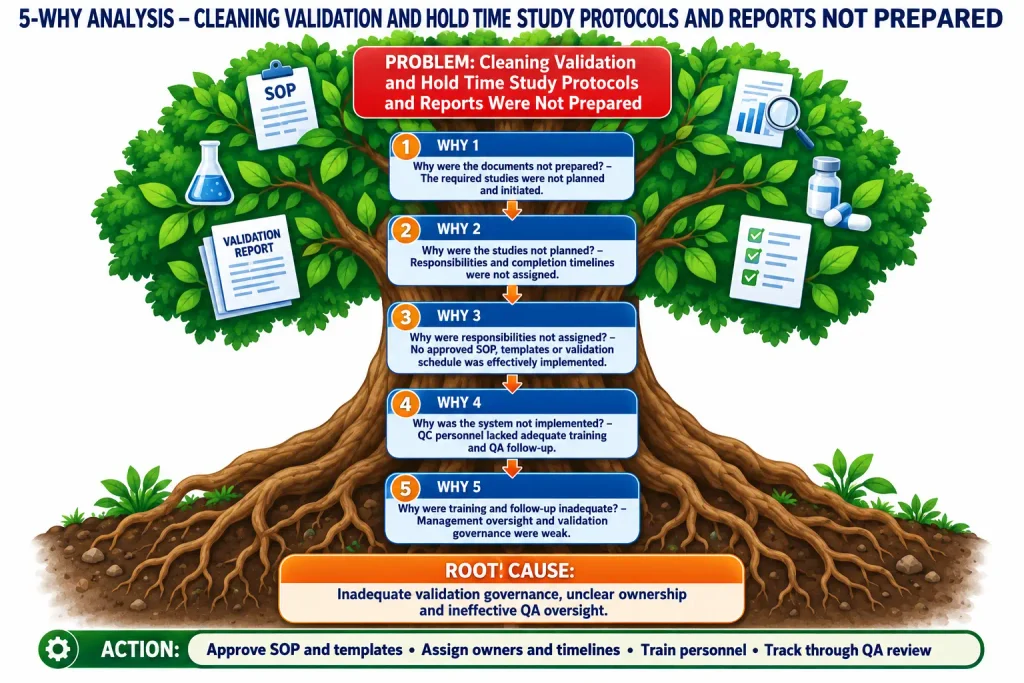
4. 5-Why Analysis for SOP for Preparation of Cleaning Validation and Hold time study Protocol & reports not performed:
The 5-Why analysis traces the failure to prepare Cleaning Validation and Hold-Time Study protocols and reports from the immediate problem to its systemic root cause. Documents were not prepared because required studies were neither planned nor initiated. This occurred because responsible personnel and completion timelines were not assigned. Responsibilities remained unclear because approved SOPs, templates, and validation schedules were not effectively implemented. Implementation failed due to inadequate QC training and weak QA follow-up. Ultimately, insufficient management oversight and poor validation governance caused unclear ownership. Strengthening procedures, training, accountability, scheduling, and QA monitoring will prevent recurrence and improve GMP documentation compliance.
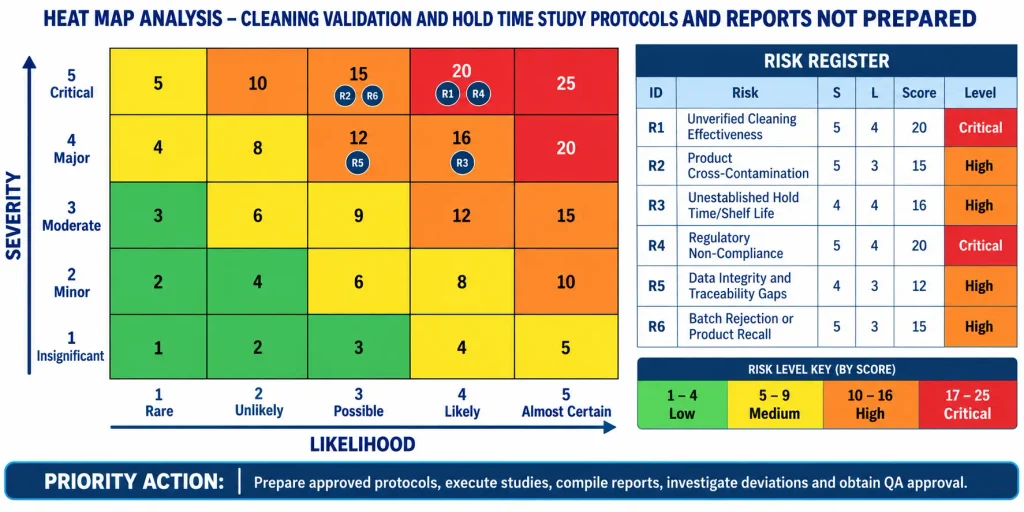
5. Heat-Map Analysis for SOP for Preparation of Cleaning Validation and Hold time study Protocol & reports not performed:
The heat-map analysis evaluates risks arising from the absence of Cleaning Validation and Hold-Time Study protocols and reports by combining severity and likelihood. Critical risks include unverified cleaning effectiveness and regulatory non-compliance, each scoring 20. High-level risks include product cross-contamination, batch rejection or recall, unestablished hold-time or shelf-life limits, and data integrity or traceability gaps. These conditions may compromise product quality, patient safety, documented evidence, and inspection readiness. Immediate priority should be given to preparing approved protocols, executing planned studies, documenting observations, investigating deviations, compiling reports, and obtaining QA approval. Regular monitoring, assigned ownership, defined timelines, and management review reduce recurrence.
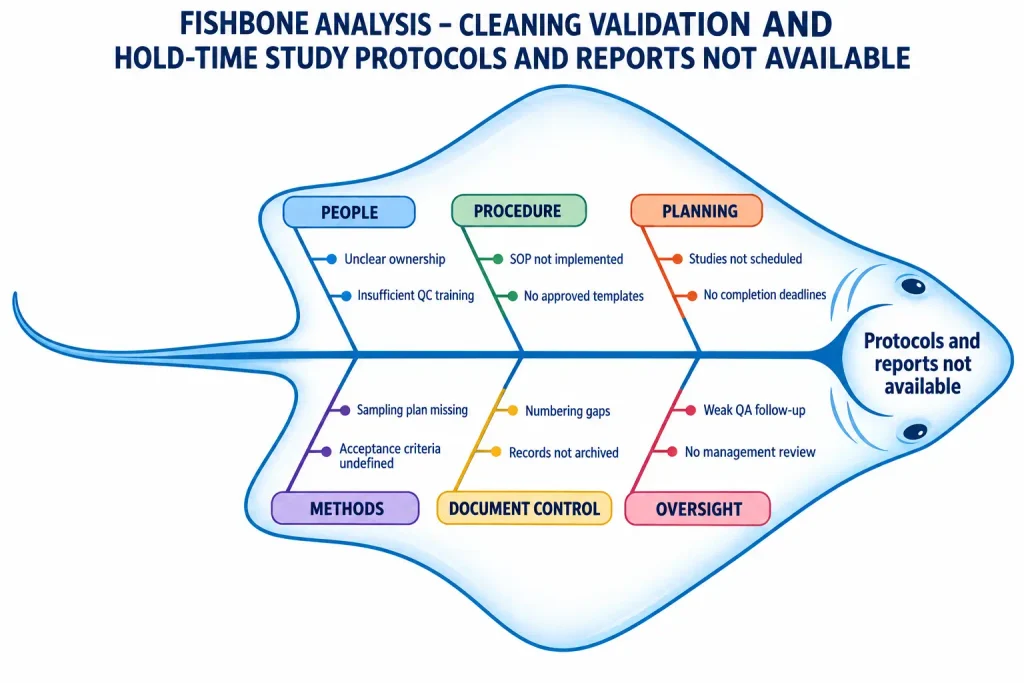
6. Fishbone Analysis for SOP for Preparation of Cleaning Validation and Hold time study Protocol & reports not performed:
The stingray fishbone diagram groups possible reasons why Cleaning Validation and Hold-Time Study protocols and reports are unavailable. People covers unclear ownership and insufficient QC training. Procedure and planning cover missing templates, an unimplemented SOP, unscheduled studies, and absent deadlines. Methods highlights gaps in sampling plans and acceptance criteria, while document control addresses numbering and archiving. Oversight considers weak QA follow-up and management review. These are potential causes for investigation; records, interviews, and study schedules should be checked before confirming a root cause.
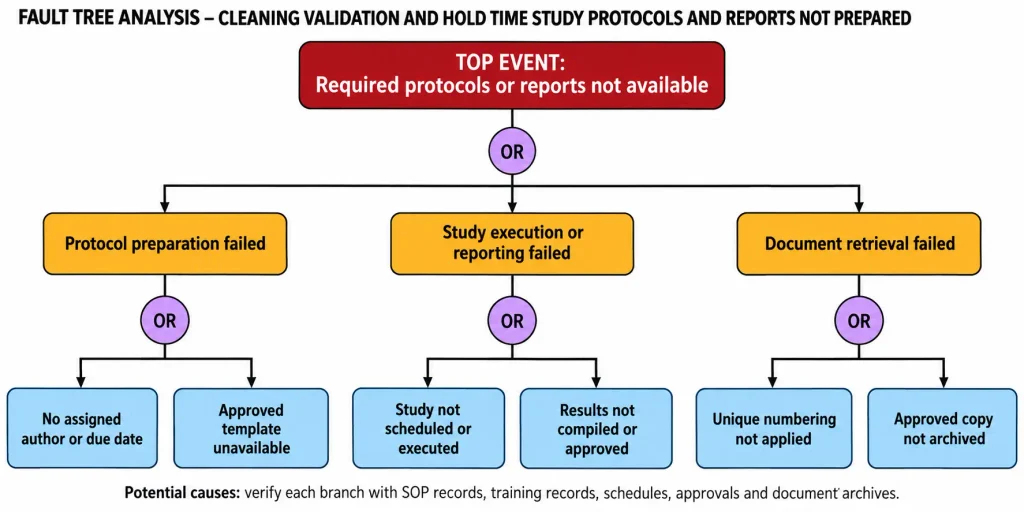
7. Fault Tree Analysis for SOP for Preparation of Cleaning Validation and Hold time study Protocol & reports not performed:
The fault tree examines why Cleaning Validation and Hold-Time Study protocols or reports may be unavailable. The top event can arise through three paths: protocol preparation failure, study execution or reporting failure, and document retrieval failure. Possible contributing events include an unassigned author, missing deadlines or templates, studies that were never scheduled, results that were not compiled or approved, and gaps in numbering or archiving. The OR gates show that any one event on a branch could contribute to the outcome. Investigators should verify each possibility against study schedules, training records, approval histories, document registers, and archives before confirming causes or assigning corrective actions.
8. Pareto Analysis for SOP for Preparation of Cleaning Validation and Hold time study Protocol & reports not performed:
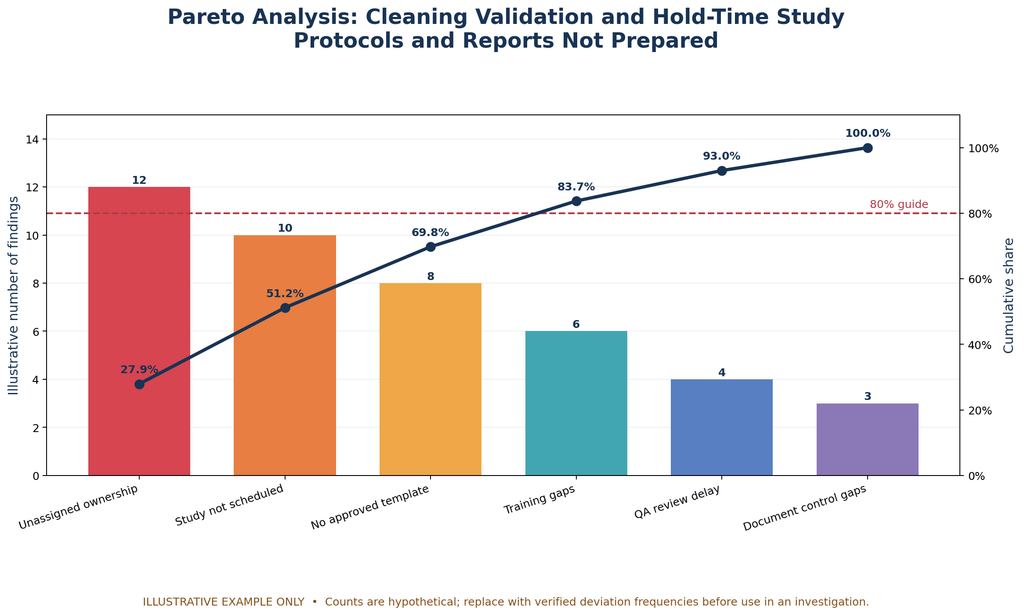
The Pareto chart ranks six potential reasons why Cleaning Validation and Hold-Time Study protocols and reports were not prepared. Unassigned ownership, unscheduled studies, missing approved templates, and training gaps account for approximately 84% of the illustrative findings. QA review delays and document control gaps make up the remainder. The cumulative line shows how addressing the leading causes could resolve most recorded issues. However, the displayed counts are hypothetical and do not establish the actual causes at the site. Investigators should review schedules, responsibilities, training records, approved templates, and document registers, then rebuild the chart using verified deviation data before selecting corrective actions.
9. Corrective Action and Preventive Action:
Observation: Cleaning Validation and Hold-Time Study protocols and reports were not prepared or could not be located.
| Stage | Action | Proposed owner | Evidence |
|---|---|---|---|
| Immediate containment | Identify affected equipment, products, materials, and study periods. Open a deviation and assess whether any current operations rely on unverified cleaning or hold times. Apply appropriate use or release controls pending QA assessment. | QA with QC and Production | Deviation, impact assessment, control records |
| Document investigation | Search controlled archives and electronic records. Distinguish documents that were never prepared from documents that were completed but cannot be retrieved. | QA Document Control | Document register, retrieval record |
| Retrospective assessment | Review relevant batches, cleaning records, hold durations, test results, deviations, and change controls. Assess product quality impact and decide whether additional testing or other action is required. | QA with QC and Production | Approved retrospective assessment |
| Corrective action | Assign study owners and deadlines. Prepare and approve protocols before executing outstanding studies; record results and deviations, then prepare and approve reports. Do not create retrospective protocols as though they were approved before past work. | QC; QA approval | Approved protocols, raw data, reports |
| Preventive action | Review and implement the SOP and approved templates. Add required studies to a tracked validation schedule, train responsible staff, and verify numbering, approval, archiving, and periodic QA follow-up. | QC Head and QA Head | SOP, training records, schedule, document register |
Effectiveness review: At an agreed interval, QA should sample newly required studies and confirm that protocols were approved before execution, reports were completed by their due dates, and all documents can be retrieved. Close the CAPA only after any overdue items and repeat gaps are resolved.
10. Questions and Answers: Cleaning Validation and Hold-Time Study Protocols and Reports:
1. What is the purpose of a study protocol?
A protocol defines the study objective, scope, responsibilities, method, sampling plan, acceptance criteria, and approval requirements before execution.
2. What is the purpose of a study report?
A report presents the observations and results, assesses them against the approved criteria, documents deviations, and states the conclusion.
3. Why is a cleaning validation protocol needed?
It establishes how the cleaning process will be evaluated for removal of relevant residues and contaminants from the specified equipment.
4. Why is a hold-time study protocol needed?
It defines how the proposed holding period and conditions will be assessed against appropriate quality criteria.
5. What should happen if a required protocol was never prepared?
Open a deviation, assess affected operations and products, assign an owner, and prepare an approved protocol before conducting the outstanding study.
6. Can a protocol be written after a study and dated as though it was approved beforehand?
No. Any retrospective assessment must accurately state when the work and documentation occurred.
7. What if the study was performed but its report is missing?
Check whether complete, attributable raw data exist. QA should assess whether a report can be compiled from those records and document any gaps through the deviation process.
8. What if an approved document exists but cannot be found?
Investigate document control and retrieval records, locate the controlled copy, and assess whether any document integrity or compliance gap remains.
9. Who should approve the protocols and reports?
They should be prepared and reviewed by the assigned functions and receive final approval according to the site SOP; the attached SOP assigns final approval to the Head of QA.
10. How can recurrence be prevented?
Maintain approved templates, trained owners, a tracked study schedule, document numbering and archiving controls, and periodic QA review of overdue studies and reports.
11. Reference Guidelines:
| Reference | Relevance to the SOP |
|---|---|
| EU GMP Annex 15: Qualification and Validation | Covers validation planning, approved protocols, predefined acceptance criteria, deviation investigation, reports, and cleaning validation. |
| EU GMP Chapter 4: Documentation | Supports document preparation, approval, control, retention, and traceability. |
| WHO TRS 1019, Annex 3: GMP Guidelines on Validation | Provides general guidance for planning, conducting, and documenting validation activities. |
| WHO TRS 992, Annex 4: General Guidance on Hold-Time Studies | Guides the design of manufacturing hold-time studies, primarily for non-sterile solid dosage forms. |
| FDA: Process Validation—General Principles and Practices | Provides broader lifecycle principles for validation and documented evaluation of results. |