







Brief Description
This SOP describes the procedure for environmental monitoring of the microbiological laboratory using the settle plate exposure method. Its purpose is to monitor viable airborne microbial contamination and help maintain suitable environmental conditions within the laboratory. The Microbiologist/Executive QC is responsible for performing the monitoring, while Manager-QC and Head QA/QC ensure effective implementation.Soyabean Casein Digest Agar plates are prepared, sterilized, poured, solidified and pre-incubated before use. Contamination-free plates are labelled according to the monitoring location, transferred in sterile conditions and exposed at designated sampling points for 2 hours in non-sterile areas. After exposure, plates are incubated first at 20–25°C for three days for fungal growth, followed by 30–35°C for 48 hours for bacterial growth. Colonies are then counted using a colony counter. Monitoring is performed once every month.The SOP identifies monitoring locations including Air Lock-1, Air Lock-2, LAF Room and Pass Box, with the layout illustrated in Annexure-II.
Skip to PDF content1. Flow Diagram:
The flower-shaped flow diagram presents the Environmental Monitoring procedure for the Microbiological Section using the settle plate exposure method in an easy, stepwise format. The process begins with preparation of Soyabean Casein Digest Agar, followed by pouring the sterilized media into Petri plates and allowing them to solidify. The plates are then pre-incubated at 30–35°C for 48 hours and checked for contamination before use.
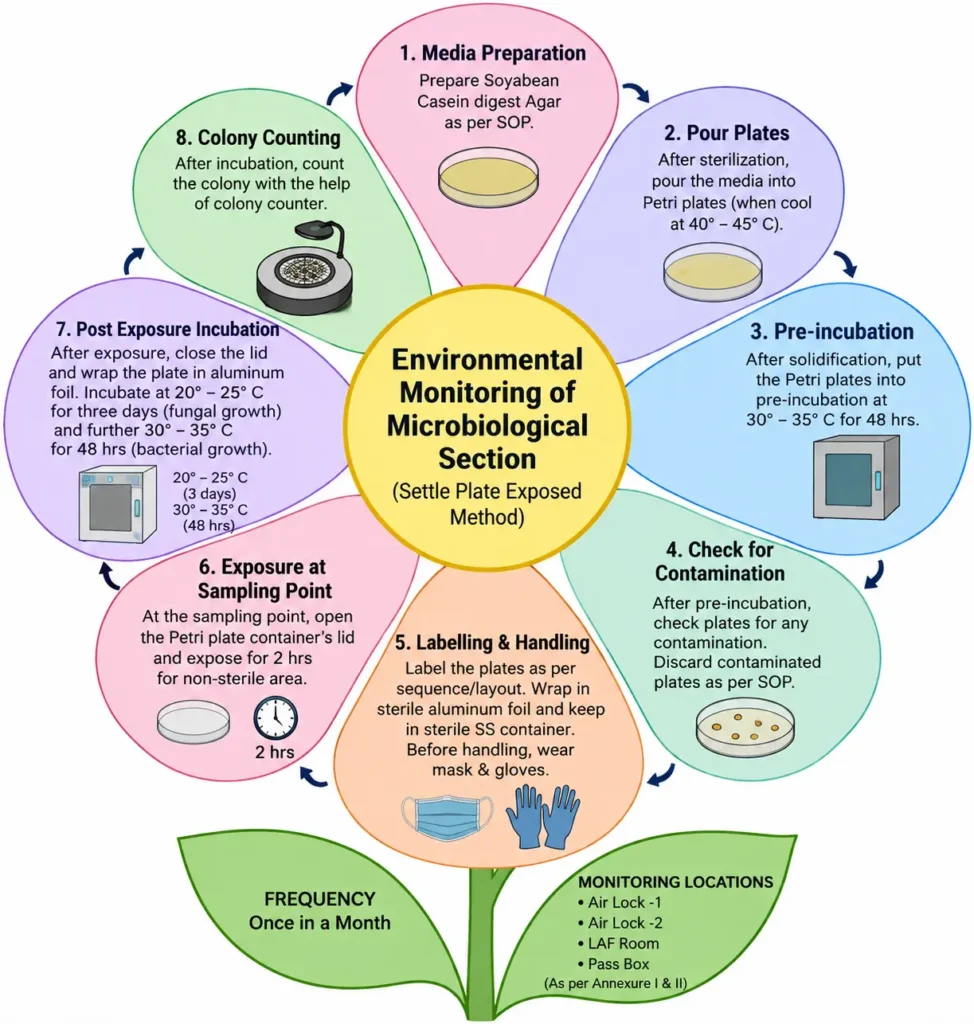
Contamination-free plates are labelled according to the monitoring layout, wrapped in sterile aluminium foil, transferred in a sterile SS container, and handled using mask and gloves. At the sampling point, plates are exposed for 2 hours in the non-sterile area. After exposure, they are incubated at 20–25°C for three days for fungal growth and then at 30–35°C for 48 hours for bacterial growth. Finally, colonies are counted using a colony counter. The SOP specifies a monitoring frequency of once per month.
2. Brainstorming for SOP Failure:
The brainstorming diagram highlights the possible causes of failure in the SOP for Environmental Monitoring of the Microbiological Section. It is presented as a pharmaceutical training session where QA, QC, microbiology, and production personnel discuss potential weak points in the monitoring process.
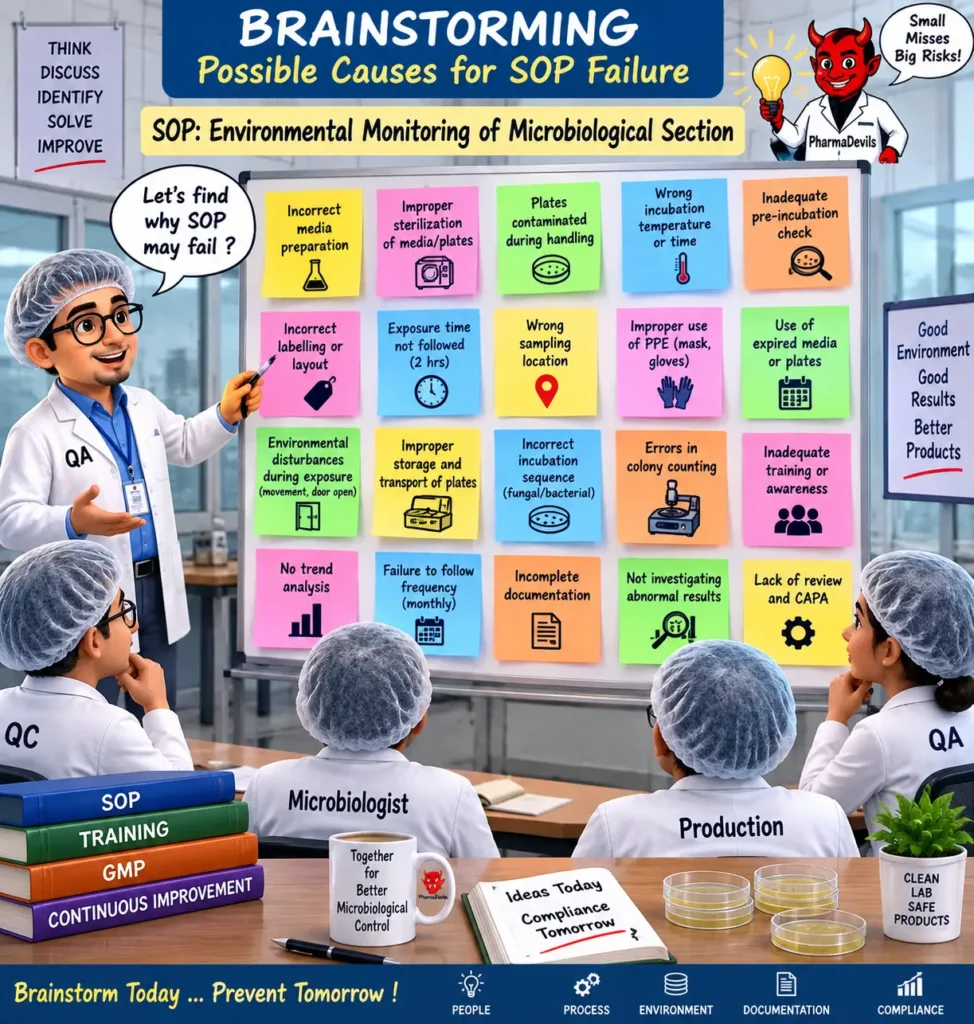
The sticky notes identify causes such as incorrect media preparation, improper sterilization, contaminated plates, incorrect incubation temperature or time, inadequate pre-incubation checks, wrong labelling, incorrect sampling location, failure to maintain the 2-hour exposure time, improper PPE use, expired media or plates, and environmental disturbances during exposure. Other possible causes include improper storage and transport of plates, incorrect fungal/bacterial incubation sequence, colony counting errors, inadequate training, poor trend analysis, missed monthly monitoring frequency, incomplete documentation, failure to investigate abnormal results, and lack of review or CAPA.The diagram promotes teamwork, training, compliance, and continuous improvement to prevent environmental monitoring failures.
3. 5-Why Analysis for SOP Failure:
The 5-Why Analysis diagram explains the possible root cause of failure in the Environmental Monitoring SOP for the Microbiological Section. The central problem is considered as high microbial count or out-of-limit environmental monitoring results. The first Why identifies contamination of settle plates during monitoring. The second Why links this contamination to incorrect exposure time or improper handling of plates. The third Why indicates that personnel may not have followed the required procedure due to inadequate training. The fourth Why identifies failure to conduct training periodically, while the fifth Why reaches the potential root cause: lack of an effective training planning, tracking, and review system.
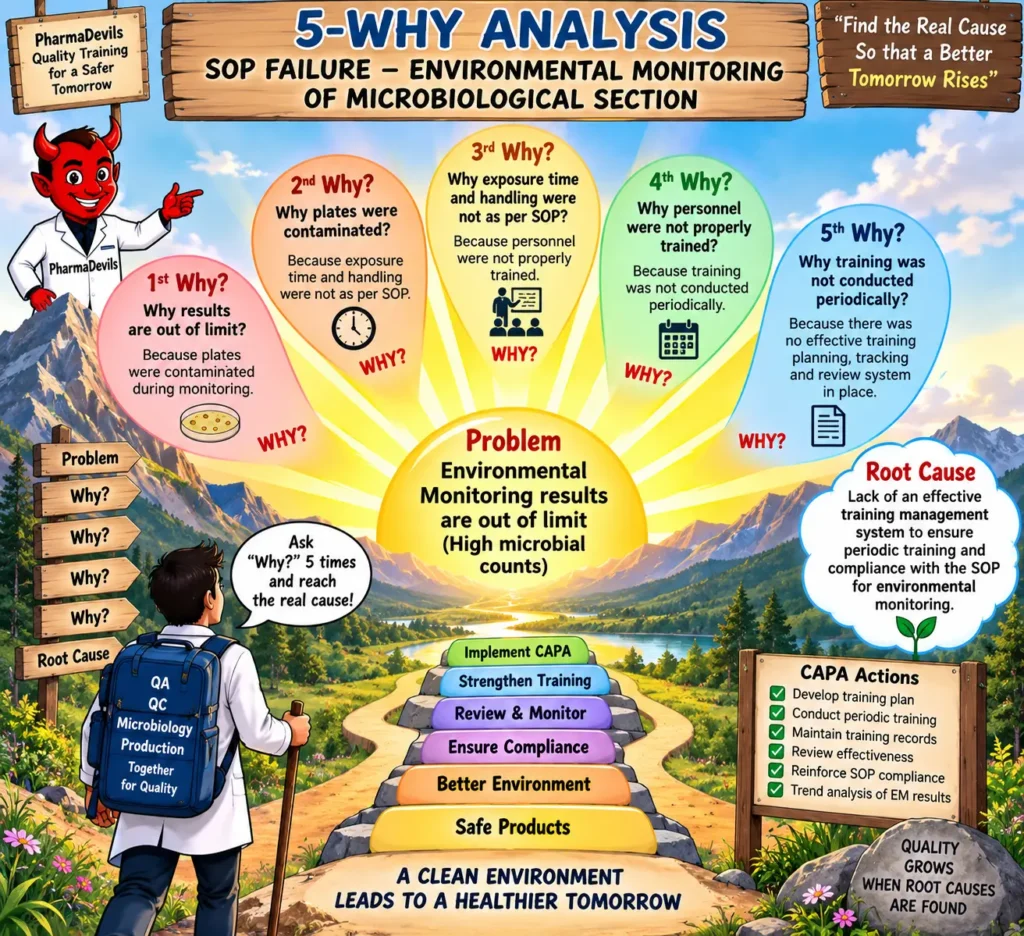
The sunrise design symbolizes identification of the root cause and improvement toward better GMP compliance. Recommended CAPA includes periodic training, maintenance of training records, effectiveness evaluation, reinforcement of SOP requirements, and trend review of environmental monitoring results. The SOP itself specifies controlled plate handling, a 2-hour exposure period, defined incubation conditions, and microbiologist training.
4. Fishbone Analysis for SOP Failure:
The Fishbone Analysis diagram identifies potential causes that may lead to failure of the Environmental Monitoring SOP for the Microbiological Section. The main problem is considered as out-of-limit microbial count during environmental monitoring. The causes are organized into major categories such as Man, Method, Machine, Material, Environment, and Measurement.
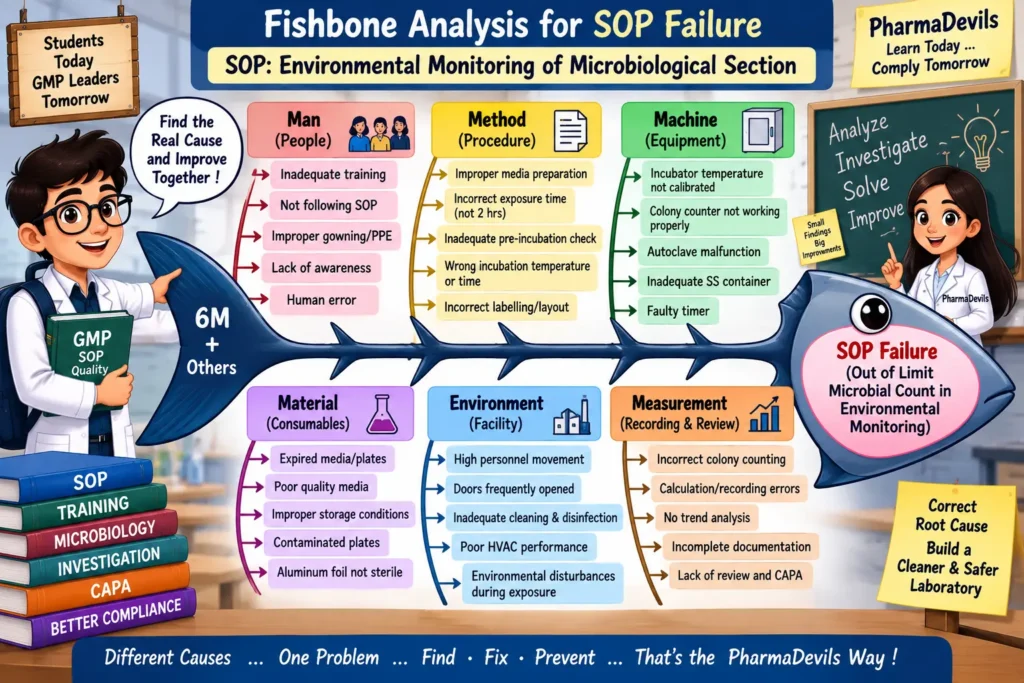
Under Man, possible causes include inadequate training, failure to follow the SOP, improper PPE, lack of awareness, and human error. Method-related causes include incorrect media preparation, improper exposure time, inadequate pre-incubation checks, wrong incubation conditions, and incorrect labelling. Machine causes may involve incubator, colony counter, autoclave, timer, or container problems. Material causes include expired or contaminated media and plates. Environment factors include excessive personnel movement, frequent door opening, inadequate cleaning, and poor HVAC conditions. Measurement issues may include colony-counting errors, incomplete records, lack of trend analysis, and inadequate CAPA review.The diagram helps systematically identify root causes and supports corrective and preventive actions to improve SOP compliance.
5. Fault Tree Analysis for SOP Failure:
The Fault Tree Analysis (FTA) diagram presents a systematic evaluation of possible causes that can lead to failure of the Environmental Monitoring SOP for the Microbiological Section. The top event is defined as SOP failure resulting in out-of-limit microbial counts. The potential causes are organized into major branches including Personnel Competence, SOP/Method, Equipment or Instrument, Material, Environmental Factors, and Documentation & Review.
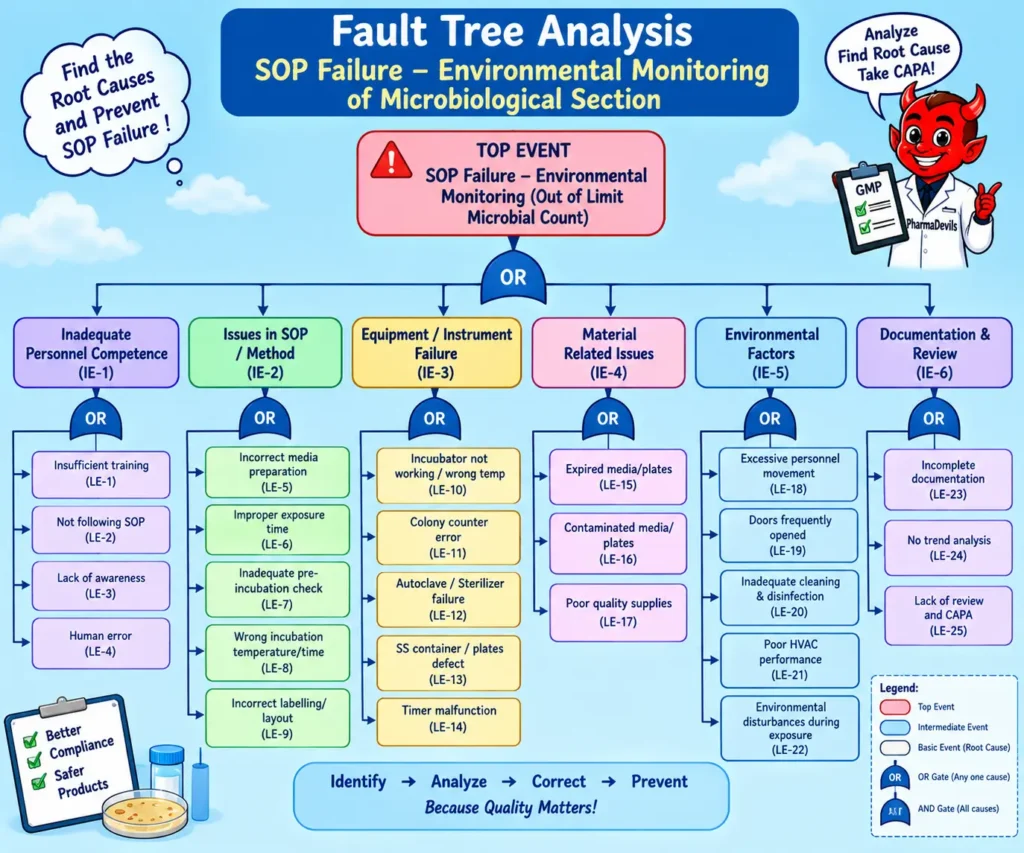
Possible contributing events include inadequate training, failure to follow the SOP, incorrect media preparation, improper exposure time, inadequate pre-incubation checks, wrong incubation conditions, equipment malfunction, contaminated or expired media, excessive personnel movement, inadequate cleaning, and incomplete documentation. The original SOP requires controlled plate preparation and handling, a defined 2-hour exposure period, specified incubation conditions, colony counting, and trained microbiology personnel.By breaking the main failure into intermediate and basic events, FTA helps identify probable root causes, prioritize investigation, implement appropriate CAPA, and strengthen environmental monitoring compliance.
Questions & Answers – Environmental Monitoring of Microbiological Section
Q1. What is the objective of this SOP?
Answer: To describe the procedure for environmental monitoring in the microbiological laboratory.
Q2. Who is responsible for execution of this SOP?
Answer: The Microbiologist/Executive QC is responsible for execution of the SOP.
Q3. Which environmental monitoring method is described in the SOP?
Answer: The settle plate exposed method.
Q4. Which culture medium is used for settle plates?
Answer: Soyabean Casein Digest Agar.
Q5. At what temperature is the sterilized media poured into Petri plates?
Answer: When the media has cooled to approximately 40–45°C.
Q6. What is the pre-incubation condition for the plates?
Answer: The plates are pre-incubated at 30–35°C for 48 hours.
Q7. What should be done if contamination is observed during pre-incubation?
Answer: The contaminated plate should be discarded as per the applicable SOP.
Q8. How should the plates be prepared before exposure?
Answer: Plates should be labelled according to sequence/layout, wrapped in sterile aluminium foil, and kept in a sterile SS container.
Q9. What PPE is required before handling the settle plates?
Answer: Mask and gloves.
Q10. What is the settle plate exposure time for a non-sterile area?
Answer: 2 hours.
Q11. What should be done after completion of the exposure time?
Answer: Close the plate lid and wrap the plate in aluminium foil.
Q12. What are the incubation conditions after exposure?
Answer: Incubate at 20–25°C for three days for fungal growth, followed by 30–35°C for 48 hours for bacterial growth.
Q13. How are microbial colonies counted after incubation?
Answer: Colonies are counted with the help of a colony counter.
Q14. What is the frequency of environmental monitoring in this SOP?
Answer: Once in a month.
Q15. Who is the trainer specified in the SOP?
Answer: Head QA/QC.
Q16. Who are the trainees?
Answer: Microbiologists.
Q17. What is the specified training duration?
Answer: One hour.
Q18. Which locations are listed for microbiological monitoring by settle plate?
Answer: Air Lock-1, Air Lock-2, LAF Room, and Pass Box.
Q19. Where should the settle plate be placed in Air Lock-1 and Air Lock-2?
Answer: In the middle of the room.
Q20. What locations are specified inside the LAF Room?
Answer: Near the riser, near the AHU, and at the back side of the LAF.