







1. Introduction – SOP for Fill Value Measurement:
The SOP for Fill Value Measurement describes the standardized procedure for checking and controlling the fill volume of liquid products during pharmaceutical filling operations. Its purpose is to ensure that each filled container contains the required quantity of product within the specified lower and upper volume limits. The SOP assigns responsibility to Production personnel for execution and to senior Production and QA/QC personnel for effective implementation.The procedure requires the filling machine to be set according to the specified fill-volume range, followed by periodic verification using an appropriate calibrated glass measuring cylinder. Fill volume is checked from consecutive units and recorded in the Batch Packing Record (BPR) at a frequency of every one hour or as defined in the BPR. Proper meniscus reading at eye level, cleanliness of the measuring cylinder, documentation of observations, and corrective adjustment of the filling machine when deviations occur help maintain accurate filling, batch consistency, product quality, and GMP compliance.
Skip to PDF content2. Flow Diagram – SOP for Fill Value Measurement:
The SOP for Fill Value Measurement provides a controlled procedure for verifying the quantity of liquid filled into pharmaceutical containers during the filling and packing process. The filling machine is first set according to the specified fill-volume limits, and an appropriate calibrated measuring cylinder is selected based on the required volume.
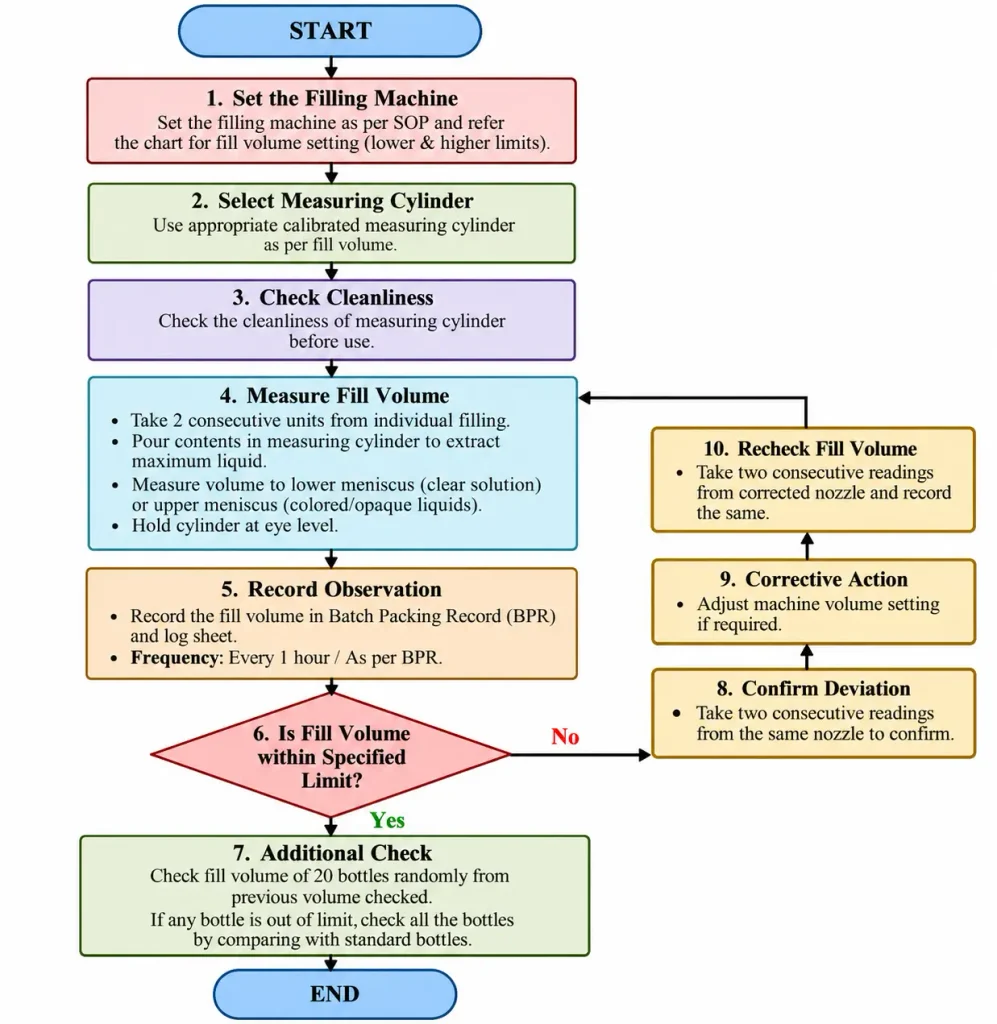
Two consecutive filled units are checked, and the liquid volume is measured by observing the correct meniscus at eye level. For clear solutions, the lower meniscus is considered, while for colored or opaque liquids, the upper meniscus is used. The observations are recorded in the Batch Packing Record (BPR) and log sheet at the defined frequency. If the fill volume is outside the specified limit, the deviation is confirmed by additional readings, the machine setting is corrected where required, and the fill volume is rechecked. Random verification of additional bottles is also performed to ensure continued filling accuracy and process consistency.
3. Benefits of Following SOP for Fill Value Measurement:
Following the SOP for Fill Value Measurement helps ensure that each filled container contains the required quantity of product within the specified limits. Consistent fill-volume checks support product uniformity, help prevent underfilling or overfilling, and contribute to reliable product quality and patient safety.
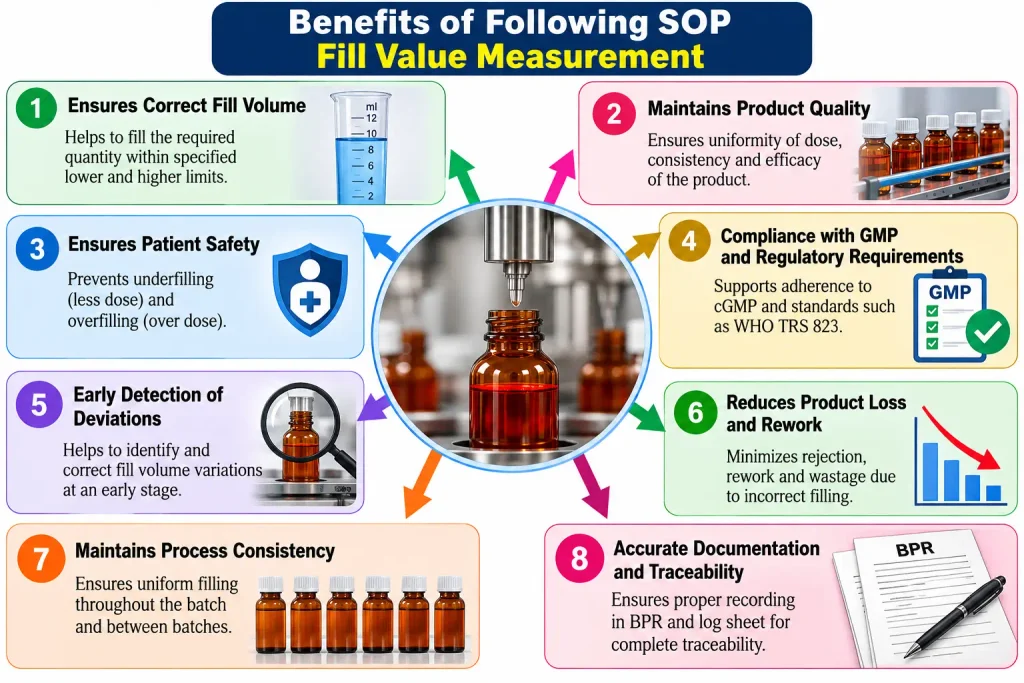
The SOP also promotes early identification of fill-volume deviations so that the filling-machine setting can be corrected promptly. This reduces the risk of rejection, product loss, rework, and unnecessary wastage. Regular verification further helps maintain consistent filling performance throughout the batch. Proper use of calibrated measuring cylinders, correct meniscus observation, and recording of results in the Batch Packing Record (BPR) and log sheet improve documentation, traceability, and process control. Overall, adherence to this SOP strengthens GMP compliance, operational consistency, accountability, and effective control of pharmaceutical liquid-filling activities.
4. Brainstorming for SOP Failure – Fill Value Measurement:
The Brainstorming Analysis for SOP Failure – Fill Value Measurement identifies potential causes that may lead to incorrect fill-volume measurement, inaccurate recording, or loss of control during pharmaceutical filling operations. The major areas considered include filling machine condition, measuring cylinder suitability, operator practices, product characteristics, measurement method, documentation, sampling, environmental conditions, calibration, maintenance, and process control.
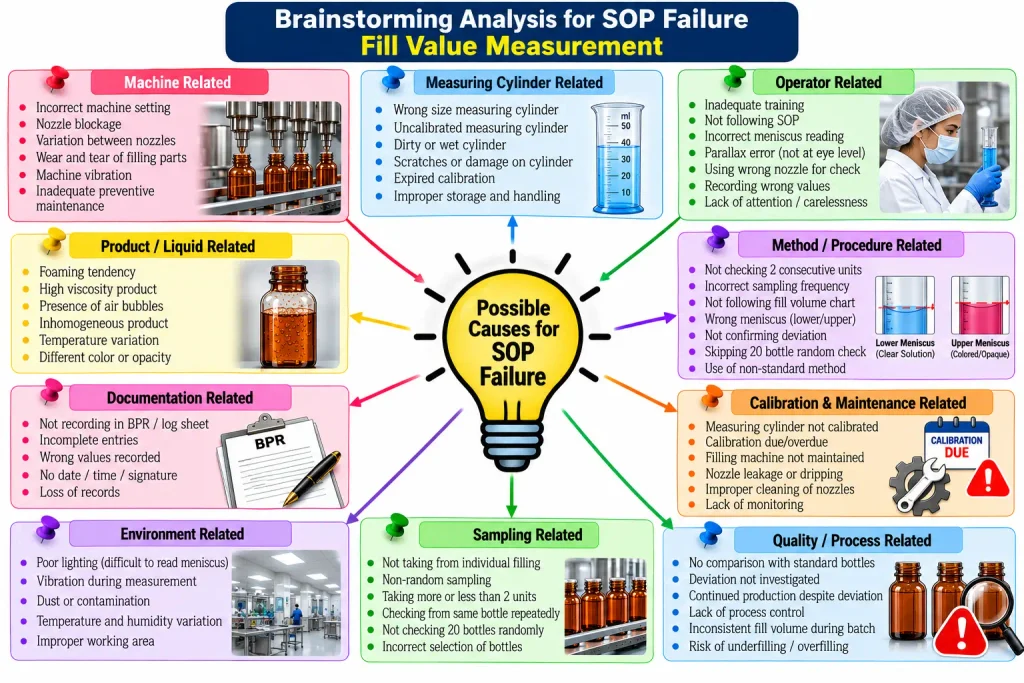
Potential failures may arise from incorrect machine settings, nozzle variation, use of an unsuitable or uncalibrated measuring cylinder, poor cleanliness, improper meniscus reading, parallax error, incorrect sampling frequency, or failure to take the required consecutive units. The SOP specifically requires use of an appropriate calibrated der, correct meniscus observation at eye level, defined sampling, and recording in the BPR and log sheet. The brainstorming exercise helps identify such possible failure points in advance so that suitable controls, training, calibration, maintenance, documentation practices, and corrective actions can be strengthened to maintain consistent fill-volume performance.
5. 5-Why Analysis for SOP Failure – Fill Value Measurement:
The 5-Why Analysis for SOP Failure – Fill Value Measurement is used to identify the underlying causes of fill-volume failures such as underfilling, overfilling, inaccurate measurement, and variation between filled units. The analysis traces each problem through a sequence of “Why” questions until the probable root cause is identified.
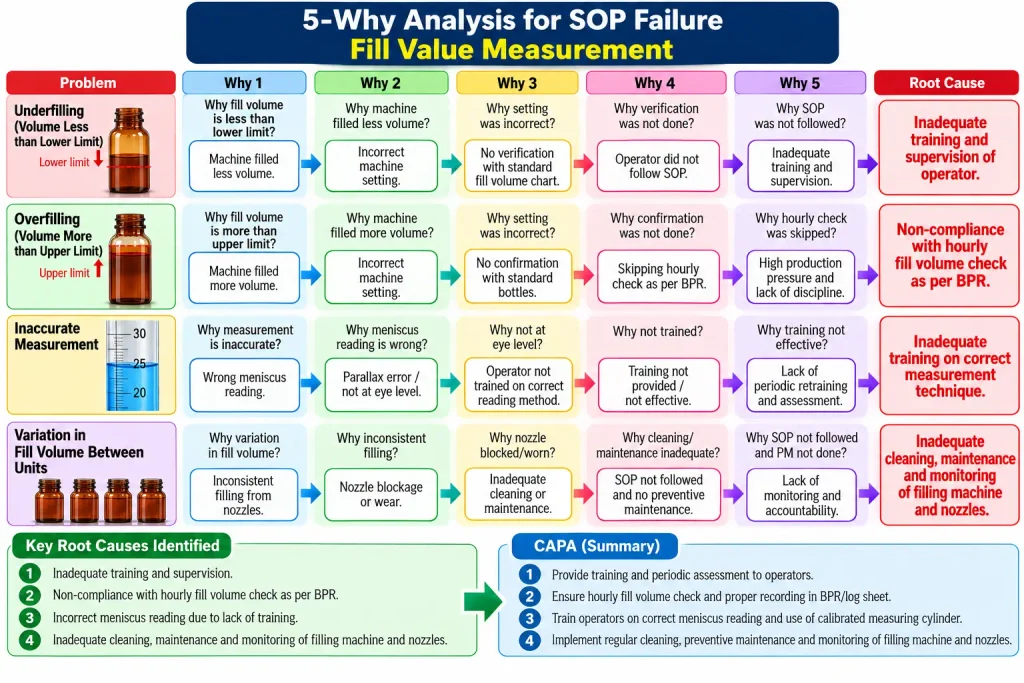
Typical causes may include incorrect filling-machine settings, failure to verify the machine setting against the approved fill-volume chart, skipping the required periodic fill-volume check, incorrect meniscus reading, poor operator training, nozzle blockage, and inadequate cleaning or preventive maintenance. The SOP requires fill-volume verification using an appropriate calibrated measuring cylinder, correct observation of the meniscus at eye level, recording in the BPR/log sheet, and confirmation of deviations through consecutive readings.The 5-Why approach helps determine the root cause so that focused CAPA, retraining, better supervision, maintenance, and stronger process monitoring can be implemented to prevent recurrence.
6. Fishbone Analysis for SOP Failure – Fill Value Measurement:
The Fishbone Analysis for SOP Failure – Fill Value Measurement identifies the major categories of causes that can contribute to incorrect or inconsistent fill-volume measurement during pharmaceutical filling operations. The analysis considers factors related to Man, Machine, Method, Material, Measurement, Environment, Management, Maintenance, Documentation, and Process Control.
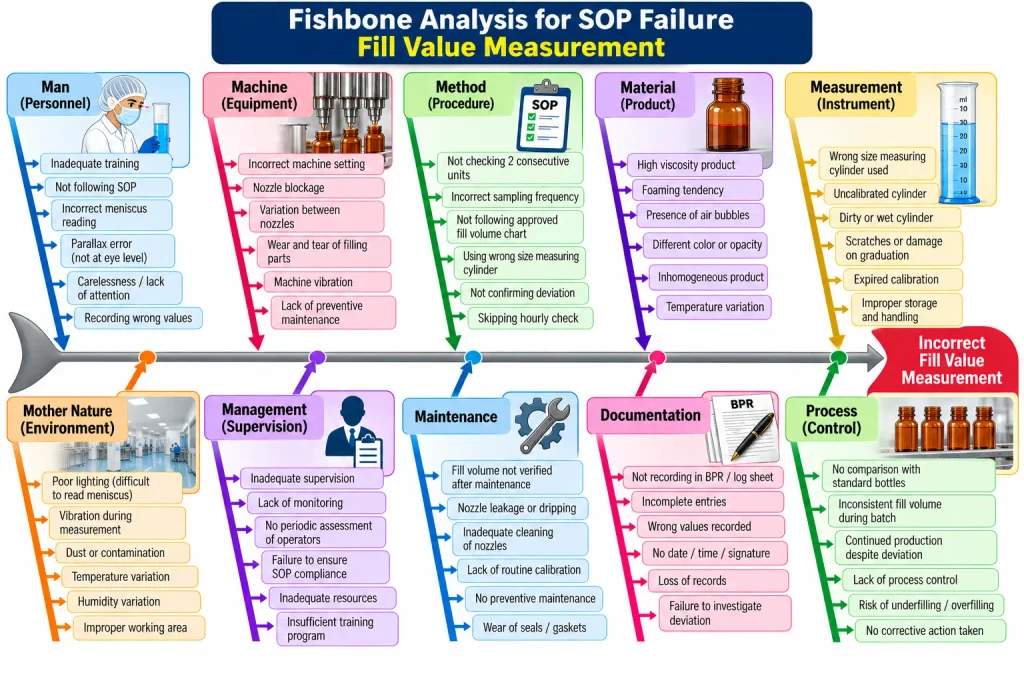
Potential causes include inadequate operator training, incorrect machine settings, nozzle blockage, improper sampling, wrong measuring-cylinder selection, incorrect meniscus reading, poor lighting, incomplete BPR entries, lack of preventive maintenance, and failure to investigate fill-volume deviations. The SOP requires correct machine setting, use of an appropriate calibrated measuring cylinder, checking of consecutive units, correct meniscus observation at eye level, and proper recording of results.This Fishbone Analysis helps organize possible causes systematically so that the most significant contributors can be investigated and suitable corrective and preventive actions can be implemented to improve fill-volume accuracy and process consistency.
7. Fault Tree Analysis for SOP Failure – Fill Value Measurement:
The Fault Tree Analysis for SOP Failure – Fill Value Measurement systematically identifies the possible causes that can lead to the top event of incorrect fill value measurement. The analysis breaks the failure into major contributing areas such as actual fill volume not matching the set value, incorrect measurement technique, improper sampling or method, and inadequate recording or follow-up.
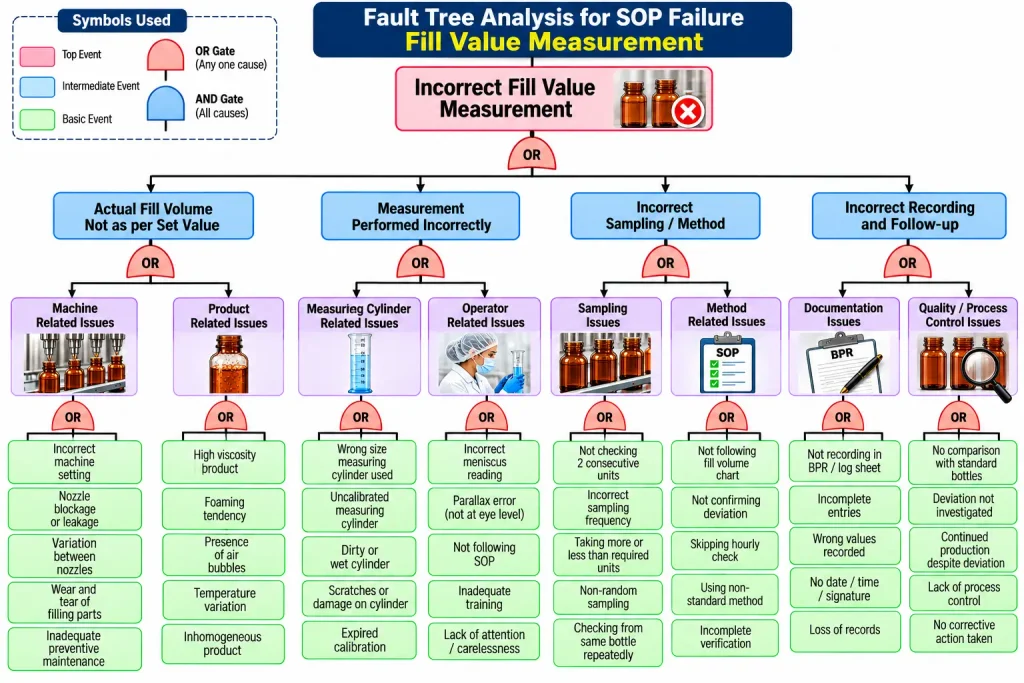
Potential causes include incorrect machine settings, nozzle blockage, variation between filling nozzles, product foaming, air bubbles, use of an unsuitable or uncalibrated measuring cylinder, incorrect meniscus reading, parallax error, failure to check two consecutive units, incorrect sampling frequency, incomplete BPR entries, and failure to investigate deviations. The SOP requires proper machine setting, use of an appropriate calibrated measuring cylinder, measurement at eye level, periodic checks, and documented corrective action when fill-volume deviations are observed.This analysis helps trace the failure back to its basic causes so that effective controls and CAPA can be established to prevent recurrence.
8. Impact Assessment for SOP Failure – Fill Value Measurement:
The Impact Assessment for SOP Failure – Fill Value Measurement evaluates the consequences that may arise when the approved fill-value measurement procedure is not followed correctly. Failure of this SOP can directly affect product quality, patient safety, regulatory compliance, manufacturing operations, documentation, and business performance.
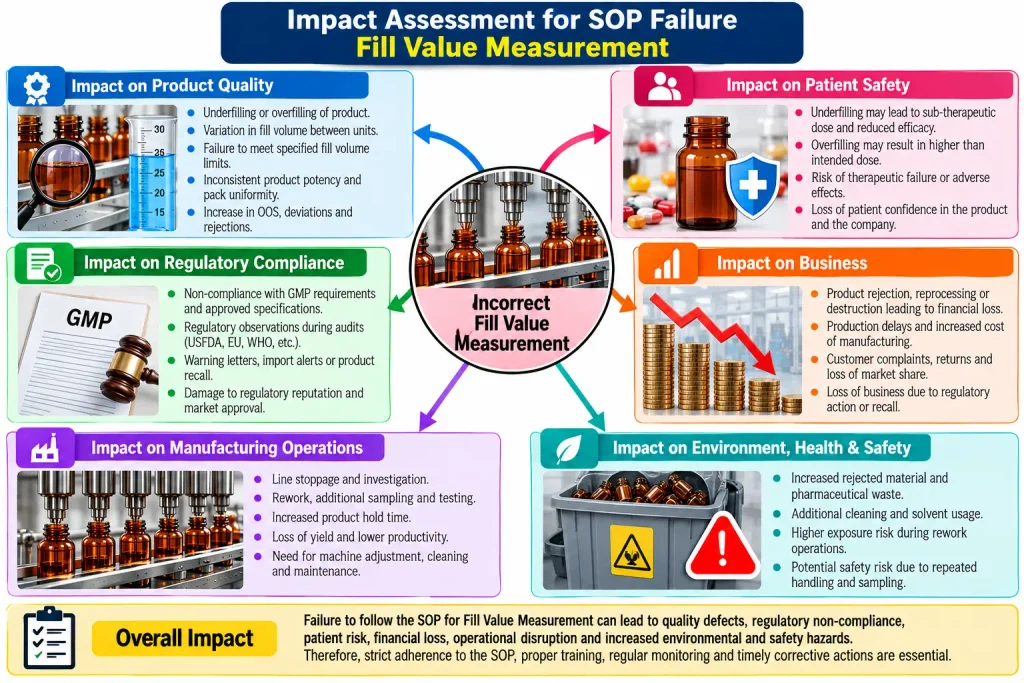
Incorrect fill volume may result in underfilling or overfilling, variation between containers, rejection of filled units, additional checking, rework, machine adjustment, and production delays. The SOP requires fill-volume verification using calibrated measuring cylinders, correct meniscus observation, periodic checks, and confirmation of any deviation through additional readings and corrective adjustment of the filling machine. Poor compliance may also lead to incomplete BPR records, investigation requirements, increased wastage, and loss of process consistency. Therefore, proper operator training, adherence to the specified measurement method, timely documentation, calibration, monitoring, and corrective action are essential to minimize the overall impact of fill-value measurement failures.
9. CAPA for SOP Failure – Fill Value Measurement:
The CAPA for SOP Failure – Fill Value Measurement is designed to correct immediate fill-volume problems and prevent their recurrence through systematic corrective and preventive actions. Corrective actions may include stopping and segregating affected production, rechecking fill volume with a calibrated measuring cylinder, verifying machine settings, inspecting filling nozzles, confirming calibration status, documenting observations, and investigating deviations.
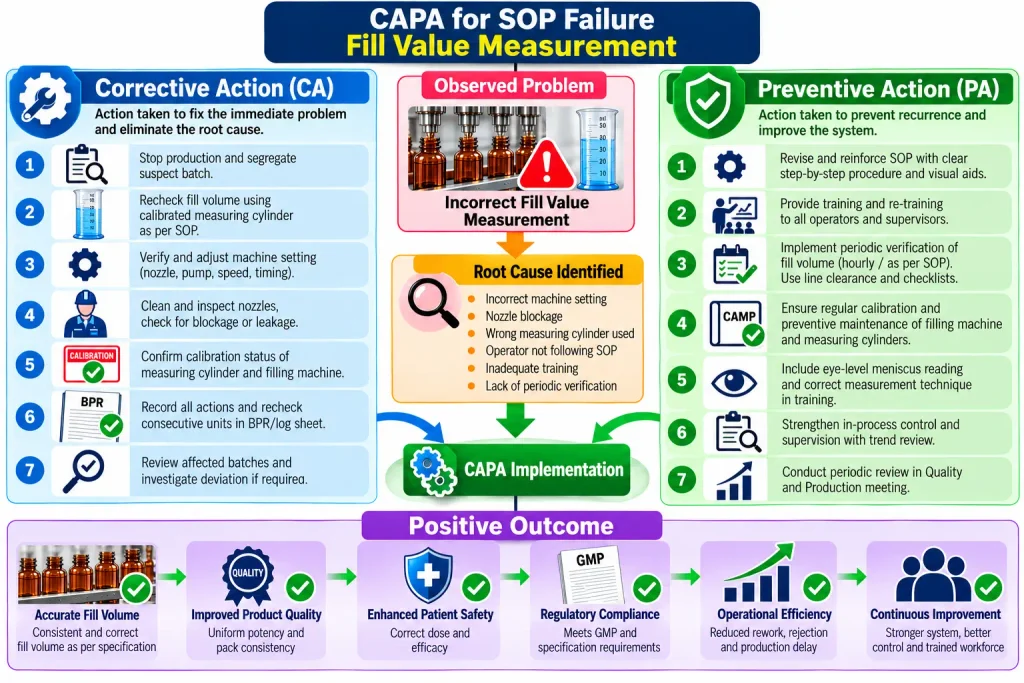
Preventive actions focus on strengthening the overall system through operator training, periodic retraining, routine fill-volume verification, calibration, preventive maintenance, correct meniscus-reading technique, improved supervision, and regular trend review. The SOP requires periodic fill-volume checks, proper measurement at eye level, documentation in the BPR and log sheet, and corrective adjustment when deviations are confirmed. Effective CAPA implementation supports accurate fill volume, improved product quality, enhanced patient safety, GMP compliance, reduced rejection and rework, and continuous improvement of the filling process.
Question & Answer – SOP for Fill Value Measurement:
- What is the objective of the SOP for Fill Value Measurement?
The objective is to lay down a procedure for fill value measurement. - Who is responsible for execution of this SOP?
Concerned Production personnel and the Production Chemist are responsible for execution of the SOP. - Who is responsible for effective implementation of the SOP?
The Senior Manager–Production and Head–QA/QC are responsible for effective implementation. - How should the filling machine be set before fill-value measurement?
The filling machine should be set as per the SOP and according to the specified fill-volume setting chart. - How many consecutive units are checked for fill volume?
Two consecutive units from individual filling are checked. - Which instrument is used for fill-volume measurement?
A specified calibrated glass measuring cylinder of appropriate capacity is used. - What is the frequency of fill-volume checking?
Fill volume is checked every one hour or as specified in the Batch Packing Record. - What should be checked before using the measuring cylinder?
The cleanliness of the measuring cylinder should be checked before use. - How is the volume of a clear solution measured?
For a clear solution, the volume is measured at the lower meniscus level. - How is the volume of colored or opaque liquid measured?
For colored or opaque liquids, the volume is measured at the upper meniscus level. - At what position should the measuring cylinder be observed?
The measuring cylinder should be held so that the meniscus is at eye level. - Where should fill-volume observations be recorded?
Observations should be recorded in the Batch Packing Record and log sheet. - What should be done if fill volume is found outside the specified limit?
The deviation should be confirmed by taking two consecutive readings from the same nozzle. - What corrective action is taken after confirming a fill-volume deviation?
The machine volume setting should be adjusted if required, and the corrected nozzle should be rechecked with two consecutive readings. - What additional verification is required after fill-volume checking?
Fill volume of 20 bottles should be checked randomly from the previously checked volume. - What should be done if any bottle is found outside the limit during the 20-bottle check?
All bottles should be checked by comparison with standard bottles. - What reference is mentioned in the SOP?
The SOP refers to WHO Technical Report Series 823. - Why is fill-value measurement important?
It helps verify that the filling operation remains within the defined lower and upper fill-volume limits and provides documented control of the filling process.
Reference Guideline – SOP for Fill Value Measurement:
WHO Technical Report Series (TRS) No. 823 – World Health Organization (WHO).