







Brief Description
The SOP for Good Chromatographic Practice establishes standardized requirements for performing HPLC analysis in the Quality Control laboratory to ensure reliable, consistent, and compliant chromatographic results. It defines responsibilities for execution, review, and effective implementation of chromatographic activities and describes chromatography as a separation technique based on differential partitioning between mobile and stationary phases. The procedure requires analysts to verify instrument operating parameters, identify analytical columns, prepare fresh buffers, ensure adequate mobile phase and washing solvents, purge solvent reservoirs, check for column leakage, and confirm absence of air bubbles and abnormal pressure fluctuations. System suitability parameters such as resolution, tailing factor, theoretical plates, and retention time must meet predefined acceptance criteria before routine analysis proceeds. The SOP also incorporates controlled checklists for HPLC readiness and chromatographic preparation, a column usage logbook, and a system suitability format covering column efficiency, tailing, resolution, retention time, area RSD, and similarity factor. Overall, the SOP supports accurate chromatographic analysis, equipment control, traceability, data reliability, and consistent QC laboratory practices.
Skip to PDF content1. Flow Diagram:
The flow diagram illustrates the sequence to be followed for Good Chromatographic Practice using HPLC. The process begins with review of the approved SOP and analytical method, followed by preparation of fresh mobile phase, buffer, standards, samples, and other required solutions. Before analysis, the HPLC system is checked for readiness, including sufficient solvent levels, clean filters, proper purging, absence of air bubbles, stable system pressure, proper vial placement, and freedom from leakage. These controls are consistent with the SOP requirements.
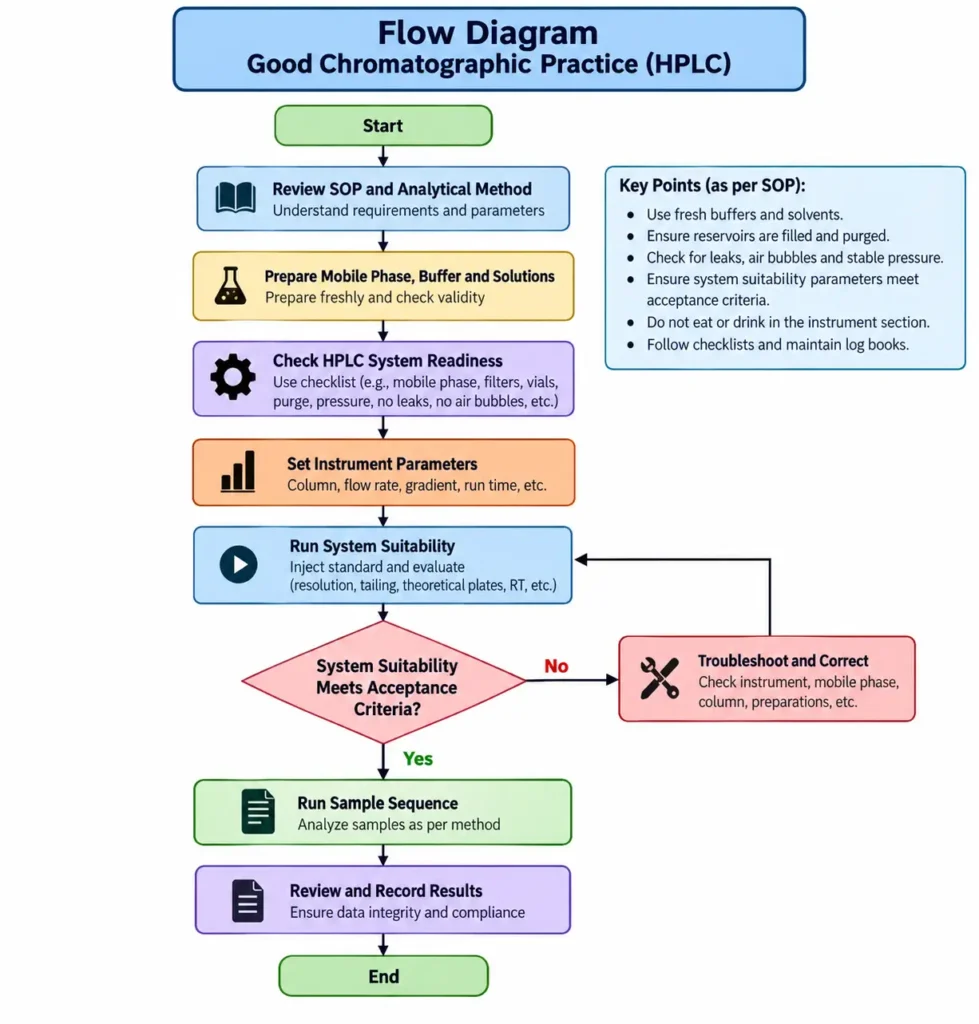
After setting instrument parameters such as column, flow rate, wavelength, injection volume, run time, and temperature, system suitability is performed. Parameters such as column efficiency, tailing factor, resolution, retention time, area RSD, and similarity factor are evaluated. If system suitability meets acceptance criteria, the sample sequence is executed and results are reviewed and recorded. If criteria are not met, troubleshooting and corrective actions are performed before repeating system suitability. This flow helps ensure consistent HPLC performance, reliable results, proper documentation, and controlled chromatographic analysis.
2. Brainstorming for SOP Failure:
The brainstorming diagram presents the major potential reasons for SOP failure in a pharmaceutical manufacturing area using a sticky-note format. The central problem, “SOP Failure in MFG Area,” is surrounded by possible contributing factors related to people, procedures, supervision, equipment, documentation, communication, and work environment.
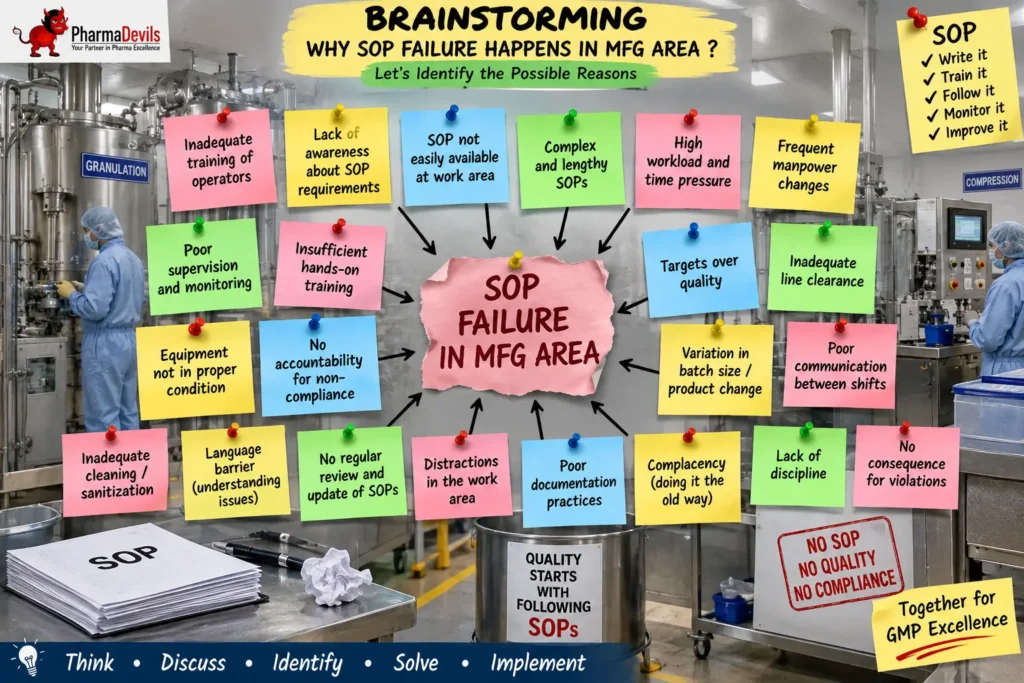
Key causes highlighted include inadequate operator training, poor SOP awareness, difficult or lengthy SOPs, unavailability of SOPs at the workplace, high workload, frequent manpower changes, weak supervision, poor line clearance, equipment problems, inadequate cleaning and sanitization, communication gaps between shifts, poor documentation practices, language barriers, complacency, distractions, lack of discipline, and insufficient accountability. The diagram is intended to support a structured brainstorming session during deviation or investigation activities. It encourages the investigation team to identify relevant causes, collect evidence, determine the most probable root cause, and establish suitable CAPA, retraining, monitoring, and SOP improvement measures. The overall message emphasizes that consistent SOP compliance is essential for GMP, product quality, operational control, and regulatory compliance.
3. 5-Why Analysis for SOP Failure:
The 5-Why diagram investigates the underlying causes of SOP failure in the pharmaceutical manufacturing area. It begins with the problem that operators did not follow the approved SOP and progressively examines why the deviation occurred.
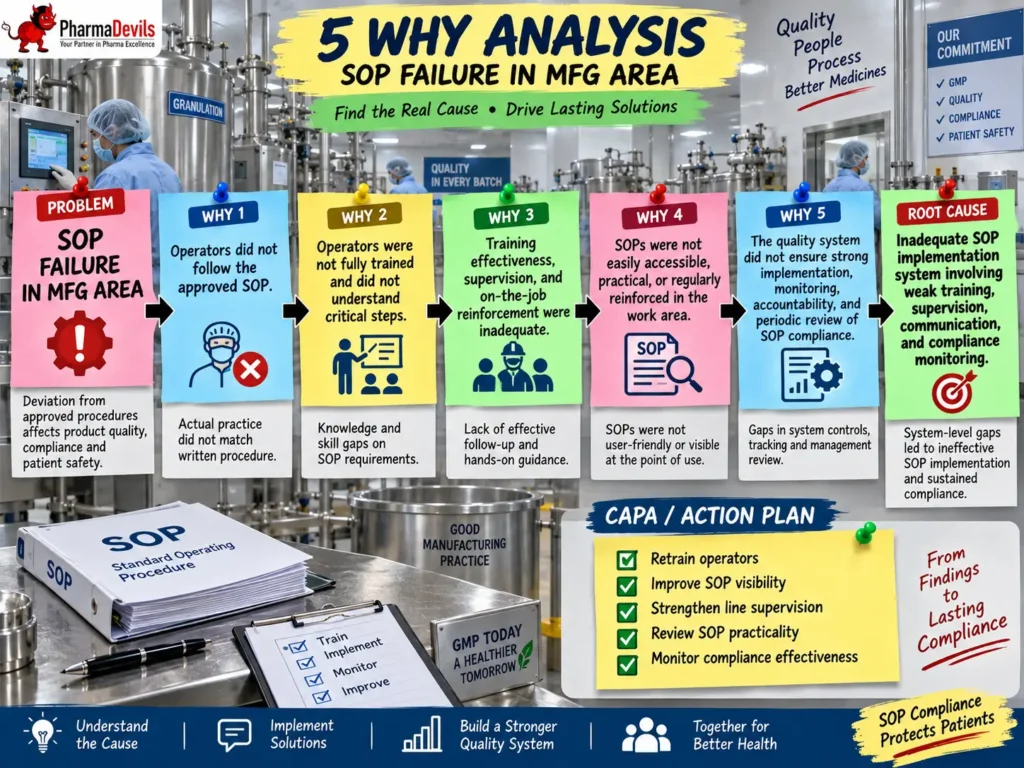
The analysis identifies inadequate understanding of critical SOP steps, insufficient training, weak supervision and on-the-job reinforcement, poor SOP accessibility or practicality, and inadequate quality-system monitoring as contributing factors. The final root cause is linked to an ineffective SOP implementation system, involving gaps in training effectiveness, supervision, communication, accountability, and routine compliance monitoring. The diagram also highlights suitable CAPA actions, including retraining operators, improving SOP visibility at the point of use, strengthening line supervision, reviewing SOP practicality, and periodically monitoring compliance effectiveness. Overall, the 5-Why approach helps move the investigation beyond individual operator error and identifies system-level weaknesses that require corrective and preventive action to achieve sustainable GMP compliance.
3. Fishbone Analysis for SOP Failure:
The Fishbone Analysis diagram systematically identifies the potential causes of SOP failure in a pharmaceutical manufacturing area. The causes are grouped into six major categories: Man (People), Method, Machine/Equipment, Material/Documents, Environment, and Management/Monitoring.
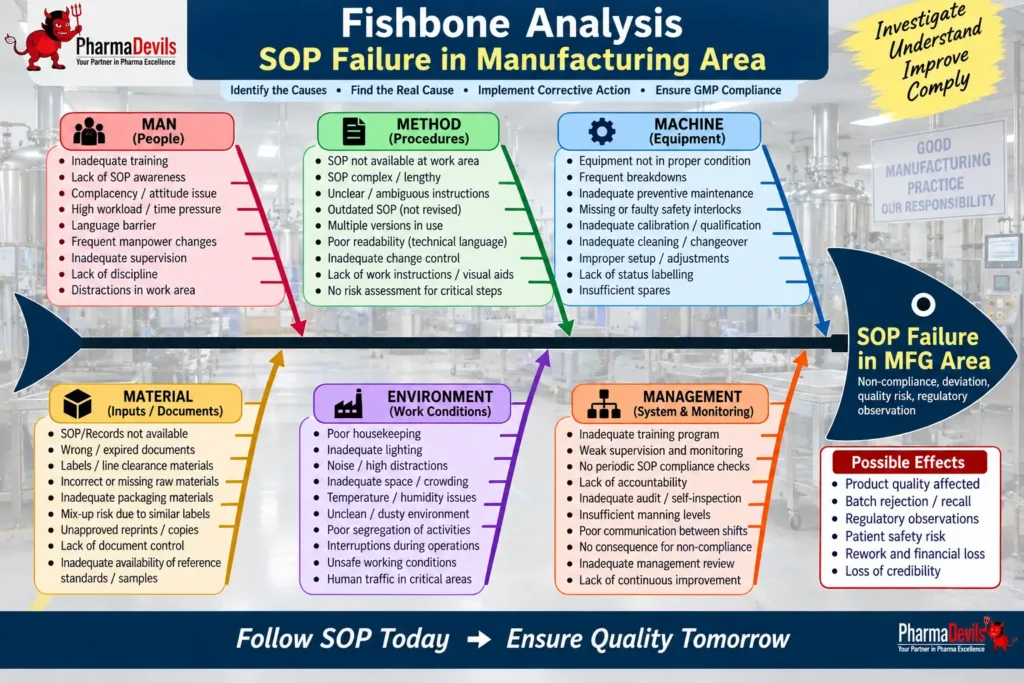
The analysis highlights factors such as inadequate training, lack of SOP awareness, language barriers, complacency, complex or impractical procedures, poor line clearance, weak shift handover, equipment condition issues, maintenance gaps, outdated or unavailable SOP copies, incomplete documentation, high workload, time pressure, housekeeping problems, inadequate supervision, and weak compliance monitoring. The probable root cause is identified as a weak SOP implementation system with gaps in training, accessibility, supervision, documentation, accountability, and compliance monitoring. Recommended CAPA includes retraining personnel, simplifying SOPs, ensuring current SOP availability at the point of use, strengthening supervision, improving compliance monitoring, and verifying CAPA effectiveness. Overall, the Fishbone Analysis supports structured root-cause investigation and helps establish sustainable actions to improve GMP compliance, process consistency, and product quality.
4. Fault Tree Analysis for SOP Failure:
The Fault Tree Analysis (FTA) diagram evaluates SOP failure in the pharmaceutical manufacturing area by breaking the top event into major contributing branches and basic causes. The analysis groups the potential failures into four main areas: personnel non-compliance, unsuitable or unavailable SOPs, weak implementation and supervision, and work-environment or operational constraints.
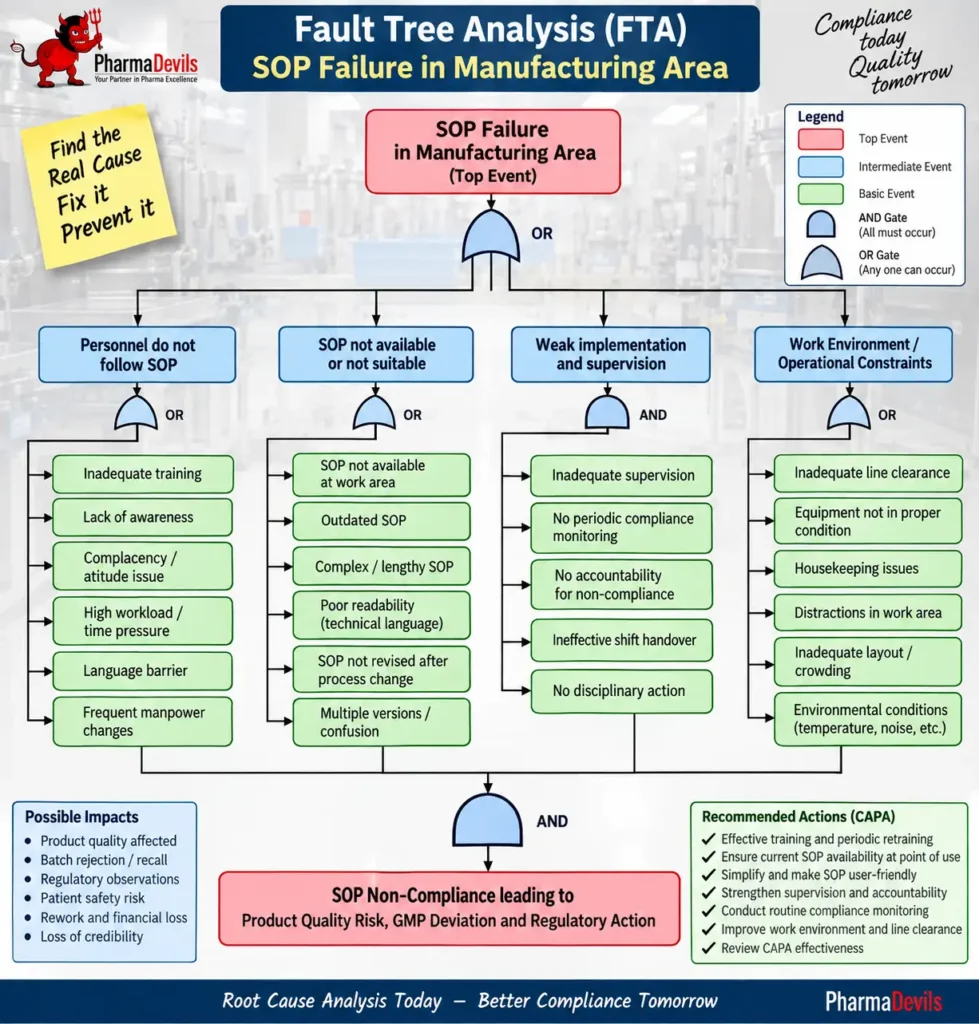
The personnel branch includes inadequate training, lack of awareness, complacency, high workload, language barriers, and frequent manpower changes. SOP-related causes include outdated procedures, complex or lengthy instructions, poor readability, multiple versions, and failure to revise procedures after process changes. Weak implementation may involve inadequate supervision, poor compliance monitoring, ineffective shift handover, and lack of accountability. Operational causes may include poor line clearance, equipment condition issues, housekeeping problems, distractions, and unsuitable environmental conditions. The analysis shows that these failures can lead to GMP deviations, product-quality risks, batch rejection or recall, regulatory observations, patient-safety concerns, rework, and financial loss. Recommended CAPA focuses on effective training and retraining, current SOP availability at the point of use, simplified procedures, stronger supervision, routine compliance monitoring, improved work conditions, and effectiveness verification.
Questions & Answers – Good Chromatographic Practice SOP
1. What is the objective of this SOP?
The objective is to establish a procedure for Good Chromatographic Practice.
2. What is the scope of this SOP?
The SOP is applicable to HPLC (High Performance Liquid Chromatography) activities.
3. Who is responsible for execution of the SOP?
The Sr. Executive-QC is responsible for execution of the SOP.
4. Who is responsible for review and effective implementation?
The Manager-QC and Head-QA/QC are responsible for review and effective implementation of the SOP.
5. What is chromatography?
Chromatography is a separation technique based on differential partitioning of compounds between the mobile phase and stationary phase, resulting in different retention behavior.
6. What should be checked before starting the HPLC instrument?
All parameters related to instrument operation should be understood and checked before starting the instrument.
7. How should HPLC columns be controlled?
Columns used for analysis should be properly identified and marked.
8. How should the buffer used for analysis be prepared?
The buffer should be freshly prepared before use.
9. What should be checked in solvent reservoirs before running a sequence?
Reservoirs such as washing solvent, rinse solvent, and mobile phases A, B, C, and D should contain sufficient solution before starting the sequence.
10. What should be done with the reservoirs before starting the main sequence?
All reservoirs should be purged, and the purge valve should be closed after purging.
11. What system suitability parameters are mentioned in the SOP?
The SOP mentions parameters such as resolution, tailing, theoretical plates, retention time, area RSD, column efficiency, and similarity factor.
12. Are air bubbles acceptable in the HPLC flow line?
No. The SOP requires that air bubbles should not be present in the flow line.
13. Is pressure fluctuation acceptable during HPLC analysis?
No. Pressure fluctuation is stated as not acceptable.
14. Where should leakage be checked in the HPLC system?
Leakage should be checked at the pump, autosampler, column compartment, and related areas.
15. What should be verified for the retention time of the principal peak?
The retention time of the principal peak should be within the applicable acceptance criteria.
16. What precautions are specified for the instrument section?
Eating and drinking are prohibited in the instrument section.
17. What is checked before starting the main HPLC sequence?
The checklist includes mobile-phase validity and quantity, clean inlet filters, air bubbles, purge-valve condition, back pressure, pressure fluctuation, correctness of preparations, vial placement, leakage, carryover, retention time, sequence naming, injection order, bracketing standards, and shutdown program.
18. What is verified during chromatographic preparation?
The SOP checks correct specifications, clean and dry glassware, valid standards and chemicals, correct diluent and dilution, sonication/centrifugation where applicable, correct filters, proper vial filling and labeling, and suitable handling of light-sensitive or thermolabile materials.
19. What records are included as annexures?
The SOP contains a HPLC system checklist, chromatographic preparation checklist, column-use logbook, and system suitability format.
20. What details are recorded in the system suitability format?
It records instrument and batch details, mobile phase, column and column ID, flow rate, wavelength, injection volume, run time, temperatures, gradient program, and system suitability parameters.
Reference Guidelines:
- WHO Technical Report Series (TRS) No. 1025, Annex 4 – Good Chromatography Practices. This is the most directly applicable reference for chromatographic activities, covering chromatographic systems, system suitability, data handling, review, storage, backup, and good laboratory practices. (World Health Organization)
WHO – Good Chromatography Practices, TRS 1025 Annex 4 - WHO TRS 1052, Annex 4 – Good Practices for Pharmaceutical Quality Control Laboratories (2024). Relevant for QC laboratory organization, equipment, analytical testing, documentation, records, quality systems, and laboratory controls. (World Health Organization)
WHO – Pharmaceutical Quality Control Laboratories - ICH Q2(R2) – Validation of Analytical Procedures. Applicable to demonstrating that analytical procedures, including chromatographic methods, are fit for their intended purpose through appropriate performance characteristics such as specificity, accuracy, precision, and range. (ICH Database)
ICH Q2(R2) Guideline - ICH Q14 – Analytical Procedure Development. Provides principles for analytical procedure development, robustness studies, risk assessment, analytical procedure control strategy, and lifecycle management. (ICH Database)
ICH Q14 Guideline - FDA – Data Integrity and Compliance With Drug CGMP: Questions and Answers. Relevant to electronic chromatographic data, audit trails, contemporaneous recording, review, security, and integrity of laboratory data. (U.S. Food and Drug Administration)
- FDA – Analytical Procedures and Methods Validation for Drugs and Biologics. Provides regulatory expectations for analytical procedures and method-validation information supporting drug quality testing. (U.S. Food and Drug Administration)