





Brief Description
The SOP for Good Microbiological Practices and Containment describes the procedures required to prevent contamination of the microbiology laboratory, protect laboratory work from environmental microorganisms, and ensure safe handling of microbial cultures. It emphasizes the use of aseptic techniques, sterile equipment, controlled handling of cultures, prevention of cross-contamination, and minimizing aerosol generation during laboratory activities.The SOP also requires proper laboratory cleanliness, organized work areas, segregation of clean and contaminated materials, regular disinfection, safe handling of sharps, use of protective clothing, and appropriate hand hygiene. Containment practices include restricted laboratory access, prevention of ingestion, inhalation and percutaneous exposure, use of microbiological safety cabinets where necessary, and safe waste disposal by disinfection or autoclaving. All accidents must be reported, documented and appropriately managed, while personnel must be trained in safe microbiological working practices.
Skip to PDF content1. Flow Diagram:
The flow diagram illustrates the step-by-step implementation of Good Microbiological Practices and Containment in a pharmaceutical microbiology laboratory. The process begins with planning and preparation, including availability of sterile materials, suitable equipment, PPE, and a clean work area. Personnel then perform hand hygiene and wear appropriate protective clothing before starting microbiological activities. Aseptic techniques are followed during sample handling, inoculation, incubation, and processing to prevent cross-contamination and minimize aerosol formation.
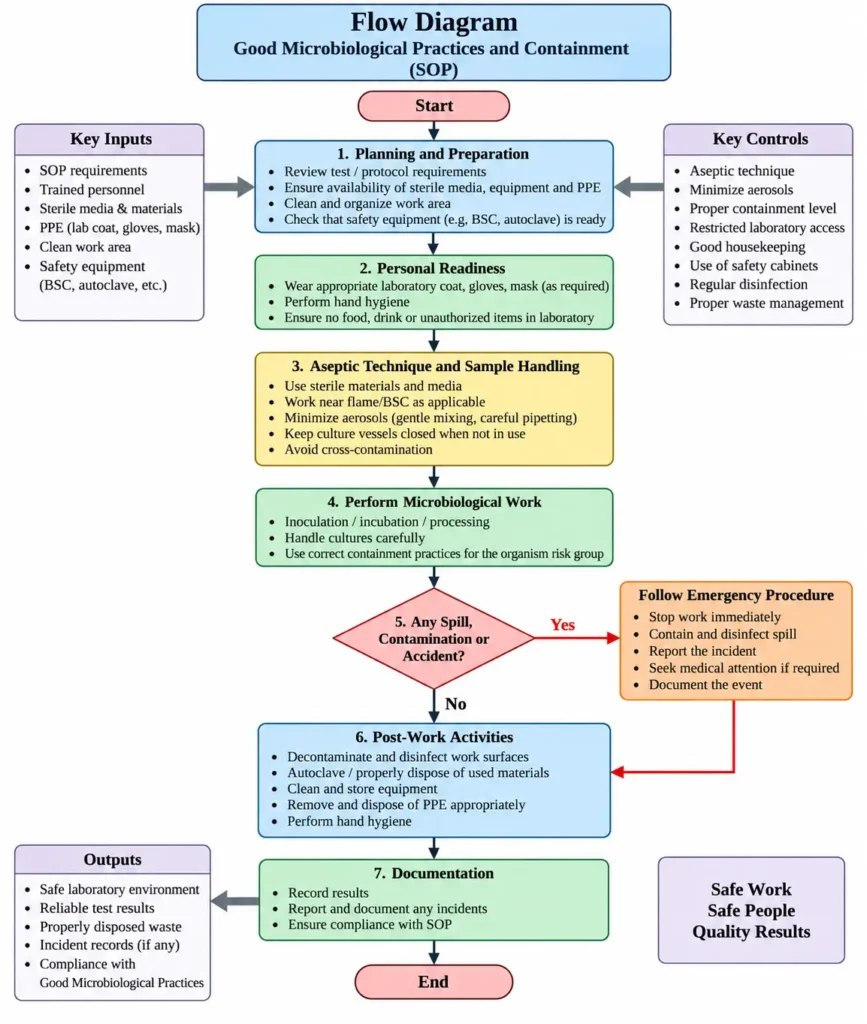
During microbiological work, appropriate containment practices and restricted laboratory access are maintained. If any spill, contamination, or accident occurs, the activity is stopped, the affected area is disinfected, and the incident is reported. After completion, work surfaces and equipment are decontaminated, waste is safely disinfected or autoclaved, PPE is removed, and hands are washed. The process concludes with proper documentation, supporting a safe laboratory environment, reliable microbiological results, and regulatory compliance.
2. Brainstorming for SOP Failure:
The brainstorming diagram identifies common reasons why an SOP may fail or may not be followed properly in a pharmaceutical manufacturing area. The possible causes are grouped under People, Machine, Materials, Method, Environment, Measurement, Management, Supervision, and Other Factors. People-related causes include inadequate training, lack of SOP awareness, workload, and carelessness. Machine-related causes include poor equipment condition, missing preventive maintenance, and unavailable change parts. Material issues may involve wrong material selection, labeling errors, or mix-ups. Method-related problems include outdated, unclear, or improperly followed SOPs.
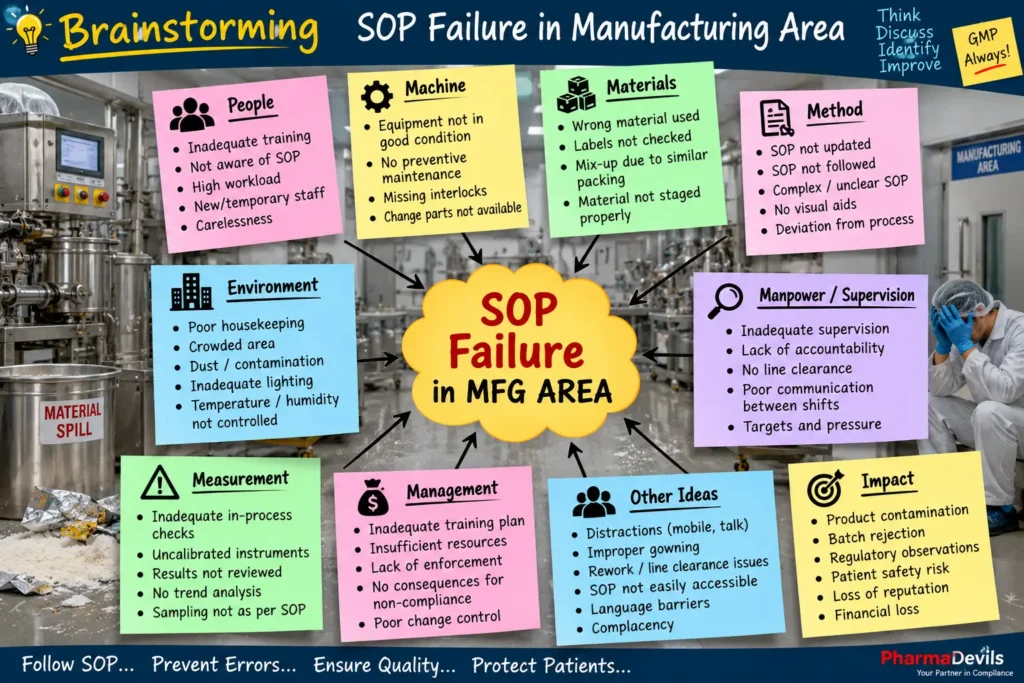
The diagram also highlights poor housekeeping, inadequate environmental control, weak supervision, insufficient in-process checks, uncalibrated instruments, poor communication, and lack of management enforcement. These failures may result in product contamination, batch rejection, regulatory observations, patient safety risks, financial loss, and damage to company reputation. Brainstorming helps identify these causes so that suitable corrective and preventive actions can be implemented.
3. 5-Why Analysis for SOP Failure:
The 5-Why analysis identifies the underlying reason for SOP failure in the manufacturing area by repeatedly asking why the required procedure was not followed. The first level shows that the operator did not perform the activity as per the approved SOP. Further analysis indicates that the operator was not fully aware of the correct procedure because adequate training and retraining were not effectively provided. The investigation then moves beyond individual error and identifies weaknesses in the training system, supervision, compliance monitoring, and management oversight.
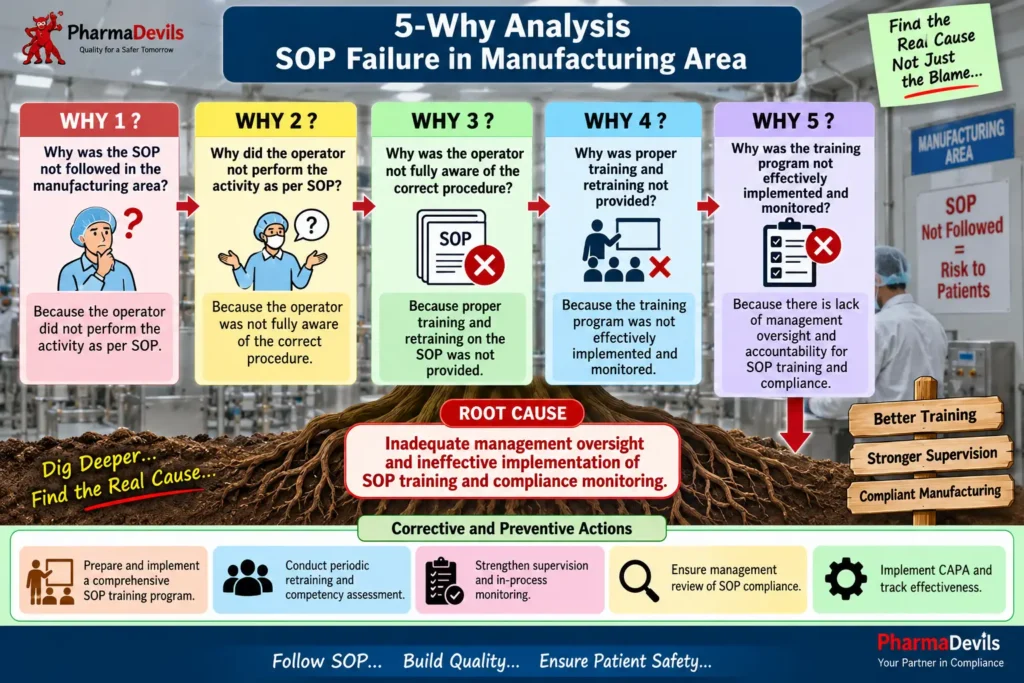
The probable root cause is therefore inadequate implementation and monitoring of SOP training and compliance, rather than only operator negligence. Appropriate CAPA should include comprehensive SOP training, periodic retraining, competency assessment, stronger shop-floor supervision, management review of SOP compliance, and effectiveness checks. This approach helps prevent recurrence, improves GMP compliance, reduces manufacturing errors, and supports consistent product quality and patient safety.
4. Fishbone Analysis for SOP Failure:
The Fishbone Analysis identifies the major potential causes of SOP failure in the manufacturing area by grouping them into different categories such as People, Machine, Method, Materials, Environment, Measurement, and Management/Supervision. People-related causes include inadequate training, poor understanding of the SOP, carelessness, high workload, and inexperienced staff. Machine-related causes may include equipment malfunction, lack of preventive maintenance, incorrect settings, or unavailable change parts.
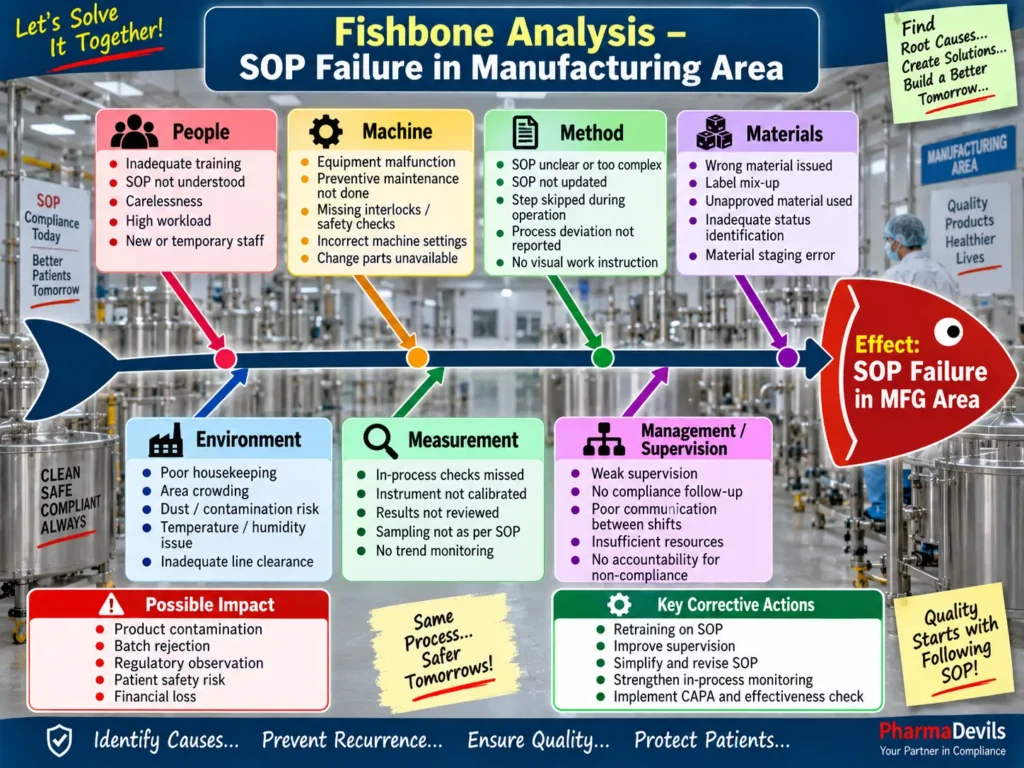
Method and material-related causes include unclear or outdated SOPs, skipped process steps, unreported deviations, wrong material issuance, label mix-ups, and improper material staging. Environmental causes may include poor housekeeping, dust, overcrowding, temperature or humidity issues, and inadequate line clearance. Measurement and supervision issues include missed in-process checks, uncalibrated instruments, weak monitoring, poor shift communication, and lack of accountability. This analysis helps identify possible root causes so that appropriate CAPA, retraining, supervision, SOP revision, and effectiveness checks can be implemented to prevent recurrence.
5. Fault Tree Analysis for SOP Failure:
The Fault Tree Analysis explains the possible causes that can lead to SOP failure in the manufacturing area. The top undesirable event is failure to follow or correctly implement an approved SOP. The analysis breaks this event into major immediate causes such as operator not following the SOP, SOP not being available or accessible, incorrect interpretation of the SOP, and outdated or unsuitable SOP instructions.
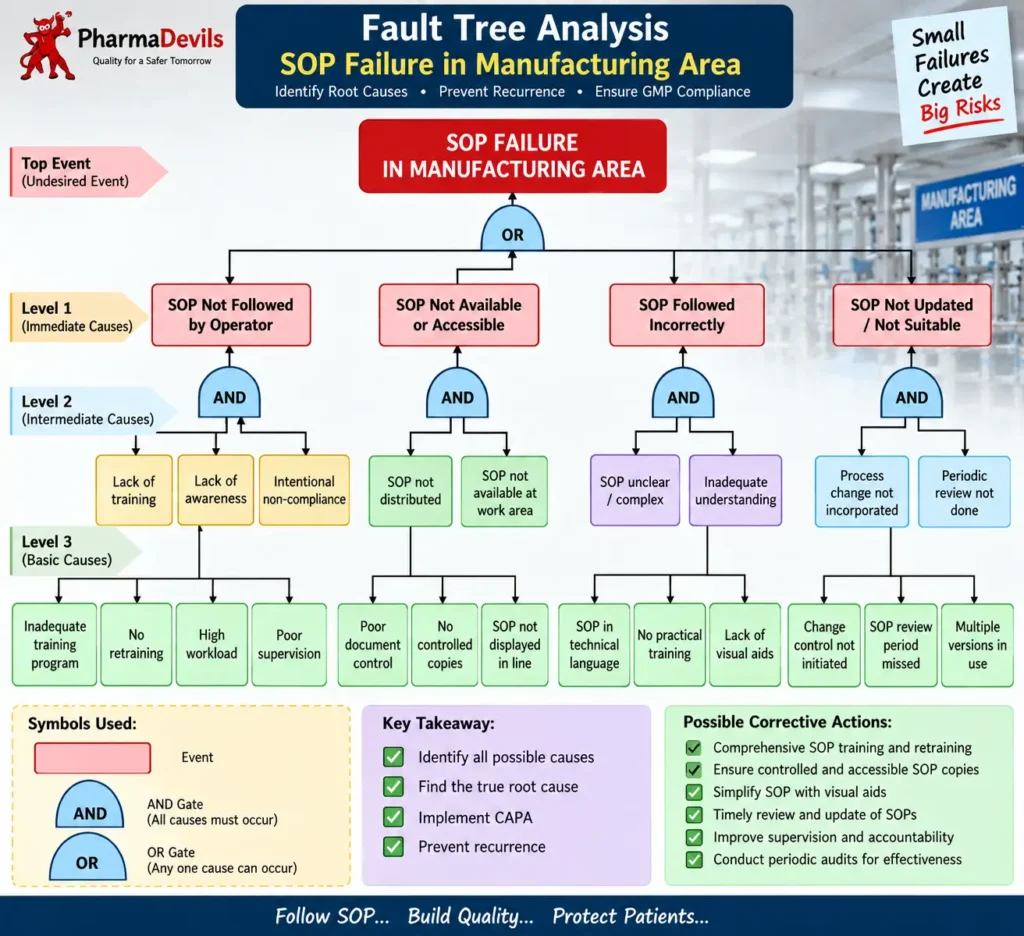
Further analysis identifies underlying causes including inadequate training, lack of awareness, poor supervision, high workload, weak document control, uncontrolled SOP copies, unclear technical language, lack of practical training, missed periodic review, and failure to incorporate process changes. The use of AND and OR gates helps show whether several conditions must occur together or whether any one cause can contribute to the failure. This analysis supports identification of the true root cause and helps define suitable CAPA such as retraining, SOP revision, improved document control, stronger supervision, periodic review, and effectiveness monitoring.
Questions & Answers – Good Microbiological Practices and Containment
- What is the objective of this SOP?
Answer: To implement good microbiological practices that prevent contamination of the laboratory by handled organisms and prevent environmental microorganisms from contaminating laboratory work. - What is the scope of the SOP?
Answer: It applies to medium-level laboratories performing routine Quality Control functions in a pharmaceutical company. - Who is responsible for implementation of this SOP?
Answer: The Microbiologist, Senior Chemist-QC, and Head QA/QC are responsible. - Why are aseptic techniques important?
Answer: They help prevent contamination of the laboratory by microorganisms being handled and prevent contamination of laboratory work from the surrounding environment. - How should culture vessels be handled during microbiological work?
Answer: Culture vessels should remain closed except for the minimum time required to introduce or remove materials. - How can aerosol formation be minimized?
Answer: Gentle rolling or swirling should be used instead of vigorous shaking, careful pipetting should be performed, and vessels should be kept close during liquid transfer. - Why should the microbiology laboratory be kept clean and tidy?
Answer: Good housekeeping reduces contamination, prevents spills and accidents, minimizes dust and debris, and supports safe microbiological work. - Why are clean and contaminated materials segregated?
Answer: Segregation and status identification help prevent mix-ups and allow work activities to be divided into clean and dirty areas. - Why should microorganisms be treated as potentially pathogenic?
Answer: Even organisms considered low risk may cause opportunistic infections, and cultures may become unintentionally contaminated with pathogenic organisms. - What is the purpose of purity checks?
Answer: Purity checks help detect contamination in cultures and can also indicate the competency of personnel in aseptic and microbiological techniques. - What is the purpose of containment?
Answer: Containment prevents microorganisms from escaping the laboratory and protects laboratory personnel by blocking possible routes of infection. - How should laboratory access be controlled?
Answer: Laboratory doors should remain closed, and access should be restricted to laboratory personnel and other authorized persons. - What activities are prohibited in the laboratory to prevent ingestion-related exposure?
Answer: Eating, drinking, smoking, storing food, applying cosmetics, mouth pipetting, licking labels, and similar activities are prohibited. - How should used sharps be handled?
Answer: Used sharps should be placed directly into designated sharps containers, and cracked or chipped glassware should be discarded immediately. - When should gloves be used?
Answer: Gloves provide additional protection when microorganisms may infect through the percutaneous route. Contaminated or damaged gloves should be discarded, and hands should be washed afterward. - When should a microbiological safety cabinet be used?
Answer: It should be used for procedures that may generate aerosols and for microorganisms that can infect through the respiratory route. - How should laboratory surfaces be disinfected?
Answer: Benches should be routinely disinfected after use, and all affected surfaces should be disinfected immediately following any spill. - How should contaminated waste be disposed of?
Answer: Contaminated waste must be made safe by autoclaving or disinfection before final disposal. - What should be done after an accident or incident?
Answer: The accident or incident should be reported immediately, documented, assessed for exposure risk, and handled using appropriate safe cleanup procedures. - Why is personnel training important in microbiology laboratories?
Answer: Personnel must be trained and proficient in safe working practices so they can recognize exposure routes, prevent contamination, and protect themselves and others.
Reference Guidelines:
- WHO Technical Report Series No. 961, Annex 2 – Good Practices for Pharmaceutical Microbiology Laboratories. This is the most directly relevant WHO guideline for personnel, premises, environmental monitoring, cleaning/disinfection, microbiological methods, equipment, culture media and laboratory practices. (World Health Organization)
WHO TRS 961 Annex 2 - WHO TRS No. 1052, Annex 4 – Good Practices for Pharmaceutical Quality Control Laboratories (2024). Applicable to pharmaceutical QC laboratory organization, documentation, equipment, testing, quality systems and laboratory controls. (World Health Organization)
WHO Good Practices for Pharmaceutical QC Laboratories - USP General Chapter <1117> – Microbiological Best Laboratory Practices. Covers aseptic technique, culture media, test strains, equipment controls, documentation, data evaluation and personnel competency. (USP)
USP <1117> Microbiological Best Laboratory Practices - WHO Laboratory Biosafety Manual, 4th Edition. Provides risk-based guidance for good microbiological practices, containment, PPE, biological safety cabinets, decontamination, waste management and incident management. (World Health Organization)
WHO Laboratory Biosafety Manual, 4th Edition - CDC/NIH – Biosafety in Microbiological and Biomedical Laboratories (BMBL), 6th Edition. Useful for biosafety risk assessment, containment practices, laboratory safety equipment and prevention of occupational exposure to biological agents. (CDC)
CDC BMBL 6th Edition - EU GMP, EudraLex Volume 4, Annex 1 – Manufacture of Sterile Medicinal Products. Particularly relevant where the microbiology laboratory supports sterile manufacturing, environmental monitoring, contamination control or aseptic operations. (Public Health)
EU GMP Volume 4