







1. Introduction – SOP for Handling and Control of Packing Change Parts of Blister & Strip M/C:
The SOP for Handling and Control of Packing Change Parts of Blister & Strip M/C defines a systematic procedure for the procurement, verification, cleaning, issuance, retrieval, storage, maintenance, inspection, and control of change parts used on pharmaceutical blister and strip packing machines. The SOP ensures that each change part is suitable for the intended product and machine, corresponds to the approved layout drawing, and is maintained in a clean and serviceable condition. New change parts are verified for correct layout number, dimensions, identification, appearance, damage, critical parameters, and compliance with approved requirements before use. The procedure also covers functional checks such as draw length, cavity dimensions, pinholes, knurling uniformity, wrinkles, break test, NFD functioning, and leak testing for applicable blister and strip packs. Proper implementation of this SOP helps prevent the use of incorrect, damaged, worn, or contaminated change parts, thereby supporting pack integrity, consistent machine performance, product quality, traceability, and GMP compliance.
Skip to PDF content2. Flow Diagram – Handling and Control of Packing Change Parts of Blister & Strip M/C:
The SOP for Handling and Control of Packing Change Parts of Blister & Strip M/C describes the controlled process for managing change parts used during pharmaceutical blister and strip packing operations. It covers the complete lifecycle of change parts, including procurement, receiving, verification, cleaning, issuance, use on the machine, retrieval, inspection, maintenance, and storage. New change parts are checked against the approved layout drawing, purchase order, identification number, dimensions, physical condition, and specific technical requirements before use.
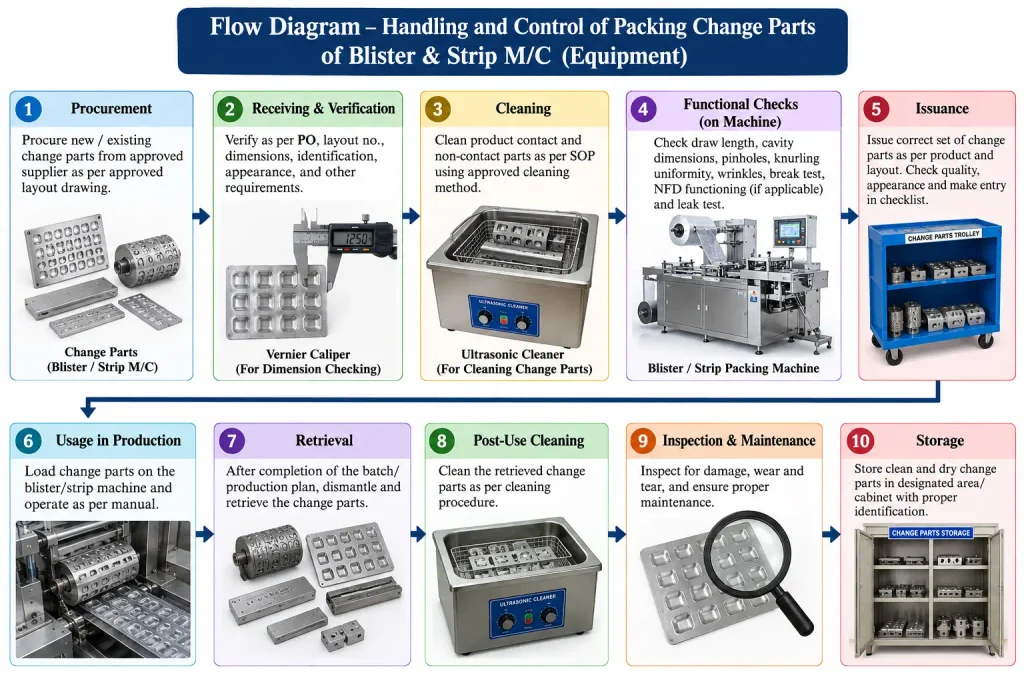
The SOP also requires functional checks such as draw length, cavity dimensions, pinholes, knurling uniformity, wrinkles, break test, NFD functioning, and leak testing, as applicable to blister and strip packs. After production, change parts are dismantled, cleaned, inspected for damage or wear, recorded, and returned to the designated change-parts storage area. Proper implementation helps maintain pack quality, machine performance, traceability, cleanliness, and controlled use of approved change parts.
3. Benefits of Following SOP for Handling and Control of Packing Change Parts of Blister & Strip M/C:
The SOP for Handling and Control of Packing Change Parts of Blister & Strip M/C provides several important benefits by ensuring that only approved, verified, clean, correctly identified, and serviceable change parts are used during packing operations. Proper verification of layout number, dimensions, identification, appearance, and physical condition helps prevent the use of incorrect or damaged change parts.
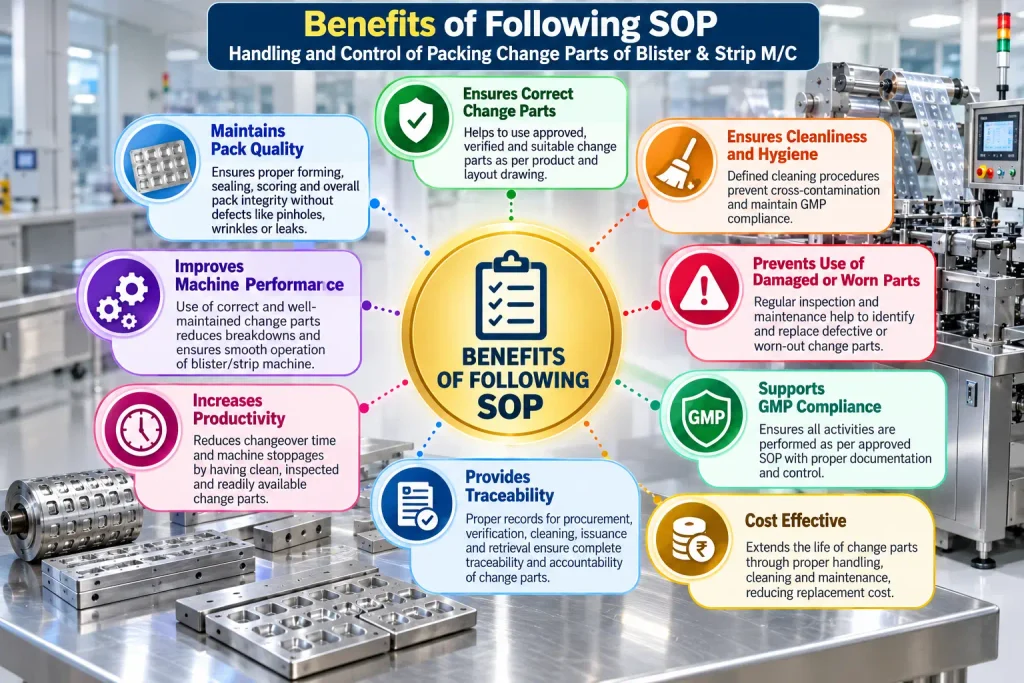
Following the SOP also supports consistent blister and strip quality through checks for draw length, cavity dimensions, pinholes, knurling uniformity, wrinkles, break test, NFD functioning, and leak integrity, as applicable. Defined cleaning, issuance, retrieval, inspection, and maintenance practices improve equipment reliability, reduce the risk of contamination, and maintain traceability of change parts throughout their lifecycle. Overall, adherence to this SOP helps improve pack quality, machine performance, productivity, documentation control, GMP compliance, change-part life, and operational consistency while reducing errors, breakdowns, and unnecessary replacement costs.
4. CPP and CQA for Handling and Control of Packing Change Parts of Blister & Strip M/C:
The SOP for Handling and Control of Packing Change Parts of Blister & Strip M/C identifies important process controls and quality attributes that help ensure reliable blister and strip packing operations. Critical process-related controls include verification of the approved layout drawing, layout number, dimensions, component identification, physical appearance, cleaning status, machine speed, forming/sealing temperature, compressed-air pressure, and proper installation of change parts.
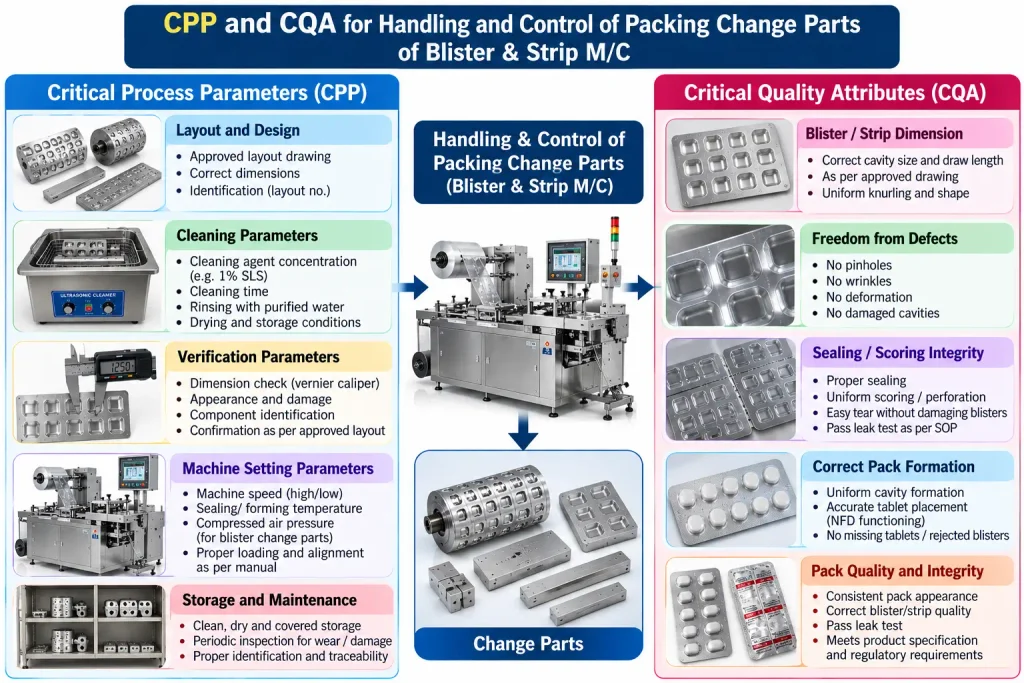
The associated quality attributes include correct draw length and cavity dimensions, absence of pinholes and wrinkles, uniform knurling, acceptable break/scoring performance, proper NFD functioning, and successful leak testing. These checks help confirm that the blister or strip pack is formed and sealed correctly and that the applicable change parts are suitable for use. Proper cleaning, inspection, storage, and maintenance of change parts further support their continued fitness for use by controlling rust, wear, damage, and other abnormalities. Overall, controlling these parameters and attributes supports consistent pack quality, equipment performance, traceability, and GMP-compliant packing operations.
4. CPP and CQA for Handling and Control of Packing Change Parts of Blister & Strip M/C:
The CAPA for Handling and Control of Packing Change Parts of Blister & Strip M/C is intended to identify, correct, and prevent problems associated with the use, cleaning, verification, storage, and maintenance of packing change parts. Typical issues may include incorrect dimensions, pinholes, wrinkles, improper sealing or scoring, damaged or worn change parts, contamination, and use of incorrect change parts. The SOP requires verification of layout number, dimensions, appearance, identification, and approved requirements before the parts are put into use.
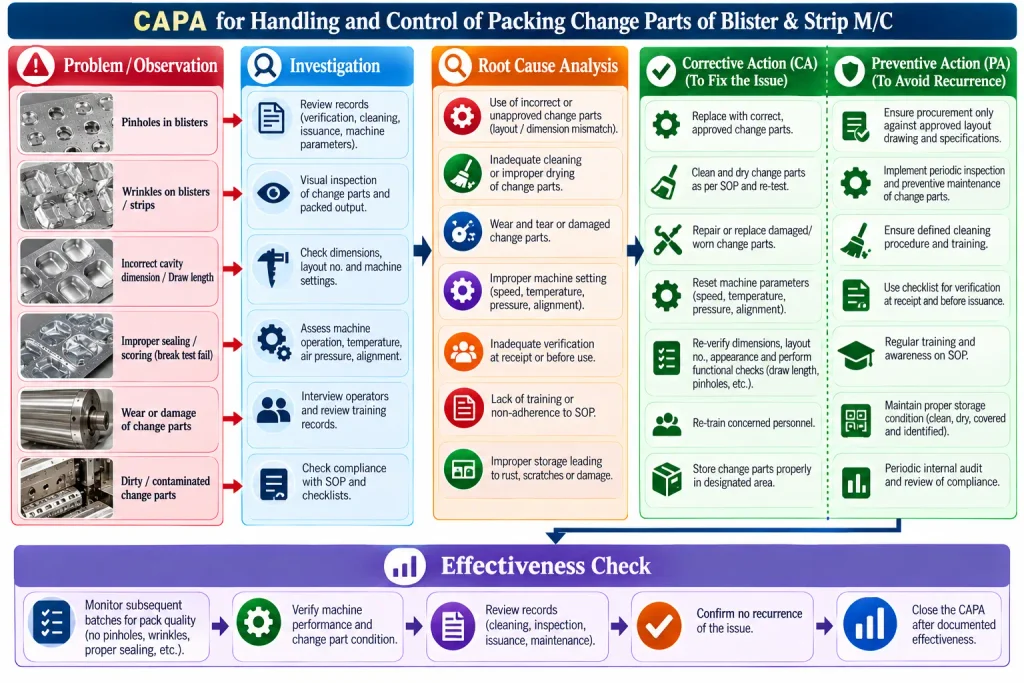
Corrective actions may include replacement or rectification of defective change parts, re-cleaning, re-verification, correction of machine settings, and retraining of concerned personnel. The SOP specifically requires deficiencies observed during receipt or testing to be recorded and the affected change parts to be sent to the supplier for rectification when necessary. Preventive actions focus on periodic inspection, proper cleaning, controlled issuance and retrieval, correct storage, maintenance, and usage-record review. Change parts must be checked for rusting, wear, tear, or other abnormalities and handled carefully to maintain their condition. Effectiveness should be confirmed by reviewing subsequent packing operations to ensure satisfactory pack quality and non-recurrence of the identified issue.
5. 5-Why Analysis for SOP Failure – Handling and Control of Packing Change Parts of Blister & Strip M/C:
The 5-Why Analysis for SOP Failure – Handling and Control of Packing Change Parts of Blister & Strip M/C is used to identify the underlying cause of defects or failures associated with blister and strip packing change parts. The analysis may begin with problems such as pinholes, wrinkles, improper sealing, incorrect cavity dimensions, or other pack defects. The SOP requires change parts to be checked for correct layout number, dimensions, identification, appearance, damage, and conformity with the approved layout before use.
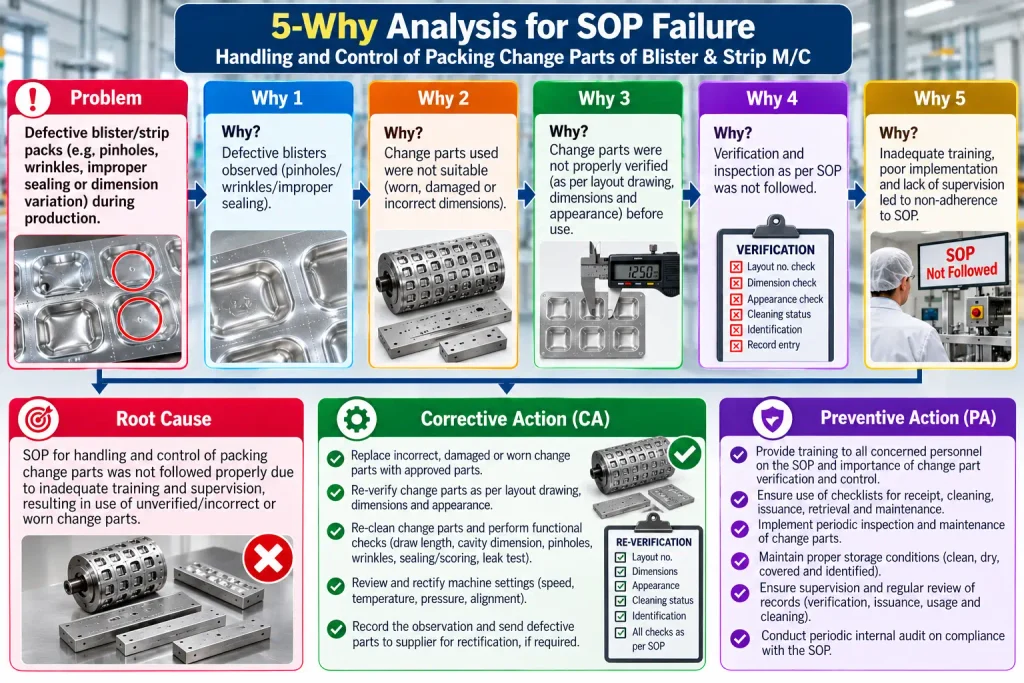
By repeatedly asking “Why?”, the investigation can move from the observed defect to possible causes such as use of unsuitable or damaged change parts, inadequate verification, improper cleaning, incorrect machine settings, or failure to follow the defined procedure. The SOP also requires checking key performance aspects such as draw length, cavity dimensions, pinholes, knurling, wrinkles, NFD functioning, and leak test results. The purpose of the 5-Why analysis is to support effective corrective and preventive actions so that the identified issue does not recur and the change parts remain properly controlled throughout their use and storage.
6. Fishbone Analysis for SOP Failure – Handling and Control of Packing Change Parts of Blister & Strip M/C:
The Fishbone Analysis for SOP Failure – Handling and Control of Packing Change Parts of Blister & Strip M/C is used to systematically identify possible causes that may lead to failure in the control, handling, cleaning, verification, issuance, use, retrieval, and maintenance of packing change parts. The analysis can be organized under major categories such as Man, Machine, Material, Method, Measurement, and Environment.
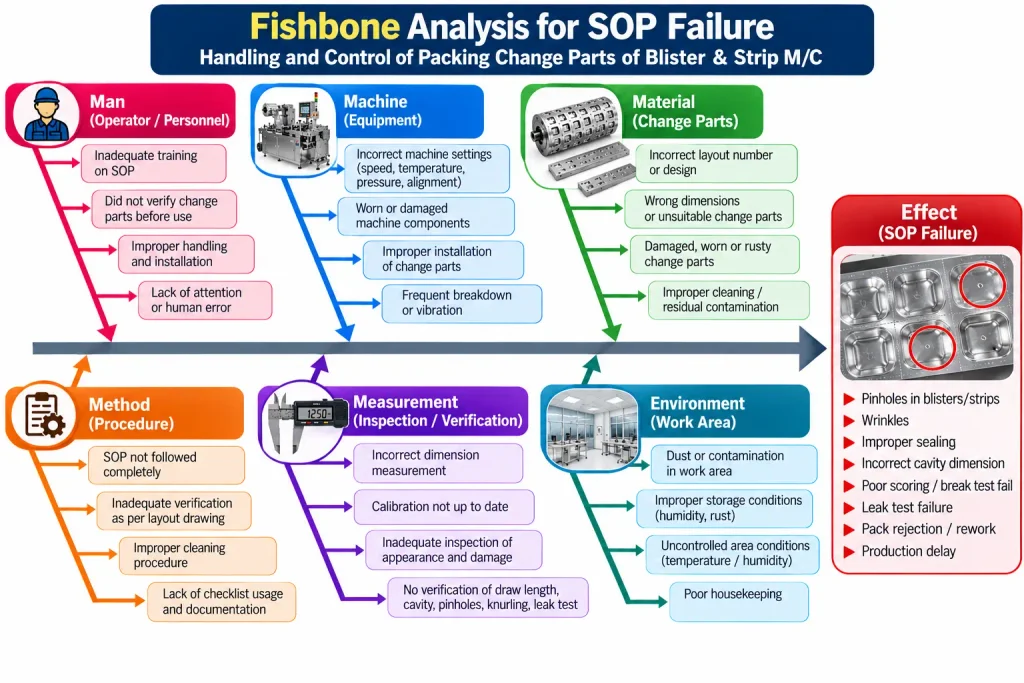
Potential causes include inadequate operator training, improper installation of change parts, use of incorrect or damaged parts, incomplete adherence to the SOP, improper cleaning, inaccurate dimensional verification, poor inspection practices, and unsuitable storage conditions. The SOP specifically requires verification of change parts against the approved layout, dimensions, identification, appearance, and damage before use.Failure in these controls may contribute to defects such as pinholes, wrinkles, improper sealing, incorrect cavity dimensions, break-test failure, and leak-test failure. Fishbone analysis helps the investigation team identify contributing factors and supports selection of appropriate corrective and preventive actions to strengthen SOP compliance and prevent recurrence.
7. Impact Assessment for SOP Failure – Handling and Control of Packing Change Parts of Blister & Strip M/C:
The Impact Assessment for SOP Failure – Handling and Control of Packing Change Parts of Blister & Strip M/C evaluates the consequences that may arise when change parts are not properly verified, cleaned, issued, retrieved, inspected, maintained, or stored. The SOP requires change parts to be checked against the approved layout drawing, dimensions, identification, appearance, damage, and other specified requirements before use. Failure to follow these controls can result in incorrect draw length, cavity dimension variation, pinholes, wrinkles, non-uniform knurling, poor scoring or break performance, NFD malfunction, and leak-test failure. Such defects can lead to rejection or rework of blister/strip packs, production delays, increased inspection, machine stoppages, and higher consumption or replacement of change parts.
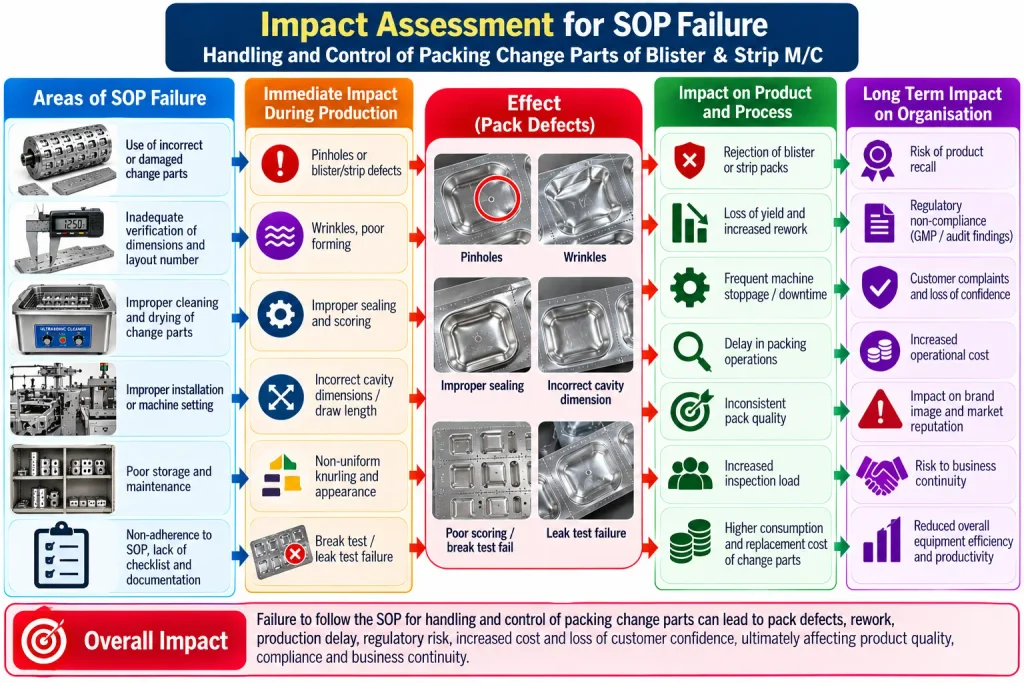
Poor maintenance may also contribute to rusting, wear, tear, or other abnormalities in the change parts. The SOP therefore requires inspection, rectification where necessary, proper storage, and careful handling. Overall, SOP failure can adversely affect pack quality, equipment performance, productivity, traceability, and GMP compliance, making effective control of change parts essential for reliable packing operations.
Question & Answer – Handling and Control of Packing Change Parts of Blister & Strip M/C:
- What is the objective of this SOP?
The objective is to describe the procedure for handling and control of packing change parts used in blister and strip packing machines. - What activities are covered under this SOP?
The SOP covers procurement, verification, cleaning, issuance, retrieval, and maintenance of blister and strip machine change parts. - Who is responsible for procurement of packing change parts?
The Deputy Production Manager is responsible for procurement of packing change parts. - Who is responsible for verification, cleaning, issuance, retrieval, and maintenance of change parts?
The Packaging Supervisor is responsible for these activities. - What should be checked when new change parts are received?
They should be checked against the purchase order, layout number, approved drawing, dimensions, identification, specific requirements, critical parameters, unauthorized modifications, appearance, and damage. - What parameters are checked for blister change parts?
Important checks include draw length, cavity dimensions, pinholes, knurling uniformity, wrinkles, break test/scoring, NFD functioning where applicable, and leak test. - What parameters are checked for strip change parts?
Strip change parts are checked for pinholes, knurling uniformity, wrinkles, and leak-test performance. - How are product-contact change parts cleaned?
Product-contact parts are cleaned using sufficient quantity of 1% sodium lauryl sulphate solution with a nylon brush and clean lint-free cloth, followed by washing, purified-water rinsing, and drying. - What machine parameters are recorded during verification?
Machine speed, forming/sealing temperature where applicable, and compressed-air pressure for blister change parts are recorded. - What action is taken if a deficiency is found in a change part?
The observation is recorded in the verification record, and the affected change part may be returned to the supplier for rectification through a Returnable Gate Pass. - How are change parts issued for production?
The required layout is selected according to the product and machine. The complete set is taken from the change-part room, cleaned, checked for completeness and appearance, and recorded in the change-part checklist. - What should be done after completion of the batch or production plan?
The change parts should be dismantled from the blister or strip packing machine, cleaned, individually checked, and returned to the change-parts room with retrieval details recorded. - What maintenance checks are required for change parts?
Change parts should be cleaned before and after use and checked for rusting, wear and tear, or other abnormalities. Rectification should be carried out when necessary. - How should change parts be stored?
Change parts should be properly stored in the designated change-parts room and handled carefully to prevent damage. - What records are associated with the SOP?
The SOP includes a Checklist for Change Parts, Change Part Inspection Record, Change Part Usage Record, and Change Part Destruction Note.
Reference Guideline – Handling and Control of Packing Change Parts of Blister & Strip M/C:
Good Manufacturing Practices (GMP) – applicable GMP requirements shall be followed for the handling, verification, cleaning, issuance, retrieval, maintenance, storage, and documentation of blister and strip packing machine change parts.
- Annexure I: Checklist for Change Parts
- Annexure II: Change Part Inspection Record
- Annexure III: Change Part Usage Record
- Annexure IV: Change Part Destruction Note