


1. Introduction – SOP for Handling & Cleaning of Equipments & Accessories/Container:
The SOP for Handling & Cleaning of Equipments & Accessories/Container describes the standardized procedure for proper handling, cleaning, drying, protection, labeling, storage, and use of manufacturing equipment, accessories, hoses, silicone tubes, brushes, polybags, and related items in pharmaceutical production areas. Its primary purpose is to maintain equipment in a clean and suitable condition and to prevent contamination or cross-contamination during manufacturing operations. & he SOP defines Type A and Type B cleaning, including circumstances requiring each type of cleaning, use of process water, detergent solution and purified water, and requirements for equipment status labeling and cleaning records. It also requires cleaned equipment to be dried, protected with suitable covers, identified with a “Cleaned” status tag, documented in the equipment usage and cleaning logbook, and visually inspected before use. Proper implementation of this SOP helps ensure GMP compliance, product quality, equipment cleanliness, contamination control, traceability, and safe manufacturing operations.
Skip to PDF content2. Flow Diagram – SOP for Handling & Cleaning of Equipments & Accessories/Container:
The SOP for Handling & Cleaning of Equipments & Accessories/Container establishes a controlled and systematic approach for cleaning, handling, protection, identification, and storage of production equipment and accessories. After completion of processing, the existing equipment status is changed to “To Be Cleaned”, and the equipment is cleaned according to the applicable Type A or Type B cleaning procedure. Type B cleaning includes process water, detergent solution, rinsing with process water, and a final rinse with purified water.
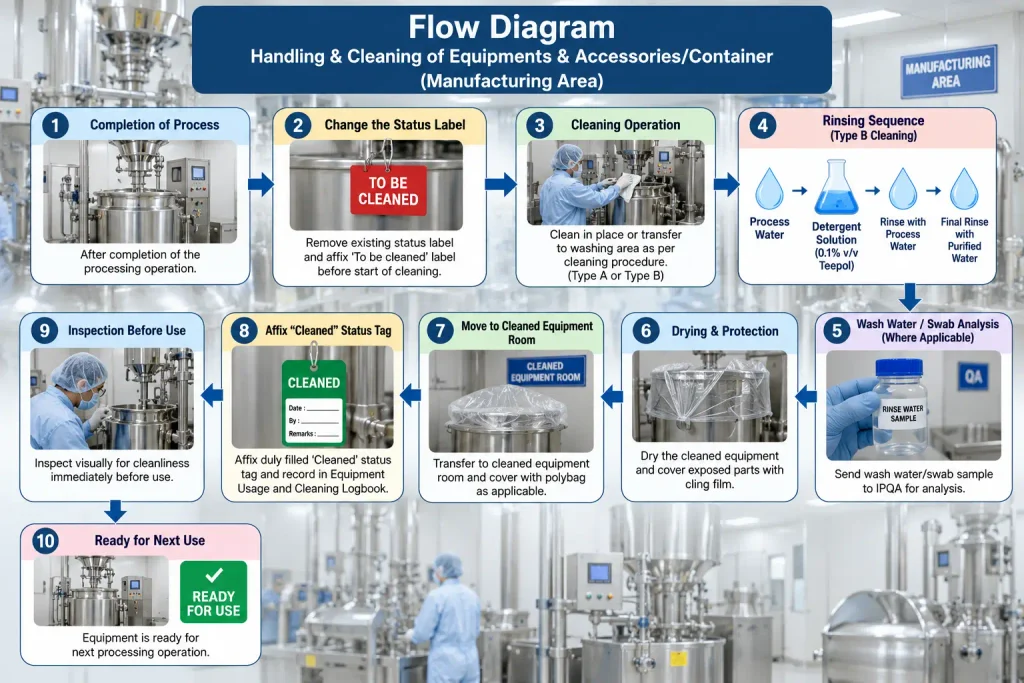
Where applicable, wash water or swab samples are submitted for analysis before the equipment is released for further use. The cleaned equipment is then dried, protected with cling film or polybag, transferred to the cleaned equipment area, and identified with a duly completed “Cleaned” status tag. Cleaning details are recorded in the equipment usage and cleaning logbook, and the equipment is visually inspected for cleanliness immediately before use. Following this SOP supports effective contamination control, equipment cleanliness, proper traceability, and consistent GMP-compliant manufacturing operations.
3. Benefits of Following SOP for Handling & Cleaning of Equipments & Accessories/Container:
Following the SOP for Handling & Cleaning of Equipments & Accessories/Container ensures that production equipment and accessories are maintained in a clean, protected, and suitable condition before and after use. The procedure helps prevent contamination by requiring defined cleaning practices, proper status labeling, drying, covering, and storage of cleaned equipment.
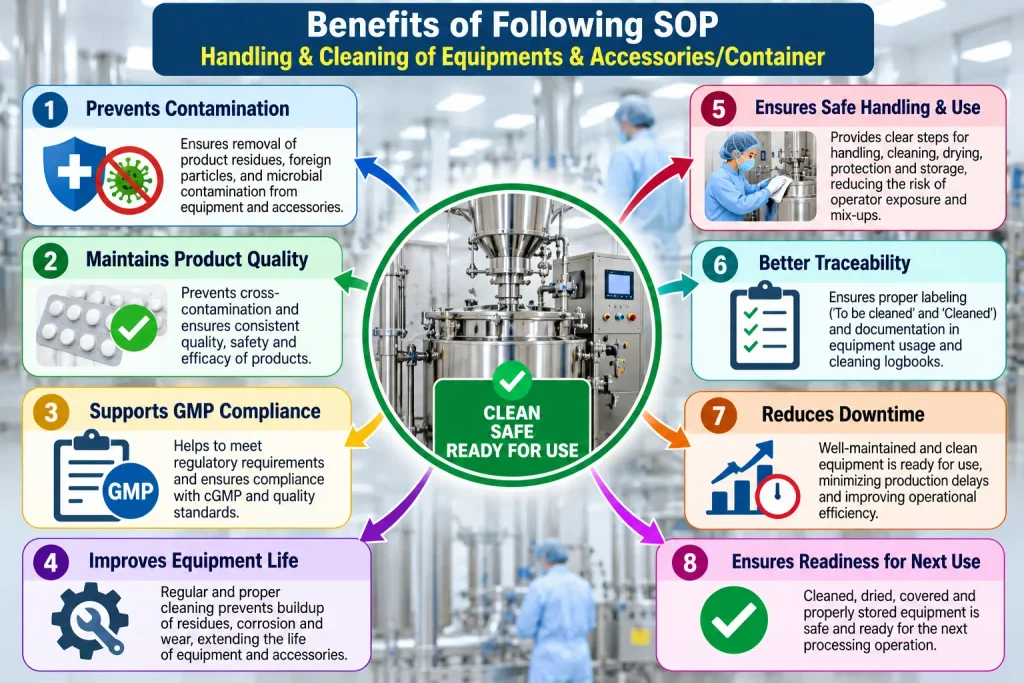
The SOP also supports effective product-changeover control through Type A and Type B cleaning, including detergent washing and purified-water rinsing where applicable. Proper use of “To be Cleaned” and “Cleaned” status labels, together with entries in the equipment usage and cleaning logbook, improves traceability and reduces the risk of mix-ups. Cleaned equipment is dried, protected, stored appropriately, and visually inspected immediately before use.Therefore, following this SOP supports contamination control, GMP compliance, product quality, equipment readiness, traceability, and safe manufacturing operations.
4. Brainstorming for SOP Failure – Handling & Cleaning of Equipments & Accessories/Container:
The Brainstorming Analysis for SOP Failure – Handling & Cleaning of Equipments & Accessories/Container identifies possible factors that may lead to ineffective cleaning, improper handling, contamination, cross-contamination, documentation errors, or equipment being used in an unsuitable condition. The SOP requires defined cleaning practices, correct status labeling, appropriate Type A or Type B cleaning, drying, covering, storage, and recording of equipment cleaning activities.
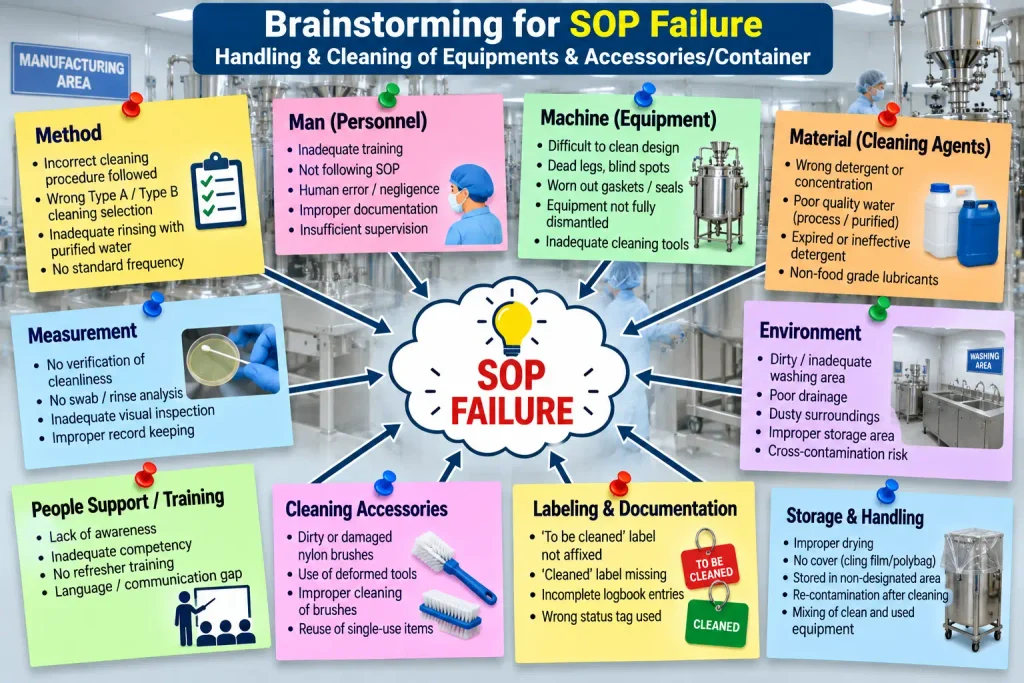
Potential failure causes may therefore include incorrect cleaning steps, inadequate rinsing, use of unsuitable cleaning agents, poor operator training, incomplete equipment dismantling, damaged cleaning accessories, improper drying, missing status labels, incomplete logbook entries, and unsuitable storage conditions. The SOP also requires wash-water or swab analysis where applicable and visual inspection before use, making verification and supervision important controls. Brainstorming these possible causes helps the team identify weak points, prioritize investigation areas, strengthen preventive controls, and improve consistent GMP-compliant equipment handling and cleaning.
5. Fishbone Analysis for SOP Failure – Handling & Cleaning of Equipments & Accessories/Container:
The Fishbone Analysis for SOP Failure – Handling & Cleaning of Equipments & Accessories/Container is used to systematically identify the possible root causes that may lead to ineffective equipment cleaning, improper handling, contamination, cross-contamination, or documentation failure. The analysis groups potential causes under major categories such as Man, Machine, Method, Material, Measurement, Environment, Management Support, and Storage & Handling.
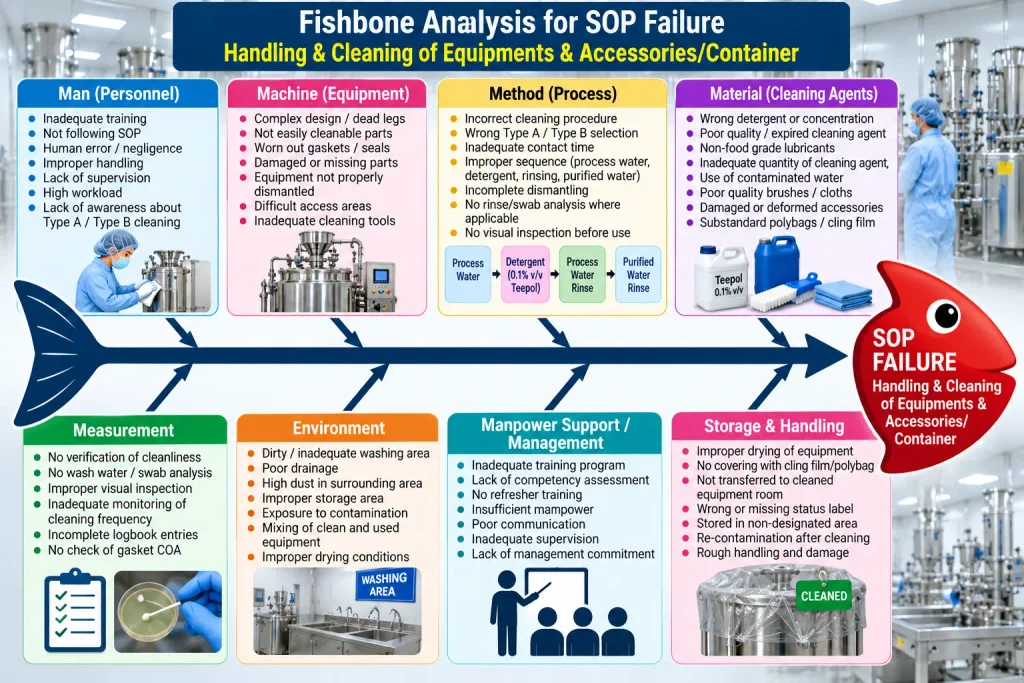
The SOP requires defined cleaning procedures, proper selection of Type A or Type B cleaning, correct labeling, drying, protection, storage, and documentation of cleaned equipment. Failures may therefore arise from inadequate operator training, damaged or difficult-to-clean equipment parts, incorrect cleaning sequence, unsuitable detergent or water quality, missing rinse/swab analysis, poor washing-area conditions, weak supervision, or improper storage of cleaned equipment. The SOP also requires cleaned equipment to be dried, covered, identified with a “Cleaned” status tag, documented in the equipment usage and cleaning logbook, and visually inspected before use.Fishbone analysis helps the investigation team evaluate these possible causes in a structured manner and supports selection of appropriate corrective and preventive actions.
6. Fault Tree Analysis for SOP Failure – Handling & Cleaning of Equipments & Accessories/Container:
The Fault Tree Analysis for SOP Failure – Handling & Cleaning of Equipments & Accessories/Container evaluates how different failures can combine to result in the top event of improperly cleaned equipment, contamination, or cross-contamination. The analysis traces the failure through major branches such as inadequate cleaning effectiveness, improper handling and protection, missing or incorrect labeling and documentation, and use of contaminated equipment.
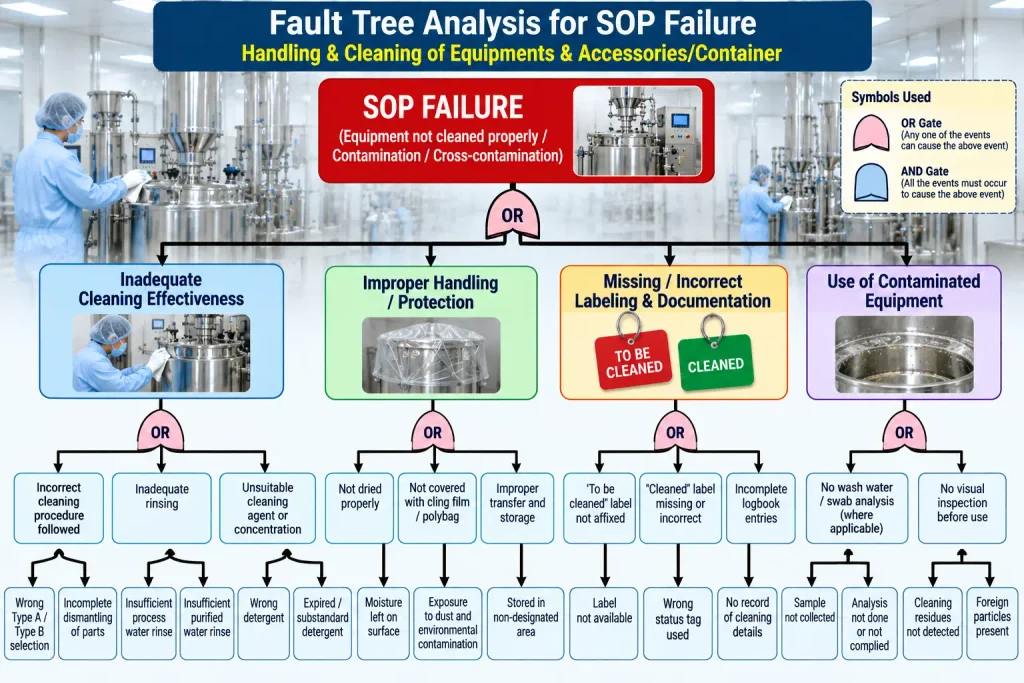
Possible contributing causes include incorrect selection of Type A or Type B cleaning, incomplete dismantling, inadequate process-water or purified-water rinsing, unsuitable detergent, improper drying, failure to cover cleaned equipment, incorrect storage, missing “To Be Cleaned” or “Cleaned” status labels, incomplete logbook entries, and absence of wash-water/swab analysis or visual inspection. These requirements are addressed in the SOP through defined cleaning, labeling, drying, storage, documentation, and pre-use inspection controls.Fault Tree Analysis helps identify the combinations of failures that can lead to SOP breakdown and supports focused corrective and preventive actions to strengthen equipment-cleaning control and GMP compliance.
7. Impact Assessment for SOP Failure – Handling & Cleaning of Equipments & Accessories/Container:
The Impact Assessment for SOP Failure – Handling & Cleaning of Equipments & Accessories/Container evaluates the possible consequences when equipment and accessories are not cleaned, handled, protected, labeled, stored, or verified according to the approved procedure. The SOP requires defined cleaning practices, correct Type A or Type B cleaning, appropriate rinsing, status labeling, drying, covering, storage, documentation, and inspection before use.
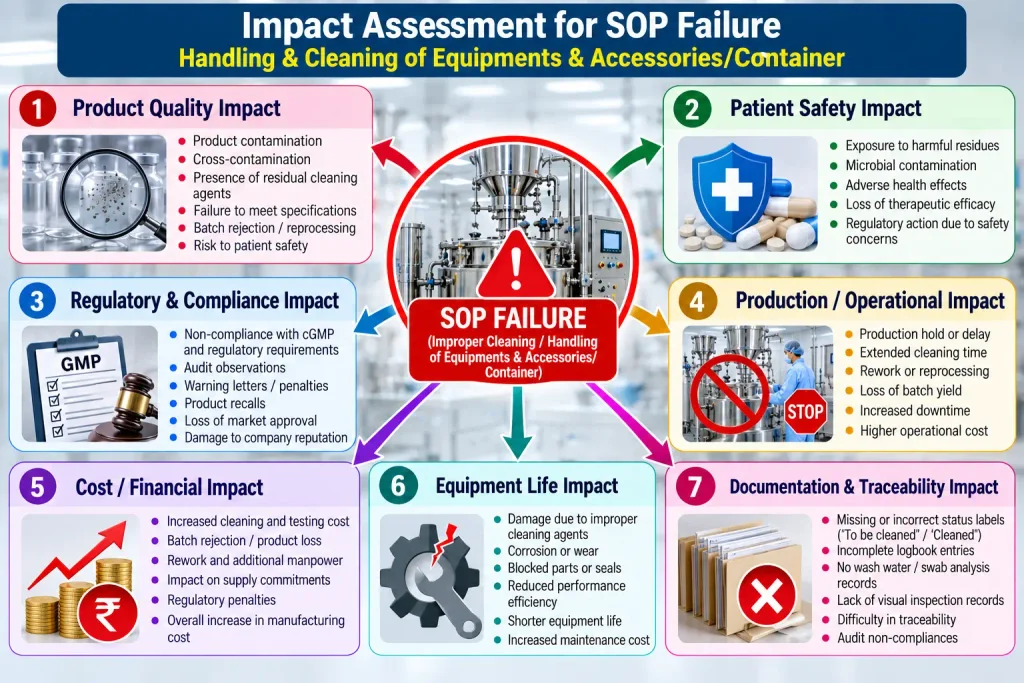
Failure to follow these controls may adversely affect product quality, contamination control, patient safety, regulatory compliance, production continuity, equipment condition, cost, and traceability. Missing cleaning steps or inadequate rinsing may leave product or detergent residues, while improper drying or covering may increase the chance of recontamination. The SOP also requires cleaned equipment to be identified with a “Cleaned” status tag, recorded in the equipment usage and cleaning logbook, and inspected for cleanliness before use.Therefore, effective implementation of the SOP helps reduce the likelihood of batch rejection, reprocessing, production delays, documentation gaps, equipment damage, and GMP non-compliance.
8. CAPA for SOP Failure – Handling & Cleaning of Equipments & Accessories/Container:
The CAPA for SOP Failure – Handling & Cleaning of Equipments & Accessories/Container is intended to eliminate identified causes of improper cleaning and handling and to prevent recurrence of contamination, cross-contamination, documentation gaps, and equipment misuse. Corrective actions may include retraining concerned personnel, reviewing the applicable Type A/Type B cleaning procedure, using approved cleaning agents at the correct concentration, ensuring adequate process-water and purified-water rinsing, replacing damaged cleaning accessories, improving drying and covering practices, correcting status labels, and completing equipment usage and cleaning records.
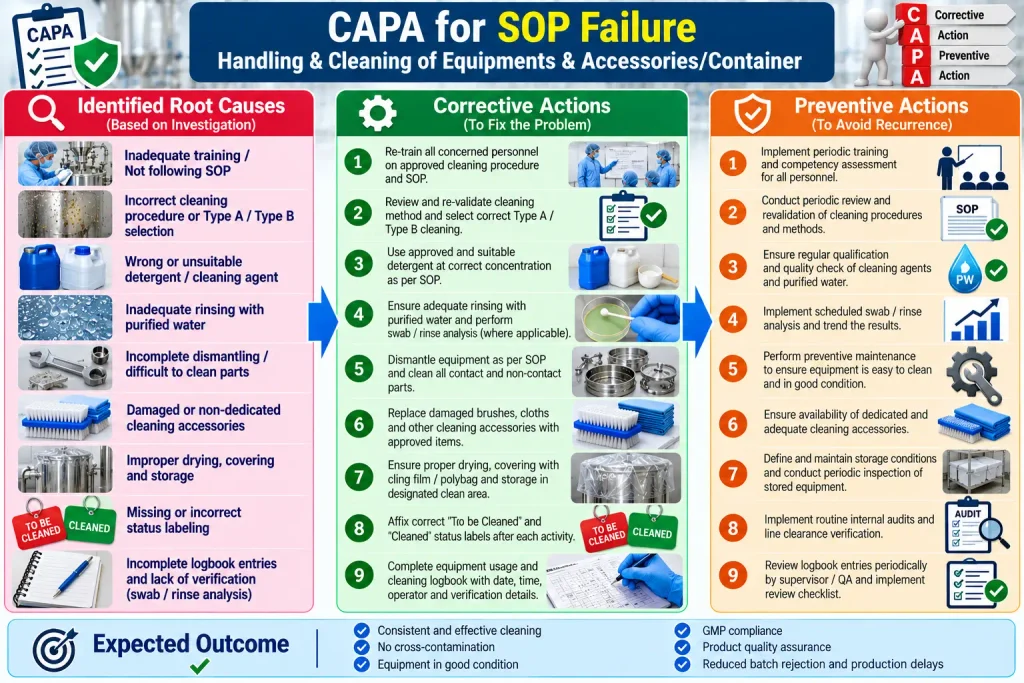
The SOP specifically requires appropriate cleaning after processing, use of “To be Cleaned” and “Cleaned” status labels, defined Type A/Type B cleaning, suitable rinsing, drying, protection, and recording of cleaning activities.Preventive actions should therefore focus on periodic training, supervision, review of cleaning practices, availability of suitable cleaning accessories, verification of wash-water/swab analysis where applicable, inspection of equipment before use, and periodic review of cleaning logbooks. Effective CAPA implementation helps maintain consistent equipment cleanliness, GMP compliance, traceability, product quality, and readiness of equipment for subsequent manufacturing operations.
9. 5-Why Analysis for SOP Failure – Handling & Cleaning of Equipments & Accessories/Container:
The 5-Why Analysis is used to identify the underlying cause of failure to follow the SOP for handling and cleaning of equipment, accessories, and containers. The SOP requires equipment to be cleaned at defined frequencies, correctly identified with status labels, protected after cleaning, and documented in the equipment usage and cleaning logbook.The analysis indicates that improper cleaning may occur when the required Type A or Type B cleaning, equipment status labeling, cleaning frequency, or documentation requirements are not followed. The SOP also requires cleaned equipment to be dried, protected, labeled as “Cleaned,” and checked before use.
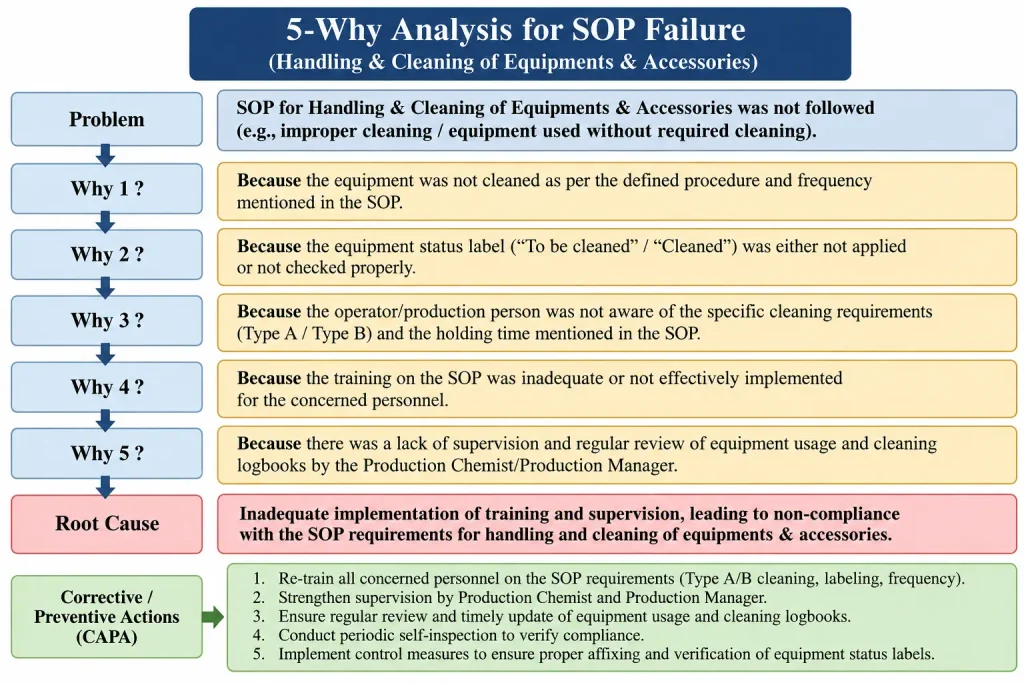
The 5-Why approach links these failures progressively to inadequate operator awareness, ineffective training, and insufficient supervisory review. The identified root cause is therefore weak implementation of training and supervision, which can lead to non-compliance with the approved cleaning and handling procedure.Corrective and preventive actions should include retraining concerned personnel, strengthening Production supervision, routine review of equipment cleaning logbooks, verification of status labels, and periodic compliance checks to ensure sustained adherence to the SOP.
Question & Answer – SOP for Handling & Cleaning of Equipments & Accessories/Container:
- What is the objective of this SOP?
The objective is to describe the procedure for handling and cleaning of equipment and accessories used in production. - Who is responsible for execution of this SOP?
Concerned Production Personnel and the Production Chemist are responsible for execution of the SOP. - Who is responsible for effective implementation of the SOP?
The Production Manager and Head-QA/QC are responsible for effective implementation. - When should the “To be cleaned” label be affixed?
It should be affixed after completion of processing and before starting the cleaning operation. - When is Type A cleaning performed?
Type A cleaning is carried out during batch changeover of the same product and ascending strength, provided the colour is the same. - When is Type B cleaning required?
Type B cleaning is required for changeover to products with different actives or colour, descending potency, after maintenance of contact parts, when the next product is unknown, and after seven consecutive Type A cleanings. - What is the Type B cleaning sequence?
Type B cleaning includes process water, 0.1% v/v Teepol solution, rinsing with process water until detergent traces are removed, followed by a final rinse with purified water. - What should be done if equipment is not used within the specified clean-hold period?
If the equipment is not used within seven days after Type B cleaning or within five days after Type A cleaning, Type B cleaning should be carried out and documented. - When is wash water or swab analysis required?
It is required where applicable during product changeover involving different actives, colour, descending potency, or when the next product is unknown. - What should be done after equipment cleaning is completed?
The equipment should be dried, exposed parts covered with cling film, transferred to the cleaned equipment room as applicable, and protected with a polybag. - What status label is applied after successful cleaning?
A duly filled “Cleaned” status tag should be affixed to the equipment or accessory. - Where should cleaning details be recorded?
Cleaning details should be recorded in the Equipment Usage and Cleaning Logbook. - What should be checked before using cleaned equipment?
The equipment should be visually inspected for cleanliness immediately before use. - How should nylon brushes used in production be cleaned?
They should be cleaned with potable water using 0.1% v/v Teepol solution, rinsed with purified water, dried with compressed air, and visually inspected. - What type of lubricant should be used on manufacturing equipment?
Lubricants used on machines should be food grade, with appropriate certification from the vendor. - What is required before issuing a new hose or silicone tube?
The food-grade certificate should be verified before issuance. - How should a used hose or silicone tube be stored after cleaning?
It should be properly dried, placed in a polybag with a status label, and both ends of the silicone tube should be covered with aluminium foil. - When should a hose pipe or silicone tube be discarded?
It should be discarded when damaged, when integrity is unsatisfactory, or when its visual appearance is not satisfactory. - What should be checked before using polybags?
The food-grade Certificate of Analysis should be checked before use. - What is the overall purpose of following this SOP?
It helps ensure proper equipment cleanliness, contamination control, correct status identification, documentation, and readiness of equipment for safe pharmaceutical manufacturing.
Reference Guidelines – SOP for Handling & Cleaning of Equipments & Accessories/Container:
- WHO Good Manufacturing Practices (GMP) – requirements for premises, equipment, sanitation, cleaning, and prevention of contamination/cross-contamination.
- EU GMP Guidelines – Part I, Chapter 3: Premises and Equipment – design, cleaning, maintenance, and prevention of contamination.
- EU GMP Guidelines – Part I, Chapter 5: Production – controls for cleaning, line clearance, and prevention of cross-contamination.
- US FDA 21 CFR Part 211.67 – Equipment Cleaning and Maintenance – requirements for cleaning, maintenance, and written procedures for equipment.
- US FDA 21 CFR Part 211.182 – Equipment Cleaning and Use Log – documentation of equipment cleaning, maintenance, and usage.
- PIC/S Guide to GMP for Medicinal Products – requirements for equipment cleanliness, maintenance, production control, and contamination prevention.
- ICH Q7 – GMP for Active Pharmaceutical Ingredients – principles for equipment cleaning, maintenance, and cleaning records where applicable.
- WHO Technical Report Series (TRS) GMP guidance – general GMP expectations for cleaning, sanitation, equipment status, and contamination control.