







1. Introduction – Handling of Defoiled and Rejected Tablets:
The Handling of Defoiled and Rejected Tablets SOP defines a systematic procedure for the controlled handling, segregation, inspection, recovery, repacking, and disposal of tablets and capsules removed from defective blisters or strips. The procedure applies to de-foiled and rejected tablets/capsules generated during packaging operations and is supervised by the Packaging Supervisor. The SOP requires defective blisters or strips to be brought into the primary packing cubicle and de-blistered or de-foiled according to the applicable procedure. During manual operations, gloves are worn and the recovered tablets or capsules are collected in properly labelled double polybags. Empty packaging material is kept separately, while the recovered product is carefully inspected for defects or adhering foil. Acceptable tablets or capsules may be packed at the end of the batch, whereas rejected units are segregated, labelled, and subsequently destroyed according to the applicable SOP. Proper implementation of this SOP helps maintain product quality, traceability, segregation, GMP compliance, prevention of mix-ups, and controlled handling of rejected pharmaceutical products.
Skip to PDF content2. Flow Diagram – Handling of Defoiled and Rejected Tablets:
The Handling of Defoiled and Rejected Tablets SOP describes the controlled procedure for managing tablets and capsules removed from defective blisters or strips during packaging operations. Defective packs are brought into the primary packing cubicle and de-foiling or de-blistering is performed according to the applicable SOP. During manual handling, the operator uses gloves and a clean polybag-covered table. Recovered tablets or capsules are collected in a properly labelled double polybag, while empty blisters or strips are kept separately.
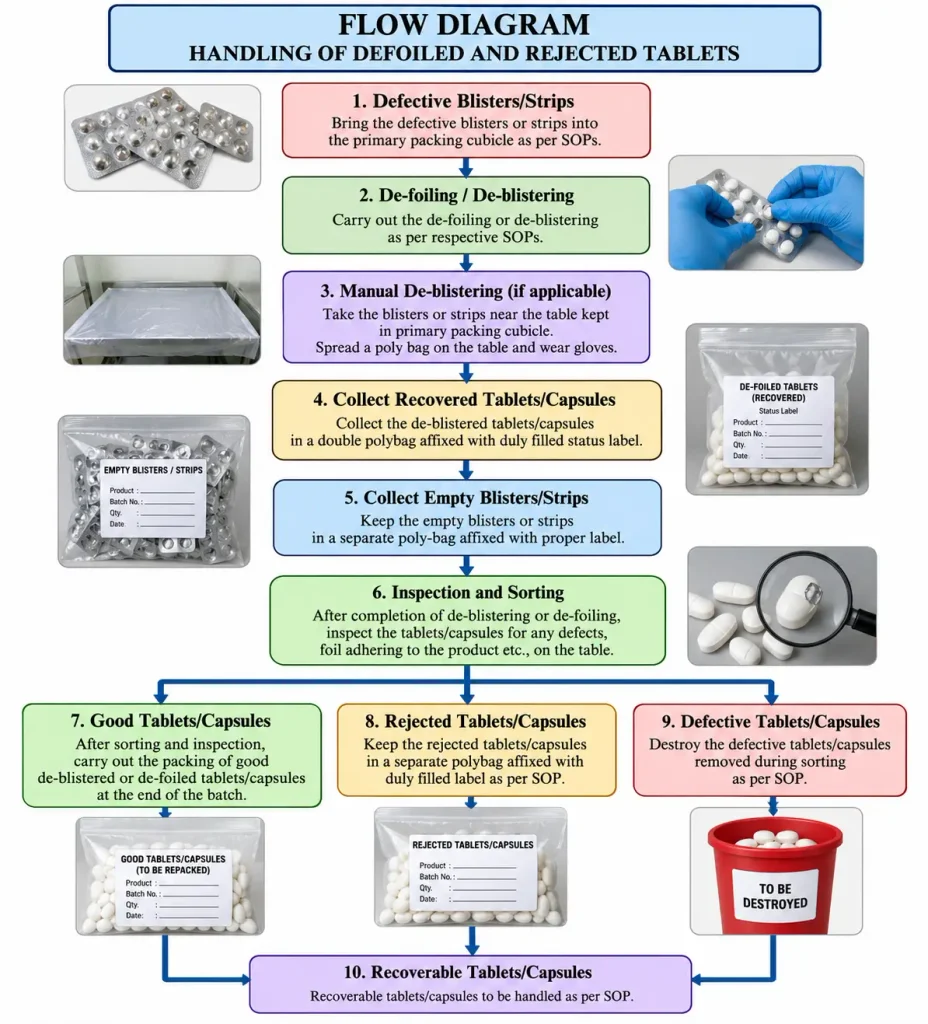
After de-blistering, the product is inspected for defects and for any adhering foil. Acceptable tablets or capsules may be packed at the end of the batch, whereas rejected units are segregated into a separate labelled polybag. Proper segregation from good product must be maintained throughout the process, and defective tablets or capsules identified during sorting are destroyed as per the applicable SOP. This procedure supports product quality, traceability, prevention of mix-ups, controlled recovery, and appropriate disposal of rejected pharmaceutical products.
3. Brainstorming for SOP Failure – Handling of Defoiled and Rejected Tablets:
The Brainstorming for SOP Failure – Handling of Defoiled and Rejected Tablets identifies the possible causes that may lead to non-compliance during de-foiling, segregation, inspection, recovery, labeling, repacking, and disposal activities. Key failure possibilities include improper identification of defective blisters or strips, incorrect de-blistering practices, failure to use gloves or suitable PPE, use of an uncovered work table, and inadequate segregation between good, recovered, and rejected tablets or capsules.
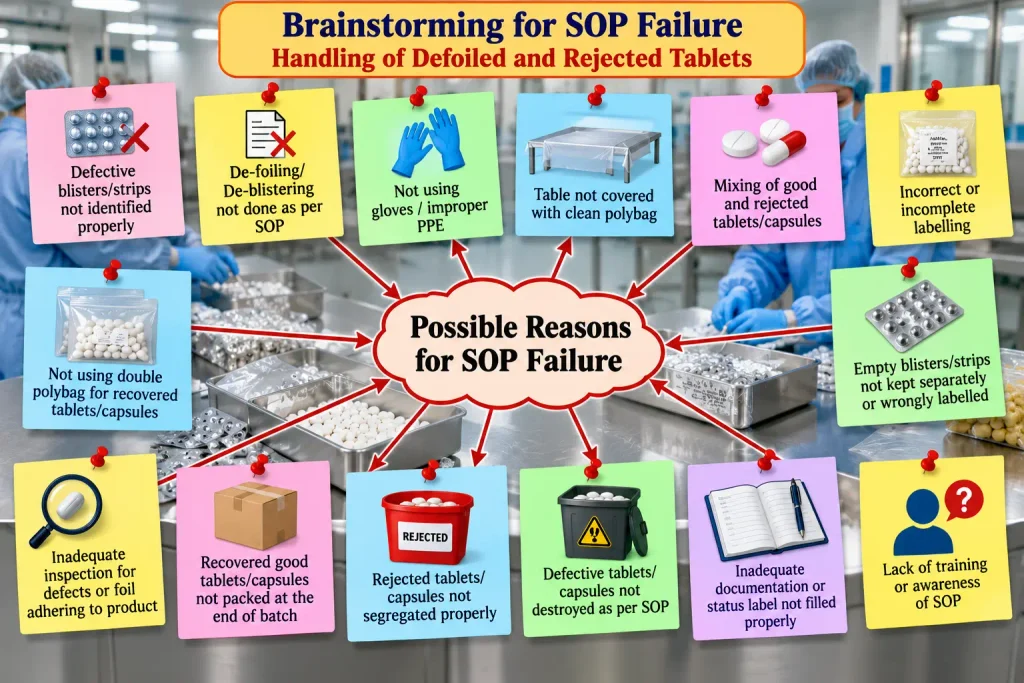
Other potential causes include incomplete status labeling, failure to use double polybags for recovered product, inadequate inspection for defects or adhering foil, improper handling of empty blisters or strips, insufficient documentation, and lack of operator training. The SOP specifically requires controlled de-blistering, use of gloves, proper labeling, separate handling of empty packaging components, inspection of recovered tablets or capsules, segregation of rejected units, and destruction of defective product according to the applicable procedure. This brainstorming approach helps identify weaknesses early and supports appropriate training, supervision, documentation, segregation, and CAPA to prevent recurrence of SOP failures.
4. 5-Why Analysis for SOP Failure – Handling of Defoiled and Rejected Tablets:
The 5-Why Analysis for SOP Failure – Handling of Defoiled and Rejected Tablets is used to identify the underlying causes of failures that may occur during de-foiling, inspection, segregation, labeling, recovery, repacking, and disposal activities. The analysis starts with an observed problem and repeatedly asks “Why?” until the probable root cause is identified. Typical failures may include defective tablets being mixed with acceptable product, empty blisters or strips being mixed with recovered tablets, foil remaining adhered to tablets or capsules, missing or incomplete status labels, and rejected product not being destroyed as required. These failures can arise from inadequate inspection, improper segregation, incorrect de-foiling technique, lack of labels or polybags, insufficient supervision, weak in-process checks, and inadequate operator training.
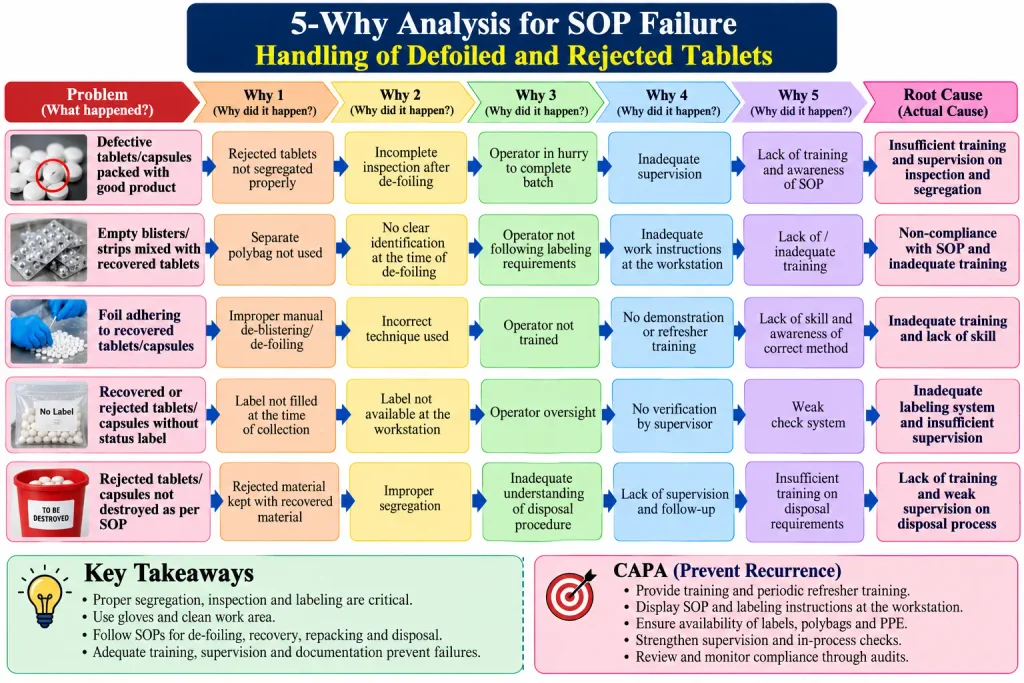
The SOP requires recovered tablets or capsules to be properly collected and labelled, empty blisters or strips to be kept separately, products to be inspected for defects and adhering foil, rejected units to be segregated, and defective units to be destroyed according to the applicable SOP. The 5-Why approach supports identification of the actual root cause and helps establish effective CAPA through improved training, supervision, workplace instructions, documentation, segregation controls, and routine compliance monitoring.
5. Fishbone Analysis for SOP Failure – Handling of Defoiled and Rejected Tablets:
The Fishbone Analysis for SOP Failure – Handling of Defoiled and Rejected Tablets is used to systematically identify the potential causes that can lead to improper handling of de-foiled, recovered, and rejected tablets or capsules. The analysis groups possible causes under major categories such as Man, Machine, Material, Method, Measurement, and Environment.
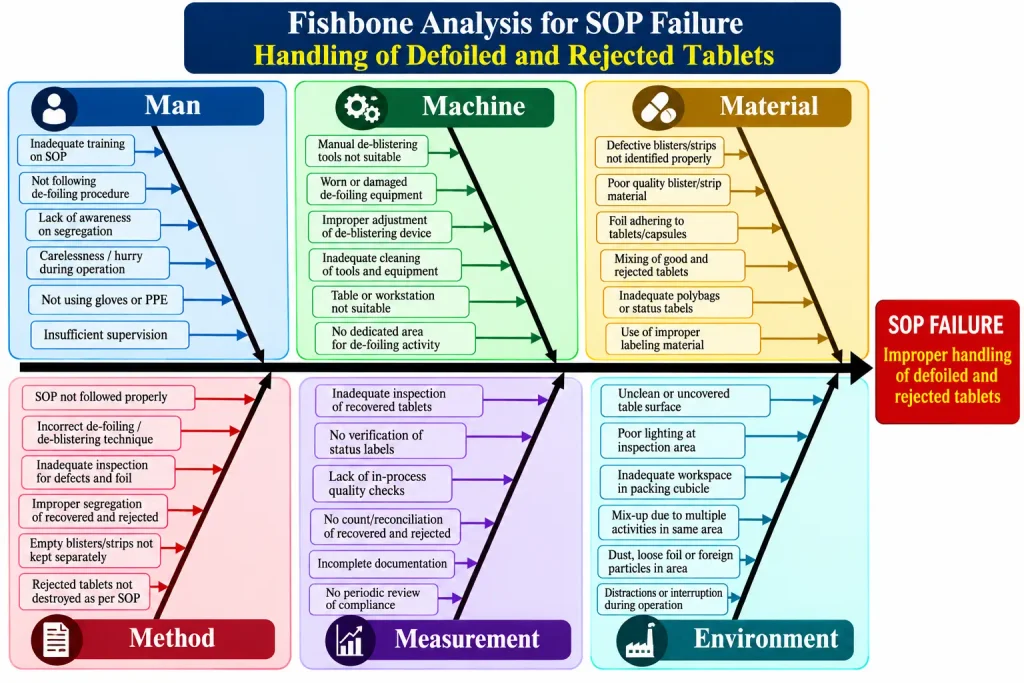
Human-related causes may include inadequate training, lack of awareness, carelessness, insufficient supervision, and failure to use gloves or required PPE. Equipment-related causes may involve unsuitable or damaged de-blistering tools and poorly maintained workstations. Material causes can include defective blisters, adhering foil, inadequate polybags, and incorrect labels. Method-related causes may involve improper de-foiling, poor segregation, inadequate inspection, and failure to destroy rejected tablets as required. Measurement and environmental factors include weak verification, incomplete documentation, poor lighting, unclean work surfaces, and workspace-related mix-up risks. The SOP requires proper de-blistering, use of gloves, labelled double polybags, separate handling of empty blisters, inspection of recovered product, segregation of rejected units, and destruction of defective tablets or capsules as per applicable procedures. This fishbone analysis helps identify contributing factors and supports focused CAPA, training, supervision, process control, and compliance improvement.
6. Fault Tree Analysis for SOP Failure – Handling of Defoiled and Rejected Tablets:
The Fault Tree Analysis for SOP Failure – Handling of Defoiled and Rejected Tablets evaluates how different failures can combine and result in the top event of improper handling of de-foiled and rejected tablets/capsules. The analysis begins with the undesired outcome and traces it downward through intermediate events and basic causes using logical branches. Major failure events may include mixing of good, recovered, and rejected tablets; foil remaining adhered to tablets or capsules; missing or incomplete status labeling; and failure to destroy rejected tablets according to the applicable procedure. These events may arise from inadequate segregation, poor inspection, operator error, incorrect de-foiling technique, damaged or unsuitable tools, unavailability of labels, lack of awareness, inadequate supervision, or improper disposal practices.
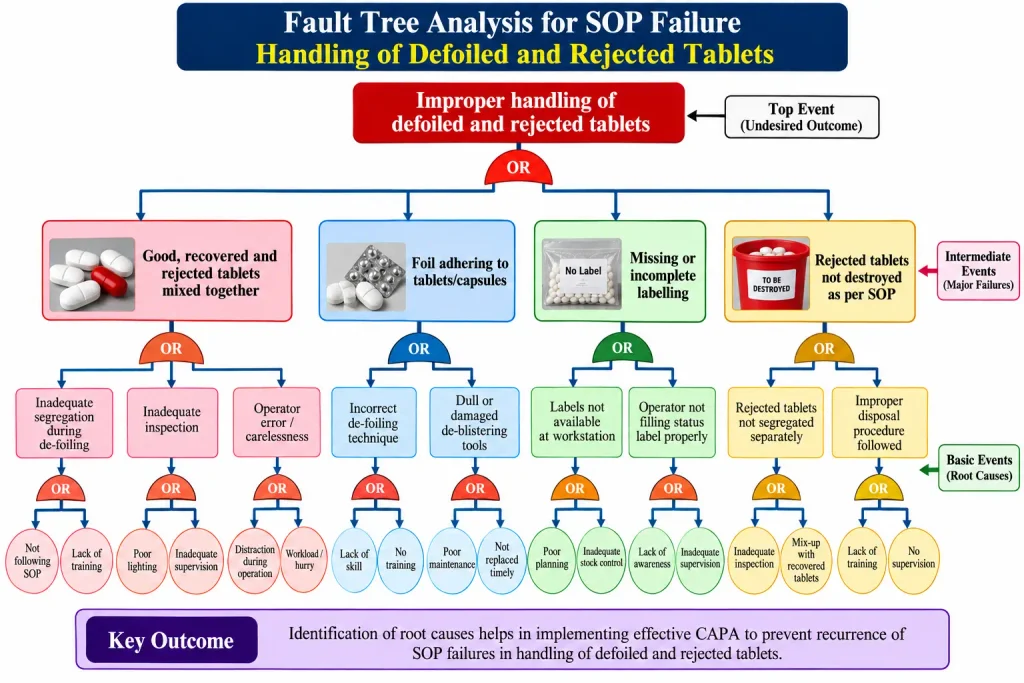
The SOP specifically requires recovered tablets/capsules to be collected in a duly labelled double polybag, empty blisters or strips to be kept separately, recovered product to be inspected for defects and adhering foil, rejected units to be segregated, and defective tablets or capsules to be destroyed as per SOP. Fault Tree Analysis helps identify critical failure pathways and root causes, supporting focused CAPA, improved training, stronger supervision, better labeling control, effective segregation, and prevention of recurring SOP failures.
7. Impact Assessment for SOP Failure – Handling of Defoiled and Rejected Tablets:
The Impact Assessment for SOP Failure – Handling of Defoiled and Rejected Tablets evaluates the possible consequences of improper de-foiling, segregation, inspection, labeling, recovery, repacking, and disposal of tablets or capsules. Failure to follow the defined procedure can result in defective or contaminated product being mixed with acceptable material, foil or other foreign matter remaining with recovered tablets, and rejected material being inadequately identified or segregated. Such failures may affect product quality, patient safety, regulatory compliance, production efficiency, documentation accuracy, financial performance, and company reputation. Inadequate handling can also lead to rework, product loss, investigation, production delays, batch-record discrepancies, complaints, recalls, or audit observations.
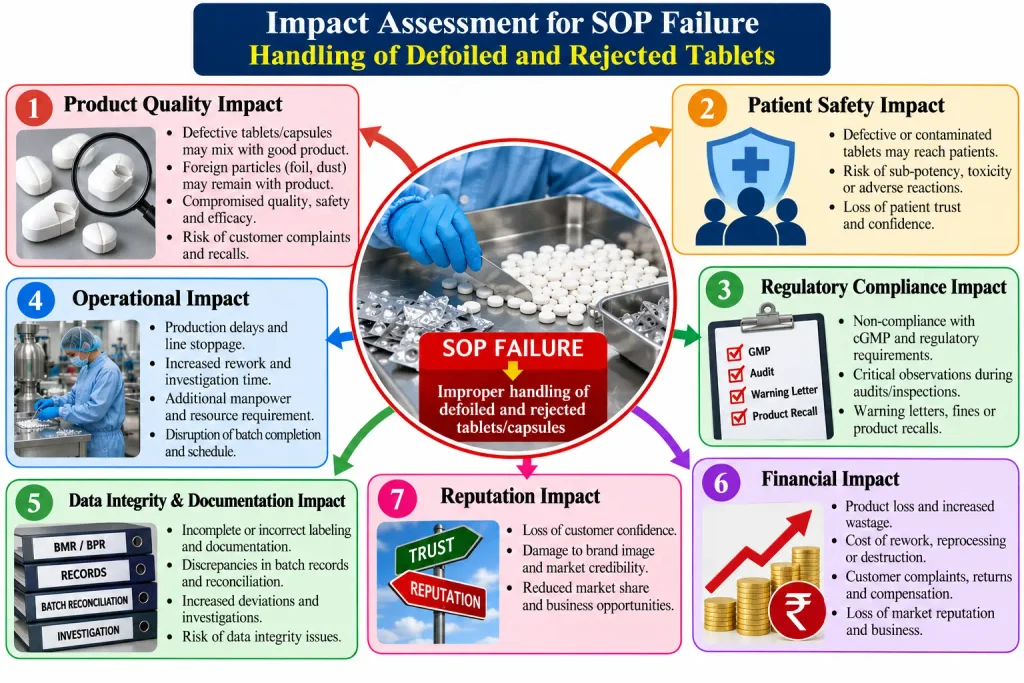
The SOP requires recovered tablets or capsules to be collected in properly labelled double polybags, empty blisters or strips to be kept separately, recovered product to be inspected for defects and adhering foil, rejected units to be segregated, and defective tablets or capsules to be destroyed according to the applicable procedure. Effective implementation of the SOP therefore helps reduce quality and compliance risks while maintaining traceability, segregation, product integrity, and controlled disposal.
8. Corrective and Preventive Action (CAPA) – Handling of Defoiled and Rejected Tablets:
The Corrective and Preventive Action (CAPA) for Handling of Defoiled and Rejected Tablets is intended to correct identified failures and prevent their recurrence during de-foiling, segregation, inspection, labeling, recovery, repacking, and disposal activities. Corrective actions may include stopping the affected activity, re-inspecting recovered tablets or capsules, removing adhering foil, segregating mixed material, quarantining unlabeled product, correcting status labels, and ensuring rejected material is destroyed according to the applicable SOP. Preventive actions focus on strengthening the overall system through operator retraining, improved supervision, availability of suitable labels and polybags, use of approved de-blistering tools, clear workstation instructions, periodic verification, and routine compliance checks.
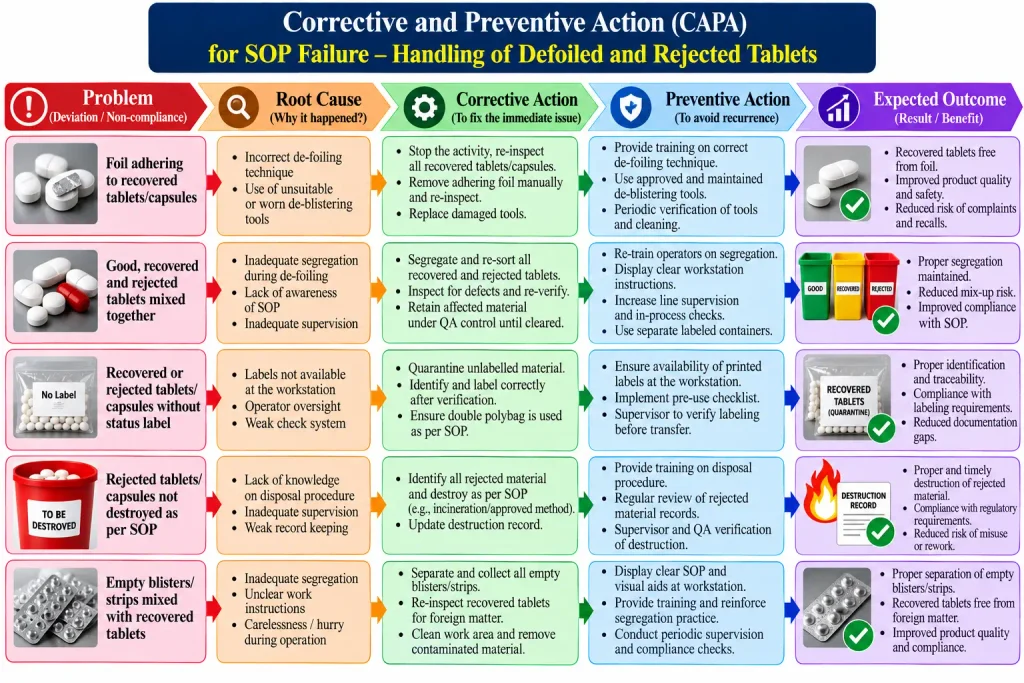
The SOP requires recovered tablets or capsules to be collected in a duly labelled double polybag, empty blisters or strips to be kept separately, recovered units to be inspected for defects or adhering foil, rejected units to be segregated, and defective tablets or capsules to be destroyed as per SOP. Effective CAPA helps improve product quality, traceability, segregation control, documentation, GMP compliance, and prevention of repeated SOP failures.
Questions & Answers – Handling of Defoiled and Rejected Tablets:
Q1. What is the objective of the SOP for Handling of Defoiled and Rejected Tablets?
The objective is to describe the procedure for handling de-foiled and rejected tablets and capsules.
Q2. Who is responsible for supervising the handling of de-foiled and rejected tablets/capsules?
The Packaging Supervisor is responsible for supervising the activity.
Q3. Where should defective blisters or strips be taken before de-foiling?
They should be brought into the primary packing cubicle as per the applicable SOP.
Q4. What precaution is required during manual de-blistering or de-foiling?
A polybag should be spread on the table, and the operator should wear gloves before carrying out the activity.
Q5. How should recovered tablets or capsules be collected?
They should be collected in a double polybag affixed with a duly filled status label.
Q6. How should empty blisters or strips be handled?
They should be kept separately in a polybag affixed with a proper label.
Q7. What inspection is required after de-blistering or de-foiling?
The tablets or capsules should be inspected for defects and for any foil adhering to the product.
Q8. What should be done with good de-blistered or de-foiled tablets/capsules?
After sorting and inspection, acceptable tablets or capsules may be packed at the end of the batch.
Q9. How should rejected tablets or capsules be handled?
They should be kept in a separate polybag with a duly filled label as per the applicable SOP.
Q10. Why is segregation important during this activity?
Proper segregation helps prevent mixing of de-foiled or de-blistered tablets/capsules with good tablets or capsules.
Q11. What should be done with defective tablets or capsules identified during sorting?
They should be destroyed as per the applicable SOP.
Q12. How should recoverable tablets or capsules be handled?
Recoverable tablets or capsules should be handled according to the relevant SOP.
Reference Guidelines – Handling of Defoiled and Rejected Tablets:
- WHO Good Manufacturing Practices (GMP) for Pharmaceutical Products – requirements for prevention of mix-ups, segregation, handling of rejected materials, documentation, and packaging controls.
- EU Guidelines for Good Manufacturing Practice, Part I – Chapter 5: Production – controls for packaging operations, rejected materials, prevention of contamination and mix-ups.
- EU GMP Part I – Chapter 4: Documentation – requirements for controlled records, labels, traceability, and documentation of manufacturing/packing activities.
- PIC/S Guide to GMP (PE 009), Part I – Chapter 5: Production – segregation, packaging controls, rejected product handling, reconciliation, and prevention of product mix-ups.
- Schedule M of the Drugs and Cosmetics Rules, India – Good Manufacturing Practices – requirements for production, packaging, rejected materials, documentation, and pharmaceutical quality systems.
- ICH Q9 – Quality Risk Management – applicable for evaluating risks related to mix-ups, contamination, incorrect segregation, and handling failures.
- Site SOPs for De-blistering/De-foiling, Rejected Material Handling, Destruction of Rejected Product, and Line Clearance – should be cross-referenced where applicable.