







1. Introduction – SOP for Handling of Dispensed Material:
The SOP for Handling of Dispensed Material describes the controlled method for handling dispensed raw materials and packing materials used during pharmaceutical manufacturing and packing operations. Its purpose is to ensure that materials are correctly identified, labelled, segregated, stored, transferred, used, returned, and reconciled so that mix-ups, contamination, loss, and incorrect material usage are prevented. The SOP covers the handling of dispensed raw and packing materials, additional material requisition, material return, and on-line rejection of materials. Dispensed raw materials are transferred from the dispensing room to the day store, kept batch-wise with proper labels and segregation, and verified for batch identity before processing. Primary and secondary packing materials are also controlled through proper labelling, segregation, secure storage, QC reference verification, FIFO practices, and attachment of relevant specimens to the Batch Packing Record. The procedure further provides controls for overprinted packing materials, additional material requirements, and return of unused packing materials to the warehouse, ensuring proper authorization, documentation, verification, and traceability throughout the material-handling process.
Skip to PDF content2. Flow Diagram – SOP for Handling of Dispensed Material:
The SOP for Handling of Dispensed Material defines the controlled process for receiving, storing, transferring, verifying, using, returning, and reconciling dispensed raw and packing materials in pharmaceutical manufacturing. Dispensed raw materials are transferred from the dispensing room to the day store, properly labelled, segregated batch-wise, and verified for batch identity before processing.
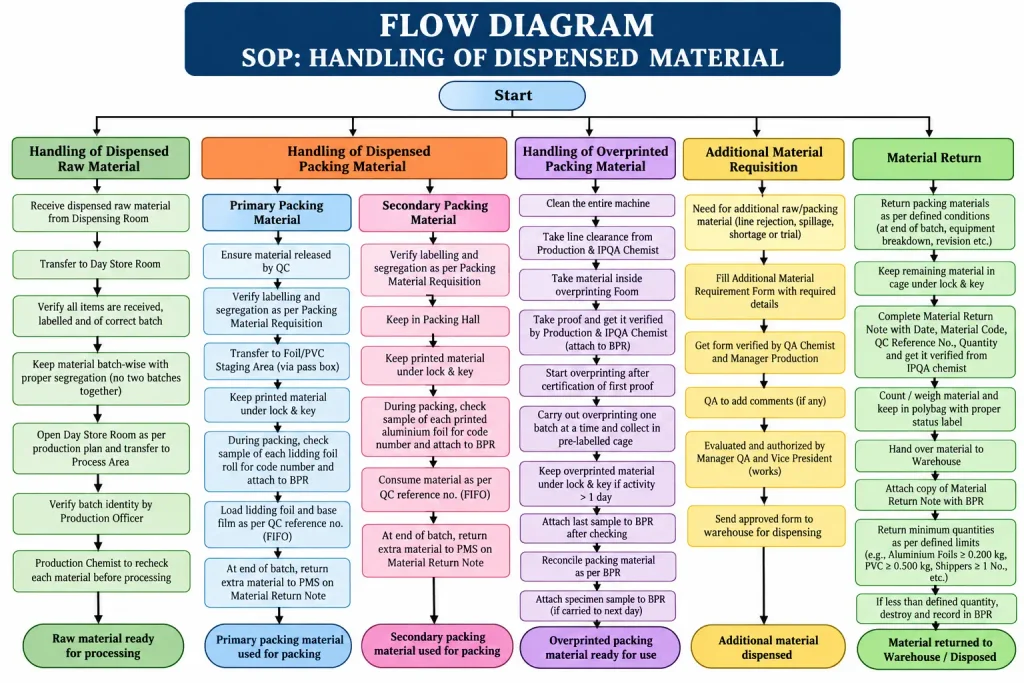
Primary and secondary packing materials are handled under defined controls such as QC release verification, proper labelling, segregation, secure storage, FIFO usage, and attachment of representative samples to the Batch Packing Record. Overprinted packing materials are controlled through line clearance, proof verification, batch-wise segregation, reconciliation, and specimen attachment to the BPR. The SOP also covers additional material requisition and material return to ensure authorization, traceability, proper documentation, and controlled disposition of unused or rejected materials.
3. Benefits of Following SOP – SOP for Handling of Dispensed Material:
The SOP for Handling of Dispensed Material provides several important benefits by ensuring that dispensed raw materials and packing materials are handled in a controlled and traceable manner. Proper labelling, batch-wise segregation, verification, secure storage, and controlled transfer help prevent material mix-ups and reduce the risk of using the wrong material in manufacturing or packing operations. For packing materials, the SOP requires QC-released materials, proper segregation, secure storage of printed components, FIFO usage where applicable, and attachment of representative samples in the Batch Packing Record. These controls support product quality, traceability, accountability, and accurate reconciliation.
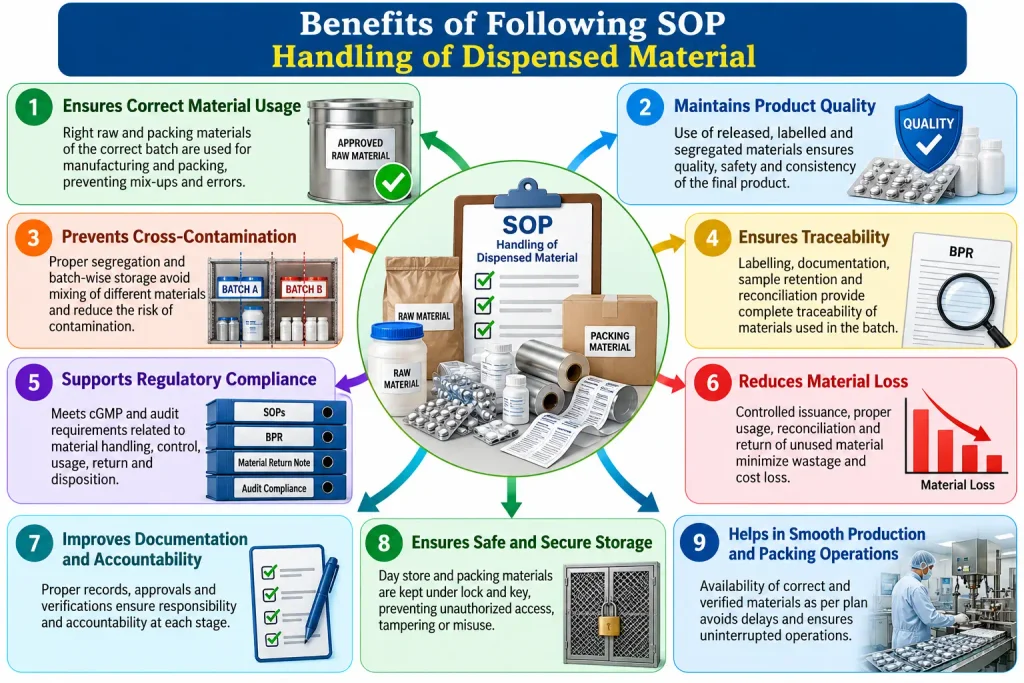
The procedure also controls additional material requisition and return of unused materials through verification, authorization, material return notes, counting or weighing, status labelling, and documentation in the BPR. This helps minimize material loss, supports proper inventory control, and ensures smooth manufacturing and packing operations.
4. Brainstorming For SOP Failure – SOP for Handling of Dispensed Material:
The SOP for Handling of Dispensed Material may fail when the defined controls for identification, segregation, storage, transfer, verification, documentation, and reconciliation are not followed properly. The SOP requires dispensed raw materials to be properly labelled, kept batch-wise, segregated from other batches, stored in the day store, and verified for batch identity before processing.
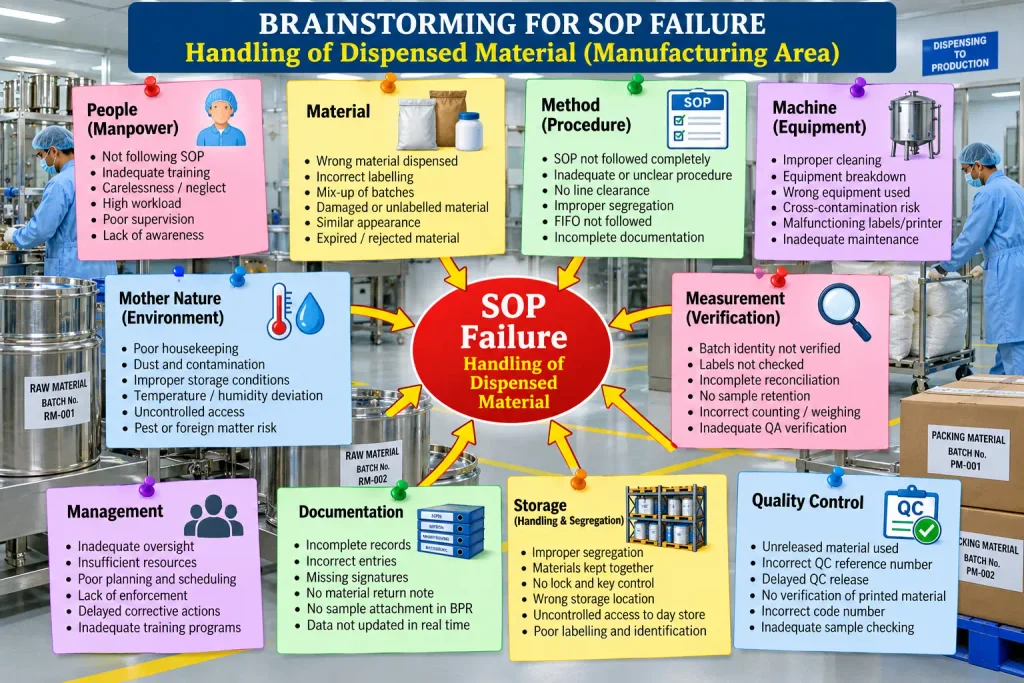
Potential failure causes therefore include incorrect labelling, mixing of different batches, poor segregation, unauthorized access to the day store, lack of batch verification, or failure to follow the prescribed handling sequence. For packing materials, additional risks include use of unreleased material, failure to maintain lock-and-key control for printed material, incorrect QC reference number, improper FIFO application, incomplete sample attachment in the BPR, and inadequate reconciliation. Brainstorming these possible causes helps Production and QA personnel identify weak points in manpower, materials, procedures, storage, verification, documentation, and supervision before they result in mix-ups, material loss, incorrect usage, or batch-related errors.
5. 5-Why Analysis for SOP Failure – SOP for Handling of Dispensed Material:
The 5-Why Analysis for SOP Failure – Handling of Dispensed Material identifies the progressive causes that may lead to improper handling of dispensed raw and packing materials in the manufacturing area. The SOP requires materials to be properly labelled, segregated batch-wise, stored under controlled conditions, and verified for batch identity before use.
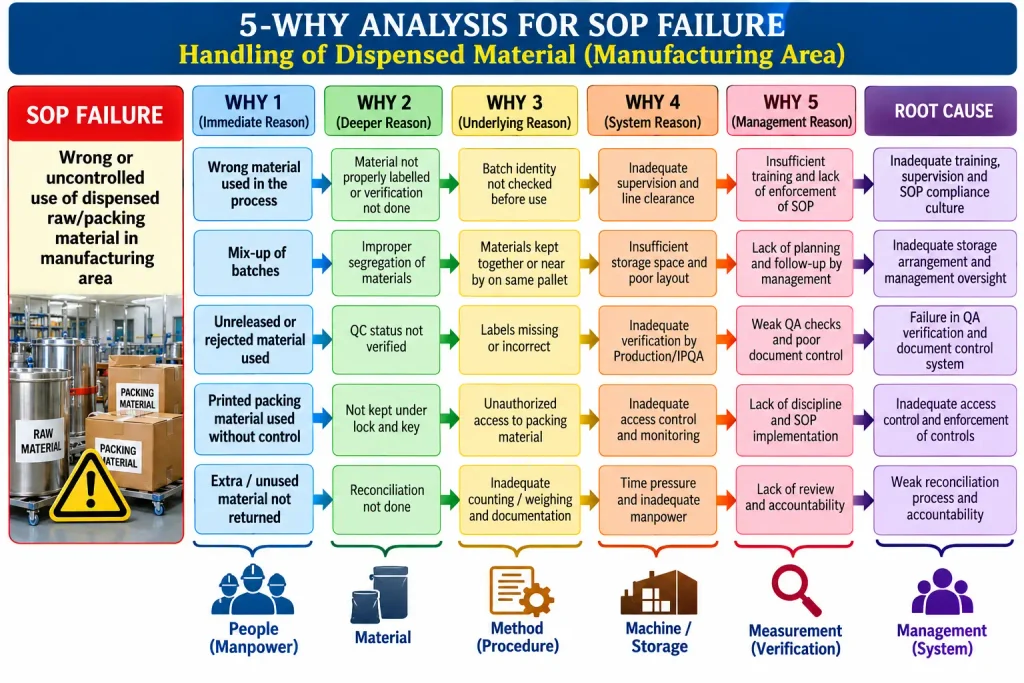
The analysis highlights that failures such as wrong material usage, batch mix-up, use of unreleased or rejected material, uncontrolled use of printed packing material, and improper return of excess material may arise when verification, segregation, storage control, reconciliation, or documentation are inadequate. For packing materials, the SOP specifically requires QC release, proper labelling and segregation, lock-and-key control for printed materials, FIFO usage, and return of excess material through a Material Return Note. The 5-Why approach helps trace these immediate failures to deeper system causes such as inadequate supervision, weak QA verification, insufficient training, poor access control, and lack of accountability. Identifying the root cause supports effective CAPA and strengthens compliance with the defined material-handling procedure.
6. Fishbone Analysis for SOP Failure – SOP for Handling of Dispensed Material:
The Fishbone Analysis for SOP Failure – Handling of Dispensed Material identifies the major possible causes that can lead to incorrect or uncontrolled handling of dispensed raw and packing materials in the manufacturing area. The causes are grouped under Manpower, Material, Method, Machine, Environment, and Measurement to make the investigation systematic and easy to understand.
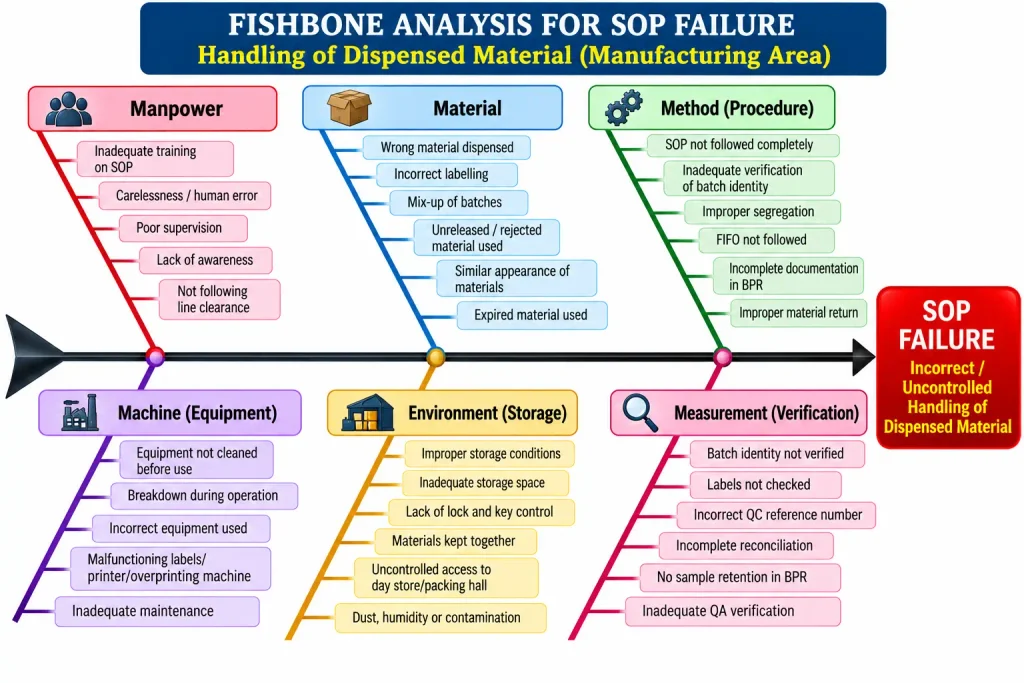
Manpower-related causes may include inadequate training, poor supervision, lack of awareness, or human error. Material-related causes include wrong material dispensing, incorrect labelling, batch mix-up, or use of unreleased material. Method-related failures may arise from improper segregation, incomplete documentation, failure to follow FIFO, or incorrect material-return practices. The SOP specifically requires batch-wise segregation, proper labelling, verification of batch identity, and controlled storage before processing. Equipment, storage, and verification failures may include poor cleaning, unsuitable storage conditions, lack of lock-and-key control, incorrect QC reference verification, incomplete reconciliation, or insufficient QA checks. These factors can collectively increase the risk of mix-ups, material loss, traceability gaps, and non-compliance.
7. Fault Tree Analysis for SOP Failure – SOP for Handling of Dispensed Material:
The Fault Tree Analysis for SOP Failure – Handling of Dispensed Material provides a structured method for identifying the possible causes that may lead to incorrect or uncontrolled handling of dispensed materials in the manufacturing area. The top event, SOP Failure, may result from failures related to raw materials, packing materials, storage, handling, documentation, verification, or material return. For raw materials, the SOP requires proper labelling, batch-wise segregation, controlled storage in the day store, and verification of batch identity before processing. Failure in any of these controls may result in wrong material use or batch mix-up. packing materials, risks may arise from use of unreleased material, incorrect QC reference numbers, uncontrolled printed materials, incomplete reconciliation, or failure to return excess material properly.
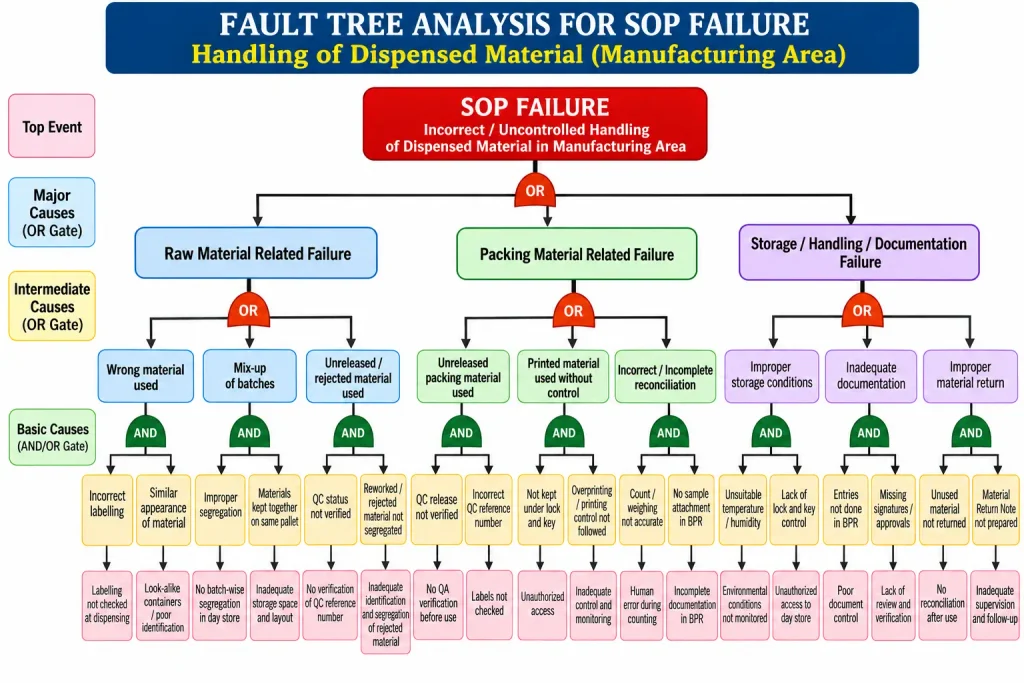
The fault tree helps trace each major failure to basic causes such as incorrect labelling, poor segregation, inadequate verification, weak access control, incomplete BPR documentation, improper storage, missing approvals, and insufficient reconciliation. This analysis supports systematic root-cause identification and helps define appropriate corrective and preventive actions to strengthen SOP compliance.
8. Impact Assessment for SOP Failure – SOP for Handling of Dispensed Material:
The Impact Assessment for SOP Failure – Handling of Dispensed Material explains the potential consequences that may arise when dispensed raw materials or packing materials are not handled according to the approved procedure. The SOP requires correct identification, labelling, batch-wise segregation, controlled storage, verification, and proper transfer of dispensed materials before use in manufacturing or packing. Failure to follow these controls can lead to wrong material usage, batch mix-ups, use of unreleased material, incorrect reconciliation, documentation gaps, material loss, production delays, and increased investigation or rework activities. For packing materials, the SOP also requires QC release, secure storage of printed materials, correct QC reference verification, FIFO usage, and proper return of excess material.
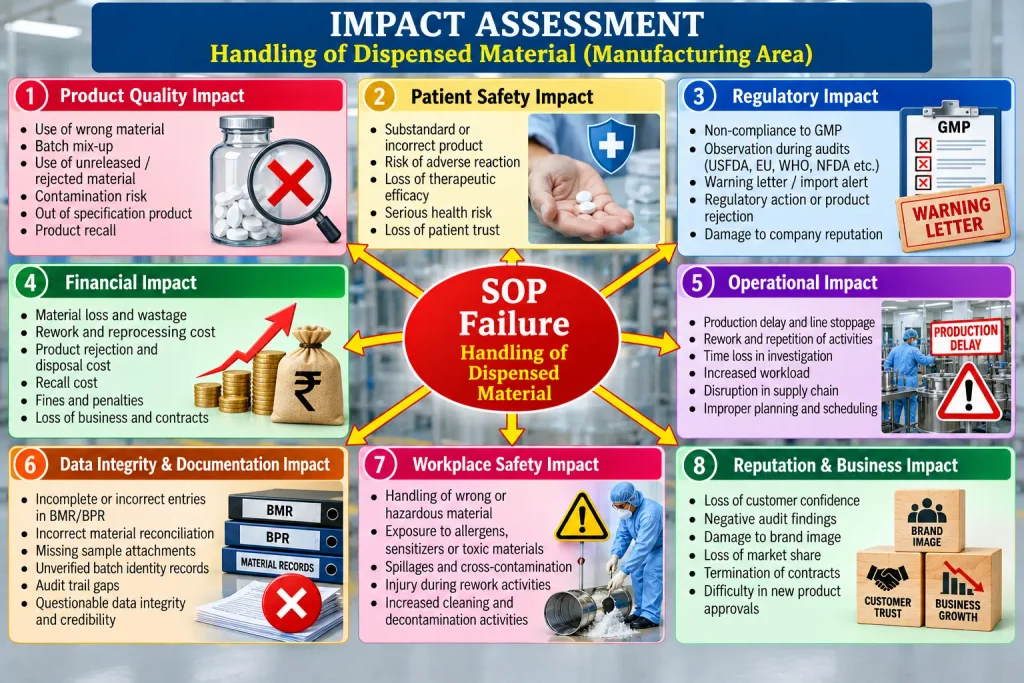
Such failures may negatively affect product quality, traceability, GMP compliance, operational efficiency, inventory control, documentation reliability, and overall batch accountability. A structured impact assessment helps Production and QA personnel understand the seriousness of SOP failure and supports timely corrective and preventive actions.
9. CAPA for SOP Failure – SOP for Handling of Dispensed Material:
The CAPA for SOP Failure – Handling of Dispensed Material is intended to correct identified material-handling failures and prevent their recurrence during manufacturing and packing operations. Immediate corrective actions may include stopping use of the affected material, segregating or quarantining suspect material, rechecking batch identity and labels, verifying QC release status, correcting BMR/BPR entries, and reconciling the dispensed quantity.
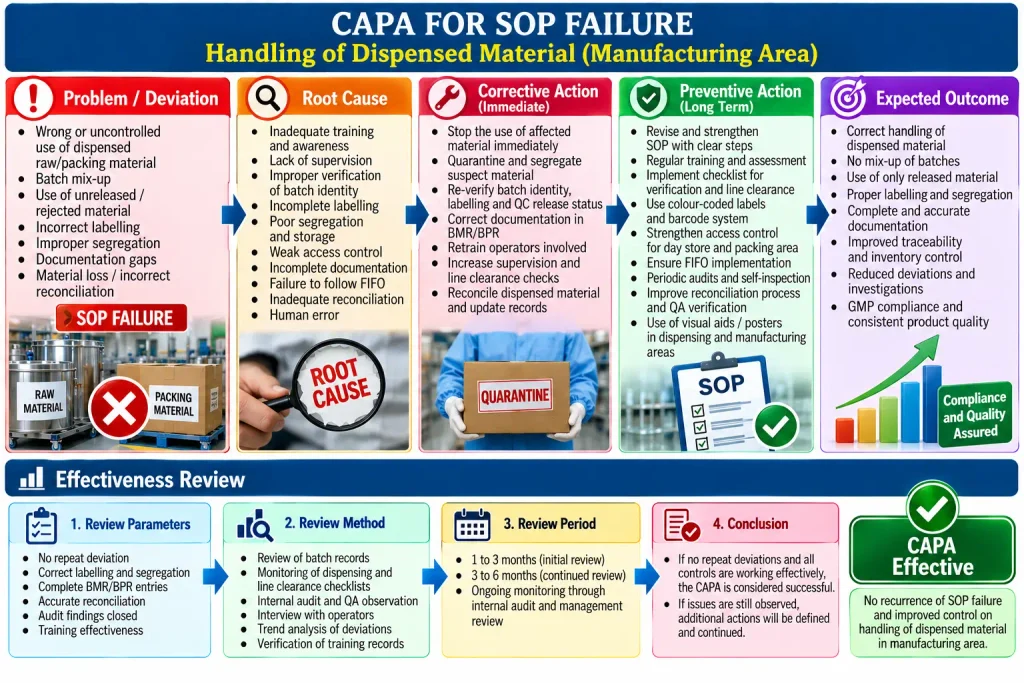
Preventive actions should focus on strengthening the existing controls defined in the SOP, including proper batch-wise segregation, correct labelling, secure storage, verification before processing, and controlled access to dispensed materials. The SOP specifically requires dispensed raw materials to be kept together batch-wise, separated from other batches, and verified by Production before processing. Printed packing materials are also required to remain under lock and key, while packing materials are to be used according to the QC reference number and FIFO controls where applicable. Effectiveness should be reviewed through batch-record checks, reconciliation accuracy, training verification, internal audits, and monitoring for repeat deviations. Successful CAPA should result in improved material traceability, reduced mix-up risk, accurate documentation, better inventory control, and consistent SOP compliance.
Questions & Answers – SOP for Handling of Dispensed Material:
- What is the purpose of the SOP for Handling of Dispensed Material?
The purpose is to describe the controlled handling of raw materials and packing materials used in manufacturing. - What does this SOP cover?
It covers handling of dispensed raw and packing materials, additional material requisition, material return, and on-line rejection of material. - Who is responsible for execution of this SOP?
Concerned Production personnel and the Production Chemist are responsible for execution of the SOP. - Where should dispensed raw material be transferred after dispensing?
It should be transferred from the dispensing room to the day store room. - How should dispensed raw materials of a batch be stored?
All dispensed raw materials of the batch should be kept together with proper labels and segregation. - Can raw materials of two different batches be kept on the same pallet or cage?
No. Materials of two different batches should not be kept on the same pallet/cage or nearby without proper separation. - Who verifies the identity of raw material before processing?
The Production Officer verifies batch identity during transfer, and the Production Chemist checks individual raw materials before processing. - How should the day store room be controlled?
The day store room should remain under lock and key and should be opened in the presence of the Production Chemist. - What is required before using primary packing material?
The material should be released by Quality Control, properly labelled, segregated, and transferred to the designated staging area. - How should printed primary packing material be stored?
It should be kept under lock and key. - What should be checked during packing of lidding foil?
A sample of each lidding foil roll should be checked for its code number and the sample should be attached to the BPR. - Which system should be followed when two batches of the same packing material are dispensed?
The FIFO system should be followed according to the QC reference number mentioned in the Material Requisition. - What should be done with extra packing material after completion of the batch?
Extra material should be returned to PMS/Warehouse through a Material Return Note. - What is required before starting overprinting activity?
The machine should be cleaned, and line clearance of the machine and room should be obtained from Production and IPQA. - When can overprinting activity be started?
It can be started after the first overprinted proof has been verified and certified by Production and IPQA. - Why may additional material be required?
Additional material may be required due to online rejection, spillage, material shortage, or equipment performance trials with appropriate authorization. - Who verifies and authorizes an Additional Material Requirement Form?
The form is verified by the QA Chemist and Manager Production and then evaluated and authorized by Manager QA and the Vice President (Works). - Under what conditions can packing material be returned to the warehouse?
It may be returned after completion of packing when material remains, after a major equipment breakdown, or when packaging components are revised and the batch must use new components. - How should returned material be handled?
It should be counted or weighed, placed in a polybag with a proper status label, verified through the Material Return Note, and handed over to the warehouse. - What should be done when the remaining quantity is below the defined return limit?
The material should be destroyed and the destruction recorded in the Batch Packing Record.
Reference Guidelines – SOP for Handling of Dispensed Material:
- WHO Good Manufacturing Practices (GMP) – Requirements for material handling, storage, dispensing, prevention of mix-ups, documentation, and production controls.
- PIC/S Guide to GMP – PE 009, Part I, Chapter 5: Production – Controls for starting materials, packaging materials, prevention of mix-ups/cross-contamination, line clearance, and reconciliation.
- EU Guidelines for GMP, Volume 4, Part I, Chapter 5 – Production – Requirements for receipt, identification, dispensing, handling, storage, and control of materials used in pharmaceutical manufacturing.
- 21 CFR Part 211 – Current Good Manufacturing Practice for Finished Pharmaceuticals, particularly §211.80–§211.94, covering receipt, identification, storage, handling, sampling, testing, and control of components and packaging materials.
- Schedule M of the Drugs Rules, 1945, India – Good Manufacturing Practices – Requirements relating to material storage, dispensing, production controls, documentation, segregation, and prevention of mix-ups.
- ICH Q9(R1) – Quality Risk Management – Applicable where risks related to material mix-up, incorrect dispensing, segregation failure, or handling errors are evaluated.
- ICH Q10 – Pharmaceutical Quality System – Supports deviation management, CAPA, documentation, training, and continual improvement associated with material-handling systems.