







1. Introduction – SOP for Handling of Glass Bottle:
The SOP for Handling of Glass Bottle describes the systematic procedure for receiving, storing, sampling, issuing, deboxing, washing, filling, sealing, inspecting, and controlling glass bottles used in pharmaceutical manufacturing. The main objective of this SOP is to prevent bottle breakage and minimize the risk of glass particles entering the product during handling and processing. The procedure requires proper checking of incoming bottle packs, rejection of packs containing broken bottles, controlled stacking during storage, AQL-based sampling, and appropriate recording and reconciliation of rejected bottles. Special precautions are also defined for bottle washing, filling, and sealing operations. Whenever breakage occurs, potentially affected bottles are rejected or quarantined, the quantity is recorded in the BPR, and equipment alignment or operating conditions are checked before restarting the process. The SOP also includes optical inspection methods for identifying possible glass particles in filled bottles and requires corrective action whenever abnormal equipment movement, bottle toppling, impact, or other signs of potential glass contamination are observed.
Skip to PDF content2. SOP for Handling of Glass Bottle – Flow Diagram:
The SOP for Handling of Glass Bottle defines the controlled sequence for receiving, storing, sampling, issuing, deboxing, washing, filling, sealing, inspecting, and packing glass bottles used in pharmaceutical production. On receipt, bottle packs are checked for damage, and any pack containing a broken bottle is rejected. During storage, bottles are stacked carefully to prevent breakage and maintain pack integrity. Sampling and quality inspection are performed as per the applicable checklist and AQL requirements. Before use, only intact bottle packs are issued to production, while damaged packs are rejected and documented.
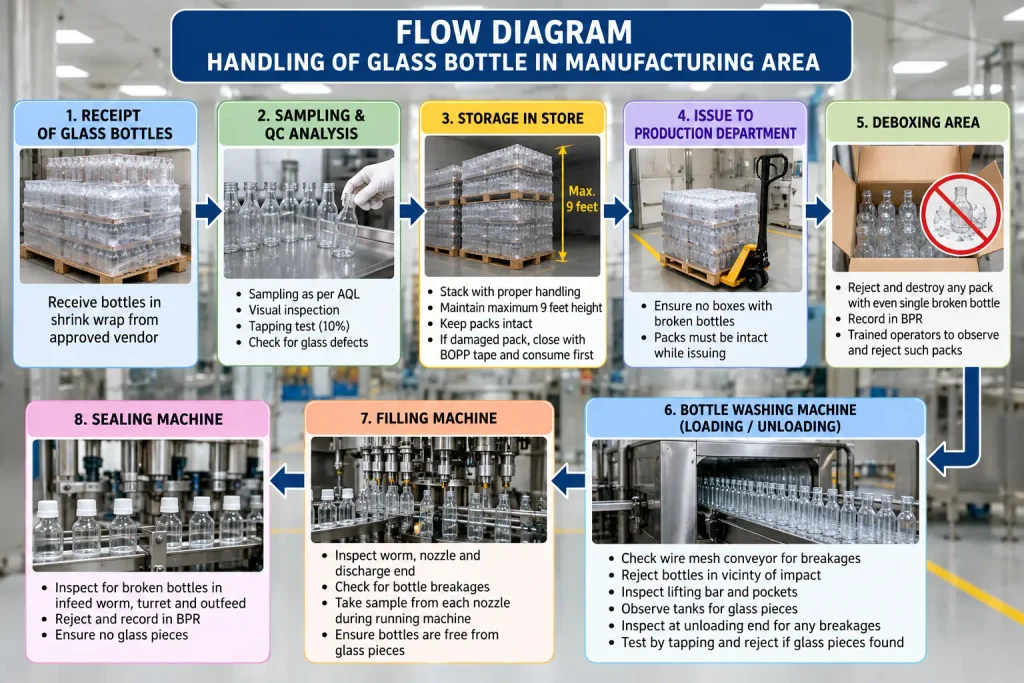
During deboxing, washing, filling, and sealing, any bottle breakage requires immediate rejection of potentially affected bottles and recording in the BPR. Filling equipment alignment and abnormal jerking are checked to prevent glass generation. Filled bottles are finally inspected optically for glass particles, and only acceptable, glass-free bottles are allowed to proceed for labeling and packing.
3. Benefits of Following SOP – Handling of Glass Bottle:
Following the SOP for Handling of Glass Bottle helps ensure that glass bottles are received, stored, sampled, issued, deboxed, washed, filled, sealed, and inspected in a controlled manner. The procedure requires bottles to be obtained in intact packs, checked for breakage and glass defects, sampled according to AQL requirements, and protected from damage during storage and transfer. Proper implementation of the SOP also reduces the risk of glass-particle contamination, bottle breakage, product loss, and operator injury. Packs containing broken bottles are rejected, affected quantities are recorded in the BPR, and operators are trained to identify and handle damaged packs appropriately.
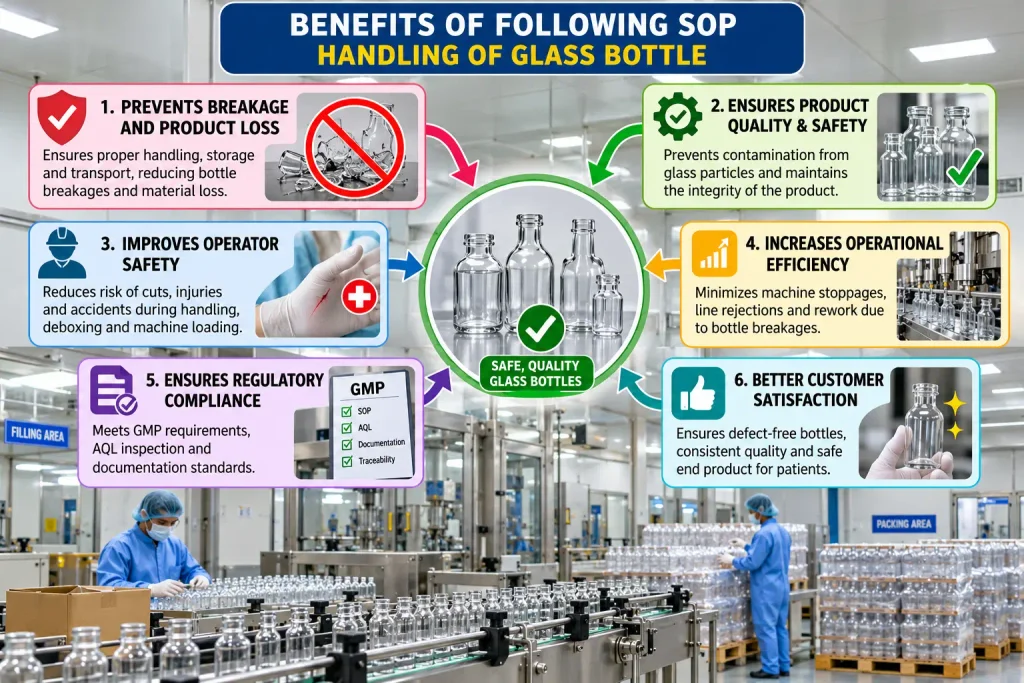
During washing, filling, and sealing operations, the SOP provides defined actions for bottle breakage, equipment misalignment, inspection of affected bottles, rejection, quarantine, and machine correction. These controls support product quality, patient safety, traceability, GMP compliance, operational efficiency, and consistent manufacturing performance. Overall, adherence to the SOP helps maintain safe, defect-free glass bottles throughout the manufacturing process and minimizes the possibility of glass contamination reaching the finished product.
4. CPP & CQA – Handling of Glass Bottle:
The Critical Process Parameters (CPP) and Critical Quality Attributes (CQA) for Handling of Glass Bottle are important controls used to maintain bottle integrity and prevent glass contamination throughout manufacturing. As defined in the SOP, key process controls include receipt of intact shrink-wrapped bottles, AQL-based sampling, visual inspection, tapping tests, controlled storage, careful deboxing, monitoring of bottle washing, filling-machine alignment, sealing-machine operation, and appropriate rejection and documentation of damaged bottles. The major CPPs include correct stacking and handling, maximum storage height, inspection for breakage, washing-machine loading and unloading controls, filling-nozzle centering, smooth conveyor movement, and proper sealing-machine timing. Any abnormality such as bottle breakage, jerky movement, nozzle misalignment, or glass particles requires immediate corrective action, rejection, quarantine, or line stoppage as applicable.
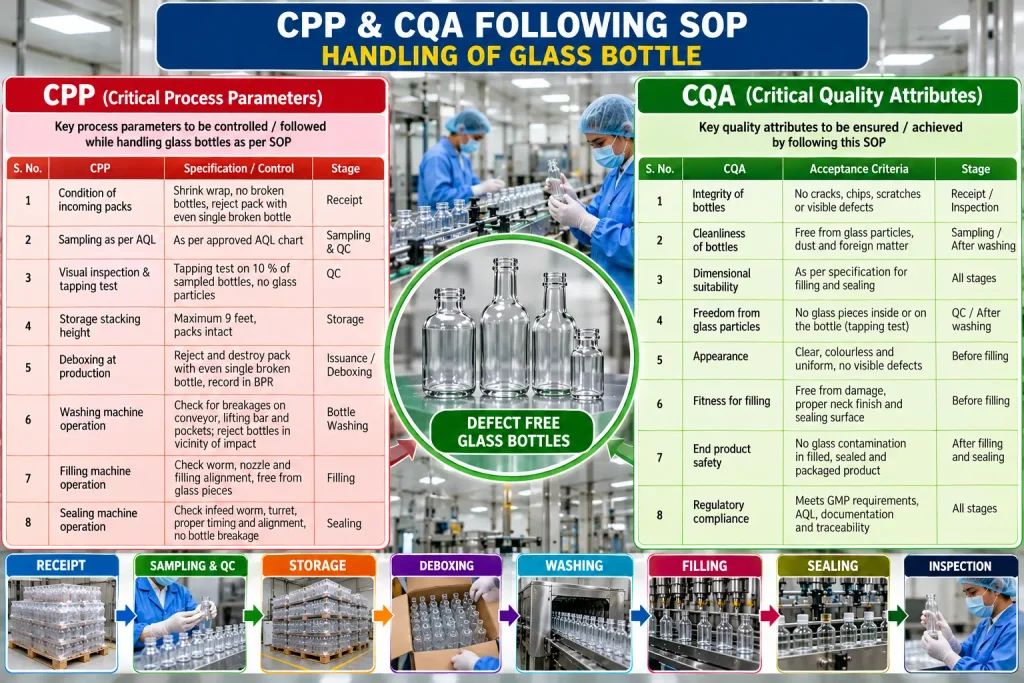
The corresponding CQAs are intact and defect-free bottles, absence of cracks or chips, freedom from glass particles, suitable bottle condition for filling and sealing, and safe finished-product presentation. Optical inspection against a white background and observation for shining particles are specifically described for detecting possible glass contamination in filled bottles. Effective control of these CPPs helps ensure that the required CQAs are consistently achieved, supporting product quality, patient safety, GMP compliance, traceability, and reliable manufacturing performance.
5. Brainstorming for SOP Failure – Handling of Glass Bottle:
Brainstorming for failure of the SOP for Handling of Glass Bottle helps identify potential causes that may lead to bottle breakage, glass contamination, rejection, line stoppage, or product-quality risk during manufacturing. The SOP requires receipt of bottles in proper shrink-wrapped packs, rejection of packs containing even a single broken bottle, controlled storage, AQL-based sampling, visual inspection, and tapping tests for detection of glass defects or particles. Possible failure causes include damaged incoming packs, improper shrink wrapping, excessive stacking height, rough handling, inadequate sampling, poor visual inspection, ineffective tapping tests, improper deboxing, and inadequate operator training. Failure to reject damaged packs or record destroyed bottles in the BPR can also weaken traceability and reconciliation controls.
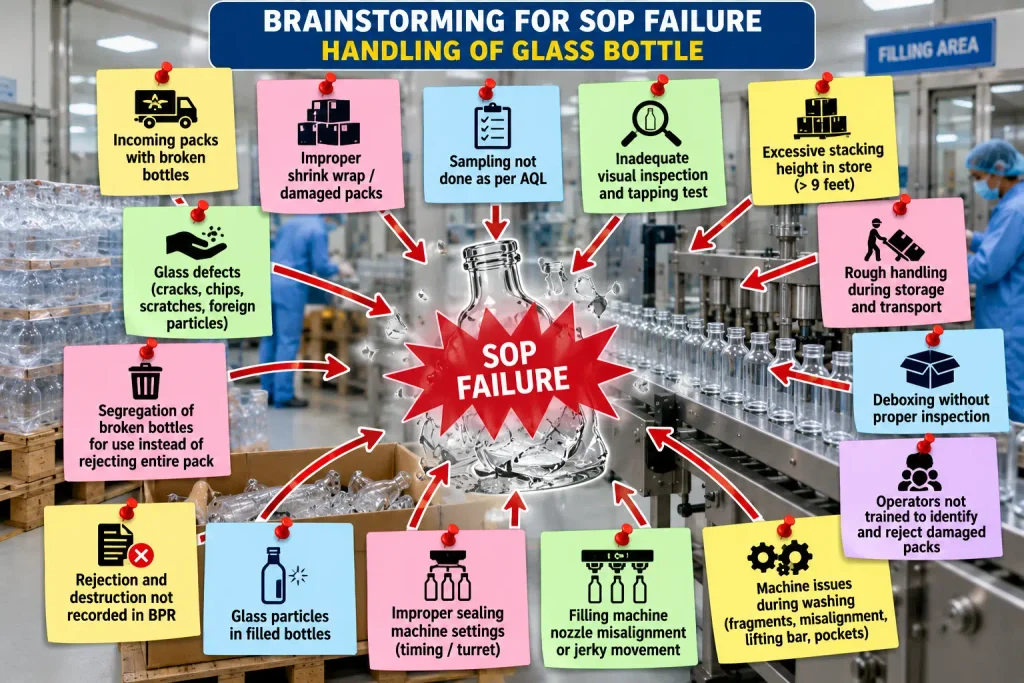
During processing, additional causes may include washing-machine breakages, misalignment of lifting bars or pockets, filling-nozzle misalignment, jerky machine movement, improper sealing-machine timing, and inadequate inspection after a bottle-breakage event. Such failures can increase the risk of glass fragments entering filled bottles. This brainstorming exercise supports systematic identification of weak points so that appropriate training, inspection, equipment checks, rejection controls, documentation, and corrective actions can be strengthened to maintain product safety, bottle integrity, GMP compliance, and patient protection.
6. 5-Why Analysis for SOP Failure – Handling of Glass Bottle:
The 5-Why Analysis for failure of the SOP for Handling of Glass Bottle is used to systematically identify the underlying reason for broken, defective, or potentially contaminated glass bottles reaching the manufacturing process. The SOP requires damaged packs to be rejected, bottles to be inspected through AQL-based sampling and tapping tests, and operators to follow defined controls during receipt, storage, deboxing, washing, filling, sealing, and inspection. In a typical failure scenario, broken bottles are found during production because damaged bottles entered the line. This may occur because packs containing broken bottles were not rejected during receipt or deboxing. The next level of analysis may identify that visual inspection and tapping tests were not performed effectively as required. The SOP specifically requires rejection of any pack containing even a single broken bottle and recording of destroyed quantities in the BPR.
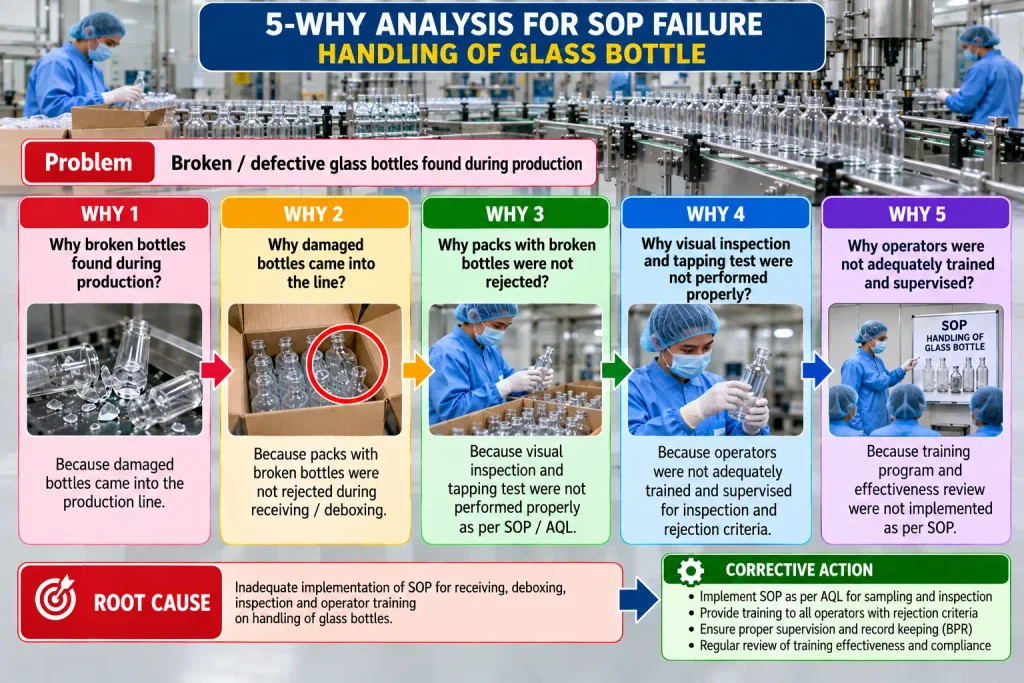
Further investigation may identify inadequate operator training, supervision, or implementation of rejection criteria as contributing causes. The SOP requires operators and pack-line supervisors involved in deboxing to be trained to identify and reject packs containing broken bottles. The resulting root cause may therefore be inadequate implementation of the approved SOP, insufficient training, or ineffective inspection controls. Corrective and preventive actions should focus on reinforcing SOP training, ensuring proper AQL sampling and inspection, strengthening supervision, accurately documenting rejection and destruction in the BPR, and periodically verifying the effectiveness of these controls. This helps prevent recurrence and supports product safety, glass-contamination control, GMP compliance, and patient protection.
7. Fishbone Analysis for SOP Failure – Handling of Glass Bottle:
The Fishbone Analysis for failure of the SOP for Handling of Glass Bottle is used to identify and categorize the possible causes that can lead to broken or defective bottles, glass-particle contamination, rejection, and product-quality risk during manufacturing. Based on the SOP, the potential causes can be grouped under Man, Machine, Material, Method, Environment, and Measurement.
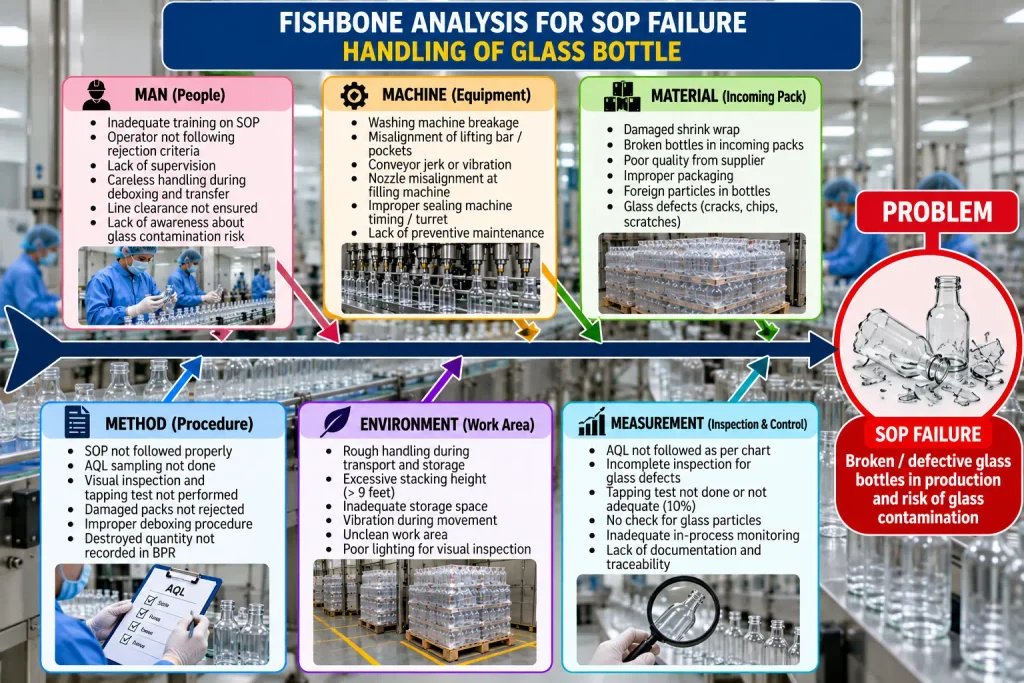
Under Man, possible causes include inadequate operator training, improper handling during deboxing or transfer, failure to identify damaged packs, and insufficient supervision. The SOP specifically requires operators and line supervisors to be trained for recognizing and rejecting packs containing broken bottles. Under Machine, causes may include bottle breakage at the washing machine, misalignment of lifting bars or pockets, filling-nozzle misalignment, jerky movement of the filling machine, and improper sealing-machine timing. The SOP describes defined rejection and corrective actions when breakage or misalignment occurs. Under Material and Method, likely causes include damaged incoming packs, bottles with cracks or glass particles, improper shrink wrapping, incorrect stacking, inadequate AQL sampling, ineffective visual inspection, and failure to perform the tapping test. The SOP requires receipt in shrink wrap, rejection of packs containing broken bottles, controlled storage, AQL-based sampling, and tapping of sampled bottles.The Environment and Measurement branches may include poor handling or storage conditions, excessive stacking, weak inspection practices, incomplete BPR recording, and inadequate verification of rejected or destroyed quantities. The SOP requires maximum stacking height control, proper storage precautions, recording of destroyed bottles in the BPR, and inspection of doubtful stock where applicable. Overall, the Fishbone Analysis helps identify the contributing factors behind SOP failure so that targeted actions can be taken to strengthen training, equipment control, material inspection, procedural compliance, documentation, and supervision, thereby reducing bottle breakage and the risk of glass contamination.
8. Fault Tree Analysis for SOP Failure – Handling of Glass Bottle:
The Fault Tree Analysis for failure of the SOP for Handling of Glass Bottle helps identify the combination of events that can result in the top event: broken, defective, or potentially glass-contaminated bottles during manufacturing. The analysis starts from this undesired event and traces the possible contributing failures through receipt, deboxing, washing, filling, sealing, inspection, training, and documentation.One branch may involve defective bottles entering the production line because damaged packs were accepted, broken bottles were not rejected, or required visual inspection and tapping tests were not performed effectively. The SOP requires rejection of packs containing even a single broken bottle and mandates AQL-based sampling with visual and tapping checks A second branch involves bottle breakage during processing operations. At the washing machine, breakage may occur because of conveyor, lifting-bar, pocket, or alignment problems. At the filling stage, improper nozzle centering, jerky motion, or turret-related issues can damage bottles. The SOP requires rejection of bottles in the affected area, recording in the BPR, correction of alignment, and inspection before restarting operations.
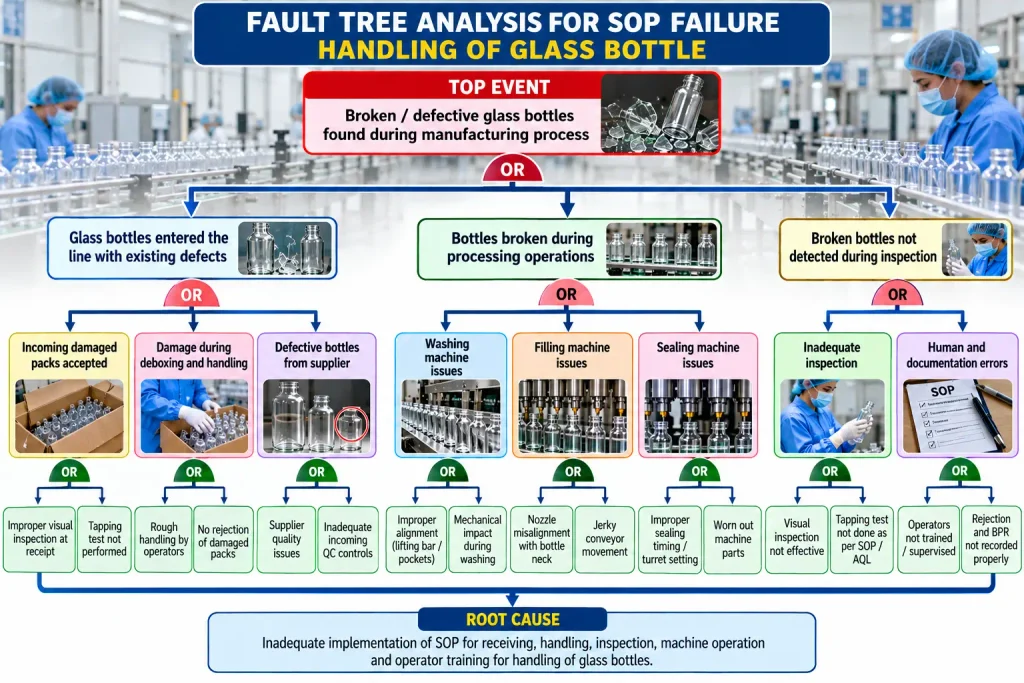
A third branch concerns failure to detect the problem, which may arise from inadequate visual inspection, ineffective tapping tests, insufficient operator training, or poor recording of rejected and destroyed bottles. The SOP specifically requires trained operators and supervisors at deboxing and defined recording of rejected or destroyed quantities in the Overall, the fault tree indicates that SOP failure can result from one or more weaknesses in material control, equipment operation, inspection, training, supervision, and documentation. Identifying these contributing events helps focus corrective and preventive actions on strengthening SOP implementation, improving machine checks, reinforcing inspection practices, ensuring effective training, and maintaining complete traceability throughout glass-bottle handling.
9. Impact Assessment for SOP Failure – Handling of Glass Bottle:
The Impact Assessment for failure of the SOP for Handling of Glass Bottle evaluates the potential consequences that may arise when glass bottles are not properly received, inspected, stored, deboxed, washed, filled, sealed, or handled during manufacturing. The SOP requires rejection of packs containing broken bottles, controlled storage, AQL-based sampling, visual inspection, tapping tests, and defined actions whenever bottle breakage is observed. Failure to follow these controls can have a significant product quality and patient safety impact, especially if glass fragments or defective bottles enter the manufacturing process. The SOP also requires rejection and destruction of affected bottles, recording in the BPR, and trained operators for deboxing and handling activities.
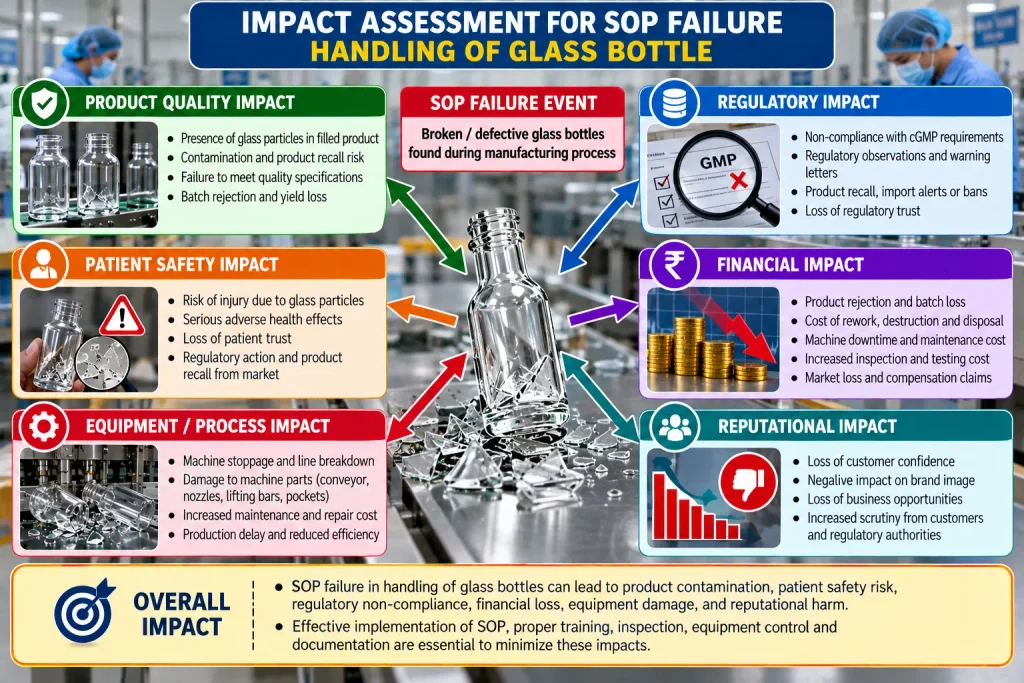
There may also be an equipment and process impact. Bottle breakage at the washing, filling, or sealing stages can result in machine stoppage, additional cleaning and inspection, rejection of bottles in the affected area, and production delays. Filling-nozzle misalignment and abnormal machine movement require immediate correction and inspection before restarting the line. From a quality-system perspective, ineffective SOP implementation can lead to increased rejection, loss of yield, additional investigation, documentation burden, and possible GMP compliance concerns. Therefore, strict adherence to the SOP, proper operator training, effective inspection, equipment control, timely rejection, quarantine, and accurate BPR documentation are essential to minimize the overall impact and maintain product quality, patient safety, process reliability, and compliance.
10. CAPA for SOP Failure – Handling of Glass Bottle:
The Corrective and Preventive Action (CAPA) for failure of the SOP for Handling of Glass Bottle is intended to eliminate identified causes of bottle breakage, defective bottles, glass-particle risk, and documentation failures during manufacturing. Immediate corrective actions include stopping the affected activity or machine, segregating and rejecting damaged bottles or packs, correcting equipment alignment, inspecting the affected area, and recording rejected or destroyed quantities in the BPR. The SOP requires rejection of packs containing broken bottles and documentation of destroyed quantities during deboxing and processing.
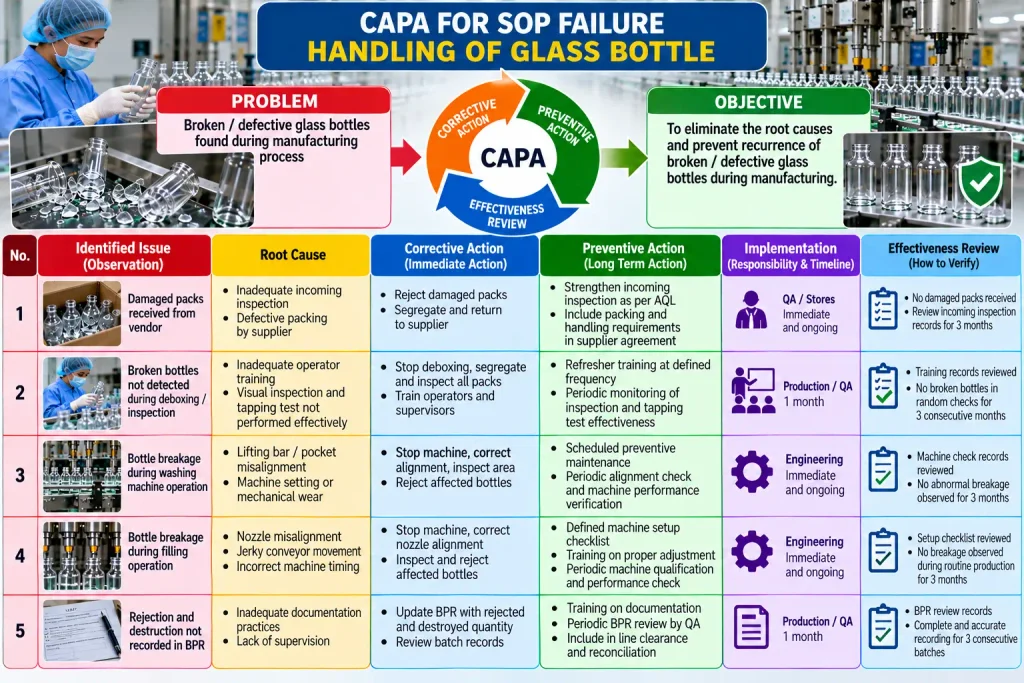
Preventive actions should focus on strengthening incoming inspection, AQL sampling, visual inspection, tapping tests, operator training, equipment alignment checks, preventive maintenance, supervision, and documentation practices. Particular attention should be given to washing-machine lifting bars and pockets, filling-nozzle centering, conveyor movement, and sealing-machine timing because these are identified areas where bottle breakage may occur. CAPA effectiveness should be verified through review of inspection records, training effectiveness, BPR entries, machine-check records, rejection trends, and recurrence of bottle breakage over a defined monitoring period. Successful CAPA implementation should demonstrate reduced breakage, absence of recurring glass contamination events, improved SOP compliance, complete documentation, and consistent safe handling of glass bottles throughout manufacturing.
Questions & Answers – Handling of Glass Bottle:
- What is the objective of the SOP for Handling of Glass Bottle?
Answer: The objective is to define a controlled procedure for proper handling of glass bottles used in production. - Who is responsible for implementation of this SOP?
Answer: Concerned production personnel, Production Chemist, and Production Manager are responsible for following the procedure. - How should glass bottles be received from the supplier?
Answer: Bottles should be supplied in shrink-wrapped packs and should not be received in corrugated shippers as specified in the SOP. - What action should be taken if even one broken bottle is found in a pack?
Answer: The complete pack containing the broken bottle should be rejected and accounted for. - When should a glass-bottle consignment be quarantined?
Answer: If approximately 5% or more of the packs are rejected because of broken bottles, the consignment should be immediately quarantined and the concerned departments informed. - What is the maximum stacking height specified for empty glass bottles?
Answer: The maximum stacking height specified in the SOP is 9 feet. - How should sampling of glass bottles be performed?
Answer: Sampling should be performed strictly according to the approved AQL chart, and all specified glass-defect parameters should be checked. - What tapping test is required during visual inspection?
Answer: The tapping test should be performed on 10% of the sampled bottles to check whether any glass particles or pieces fall from the bottles. - What should be done if glass particles are still observed after resampling?
Answer: If glass particles continue to be observed, the entire consignment should be rejected and Unit QA and the concerned representative informed. - What precautions should be taken while issuing bottles to production?
Answer: No boxes containing broken bottles should be transferred to production, and all packs should remain intact during issuance. - What action is required during deboxing if a broken bottle is found?
Answer: The entire affected pack should be rejected and destroyed, and the quantity destroyed should be recorded in the BPR for reconciliation. - What training is required for deboxing personnel?
Answer: Operators and workmen performing deboxing, as well as pack-line supervisors, should be trained to identify and reject shippers containing broken bottles. - What should be done if bottle breakage occurs at the washing-machine loading end?
Answer: Bottles in the vicinity of the impact should be rejected and destroyed, and the rejected quantity should be recorded in the BPR. - What is the likely cause of bottle breakage below the filling nozzle during operation?
Answer: One possible cause specified in the SOP is improper centering or alignment of the filling nozzle, causing the nozzle tip to strike the inner surface of the bottle. - What action should be taken if jerky motion is observed at the filling machine?
Answer: The machine should be stopped immediately, the centering and alignment of each nozzle checked and corrected, and affected bottles quarantined and inspected. - What should be done if a bottle passes through the sealing head without a PP cap?
Answer: The bottle along with its contents should be rejected and destroyed, and the quantity recorded in the BPR. It should not be resealed. - How are glass particles checked during optical inspection of filled bottles?
Answer: The bottle is held in the specified position and inspected against diffused light with a white background. Shining particles travelling downward may indicate glass particles. - What observations may indicate a risk of glass particles during filling?
Answer: Jerky conveyor movement, abnormal impact sound, frequent bottle toppling, improper lifter movement, dragging of bottles, and crushed bottle necks are some observations listed in the SOP. - What should be done when abnormal conditions that may generate glass particles are observed?
Answer: The line should be stopped, the root cause identified and corrected, the effectiveness of the action verified, and doubtful filled stock quarantined and inspected according to the severity of the event. - What is the overall purpose of following this SOP?
Answer: The SOP provides controls to minimize bottle breakage, detect glass defects and particles, ensure appropriate rejection and documentation, and maintain safe handling of glass bottles throughout production.
Reference Guideline – Handling of Glass Bottle:
- WHO Good Manufacturing Practices (GMP) – requirements for prevention of contamination, proper handling of packaging materials, line controls, documentation, and personnel training.
- EU Guidelines for Good Manufacturing Practice – EudraLex Volume 4 – particularly requirements related to production controls, packaging operations, contamination prevention, and handling of primary packaging materials.
- PIC/S Guide to Good Manufacturing Practice for Medicinal Products (PE 009) – requirements for material control, production operations, prevention of contamination, documentation, training, and investigation of abnormalities.
- Schedule M of the Drugs Rules, 1945, India – GMP requirements for pharmaceutical manufacturing premises, production practices, equipment, documentation, quality assurance, and handling of materials.
- 21 CFR Part 211 – Current Good Manufacturing Practice for Finished Pharmaceuticals – particularly controls relating to components and containers, production and process controls, packaging operations, written procedures, and records.
- USP General Chapter <660> – Containers—Glass – provides requirements and considerations for pharmaceutical glass containers and their suitability for intended use.
- ICH Q9 – Quality Risk Management – useful for evaluating risks associated with bottle breakage, glass particles, equipment malfunction, and failure of inspection controls.
- ICH Q10 – Pharmaceutical Quality System – supports CAPA, training, continual improvement, deviation management, and effectiveness monitoring.