







1. Brief Description:
This HR Policy Manual provides a structured framework for managing employees and HR activities across the organization. It is designed to keep employees informed about HRM policies, practices, responsibilities, and expected standards of conduct. The manual supersedes earlier amendments and allows future additions or deletions to be communicated through proper authority. It covers major areas such as recruitment, probation, attendance, leave, salary and wage administration, employee benefits, training, performance appraisal, promotion, welfare, safety, environmental responsibility, grievance handling, separation, transfer, travel, and other administrative matters. The document also defines organizational mission, values, quality expectations, workplace ethics, and responsibilities of employees and management. Recruitment policies include procedures for trainees, staff, operators, and temporary operators, along with selection, induction, and reference checks. Overall, the manual helps maintain consistency, fairness, discipline, compliance, and transparency in human resource management while supporting employee development and organizational goals. It also serves as a practical reference for employees.
2. Flow Diagram:
The Process Mapping Flow Diagram shows how the HR Department manages an employee from manpower planning through employment, development, welfare, and final separation. The process begins with manpower requirements and HR policies, followed by recruitment, candidate selection, offer, joining, and induction. The HR manual requires new employees to undergo induction training before being placed in their respective departments.
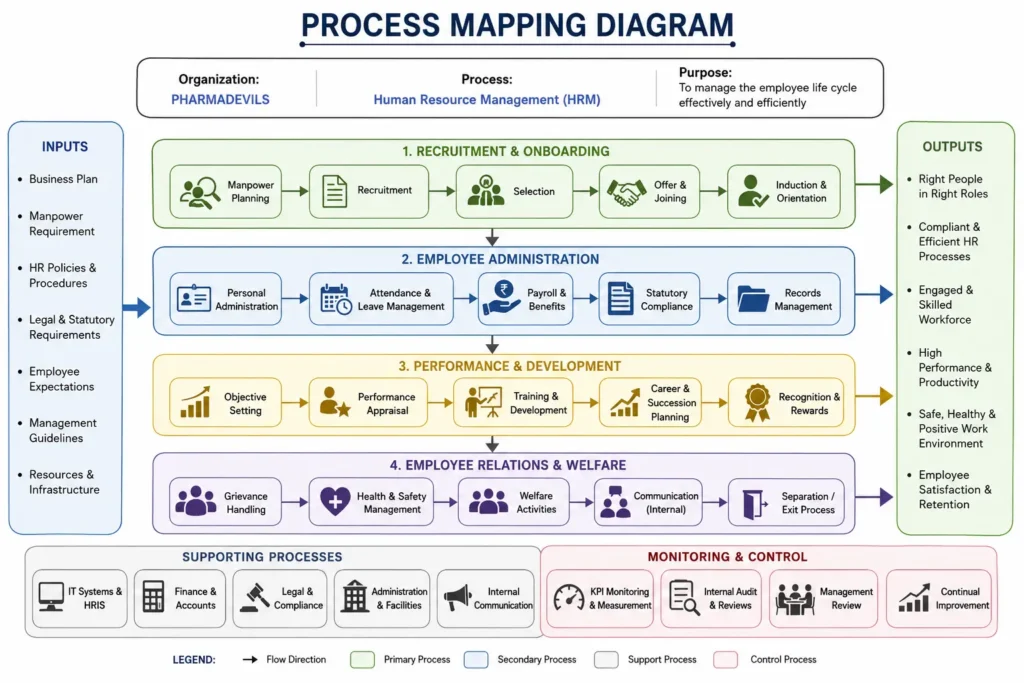
After joining, HR manages important administrative activities such as employee records, attendance, leave, payroll, benefits, and statutory compliance. The next stage focuses on performance appraisal, training and development, career growth, promotion, recognition, and employee improvement. The manual includes separate policies covering training, performance appraisal, promotion, welfare, and administrative activities.
Employee relations include grievance handling, health and safety, welfare activities, communication, and separation. Supporting functions and periodic monitoring help maintain compliance, effectiveness, employee satisfaction, productivity, and continual improvement of the overall HR management system.
3. Critical Process Parameters (CPPs) & Critical Quality Attributes (CQAs):
For the HR Policy Manual, the CPPs are the key HR activities that must be properly controlled, while the CQAs are the expected results showing that the HR system is effective and compliant. The manual includes recruitment, induction, probation, training, performance appraisal, welfare, attendance, leave, statutory benefits, and separation processes.
| Critical Process Parameters (CPPs) | Critical Quality Attributes (CQAs) |
|---|---|
| Approved manpower requirement | Correct manpower available as per business need |
| Defined qualification and experience criteria | Competent and suitable employees selected |
| Proper candidate screening and interview | Fair and documented recruitment decision |
| Technical/aptitude/skill assessment | Candidate capability confirmed |
| Reference and antecedent verification | Reliable and verified employee background |
| Offer and appointment letter issuance | Clear employment terms and conditions |
| Induction training completion | Employee understands organization, job, policies and procedures |
| Probation period and performance assessment | Employee suitability confirmed before permanent appointment |
| Attendance and leave monitoring | Accurate attendance and leave records |
| Payroll and statutory benefit control | Correct and timely employee compensation and benefits |
| Training and development | Improved employee competency and job performance |
| Performance appraisal | Objective evaluation and development planning |
| Grievance handling | Employee concerns resolved systematically |
| Safety and welfare activities | Safe, healthy and supportive workplace |
| Employee record maintenance | Complete, accurate and traceable HR documentation |
| Separation/exit process | Proper clearance and controlled employee separation |
For example, the manual requires defined recruitment procedures, selection committees and documented evaluation of candidates. It also requires induction training before employees are posted to their departments, covering organizational structure, job responsibilities, HR policies, products and quality procedures. Probationary employees are assessed before confirmation to ensure they meet job requirements.
4. Impact Assessment:
The HR Policy Manual has a significant impact on the organization because it provides a common system for managing employees in a fair, controlled, and consistent manner. The manual covers recruitment, attendance, leave, employee benefits, training, performance appraisal, promotion, welfare, grievance handling, transfer, separation, and other administrative activities.
Effective implementation of these policies can improve employee discipline, competency, job clarity, performance, satisfaction, and retention. Recruitment and induction requirements help ensure that suitable employees are selected and properly introduced to their roles and responsibilities. Performance assessment and confirmation controls help verify employee suitability before permanent placement.
Failure to follow HR policies may lead to inconsistent decisions, employee dissatisfaction, documentation gaps, compliance issues, poor performance, disputes, or increased employee turnover. Therefore, regular monitoring, communication, training, and periodic review of HR policies are important for maintaining an effective and transparent HR management system.
5. Questions & Answers:
Q1. What is the main purpose of the HR Policy Manual?
Answer: The manual provides defined HR policies and procedures so that employee-related activities are handled consistently, systematically, and effectively across the organization.
Q2. What are the major responsibilities of the HR Department?
Answer: HR responsibilities include recruitment, induction, manpower planning, personal-file management, training and development, performance appraisal, competency improvement, career planning, employee engagement, recognition, retention, mentoring, and exit-interview analysis.
Q3. Is induction training compulsory for newly recruited employees?
Answer: Yes. Every newly recruited employee must undergo induction training before being posted to the parent department.
Q4. What is covered during induction training?
Answer: Induction includes organizational structure, job responsibilities, HR policies, products, QS/ISO procedures, company vision, values, practices, processes, and expectations.
Q5. How is induction training documented?
Answer: Unit HR ensures completion according to the induction checklist. Training details are recorded and maintained in the employee’s personal file, and the employee submits an induction report after completion.
Q6. Is reference checking required for new employees?
Answer: Yes. Reference checking is required for new staff employees. For Level VII and above, confidential reference checking is performed before issuing the offer letter.
Q7. What happens if an employee provides incorrect information about experience or qualification?
Answer: Incorrect declarations regarding experience, qualifications, salary, or similar information are treated seriously and may result in termination of employment.
Q8. How are operators selected?
Answer: Operators undergo written aptitude and technical tests, departmental interviews, practical skill tests, and final evaluation by a selection committee consisting of the Department Head and HRM Head, followed by SBU Head approval.
Q9. What is the probation period for operators?
Answer: The normal probation period for operators is six months. It may be extended when additional time is required to evaluate an average or mediocre performer.
Q10. What is the training period for staff trainees?
Answer: The training period for trainees is generally one year. Confirmation is given after successful training and a performance rating of “Good & Above.”
Q11. What statutory benefits are provided to trainees?
Answer: Trainees are entitled to statutory benefits such as PF and ESI, as applicable, and leave according to the staff leave policy.
Q12. Does the manual cover performance appraisal and promotion?
Answer: Yes. It contains policies for staff performance appraisal, staff promotion, job rotation, and performance appraisal, increments, and promotion of operators.
Q13. What employee welfare activities are covered in the manual?
Answer: Welfare policies include accident insurance, Mediclaim, loans and advances, health checkups, annual-day and festival celebrations, uniforms, marriage gifts, vehicle-loan support, and other employee benefits.
Q14. Does HR have responsibility for statutory compliance?
Answer: Yes. HR responsibilities include statutory compliance related to PF, ESI, Factory Act, contract labour, fire, electricity, employment exchange, and other applicable requirements.
Q15. What is the overall objective of implementing these HR policies?
Answer: The overall objective is to maintain a competent workforce, consistent HR practices, employee development, statutory compliance, good workplace culture, employee welfare, effective communication, and systematic management of employees throughout their employment lifecycle.