






1. Introduction to Batch Manufacturing Record (BMR) of Hydroquinone, Tretinoin and Mometasone Furoate Cream
The Batch Manufacturing Record (BMR) of Hydroquinone, Tretinoin and Mometasone Furoate Cream is an essential pharmaceutical document that provides comprehensive information regarding the manufacturing process, quality control, and regulatory compliance of the finished product. This topical formulation combines three active pharmaceutical ingredients (APIs) commonly used in the treatment of melasma and certain other hyperpigmentation disorders. Hydroquinone acts as a depigmenting agent by inhibiting melanin synthesis, while Tretinoin promotes epidermal cell turnover and enhances skin renewal. Mometasone Furoate is a corticosteroid that helps reduce inflammation associated with the treatment. The BMR provides step-by-step documentation of manufacturing activities, including raw material dispensing, preparation of oil and aqueous phases, emulsification, homogenization, cooling, filling, and packaging operations. Critical Process Parameters (CPPs), such as mixing speed, temperature, homogenization time, and cooling conditions, are monitored to ensure consistent product quality. Critical Quality Attributes (CQAs), including appearance, pH, viscosity, assay, content uniformity, and microbial quality, are evaluated according to approved specifications. The BMR also ensures batch traceability, documentation integrity, equipment verification, in-process controls, and compliance with current Good Manufacturing Practices (cGMP). A properly maintained BMR supports product quality, patient safety, regulatory inspections, and consistent manufacturing performance throughout the product lifecycle.
Skip to PDF content2. Manufacturing Process Flow Diagram of Hydroquinone, Tretinoin and Mometasone Furoate Cream (BMR):
The manufacturing flow diagram of Hydroquinone, Tretinoin and Mometasone Furoate Cream illustrates the systematic sequence of pharmaceutical manufacturing operations performed under current Good Manufacturing Practices (cGMP) to ensure consistent product quality, safety, and efficacy.

The manufacturing process begins with the receipt, quality control testing, approval, and dispensing of raw materials according to the approved Batch Manufacturing Record (BMR). All active pharmaceutical ingredients (APIs) and excipients are accurately weighed and verified before processing. The aqueous and oil phases are prepared separately under controlled processing conditions. Both phases are combined through emulsification and controlled mixing to obtain a uniform cream base Hydroquinone, Tretinoin, and Mometasone Furoate are incorporated at appropriate manufacturing stages according to the validated formulation and approved manufacturing instructions. Particular attention is given to temperature control, mixing efficiency, and protection of sensitive ingredients from degradation. The cream undergoes homogenization to achieve uniform distribution of ingredients and the required consistency. In-process quality checks include appearance, pH, viscosity, homogeneity, and other approved parameters. After satisfactory in-process results, the bulk cream is transferred for tube filling, sealing, coding, and secondary packaging. Finally, finished product quality control testing, BMR review, and Quality Assurance (QA) approval are completed before batch release. The manufacturing flow diagram supports process standardization, batch traceability, regulatory compliance, and consistent pharmaceutical product quality.
3. Critical Process Parameters (CPPs) and Critical Quality Attributes (CQAs) of Hydroquinone, Tretinoin and Mometasone Furoate Cream:
Critical Process Parameters (CPPs) and Critical Quality Attributes (CQAs) play an essential role in ensuring the consistent quality, safety, and efficacy of Hydroquinone, Tretinoin and Mometasone Furoate Cream during pharmaceutical manufacturing. Critical Process Parameters (CPPs) are manufacturing variables that require appropriate monitoring and control to maintain product quality. Potential CPPs include phase preparation temperature, mixing speed, mixing duration, emulsification conditions, homogenization speed, cooling rate, and active pharmaceutical ingredient (API) addition sequence. Temperature control is particularly important because Hydroquinone and Tretinoin are susceptible to degradation under unsuitable processing and storage conditions. Proper mixing and homogenization help achieve uniform API distribution and consistent cream texture.
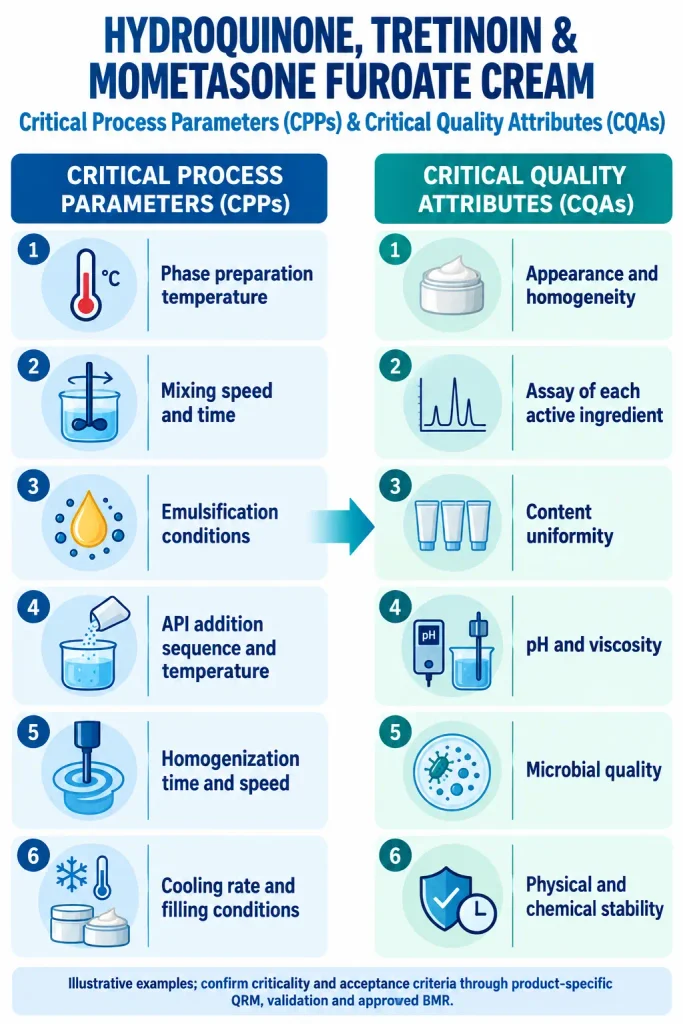
Critical Quality Attributes (CQAs) are physical, chemical, biological, or microbiological characteristics that must remain within established acceptance limits to ensure product quality. Important CQAs include appearance, homogeneity, pH, viscosity, assay of individual APIs, content uniformity, microbial quality, and physical and chemical stability. Appropriate in-process testing, validated analytical methods, and established specifications help verify product conformity. Effective CPP monitoring and CQA evaluation, supported by Quality Risk Management (QRM), process validation, and cGMP documentation, contribute to batch-to-batch consistency, regulatory compliance, and reliable pharmaceutical manufacturing.
Note: The actual CPPs and CQAs must be established through product-specific development studies, risk assessments, and process validation.