






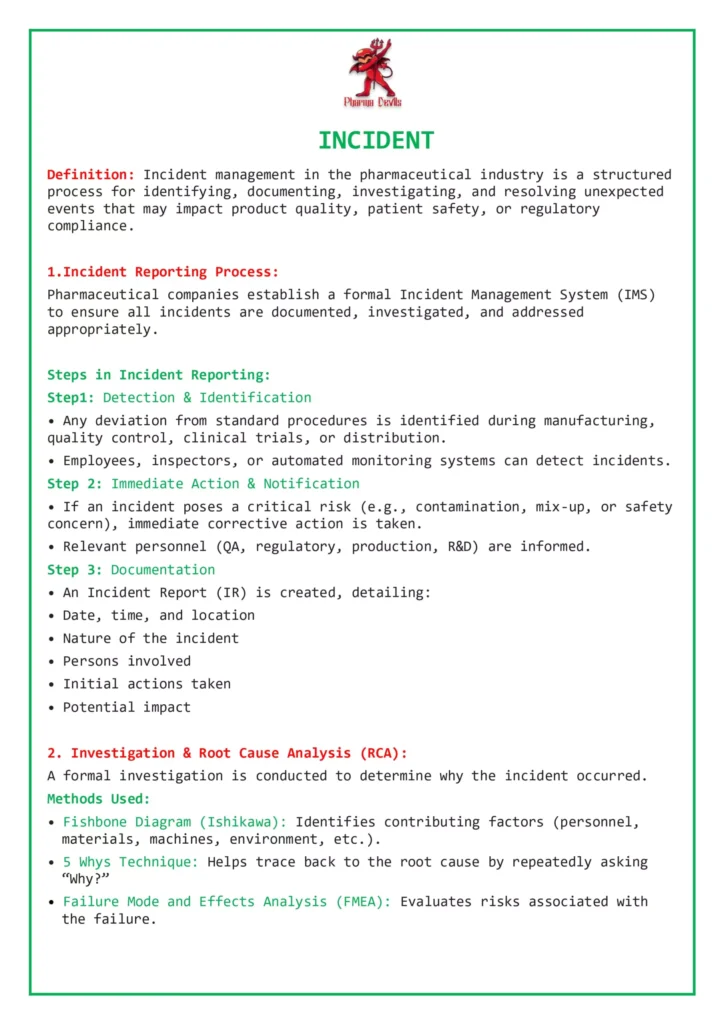
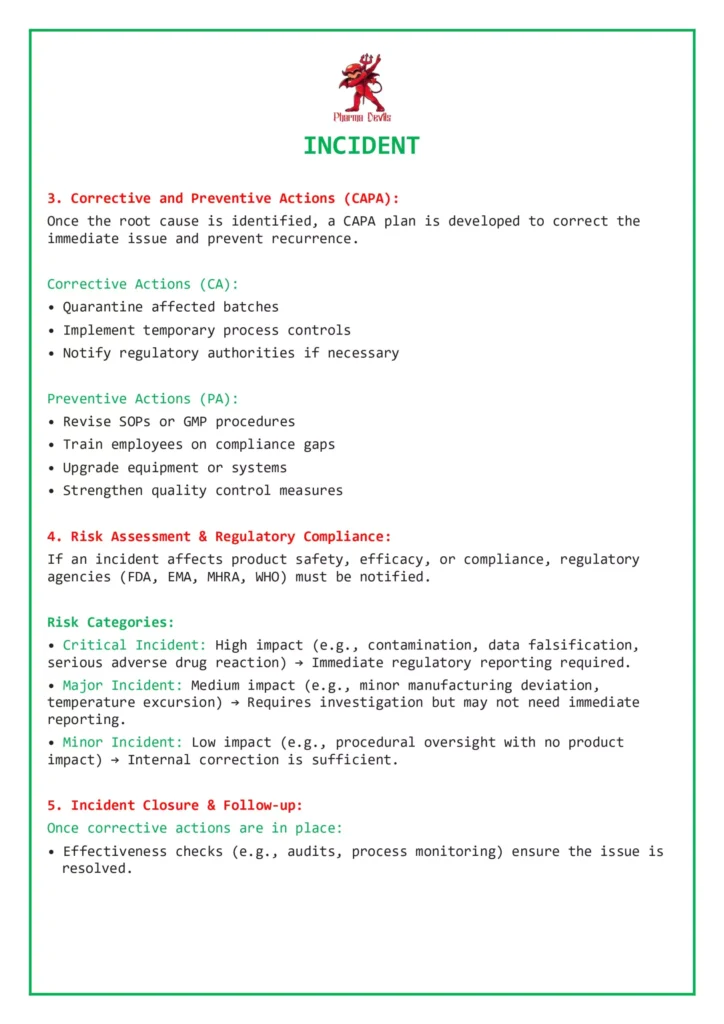
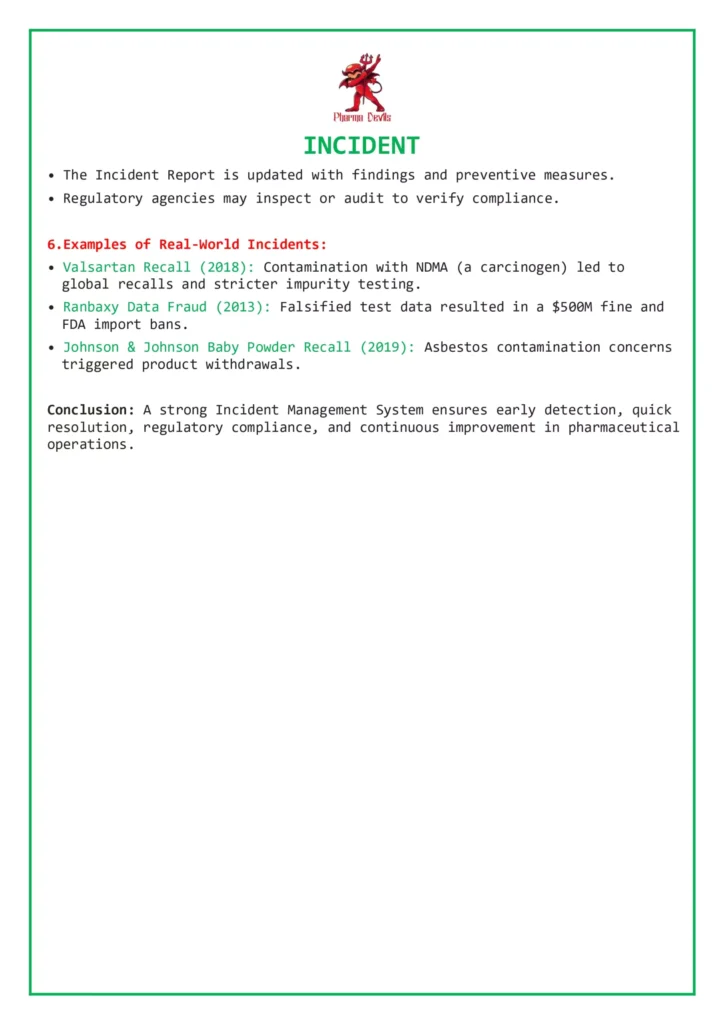
In pharma, an incident is any unplanned event that disrupts normal operations or creates a potential or actual risk to product quality, patient safety, regulatory compliance, data integrity, environment, or worker safety. Incidents can occur in manufacturing, packaging, QC laboratories, utilities, warehouses, and distribution. Unlike routine process variation, an incident signals a loss of control or an abnormal condition that must be assessed, contained, and documented.
Common examples
- Manufacturing: power failure during mixing, incorrect setpoint, equipment breakdown, hold time exceedance, spillage in a classified area.
- Utilities/cleanrooms: HVAC differential pressure excursion, HEPA damage, water system microbial spike, compressed air oil carryover.
- QC lab: instrument failure mid-run, wrong standard preparation, data system outage, OOS/OOT result requiring investigation.
- Packaging: coding error, wrong leaflet, reconciliation mismatch, line clearance failure.
- Warehousing/distribution: temperature excursion in cold chain, damaged containers, pest sighting, security breach, suspected counterfeit.
Why incident management is critical
Incidents are managed to prevent defective product release and protect patients. A robust system ensures timely containment (stop the activity, quarantine impacted materials, restrict access), a structured impact assessment, and effective corrective actions. Repeated incidents also indicate deeper system weaknesses and trigger management review.
Typical incident handling workflow
- Immediate reporting and containment: notify supervisor/QA; stop the process; segregate affected materials/batches.
- Initial risk assessment: determine potential impact on product (quality attributes, contamination, mix-ups) and whether any released product may be affected.
- Investigation: collect evidence (BMR/BPR, logs, alarms, raw data), identify root cause using tools like 5-Why/Ishikawa, and document conclusions.
- CAPA: corrective action addresses the immediate issue; preventive actions reduce recurrence (engineering controls, SOP updates, maintenance improvements, training redesign).
- Effectiveness check and closure: verify CAPA worked (trend improvement, no recurrence, successful qualification runs).
- Escalation if needed: serious incidents may trigger batch rejection, regulatory notification, recall assessment, or field corrective actions depending on severity and markets.
Good incident management is closely linked to deviation control, change control, and quality risk management—ensuring the site remains in a state of control and products remain safe and effective.