






Brief Description
The Installation Qualification (IQ) Protocol for the Automatic Capsule Filling Machine is prepared to confirm that the machine has been properly installed according to the approved design and manufacturer’s requirements. It describes the machine, its major components, utilities, safety features, calibration requirements, material of construction, drawings, documents, and related SOPs. The protocol also includes an installation checklist to verify electrical connections, equipment anchoring, identification, wiring, and servicing space. The machine has production and non-production zones with systems for capsule loading, powder/tablet filling, rejection, locking, ejection, and cleaning. Required utilities include three-phase electricity and compressed air. Safety features such as emergency switches, door interlocks, pressure interlocks, and password protection are identified. Any deficiency is documented with corrective action. After completion, the IQ data and discrepancies are reviewed, and the final report is approved by Production, Engineering, Quality Assurance, and Head Operations.
Skip to PDF content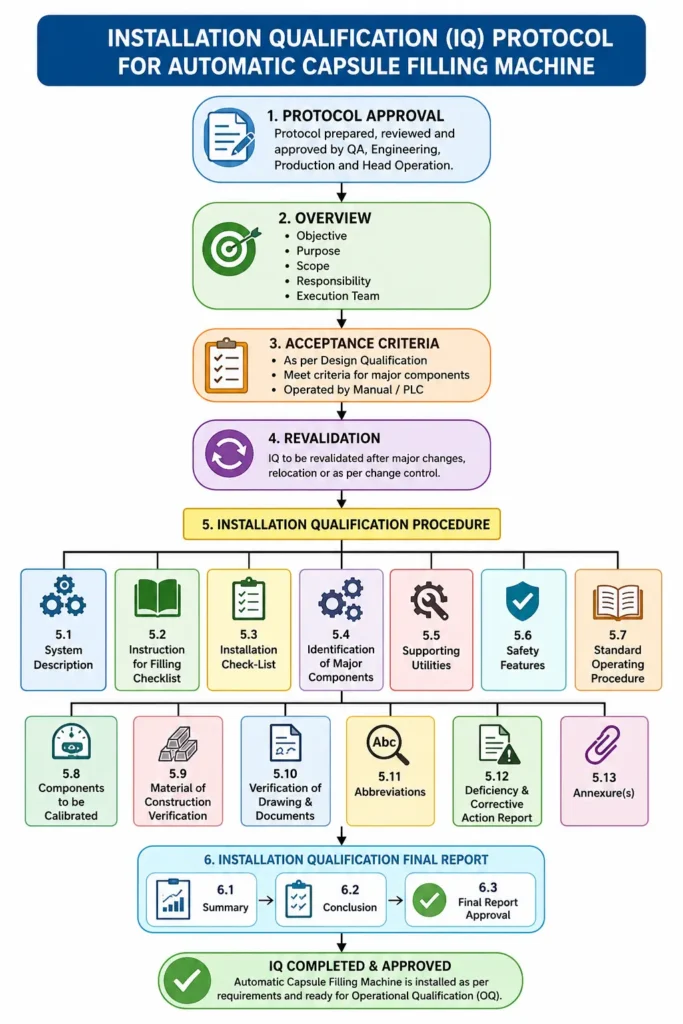
1. Brainstorming:
The brainstorming diagram identifies the possible reasons why Installation Qualification (IQ) for the Automatic Capsule Filling Machine was not performed. It organizes potential causes under key areas such as Documentation, Team & Responsibility, Verification, Utilities & Safety, and Planning & Compliance. Major concerns include pending protocol approval, unclear responsibilities, poor coordination between QA, Engineering, and Production, non-execution of the installation checklist, incomplete verification of major components, utilities, safety features, calibration requirements, material of construction, and supporting documents. It also highlights planning gaps, schedule pressure, missing SOP identification, and failure to prepare deficiency reports and the final IQ summary.
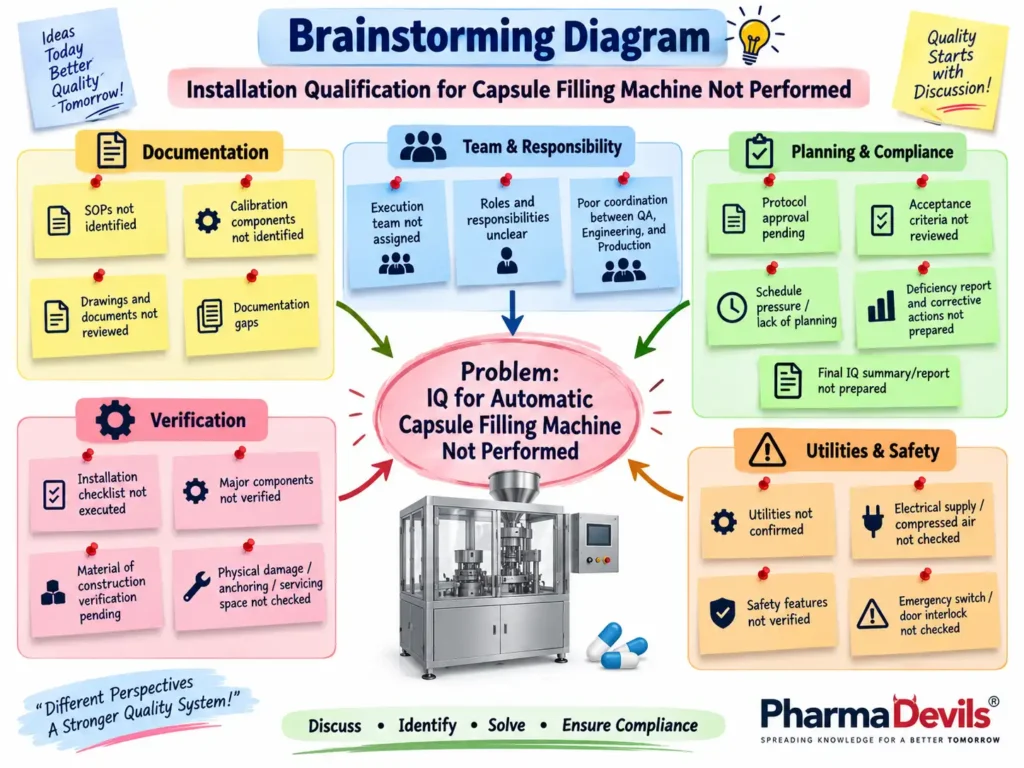
The brainstorming approach helps the investigation team collect and classify possible causes before selecting the most probable root cause. This supports a systematic deviation investigation and helps define appropriate corrective and preventive actions to ensure the capsule filling machine is properly installed, documented, and qualified before routine GMP use.
2. 5 Why Analysis:
The 5 Why Analysis was performed to identify the underlying reason why the Installation Qualification (IQ) of the Automatic Capsule Filling Machine was not performed. The analysis starts with the immediate issue—the IQ protocol was not executed—and then progressively examines why the approved protocol was unavailable, why its review and approval were delayed, and why the required supporting documents were not prepared on time. The analysis ultimately identifies inadequate project planning and poor coordination between Engineering, Quality Assurance, Production, and other stakeholders as the likely root cause. This resulted in delayed preparation and approval of the IQ protocol and, consequently, failure to execute the qualification activity at the required stage.
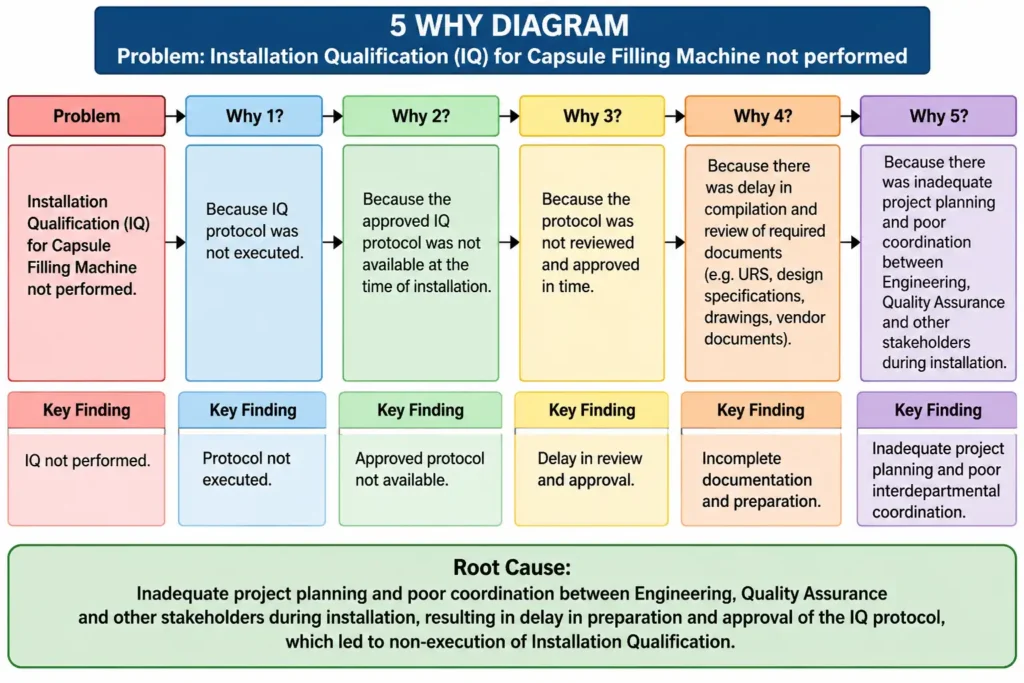
The uploaded IQ protocol specifically requires an approved protocol, defined responsibilities, execution by a multidisciplinary team, installation checks, document verification, and final review/approval. This 5 Why analysis helps support appropriate CAPA, responsibility assignment, scheduling, and stronger qualification controls.
3. Impact Assessment:
The Installation Qualification (IQ) of the Automatic Capsule Filling Machine has an important impact on the safety, quality, and reliability of capsule manufacturing. The IQ confirms that the machine is installed correctly as per the approved design, manufacturer’s requirements, and GMP expectations. Proper verification of major components, electrical connections, compressed air supply, safety features, calibration requirements, and material of construction helps reduce the risk of equipment failure and product quality problems. The identified safety features, such as emergency switch, door interlock, vacuum pressure interlock, air pressure interlock, and password protection, help protect the operator and batch. Any installation deficiency or discrepancy is recorded and addressed through corrective action. Completion of IQ provides documented evidence that the machine is suitable for further qualification activities. Therefore, successful IQ has a positive impact on equipment performance, operator safety, product quality, and GMP compliance. The machine can proceed to the next qualification stage after approval of the IQ report.
For the Automatic Capsule Filling Machine, the uploaded IQ protocol does not specifically define CPPs and CQAs. It does, however, identify the machine functions, major components, utilities, safety features, and calibration requirements that can affect capsule filling.
Critical Process Parameters (CPPs)
| S. No. | Critical Process Parameter | Impact |
|---|---|---|
| 1 | Machine speed (RPM) | Affects filling accuracy and output |
| 2 | Powder dosing/tamping setting | Affects fill weight |
| 3 | Powder feeder speed | Affects uniform powder feeding |
| 4 | Vacuum pressure | Affects capsule separation and operation |
| 5 | Compressed air pressure | Affects pneumatic operation |
| 6 | Capsule size setting | Ensures correct capsule handling |
| 7 | Tablet feeding setting | Ensures proper tablet filling |
| 8 | Rejection/interlock setting | Prevents defective capsules |
Critical Quality Attributes (CQAs)
| S. No. | Critical Quality Attribute |
|---|---|
| 1 | Capsule fill weight |
| 2 | Fill-weight uniformity |
| 3 | Capsule locking |
| 4 | Capsule appearance |
| 5 | Capsule integrity |
| 6 | Correct product/capsule size |
| 7 | Absence of empty or improperly filled capsules |
| 8 | Correct tablet/powder quantity, where applicable |
In simple words: CPPs are the machine/process settings we control, while CQAs are the quality results we check.
FMEA – Automatic Capsule Filling Machine
Based on the IQ protocol, the following Failure Mode and Effects Analysis (FMEA) can be used for the Automatic Capsule Filling Machine. The machine includes powder filling, capsule loading/separation, tablet filling, rejection, locking, ejection, electrical, pneumatic and vacuum systems.
Rating: Severity (S), Occurrence (O), Detection (D): 1 = Low/Good, 10 = High/Poor.
RPN = S × O × D
| S. No. | Process/Component | Potential Failure Mode | Potential Effect | S | O | D | RPN | Recommended Control |
|---|---|---|---|---|---|---|---|---|
| 1 | Capsule Loading | Improper capsule feeding | Empty/missing capsule | 7 | 4 | 3 | 84 | Check capsule feeding system |
| 2 | Capsule Separation | Capsule not separated properly | Improper filling/rejection | 8 | 4 | 3 | 96 | Check vacuum and separator |
| 3 | Powder Filling | Incorrect dosing | Fill-weight variation | 9 | 4 | 3 | 108 | Check dosing/tamping setting |
| 4 | Powder Feeder | Improper powder feeding | Weight variation | 8 | 4 | 3 | 96 | Verify feeder operation |
| 5 | Tablet Filling | Improper tablet feeding | Missing/wrong tablet quantity | 9 | 3 | 3 | 81 | Check tablet feeder and sensor |
| 6 | Machine Speed | Incorrect speed | Poor filling/production variation | 7 | 4 | 3 | 84 | Verify machine speed |
| 7 | Vacuum System | Low vacuum | Improper capsule separation | 8 | 3 | 3 | 72 | Check vacuum pressure |
| 8 | Compressed Air | Low air pressure | Improper pneumatic operation | 8 | 3 | 3 | 72 | Check air pressure |
| 9 | Locking Assembly | Improper capsule locking | Open/loose capsule | 9 | 3 | 3 | 81 | Check locking mechanism |
| 10 | Ejection System | Improper ejection | Capsule damage/jamming | 7 | 3 | 3 | 63 | Check ejection pins/chute |
| 11 | Sensors | Sensor malfunction | Incorrect operation/rejection | 8 | 3 | 4 | 96 | Sensor inspection/calibration |
| 12 | Electrical/PLC | PLC/control failure | Machine stoppage/incorrect operation | 9 | 2 | 4 | 72 | Preventive maintenance and checks |
| 13 | Safety Interlock | Interlock failure | Operator/process safety risk | 10 | 2 | 3 | 60 | Verify interlock during qualification |
| 14 | Cleaning | Inadequate cleaning | Cross-contamination risk | 10 | 3 | 4 | 120 | Approved cleaning SOP and verification |
| 15 | Calibration | Calibration not performed | Incorrect process measurement | 9 | 2 | 4 | 72 | Calibration before use and periodically |
Highest-Risk Areas
The major risks identified are inadequate cleaning (RPN 120), powder dosing (RPN 108), capsule separation (RPN 96), powder feeding (RPN 96), and sensor malfunction (RPN 96). These areas should receive particular attention during qualification, routine operation, preventive maintenance, and monitoring.
Note: The S/O/D scores above are a sample risk assessment. Final scores should be reviewed and approved by QA, Production, and Engineering according to the site’s approved FMEA procedure.
Question & Answers
1. What is the purpose of IQ?
The purpose of Installation Qualification is to verify and document that the Automatic Capsule Filling Machine has been properly installed according to the approved design and specified requirements.
2. What is the objective of the IQ protocol?
The objective is to collect sufficient information and confirm that the machine installation meets the specified design requirements and acceptance criteria.
3. What is the scope of the IQ?
The scope covers the installation of the Automatic Capsule Filling Machine and the related documentation required for its qualification.
4. Who is responsible for IQ execution?
The IQ is executed by a team consisting of personnel from Production, Engineering, and Quality Assurance.
5. What are the main zones of the machine?
The machine is divided into two main zones, namely the Production Zone and the Non-Production Zone.
6. What are the major assemblies of the machine?
The major assemblies include the loader assembly, powder assembly, rejection assembly, locking assembly, ejection assembly, turret assembly, and tablet filling attachments.
7. What utilities are required for the machine?
The machine requires a three-phase electrical supply of 440 V, 50 Hz and compressed air of not less than 5 kg/cm².
8. What safety features are provided?
The machine is provided with an emergency switch, vacuum pressure drop interlock, door interlock, password protection, and air pressure drop interlock.
9. What is checked during installation verification?
The installation verification includes checking the drawings, equipment anchoring, physical condition, servicing space, electrical and piping connections, wiring, access ports, and equipment identification.
10. What is the Material of Construction of major product-contact components?
The powder hopper, punches, top segment, bottom segment, dosing disc, and drum are made of SS316.
11. What happens if any deficiency is found during IQ?
Any deficiency identified during IQ is documented, and appropriate corrective action is taken and approved by the concerned personnel.
12. When is revalidation required?
Revalidation is required after major changes affecting system performance, after major breakdown maintenance, or according to the approved revalidation schedule.
13. What is the final step of IQ?
The completed IQ data and discrepancies are reviewed, followed by preparation and approval of the final IQ report.
14. Who reviews and approves the final IQ report?
The final report is reviewed by Quality Assurance, Engineering, and Production and approved by Head Operations and Quality Assurance.
15. Does completion of IQ mean that the machine is ready for routine production?
No. IQ confirms proper installation. Further qualification activities, as applicable, must be completed before routine production use.