







Brief Description
The SOP for Keeping of Reference Samples defines the procedure for collection, identification, documentation, and storage of reference samples from finished product batches. The Executive-QC is responsible for carrying out the procedure, while the Manager-QC ensures its effective implementation. Reference samples are collected during final packing at different stages of the batch: the initial sample at approximately 20% packing, middle sample at 50%, and final sample after more than 80% of the batch is packed. The required quantity is determined according to the applicable annexures. After collection, samples are transferred to the reference sample room, entered in the reference sample register, appropriately stamped, and stored under conditions suitable for the respective product.The SOP also includes a Reference Sample Register, tablet sample quantities, and liquid sample quantities for QC, microbiological testing, and control/reference purposes.
Skip to PDF content1. Flow Diagram:
The flow diagram illustrates the step-by-step process for keeping reference samples of finished pharmaceutical products. Reference samples are collected while final packing is in progress. Sampling is performed at defined stages of the batch: initial sample at 20% packing, middle sample at 50%, and final sample after more than 80% of the batch has been packed.
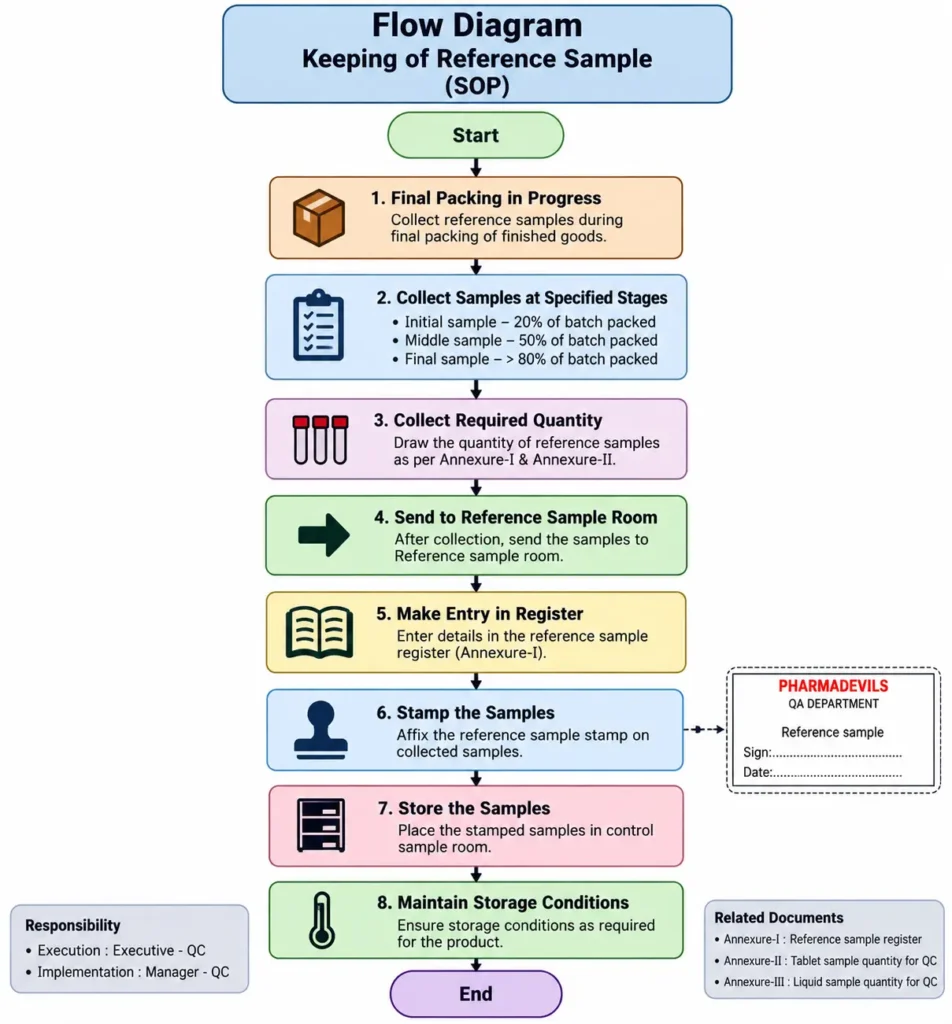
The required quantity of samples is collected according to the applicable annexures. After collection, the samples are transferred to the Reference Sample Room, and the relevant details are entered in the reference sample register. Each sample is then stamped with the reference sample identification, including signature and date. The stamped samples are placed in the designated control/reference sample room and stored under conditions appropriate for the specific product.This flow ensures proper traceability, identification, documentation, storage, and availability of reference samples when required for future evaluation or investigation.
2. Brainstorming for SOP Failure:
The brainstorming diagram identifies the major reasons why the SOP for Keeping of Reference Samples may fail during routine pharmaceutical operations. The classroom-style sticky notes highlight potential causes such as inadequate training, failure to follow the SOP, incorrect sampling stages, wrong quantity collection, selection of the wrong batch or product, missed collection during final packing, improper labeling or stamping, and failure to make entries in the reference sample register. Other possible causes include samples not being transferred to the reference sample room, incorrect storage conditions, failure to refer to the annexure for sample quantity, sample misplacement or loss, poor supervision, high workload, and weak communication between Production and QC.
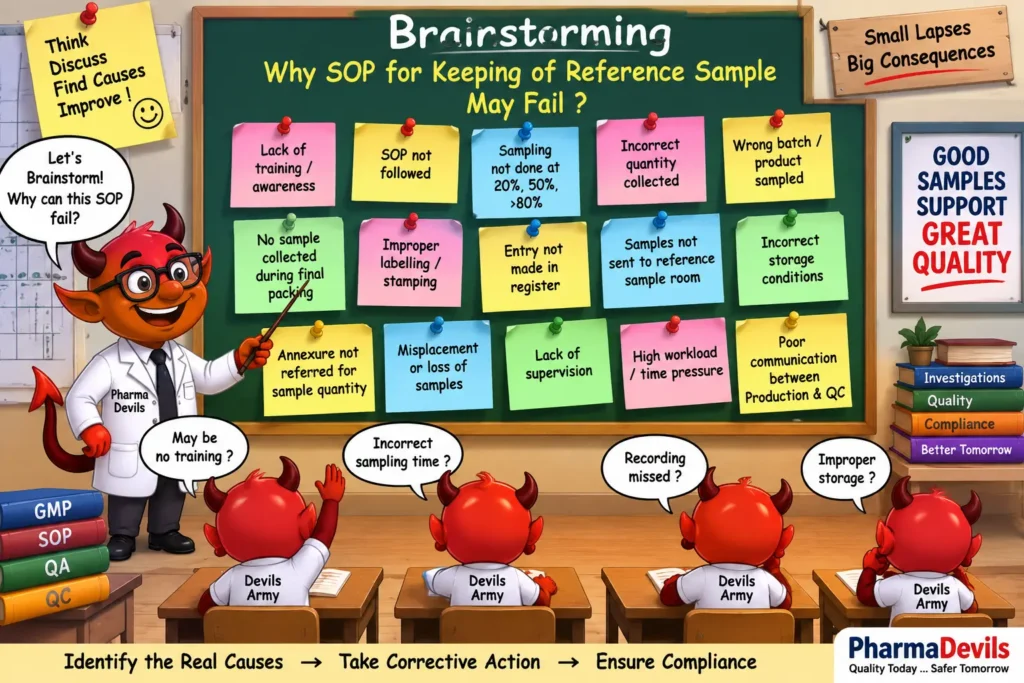
The brainstorming approach helps the team openly discuss possible failure points, identify the most likely root causes, and define corrective and preventive actions to improve traceability, sample integrity, GMP compliance, and overall quality control effectiveness.
3. 5-Why Analysis for SOP Failure:
The 5-Why Analysis for SOP Failure – Keeping of Reference Sample explains the sequence of causes that can lead to improper handling of reference samples. The analysis starts with the problem that reference samples were not collected and stored correctly. It then identifies that sampling may not have been performed at the required stages and quantities, even though the SOP specifies collection during final packing at approximately 20%, 50%, and above 80% of the packed batch.
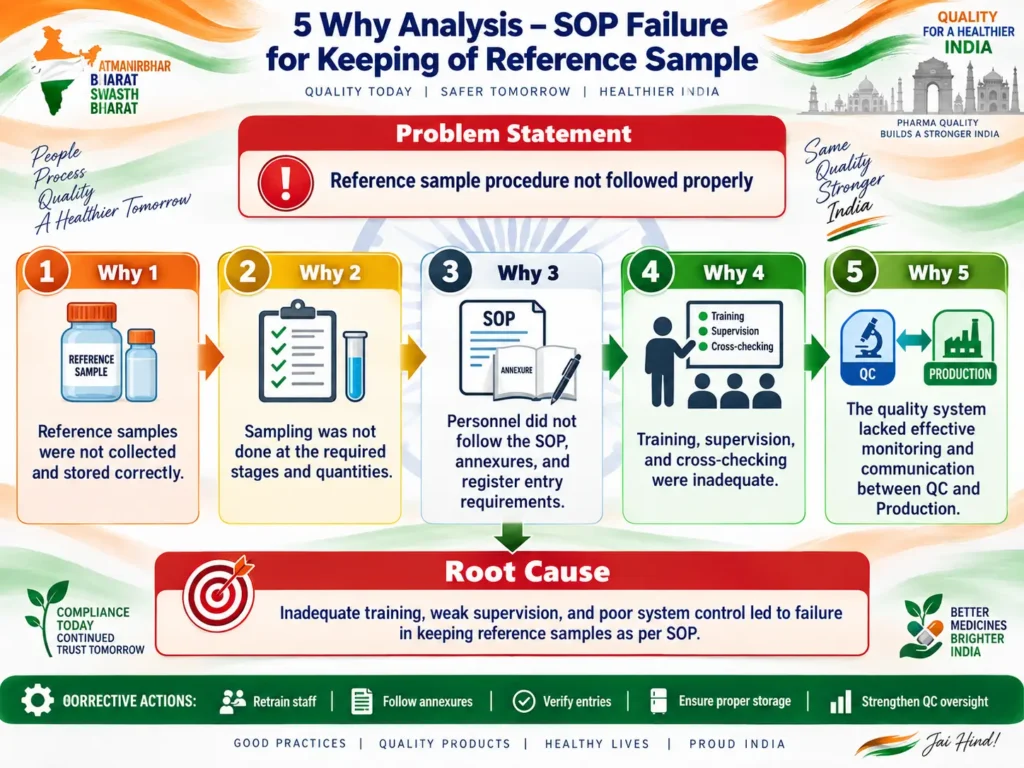
Further questioning shows that personnel may not have followed the SOP, annexures, and reference sample register requirements. Weak training, inadequate supervision, insufficient cross-checking, and poor communication between Production and QC can contribute to the failure. The analysis identifies the root cause as inadequate training, weak supervision, and ineffective system controls.Corrective actions include retraining personnel, following approved annexures, verifying register entries, ensuring proper storage conditions, and strengthening QC oversight.
4. Fishbone Analysis for SOP Failure:
The Fishbone Analysis for SOP Failure – Keeping of Reference Sample identifies possible causes that may lead to improper collection, documentation, identification, and storage of reference samples. The causes are organized into six major categories: Man (People), Method (Procedure), Machine (Equipment), Material (Samples), Mother Nature (Environment), and Measurement (Record & Control).
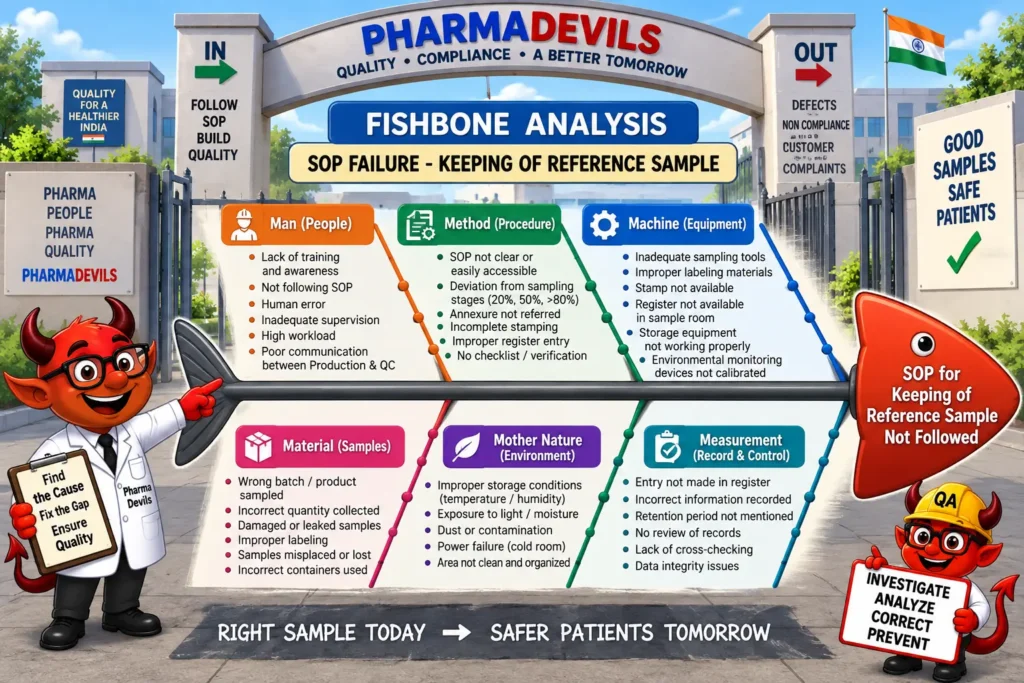
Key contributing factors include inadequate training, human error, poor supervision, deviation from required sampling stages, incomplete stamping, incorrect register entries, unavailable or unsuitable sampling tools, wrong batch selection, incorrect sample quantities, sample loss or damage, improper storage temperature or humidity, and inadequate record review or cross-checking.The fishbone approach helps the QA/QC team systematically investigate the problem, identify probable root causes, and implement corrective and preventive actions to strengthen SOP compliance, sample traceability, storage control, data integrity, and overall pharmaceutical quality assurance.
5. Fault Tree Analysis for SOP Failure:
The Fault Tree Analysis for SOP Failure – Keeping of Reference Sample shows how different failures can combine to cause the top event: reference samples not being collected, stored, or available as required by the SOP. The analysis divides the failure into four main branches: samples not collected, samples collected but not properly identified or recorded, samples not stored properly, and samples lost or unavailable.
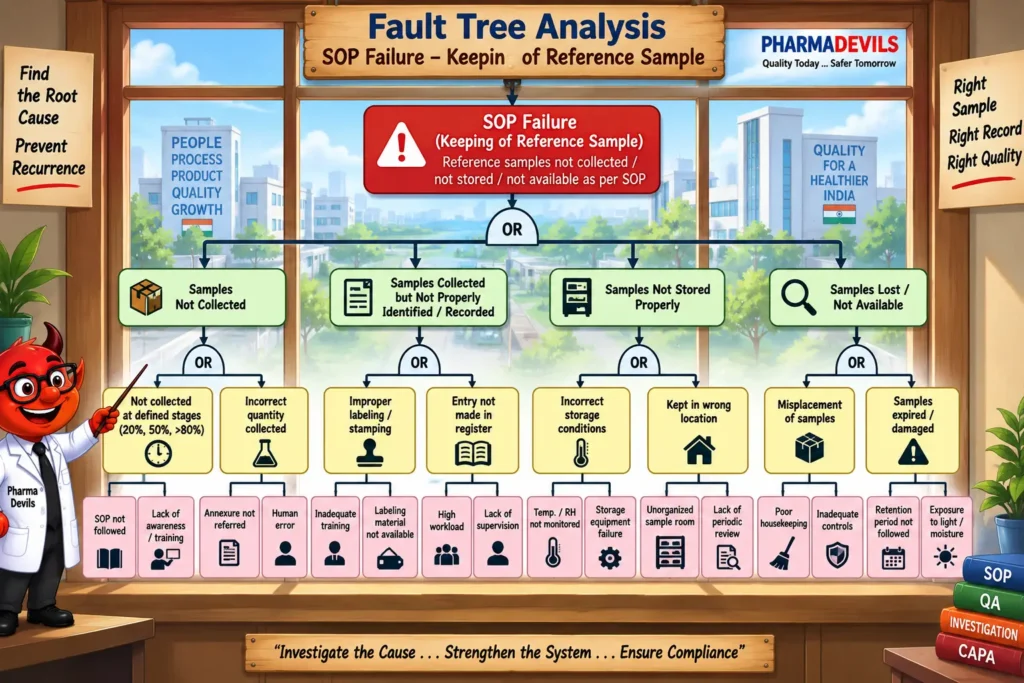
Possible causes include failure to collect samples at the defined 20%, 50%, and more than 80% packing stages, incorrect sample quantity, failure to refer to the annexure, improper labeling or stamping, missing register entries, inadequate training, weak supervision, unsuitable storage conditions, equipment failure, poor housekeeping, misplacement, and failure to follow the required retention period. The diagram helps QA/QC teams trace contributing causes systematically, identify the most critical weaknesses, and implement appropriate CAPA, supervision, training, documentation controls, and storage improvements to prevent recurrence.
Questions & Answers – SOP for Keeping of Reference Samples
- What is the objective of this SOP?
The objective is to lay down a procedure for keeping reference samples. - Who is responsible for executing the SOP?
The Executive-QC is responsible for execution of the SOP. - Who is responsible for effective implementation of the SOP?
The Manager-QC is responsible for effective implementation. - When should reference samples be collected?
Reference samples should be collected while the final packing of the finished product is in progress. - At what stages of packing are reference samples collected?
Samples are collected at approximately 20% of packing, 50% of packing, and after more than 80% of the batch is packed. - How is the quantity of reference samples determined?
The SOP states that the required quantity should be drawn as specified in the applicable annexures. - Where are reference samples sent after collection?
After collection, they are sent to the Reference Sample Room. - What documentation is required after sample collection?
An entry must be made in the Reference Sample Register maintained in the reference sample room. - What identification is applied to the reference sample?
The samples are stamped with a Reference Sample identification containing provision for signature and date. - Where are stamped reference samples stored?
The stamped samples are placed in the control sample room. - What storage conditions should be maintained?
Storage conditions appropriate for the respective product must be maintained in the reference sample room. - Who provides training for this SOP?
The Manager-QC is the trainer, and Quality Control personnel are the trainees. The stated training period is one day. - What are the main enclosures/annexures in the SOP?
The SOP lists a Reference Sample Register, Tablet Sample Quantity for QC, and Liquid Sample Quantity for QC as annexures. - What information is recorded in the Reference Sample Register?
The register includes details such as date, product name, batch number, item code, manufacturing and expiry dates, sampled quantity, control number, purpose, sample kept by, checked by, and retention period. - Why are reference samples important according to this SOP process?
The SOP establishes controlled collection, identification, documentation, and storage so that samples from finished-product batches remain properly traceable and available during their defined retention period.
Reference Guidelines:
Your uploaded SOP currently states “Reference: In House.” For a stronger regulatory reference section, the following official guidelines can be cited:
- Revised Schedule M – Drugs Rules, 1945, India (G.S.R. 922(E), 28 December 2023)
Revised Schedule M requires adequate QC arrangements, approved sampling procedures, records, and retention of sufficient samples for future examination. The CDSCO Gazette page lists the official Schedule M notification. (CDSCO)
CDSCO – Revised Schedule M / G.S.R. 922(E) - EU GMP – EudraLex Volume 4, Annex 19: Reference and Retention Samples
This is one of the most directly relevant international guidelines for reference/retention samples, covering sample purpose, quantity, storage, location, and retention arrangements. The revised Annex 19 was published on 24 June 2026 and becomes applicable 24 September 2026. (Public Health)
European Commission – EU GMP Annex 19 - WHO GMP – TRS 986, Annex 2: Good Manufacturing Practices for Pharmaceutical Products – Main Principles
WHO states that retention samples of finished products should generally be maintained for at least one year after expiry, stored under recommended conditions, and be sufficient to permit at least two full re-examinations. (WHO CDN)
WHO – TRS 986 Annex 2 GMP Main Principles - US FDA – 21 CFR §211.170, Reserve Samples
US cGMP requires an appropriately identified and representative reserve sample from each lot/batch. For finished drug products, the reserve sample should generally contain at least twice the quantity necessary for required testing, be stored under conditions consistent with labeling, and normally be retained for one year after expiry. (GovInfo)
US FDA cGMP – 21 CFR Part 211, §211.170
Recommended SOP reference wording: “Revised Schedule M of Drugs Rules, 1945; WHO GMP TRS 986 Annex 2; EU GMP Annex 19 – Reference and Retention Samples; and 21 CFR 211.170 – Reserve Samples, as applicable.”