





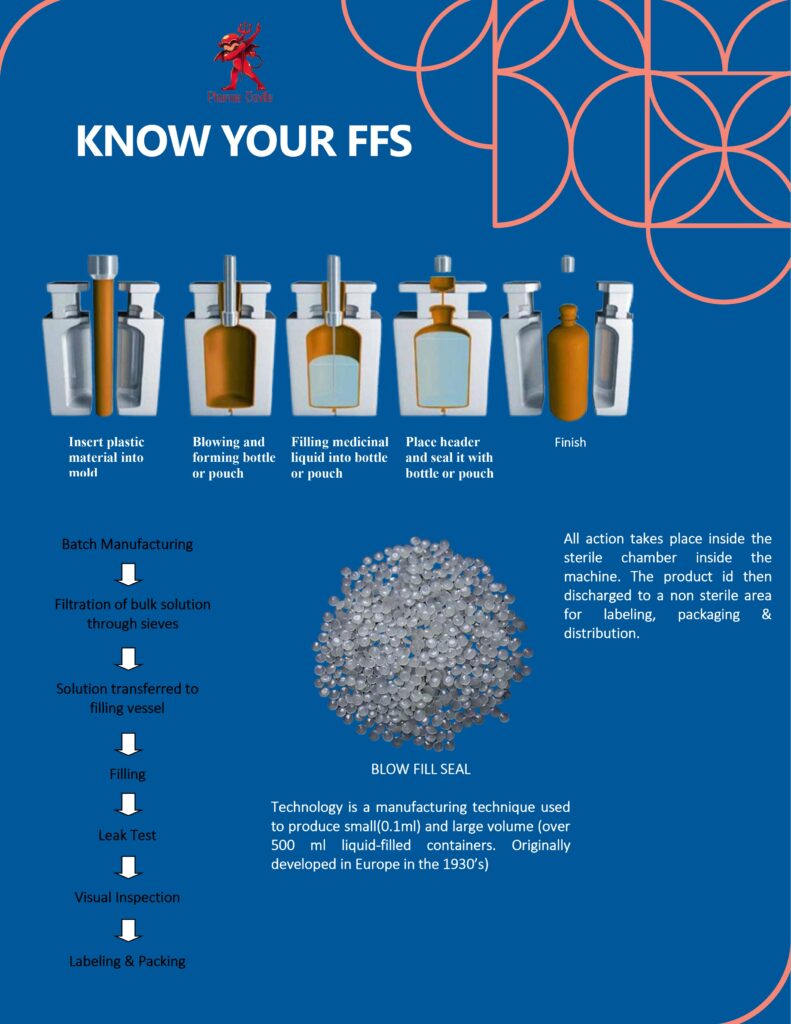
Form-Fill-Seal (FFS) in pharma is an automated packaging process where a container is formed, then filled with product, and immediately sealed—all in one continuous, controlled operation. It is widely used for sterile liquids (BFS) and some non-sterile products because it minimizes human intervention, reduces contamination risk, and improves consistency.
Types used in pharma
- BFS (Blow-Fill-Seal): Most common for sterile unit-dose products. A parison (molten polymer tube) is extruded, blown into a mold to form the container, filled aseptically, then sealed in the same machine cycle. Typical packs: ampoules, vials, bottles, IV containers.
- FFS sachet/strip (horizontal/vertical): Film is formed into pouches/sachets, filled, and sealed. Used for powders, granules, liquids (often non-sterile or low-risk sterile applications depending on design).
Basic process steps (BFS example)
- Polymer melting & extrusion (e.g., LDPE/PP)
- Container forming by blow molding inside the mold
- Filling through sterile filling nozzles (critical step)
- Sealing (top seal/closure formation)
- Cooling & ejection, then inspection and packing
Why it’s important
- Low contamination risk: minimal operator exposure
- High speed & repeatability: consistent fill volume and sealing quality
- Reduced handling: fewer transfers and open operations
- Good for unit-dose: improves patient safety and dosing accuracy
Critical Quality Attributes (CQA’s)
- Fill volume/weight accuracy
- Container integrity (CCI): seal strength, leak tightness
- Particulate control
- Sterility assurance (for BFS): aseptic conditions, environmental control
- Material quality: resin grade, extractables/leachables, compatibility
- Seal defects: pinholes, weak seals, deformation
Key controls (CPP’s)
- Polymer temperature, extrusion speed, mold temperature
- Aseptic zone airflow/HEPA integrity (BFS)
- Filling time, nozzle alignment, product temperature/viscosity
- Seal time/pressure/temperature
- Online monitoring: weight checks, vision inspection, leak testing
Validation & Compliance focus
- Process validation: forming, filling, sealing consistency
- Media fill / aseptic process simulation (for BFS sterile operations)
- Cleaning validation (product contact parts, nozzles, pathways)
- Environmental monitoring and operator interventions control
- Container-closure integrity testing and stability studies