




1. Introduction – Labeling Procedure in Plant:
The Labeling Procedure in Plant is established to ensure clear identification and proper status control of materials, containers, equipment, instruments, and manufacturing areas throughout pharmaceutical operations. The SOP applies to labeling activities in the Production Department and assigns responsibility to Production personnel for execution, with Production and Quality Assurance personnel responsible for effective implementation. A systematic labeling system helps communicate the current condition or status of equipment and materials and supports traceability during manufacturing and packing activities. The SOP defines various status labels, including Container Status, Equipment Status, Recoverable, Cleaned, Online Rejection, Non-Recoverable, Under Maintenance, Material Return, To Be Cleaned, Sample for Analysis, Instrument Calibration Status, Preventive Maintenance, and Hold labels. Correct completion, verification, attachment, and removal of these labels help prevent mix-ups, incorrect material usage, processing errors, and unintended use of equipment. The procedure therefore supports effective GMP status identification, accountability, documentation, and controlled pharmaceutical manufacturing operations.
Skip to PDF content2. Flow Diagram – Labeling Procedure in Plant:
The Labeling Procedure in Plant provides a systematic method for identifying the status of materials, containers, equipment, instruments, and manufacturing areas during pharmaceutical operations. The SOP requires that appropriate status labels be selected according to the condition or stage of operation and that all required information be entered clearly and legibly. Typical labels include Container Status, Equipment Status, Cleaned, Recoverable, Non-Recoverable, Under Maintenance, Material Return, To Be Cleaned, Hold, Sample for Analysis, Calibration Status, and Preventive Maintenance.
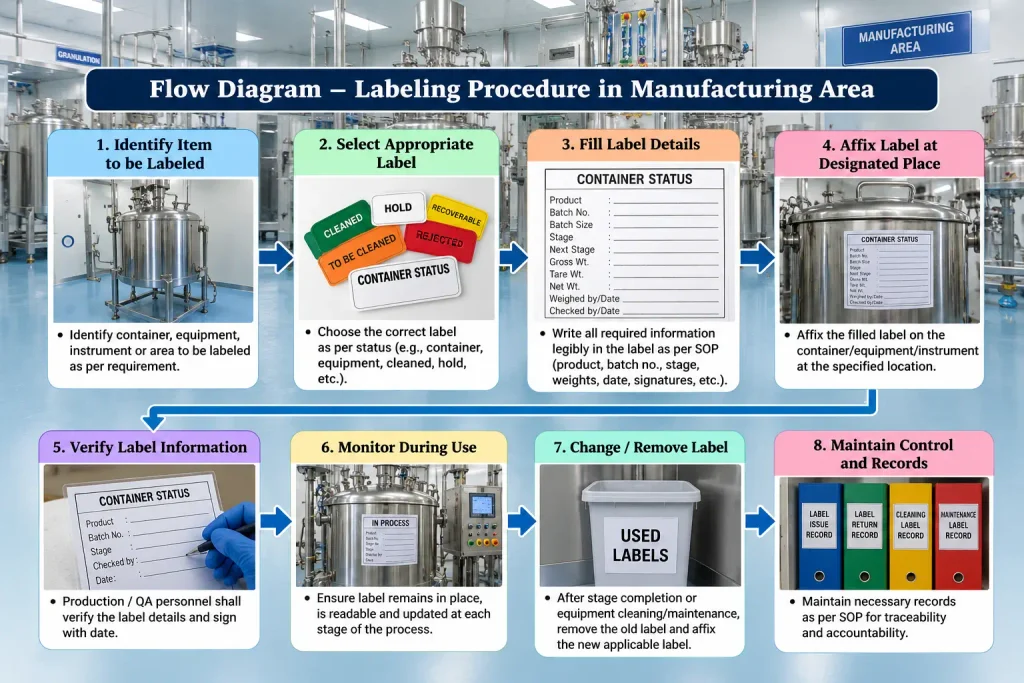
Labels are affixed at the designated location and checked by responsible Production and Quality Assurance personnel where applicable. During processing, labels should remain readable and reflect the current status. When the activity, cleaning, maintenance, or processing stage is completed, the previous label is removed or destroyed as specified and replaced with the applicable status label. This system supports traceability, prevents mix-ups, and helps maintain controlled manufacturing operations.
3. Benefits of Following SOP – Labeling Procedure in Plant:
Following the Labeling Procedure in Plant ensures that materials, containers, equipment, instruments, and manufacturing areas are clearly identified with the correct status throughout pharmaceutical operations. The SOP defines multiple status labels such as Container Status, Equipment Status, Cleaned, Recoverable, Online Rejection, Non-Recoverable, Under Maintenance, Material Return, To Be Cleaned, Sample for Analysis, Calibration Status, Preventive Maintenance, and Hold.
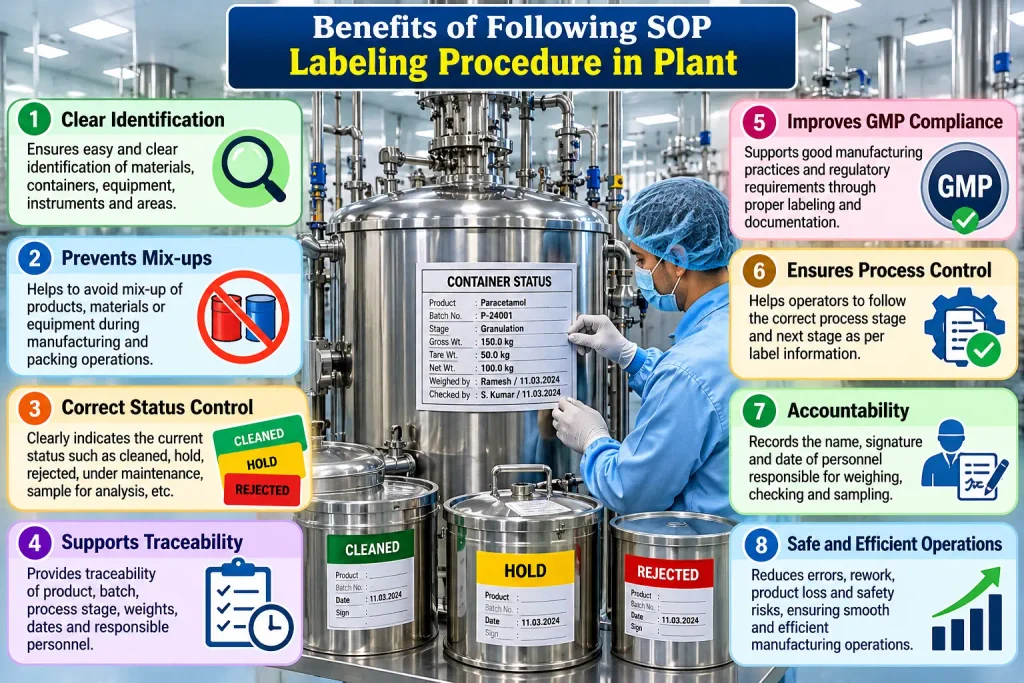
Proper labeling helps prevent mix-ups and ensures that the current condition of materials or equipment is easily understood by Production and Quality personnel. For example, container labels include product, batch, stage, weight, and verification details, while cleaned labels identify equipment or containers that have undergone cleaning and visual verification. Compliance with this SOP improves traceability, accountability, process control, GMP compliance, and operational safety. Clear labeling also supports correct decision-making during manufacturing, packing, maintenance, sampling, cleaning, and material handling, thereby reducing errors and improving the overall control of plant operations.
4. Brainstorming for SOP Failure – Labeling Procedure in Plant:
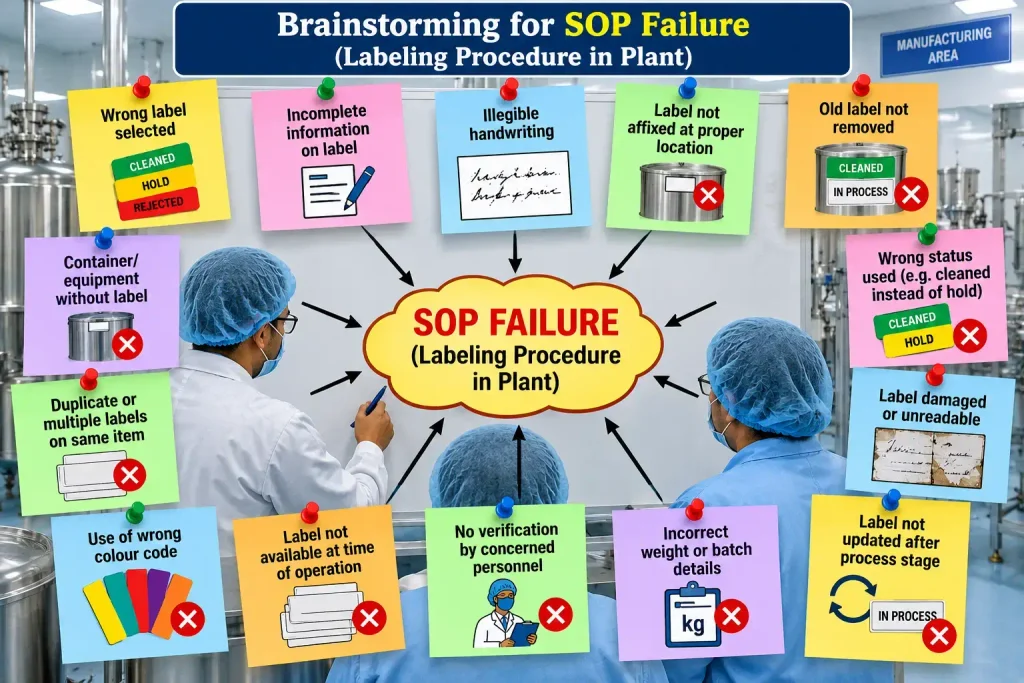
Brainstorming for failure of the Labeling Procedure in Plant is used to identify possible weaknesses that may lead to incorrect or unclear status identification during manufacturing activities. The SOP requires appropriate labels to be used for containers, equipment, recoverable and non-recoverable material, cleaned items, maintenance status, material return, sampling, calibration, preventive maintenance, hold status, and other defined conditions. Potential failure causes include selection of the wrong label, incomplete entries, illegible handwriting, missing labels, incorrect status indication, use of the wrong colour code, duplicate labels, damaged or unreadable labels, failure to remove old labels, incorrect batch or weight details, and absence of verification by responsible personnel. The SOP specifically requires labels to be clearly completed, checked, signed, and dated where applicable.
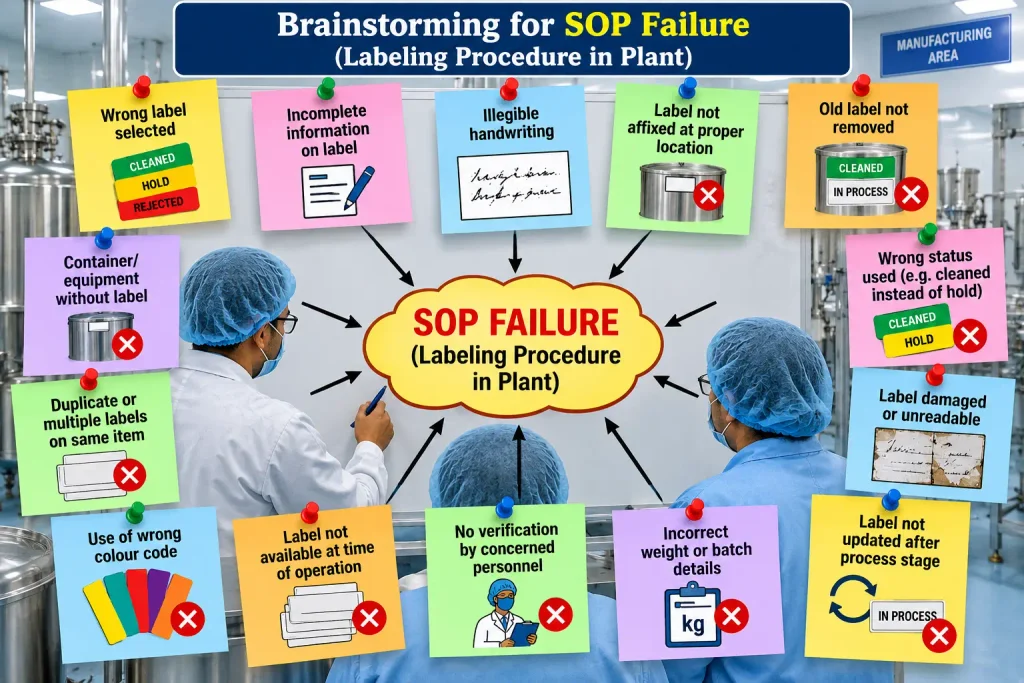
Identifying these possible failures through brainstorming helps strengthen label control, prevent mix-ups, improve traceability, and ensure that the actual status of materials, equipment, and process stages remains clearly communicated throughout plant operations.
5. 5-Why Analysis for SOP Failure – Labeling Procedure in Plant:
The 5-Why Analysis for SOP Failure – Labeling Procedure in Plant is used to identify the underlying reason for incorrect, incomplete, missing, or inappropriate status labeling during pharmaceutical manufacturing activities. The analysis begins with a problem such as confusion about the actual status of a material, container, or equipment and progressively investigates why the failure occurred.
The likely sequence may start with a missing or incorrect label, followed by incomplete label details or selection of the wrong label. This can further be linked to inadequate understanding of the labeling requirements, insufficient training, weak supervision, or ineffective monitoring of the labeling control system. The SOP requires proper identification of equipment and containers and specifies different labels for statuses such as cleaned, recoverable, non-recoverable, under maintenance, material return, hold, and other defined conditions.The analysis helps establish appropriate corrective and preventive actions such as retraining personnel, verifying label entries, removing obsolete labels, strengthening supervisory checks, and periodically reviewing labeling practices to prevent recurrence.
6. Fishbone Analysis for SOP Failure – Labeling Procedure in Plant:
The Fishbone Analysis for SOP Failure – Labeling Procedure in Plant is used to systematically identify possible causes that may lead to incorrect, incomplete, missing, damaged, or misleading status labels during pharmaceutical manufacturing operations. The analysis groups potential causes under major categories such as Man, Machine, Material, Method, Measurement, and Environment.
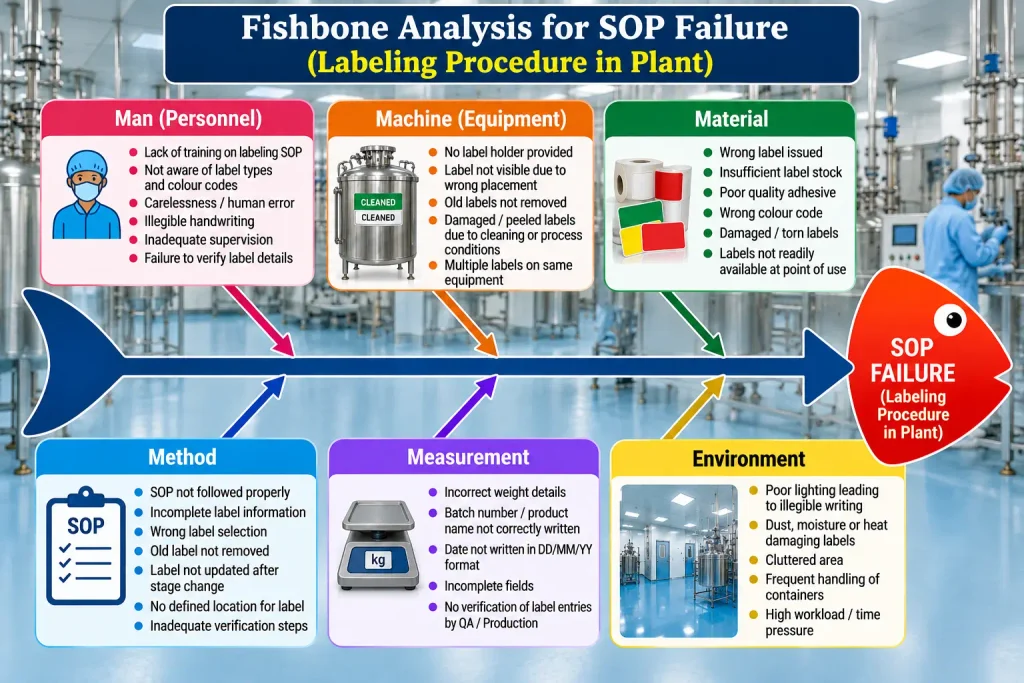
Personnel-related causes may include lack of training, poor awareness of label types and colour codes, illegible handwriting, inadequate supervision, and failure to verify label details. Method-related failures can include use of the wrong label, incomplete information, failure to remove an old label, or failure to update the label after a process-stage change. The SOP specifically defines different labels and colour codes for statuses such as Cleaned, Recoverable, Non-Recoverable, Under Maintenance, Material Return, To Be Cleaned, Sample for Analysis, Hold, and Equipment Status. The SOP also requires clear completion and verification of information such as product name, batch number, process stage, weight, date, and responsible personnel.By identifying these contributing causes, the fishbone analysis supports targeted CAPA, improved training, stronger verification, better label control, and prevention of recurrence.
7. Fault Tree Analysis for SOP Failure – Labeling Procedure in Plant:
The Fault Tree Analysis for SOP Failure – Labeling Procedure in Plant evaluates how different labeling-related failures can combine to produce the undesired top event of incorrect, missing, or misleading labeling in the plant. The analysis breaks the failure into major branches such as label not available or not used, label used with incorrect or incomplete information, and label present but ineffective or unreadable.
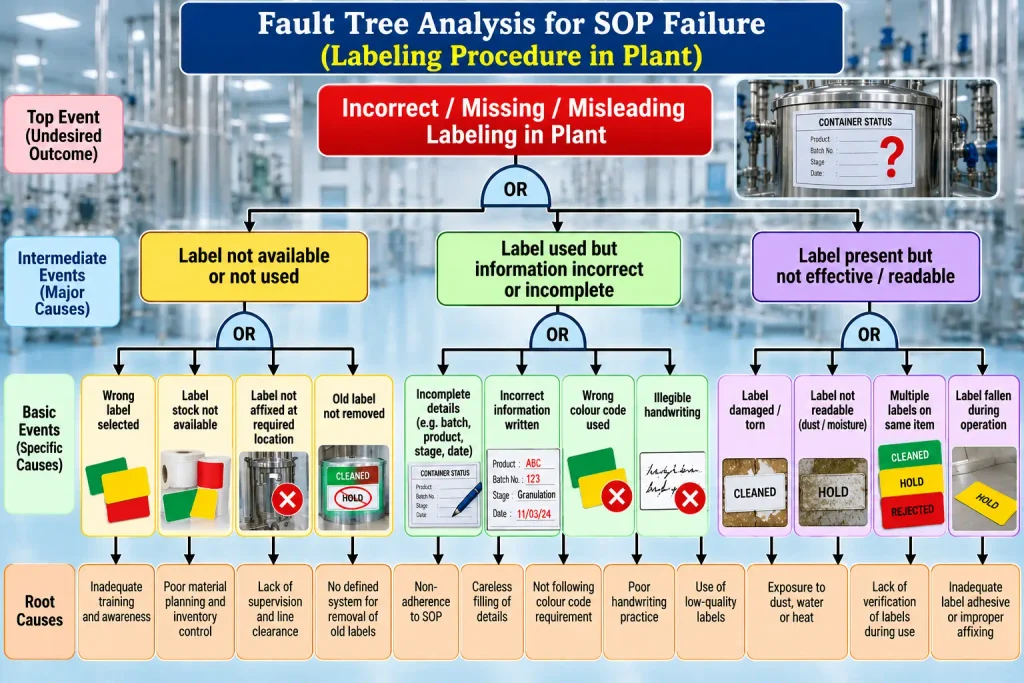
Typical basic causes include selection of the wrong label, non-availability of label stock, failure to affix the label at the required location, old labels not being removed, incomplete product or batch details, incorrect entries, wrong colour coding, illegible handwriting, damaged labels, and multiple labels on the same item. The SOP specifically defines several status labels and their colour codes for different plant conditions. The SOP also requires container labels to include details such as product name, batch number, stage, gross weight, tare weight, net weight, signatures, and dates. Fault Tree Analysis therefore helps identify the underlying control failures so that suitable actions can be taken to strengthen training, verification, label availability, readability, placement, and removal of obsolete labels.
8. Impact Assessment for SOP Failure – Labeling Procedure in Plant:
The Impact Assessment for SOP Failure – Labeling Procedure in Plant evaluates the possible consequences of incorrect, missing, damaged, or misleading status labels during pharmaceutical manufacturing and packing operations. Since the SOP uses labels to identify the status of containers, equipment, materials, instruments, and manufacturing areas, failure of the labeling system can create confusion and increase the risk of mix-ups.
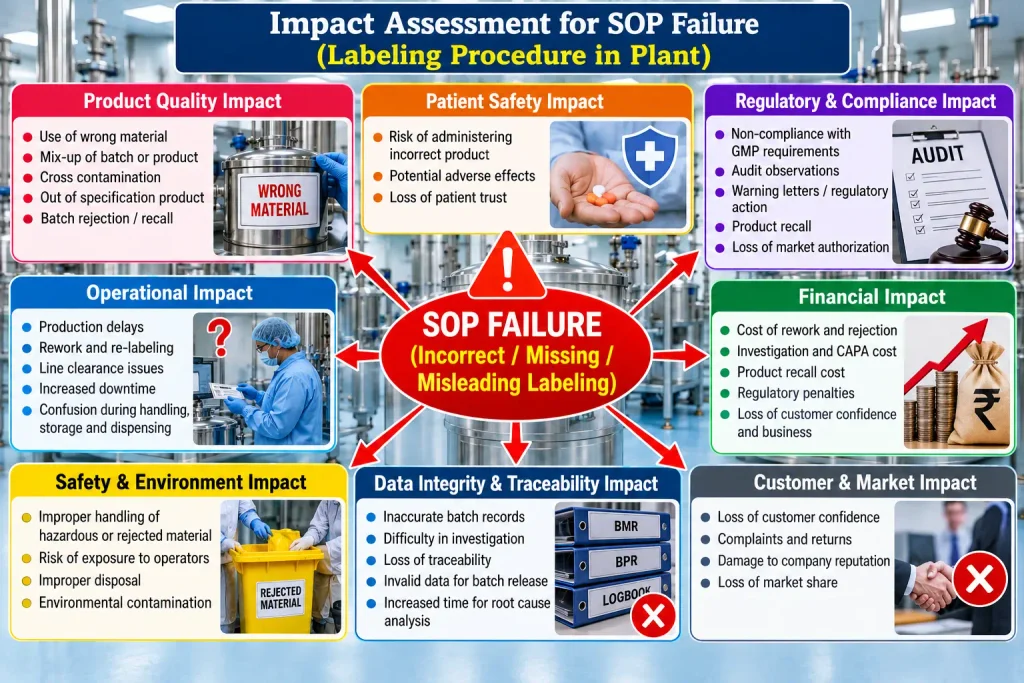
The impact may include incorrect material or equipment identification, loss of traceability, improper handling of rejected or recoverable materials, production delays, re-labeling, investigation, and additional QA review. Container labels are intended to record key information such as product name, batch number, processing stage, weights, dates, and verification details. Failure to maintain correct labeling can therefore affect product quality, process control, GMP compliance, data integrity, operational efficiency, and accountability. The assessment helps determine the seriousness of the failure and supports appropriate corrective and preventive actions to restore reliable status identification throughout plant operations.
9. CAPA for SOP Failure – Labeling Procedure in Plant:
The Corrective and Preventive Action (CAPA) for SOP Failure – Labeling Procedure in Plant is intended to eliminate identified labeling errors and prevent their recurrence during pharmaceutical manufacturing operations. Typical failures may include missing labels, incorrect status labels, incomplete entries, wrong colour codes, illegible information, failure to remove obsolete labels, or inadequate verification. The SOP defines specific label types and colour codes for different operational conditions, making correct selection and use essential. Corrective actions should include immediate identification and correction of wrongly labeled items, removal of obsolete or incorrect labels, verification of product and batch details, retraining of concerned personnel, and review of affected labeling records. The SOP requires important details such as product name, batch number, stage, weights, signatures, and dates to be correctly recorded and checked.
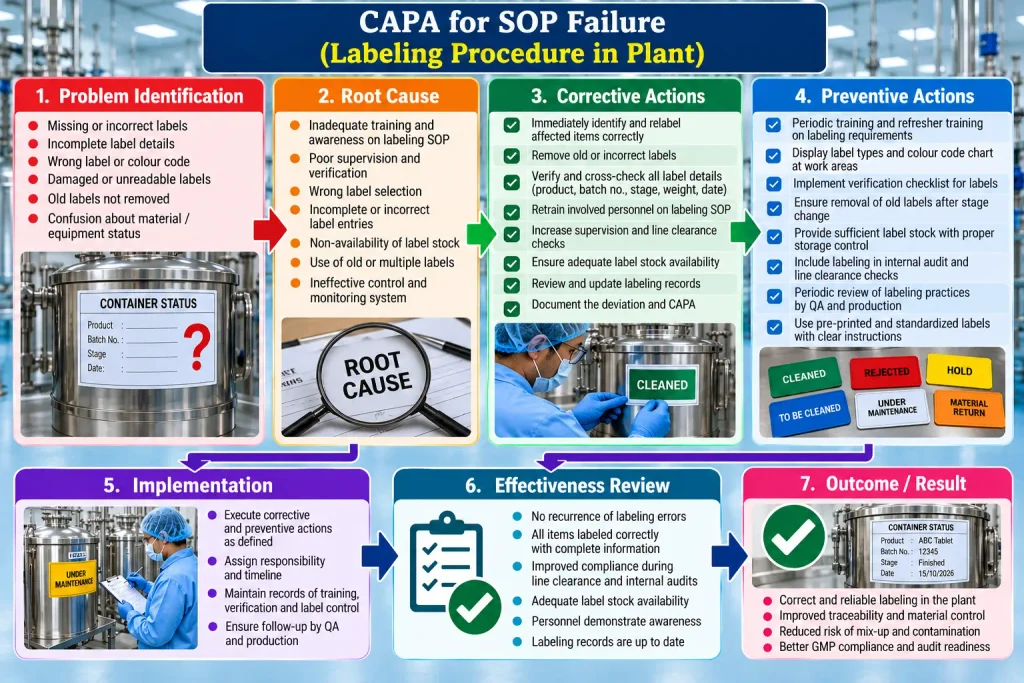
Preventive actions may include periodic refresher training, display of approved label formats and colour codes, adequate label-stock control, enhanced Production/QA verification, routine line-clearance checks, and periodic review of labeling practices. CAPA effectiveness should be demonstrated through absence of repeat labeling errors, improved traceability, complete records, and consistent compliance with the approved SOP.
Questions & Answers – Labeling Procedure in Plant:
Q1. What is the objective of the Labeling Procedure in Plant SOP?
Answer: The objective is to establish a defined procedure for labeling activities in the plant so that materials, equipment, containers, instruments, and areas can be properly identified and controlled.
Q2. Who is responsible for execution of this SOP?
Answer: Concerned Production personnel and Production Chemists are responsible for execution of the SOP.
Q3. Why are status labels required on equipment and instruments?
Answer: The SOP requires instruments and equipment to carry status labels so their identity and current status can be clearly recognized.
Q4. What types of labels are covered under this SOP?
Answer: The SOP includes Container Status, Equipment Status, Recoverable, Cleaned, Online Rejection, Non-Recoverable, Under Maintenance, Material Return, To Be Cleaned, Area Status Board, Over Printed Material Checked, Sample for Analysis, Instrument Calibration Status, Filter Replacement, Water Tank Cleaning, Preventive Maintenance, Hold, and Instrument Verification Status labels.
Q5. What information should be entered on a Container Status label?
Answer: The label includes details such as product name, batch number, batch size, manufacturing/expiry details, stage, next stage, gross weight, tare weight, net weight, and signatures or dates of concerned personnel.
Q6. How should containers from the same product and batch be numbered?
Answer: Containers should be numbered against the total number of containers, for example 01 of 03, 02 of 03, and 03 of 03.
Q7. What is the purpose of the Equipment Status label?
Answer: It identifies equipment while in use and records the equipment name/number, product, batch number, stage of operation, and checking details.
Q8. When is a Recoverable label used?
Answer: It is used on HDPE or stainless-steel containers holding recoverable material generated during operations such as granulation, compression, coating, capsule filling, sorting, inspection, and packing.
Q9. When should a Cleaned label be affixed?
Answer: A Cleaned label should be affixed on cleaned equipment, containers, and accessories after cleaning. The operator records the cleaning details, and the Production Chemist verifies visual cleanliness.
Q10. What is the purpose of the Online Rejection label?
Answer: It identifies containers holding material rejected during dispensing or production and records details such as item name, batch number, quantity, reason for rejection, and approval/receipt information.
Q11. When is the Under Maintenance label used?
Answer: It is affixed on equipment undergoing electrical, mechanical, civil, or other maintenance work and remains present throughout the maintenance activity.
Q12. What is the purpose of the Material Return label?
Answer: It is used for extra raw or packing material remaining after completion of a batch and being returned to the warehouse.
Q13. What information is displayed on the Area Status Board?
Answer: It displays the area name, product, batch number, current status, checked-by details, and date. The status may indicate conditions such as In Use, To Be Cleaned, Under Cleaning, Cleaned, or Civil Work in Progress.
Q14. What is the purpose of the Sample for Analysis label?
Answer: It is affixed to samples intended for analysis and records product name, batch number, batch size, manufacturing date, expiry date, sample quantity, date of receipt, and sampling details.
Q15. What information is required on an Instrument Calibration Status label?
Answer: It includes instrument name, instrument ID number, serial number, calibration date, calibration due date, and signatures of the concerned personnel
Q16. When is the Hold label used?
Answer: The Hold label is affixed to material placed on hold and records the material name, item code, batch number, batch size, manufacturing date, expiry date, stage, reason, and signature/date.
Q17. Who verifies or approves labeling activities?
Answer: Depending on the label type, Production personnel, Production Chemists, IPQA/QA personnel, Maintenance personnel, Warehouse personnel, or senior officers are responsible for checking, approval, receipt, or verification.
Q18. Why is proper labeling important in pharmaceutical manufacturing?
Answer: Proper labeling ensures clear status identification, supports traceability, helps prevent mix-ups, enables correct handling of materials and equipment, and supports GMP-compliant manufacturing control.
Reference Guidelines – Labeling Procedure in Plant:
- WHO Good Manufacturing Practices (GMP) – requirements for proper identification, status labeling, prevention of mix-ups, documentation, and controlled manufacturing operations.
- PIC/S Guide to Good Manufacturing Practice for Medicinal Products – PE 009 – provisions related to premises, equipment status, documentation, production controls, and prevention of mix-ups.
- EU Guidelines for Good Manufacturing Practice, EudraLex Volume 4 – particularly Chapter 3: Premises and Equipment, Chapter 4: Documentation, and Chapter 5: Production.
- US FDA 21 CFR Part 211 – especially requirements related to equipment identification, component and container control, production and process controls, labeling, and records.
- Schedule M of the Drugs Rules, India – GMP requirements for pharmaceutical manufacturing premises, equipment, documentation, production, and material identification/status control.
- ICH Q9 – Quality Risk Management – useful when assessing risks arising from labeling errors, mix-ups, incorrect status identification, or failure of labeling controls.
- ICH Q10 – Pharmaceutical Quality System – supports CAPA, training, documentation, change control, and continual improvement related to labeling systems.