






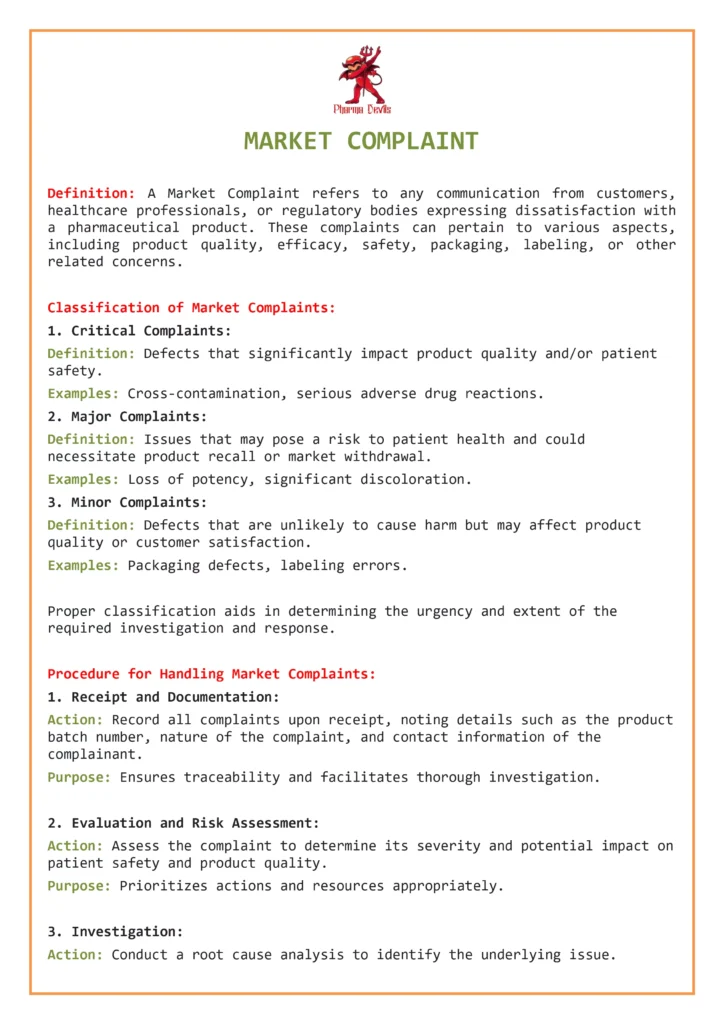

In pharma, market complaints are a critical part of the Pharmaceutical Quality System (PQS) because they can signal potential risks to patient safety, product quality defects, counterfeit infiltration, or distribution failures.
What complaints typically include
Common complaint categories are:
- Product quality defects: discoloration, odor, precipitation, caking, broken tablets, leaking vials, particulate matter, underfill/overfill.
- Packaging/labeling issues: wrong batch/expiry, missing leaflet, damaged seals, incorrect coding, broken tamper-evident features, label mix-ups.
- Performance/clinical concerns: lack of efficacy, adverse events (often handled via pharmacovigilance but linked to quality investigation if quality defect suspected).
- Distribution/storage issues: temperature excursion, transit damage, short shelf-life received, missing cold-chain evidence.
- Suspected falsified/counterfeit products: unusual pack features, poor print quality, unknown source, serialization mismatch.
How complaints are managed (typical GMP/GDP workflow)
- Receipt and logging: Each complaint is recorded with product details (name, strength, batch number, expiry, pack size), complainant details, date, location, and description.
- Triage and classification: Evaluate seriousness (critical/major/minor), potential patient risk, and whether immediate action is needed.
- Sample retrieval: Request the complaint sample, photos, invoices, storage history, and distribution traceability; preserve chain of custody.
- Investigation: QA leads a structured investigation—review BMR/BPR, QC results, deviations, change control, stability data, packaging reconciliation, and distribution conditions. Root cause tools (5-Why, Ishikawa) are used.
- Risk assessment and batch impact: Determine whether other batches/markets may be affected; assess whether product in the market is potentially unsafe.
- CAPA and trend review: Implement corrective/preventive actions (process change, packaging controls, supplier improvement, training, distribution controls). Trend complaints by defect type, batch, line, supplier, and region to detect recurring issues.
- Field action / recall decision: If patient risk is significant, evaluate the need for recall/field correction and regulatory notification per local requirements.
- Closure and communication: Document conclusion, communicate outcome to the complainant, and verify CAPA effectiveness.