




Brief Description
This SOP describes the procedure for microbial analysis of rinse and swab samples in the Microbiology Laboratory. Its objective is to provide a standardized method for determining microbial contamination in samples collected during cleaning or hygiene verification activities. The analysis is performed by the pour plate method, in which 1 mL of rinse/swab solution is transferred into a pre-sterilized Petri plate and Soyabean Casein Digest Agar (SCDA) is added. After solidification, the plates are incubated at 20–25°C for three days, followed by 30–35°C for two days in an inverted position. After incubation, colonies are counted and observations for bacteria, fungi, and negative control are recorded. The acceptance criterion is NMT 100 CFU/mL for rinse samples or NMT 100 CFU/swab for swab samples. Fungus must be absent, and the negative control must remain negative. The SOP also defines personnel responsibility, training requirements, document distribution, abbreviations, and revision-history requirements.
Skip to PDF content1. Flow Diagram:
The flow diagram describes the sequential procedure for microbial analysis of rinse and swab samples in the microbiology laboratory. The process begins with receipt of the sample, followed by transferring 1 mL of rinse/swab solution into a pre-sterilized Petri plate. Soyabean Casein Digest Agar (SCDA) is poured into the plate and allowed to solidify. The plates are then incubated in an inverted position at 20–25°C for the first three days, followed by 30–35°C for two additional days. During transfer between incubation temperatures, the plates are observed.
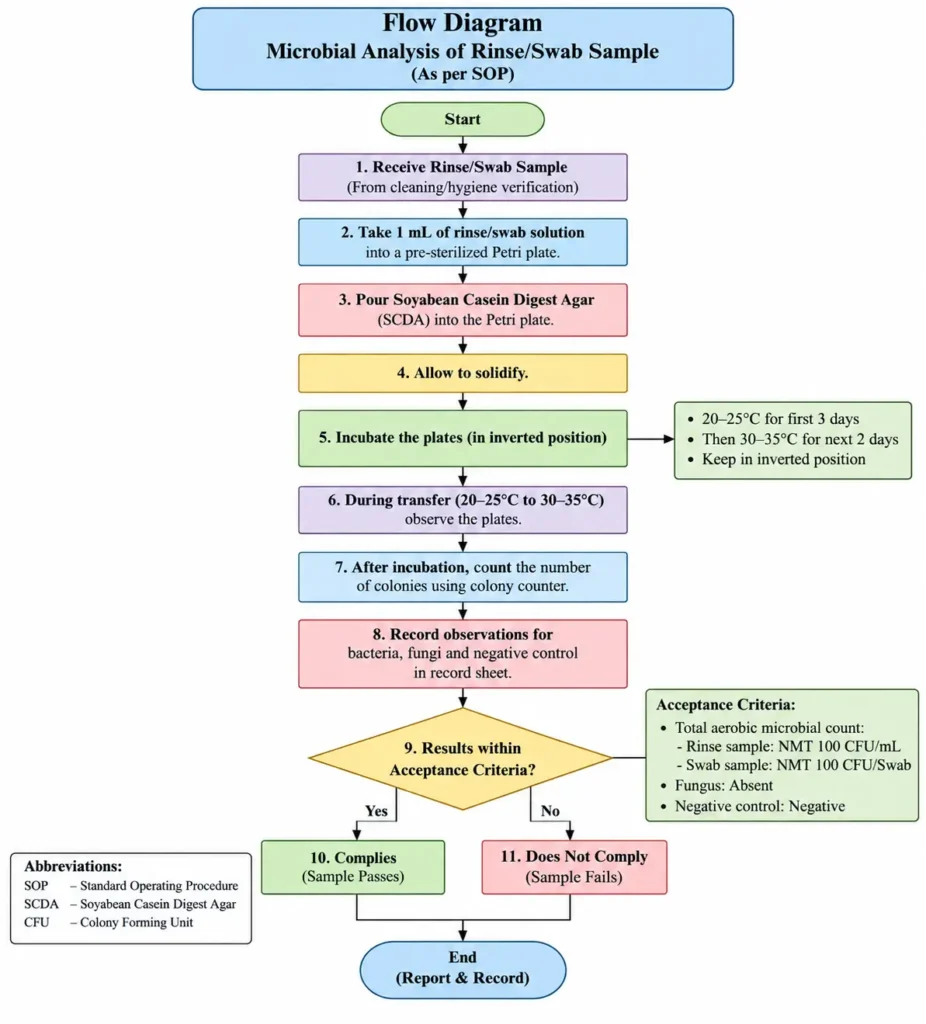
After completion of incubation, colonies are counted using a colony counter and observations for bacteria, fungi, and the negative control are recorded. Results are assessed against the acceptance criteria: NMT 100 CFU/mL for rinse samples, NMT 100 CFU/swab for swab samples, fungus absent, and negative control negative.
2. Brainstorming for SOP Failure:
The brainstorming diagram identifies the major potential causes that can lead to SOP failure in a pharmaceutical manufacturing area. The central issue, “SOP Failure in MFG Area,” is linked with possible contributing factors such as inadequate personnel training, poor understanding of the SOP, excessive workload and time pressure, insufficient supervision, unclear SOP language, and non-availability of the current SOP at the workplace.
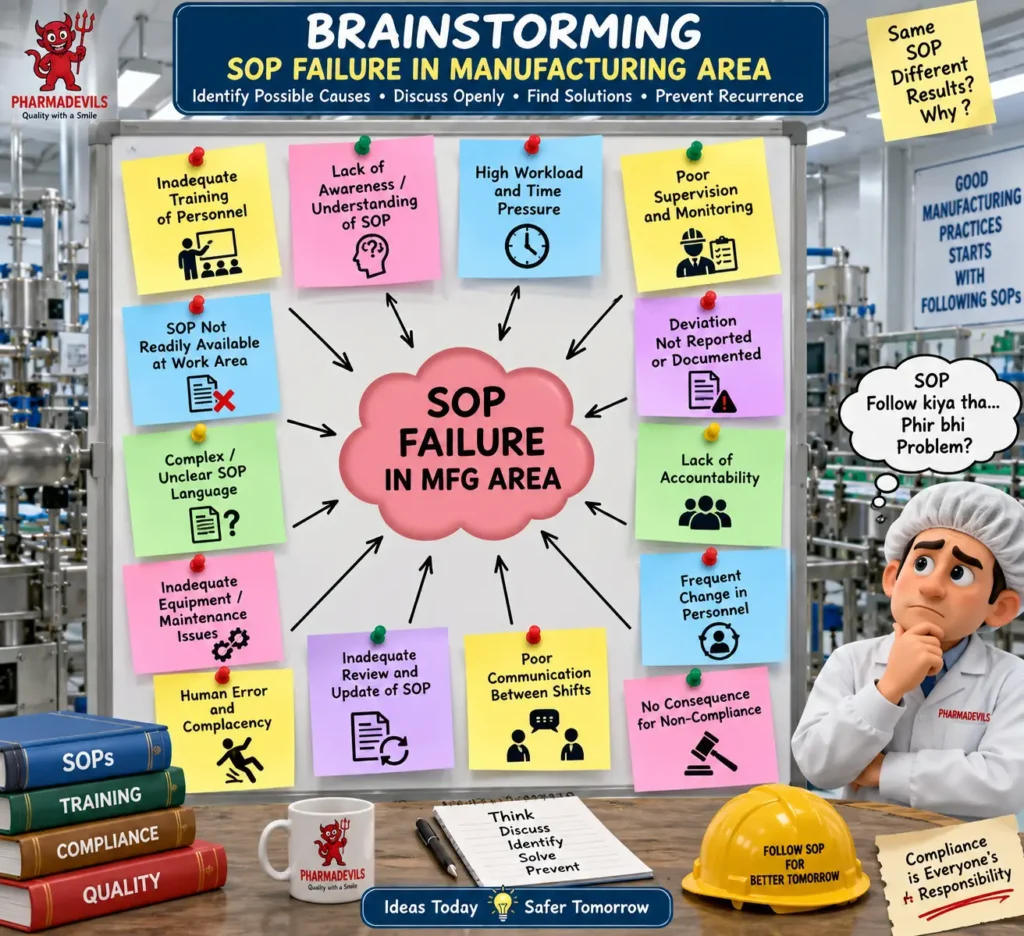
Other possible causes include equipment or maintenance problems, human error, complacency, inadequate SOP review and updating, poor communication between shifts, frequent personnel changes, lack of accountability, and failure to report or document deviations. The diagram also highlights that weak consequences for non-compliance can encourage repeated failures. This brainstorming approach helps the investigation team collect possible causes before performing detailed root-cause analysis. It supports identification of training, procedural, personnel, equipment, communication, and management-related gaps requiring corrective and preventive actions.
3. 5-Why Analysis for SOP Failure:
The 5-Why Analysis diagram systematically investigates the underlying reasons for failure to follow an SOP in the manufacturing area. The analysis starts with the problem that operators did not comply with the approved procedure. The first level identifies inadequate awareness of the exact SOP requirements. Further questioning indicates that personnel training was either insufficient or ineffective. The analysis then highlights weaknesses in training planning, competency assessment, and periodic effectiveness review.
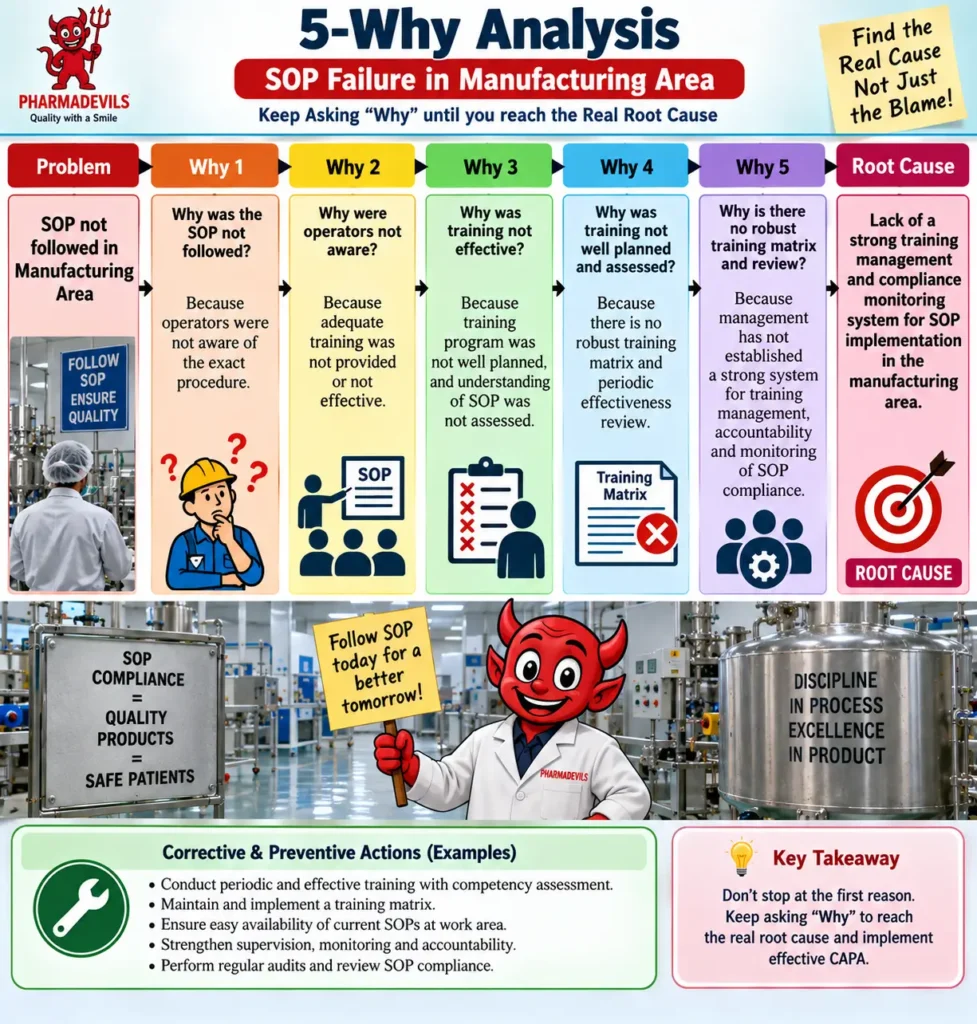
At deeper levels, the absence of a robust training matrix, structured SOP monitoring, accountability, and management oversight is identified as the major systemic weakness. The root cause is therefore linked to an inadequate training-management and compliance-monitoring system rather than only individual operator error. The diagram also recommends CAPA such as periodic training, competency assessment, updated training matrices, easy SOP availability, stronger supervision, routine audits, and regular review of SOP compliance to prevent recurrence.
4. Fishbone Analysis for SOP Failure:
The Fishbone (Ishikawa) Analysis diagram identifies the potential causes of SOP failure in the manufacturing area by grouping them into major categories such as Man, Machine, Method, Material, Measurement, and Environment. Under personnel-related causes, the diagram highlights inadequate training, lack of SOP awareness, human error, workload pressure, poor supervision, and weak accountability. Equipment-related causes include malfunction, inadequate preventive maintenance, incorrect settings, and insufficient qualification or cleaning.
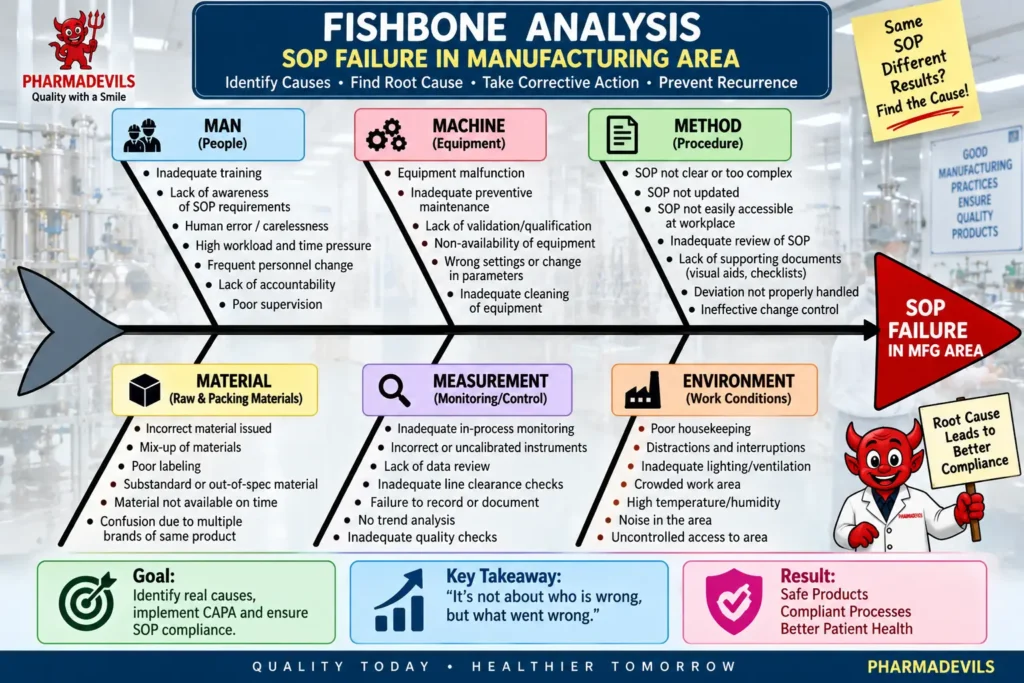
Method-related causes include unclear or outdated SOPs, poor accessibility, ineffective change control, and inadequate deviation handling. Material-related factors include incorrect material issuance, mix-ups, poor labeling, and use of unsuitable materials. Measurement-related causes involve inadequate in-process monitoring, uncalibrated instruments, insufficient data review, and poor documentation. Environmental factors include poor housekeeping, interruptions, inadequate ventilation, uncontrolled temperature/humidity, noise, and restricted-area control weaknesses. This analysis helps identify probable root causes so that suitable CAPA, training, monitoring, and compliance controls can be implemented.
5. Fault Tree Analysis for SOP Failure:
The Fault Tree Analysis (FTA) diagram systematically identifies potential causes of SOP failure in a pharmaceutical manufacturing area. The top event, “SOP Failure,” is divided into four major categories: Human-Related Failure, Procedure/Document Failure, Equipment/Facility Failure, and Material-Related Failure. Possible root causes include inadequate training, lack of SOP awareness, human error, unavailable or outdated SOPs, incorrect procedure execution, unqualified or uncalibrated equipment, utility failure, poor maintenance, incorrect materials, contamination, and material mislabeling.
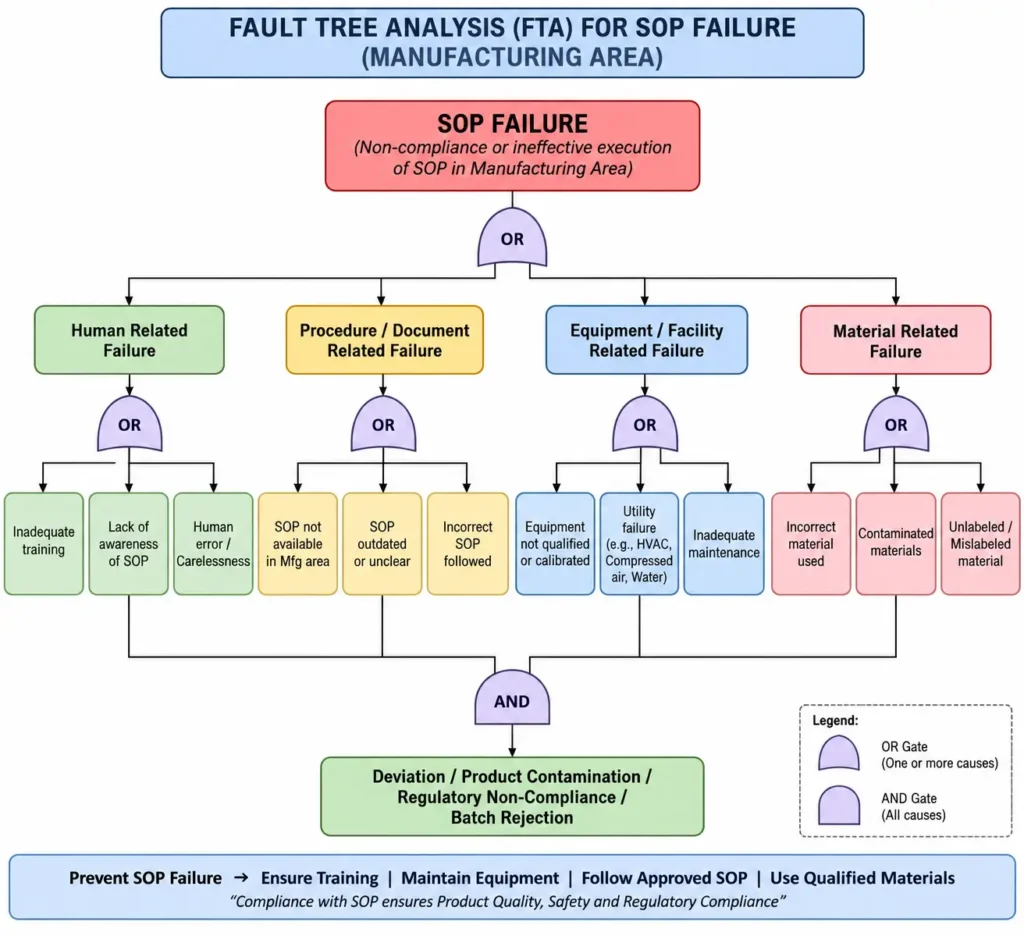
These failures can individually or collectively lead to deviations, product contamination, regulatory non-compliance, and batch rejection. The analysis emphasizes preventive controls such as effective personnel training, use of approved and current SOPs, equipment qualification and maintenance, and use of properly identified and qualified materials. This is particularly important where SOPs specify defined procedural steps, observations, recording requirements, and acceptance criteria.
Questions & Answers – Microbial Analysis of Rinse/Swab Sample SOP
Q1. What is the objective of this SOP?
Answer: To lay down the procedure for microbial analysis of rinse and swab samples.
Q2. Where is this SOP applicable?
Answer: It is applicable to the Microbiology laboratory for analysis of rinse and swab samples.
Q3. Who is responsible for implementation of this SOP?
Answer: The Microbiologist and Head-QA/QC are responsible.
Q4. Which microbiological method is described in the SOP?
Answer: The SOP describes the Pour Plate Method for rinse and swab samples.
Q5. How much rinse/swab solution is taken for analysis?
Answer: 1 mL of rinse/swab solution is transferred into a pre-sterilized Petri plate.
Q6. Which culture medium is used?
Answer: Soyabean Casein Digest Agar (SCDA) is poured into the Petri plates.
Q7. What are the incubation conditions?
Answer: Plates are incubated at 20–25°C for the first three days, followed by 30–35°C for two days, in inverted position.
Q8. When should the plates be observed during incubation?
Answer: The plates should be observed while transferring them from 20–25°C to 30–35°C.
Q9. How are microbial colonies counted after incubation?
Answer: Colonies are counted using a colony counter after completion of the incubation period.
Q10. What observations are required to be recorded?
Answer: Observations for fungi, bacteria, and negative control are recorded in the record sheet.
Q11. What is the acceptance criterion for total aerobic microbial count?
Answer: For rinse samples, the limit is NMT 100 CFU/mL, and for swab samples, NMT 100 CFU/swab.
Q12. What is the acceptance criterion for fungus?
Answer: Fungus should be absent.
Q13. What is the acceptance criterion for the negative control?
Answer: The negative control should be negative.
Q14. Who provides training for this SOP?
Answer: The trainer is the Sr. Executive – Quality Control, and the trainee is the Microbiologist. The training period specified is one day.
Q15. What is the reference mentioned in the SOP?
Answer: The reference is stated as “In House.”
Q16. What could happen if this SOP is not followed correctly?
Answer: The SOP itself does not specify failure consequences. Based on the fault-tree analysis prepared for implementation failure, possible outcomes may include unreliable microbiological results, deviations, contamination risk, regulatory non-compliance, or batch-related quality concerns.
Reference Guidelines:
- WHO Technical Report Series No. 961, Annex 2 – Good Practices for Pharmaceutical Microbiology Laboratories – covers microbiology laboratory practices, personnel, environment, equipment qualification/calibration, culture media, and validation of microbiological methods. (World Health Organization)
WHO TRS 961 Annex 2 - WHO TRS 1052, Annex 4 – Good Practices for Pharmaceutical Quality Control Laboratories, 2024 – provides current WHO guidance for pharmaceutical QC laboratories and aligns laboratory operations with GMP and ISO/IEC 17025 principles. (World Health Organization)
WHO TRS 1052 Annex 4 - USP <61> – Microbiological Examination of Nonsterile Products: Microbial Enumeration Tests – relevant for quantitative enumeration of aerobic bacteria and fungi and general microbiological enumeration methodology. (USP)
USP <61> Microbial Enumeration Tests - USP <1227> – Validation of Microbial Recovery from Pharmacopeial Articles – useful when establishing recovery efficiency, suitability of microbiological methods, neutralization, dilution, filtration, or rinsing approaches. (USP)
USP <1227> Validation of Microbial Recovery - EU GMP Annex 1 – Manufacture of Sterile Medicinal Products – applicable when rinse/swab microbiological monitoring relates to sterile manufacturing, contamination-control systems, cleanrooms, or aseptic operations. (Public Health)
- US FDA – Sterile Drug Products Produced by Aseptic Processing: Current Good Manufacturing Practice – relevant for microbiological control and monitoring associated with aseptic manufacturing operations. (U.S. Food and Drug Administration)
FDA Aseptic Processing Guidance