




Brief Description
This SOP describes the procedure for determination of residual Teepol cleaning agent in rinse and swab samples analyzed in the Quality Control laboratory. Its purpose is to verify that cleaned equipment or glassware does not retain unacceptable traces of Teepol before being released for subsequent use. The procedure includes preparation of a Teepol standard solution through specified serial dilutions and preparation of the sample by rinsing the applicable glassware or equipment contact surface with measured water. The Teepol content is determined by measuring the absorbance at 223 nm, using water as the blank, and calculating the result in ppm against the standard solution. The SOP specifies a limit of detection of 2.0 ppm. The procedure assigns execution responsibility to QC personnel and includes an annexure for recording rinse/swab sampling, visual inspection, analytical results, and equipment release or rejection for the next batch.
Skip to PDF content1. Flow Diagram:
The flow diagram illustrates the systematic procedure for determination of Teepol residues in rinse/swab samples during cleaning verification. It begins with collection or preparation of the rinse/swab sample, followed by preparation of the Teepol standard solution using specified serial dilutions. The sample solution is then prepared using 10 mL of water, and the absorbance of both standard and sample solutions is measured at 223 nm using water as blank.
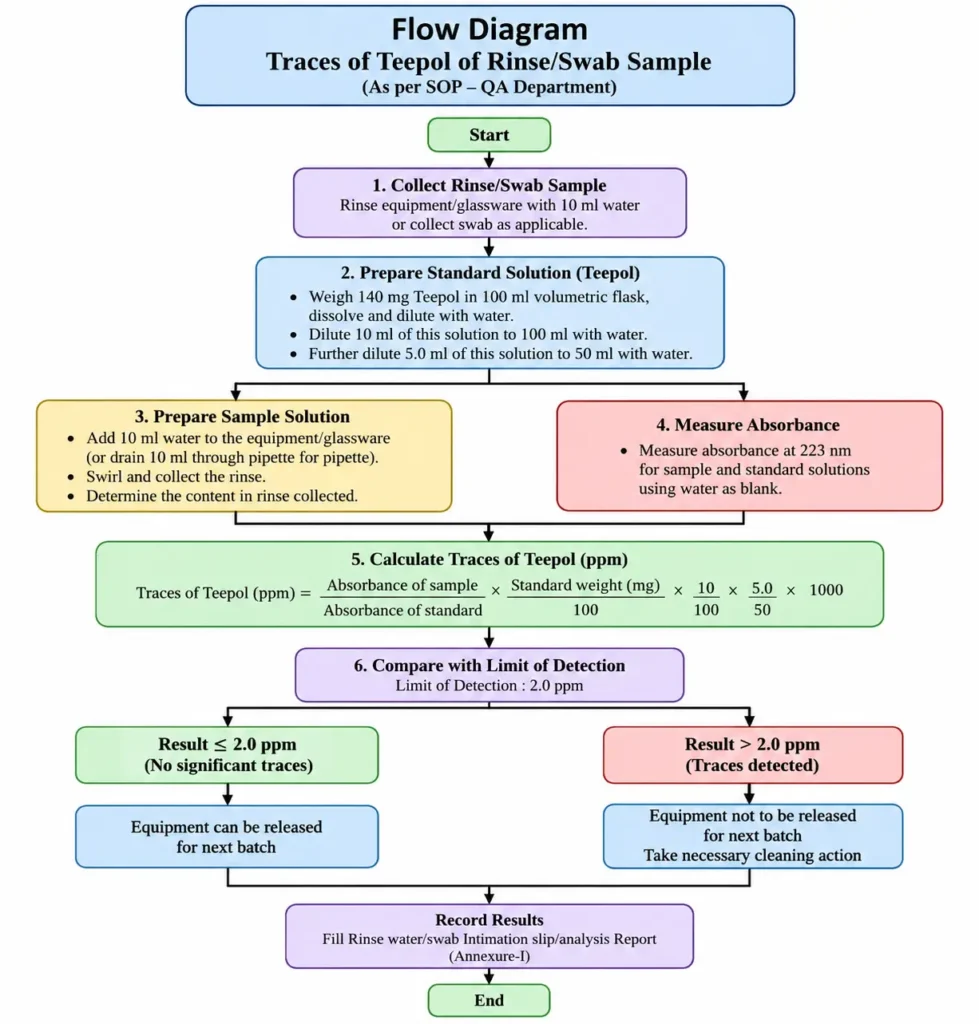
The Teepol residue is calculated in ppm using the prescribed formula and compared with the specified 2.0 ppm limit of detection. If the result is within the acceptable criterion, the equipment may be released for the next batch; otherwise, further cleaning action and re-evaluation are required. Finally, the inspection, sampling, analytical result, and equipment release status are documented in the Rinse Water/Swab Intimation Slip/Analysis Report – Annexure-I.
2. Brainstorming for SOP Failure:
The brainstorming diagram identifies potential causes that may lead to SOP failure in a pharmaceutical manufacturing area. The possible causes are grouped under key categories such as Man, Machine, Method, Material, Measurement, Environment, Management, and External Factors. Major concerns include inadequate training, failure to follow approved procedures, equipment malfunction, improper cleaning, incorrect material handling, insufficient in-process monitoring, poor housekeeping, weak supervision, ineffective CAPA, and utility interruptions.
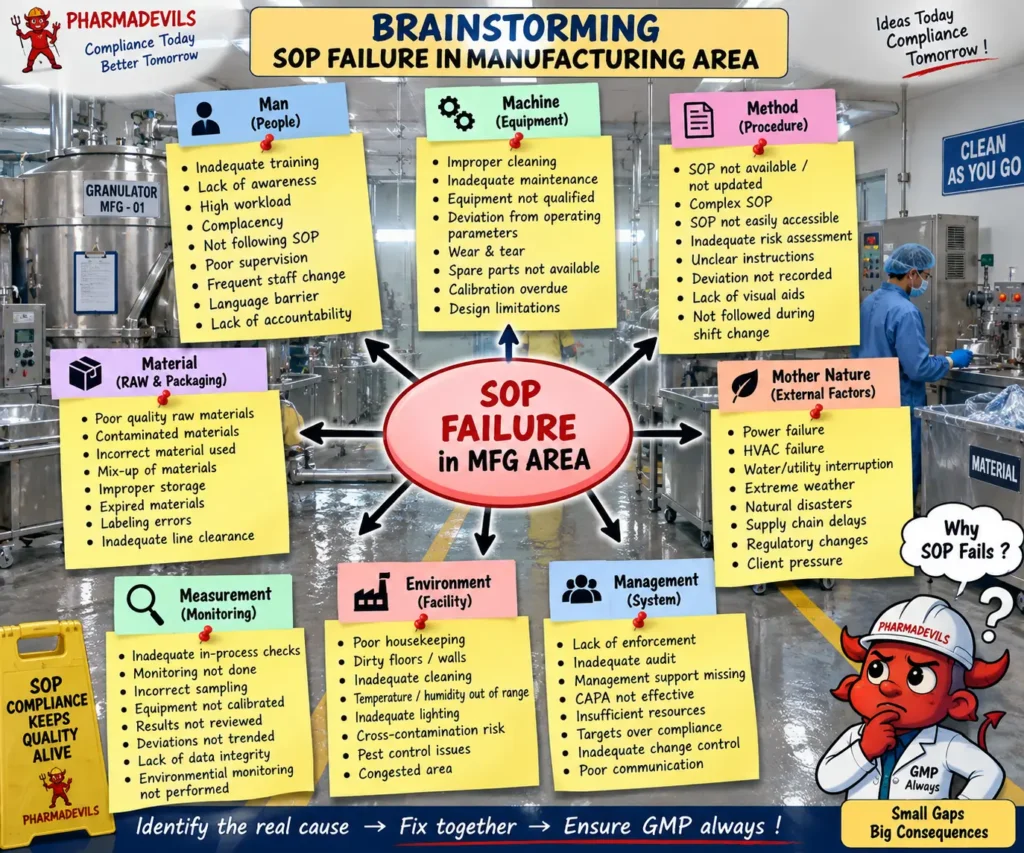
For the Teepol rinse/swab testing SOP, effective implementation depends on trained QC personnel, correct sample preparation, proper analytical testing, and accurate documentation. The SOP specifically assigns execution to QC personnel and requires effective implementation by QC/QA management. The brainstorming exercise helps teams identify likely failure points, prioritize investigation areas, determine root causes, and establish appropriate corrective and preventive actions (CAPA) to strengthen GMP compliance and prevent recurrence.
3. 5-Why Analysis for SOP Failure:
The 5 Why analysis identifies the underlying reasons for failure to follow an SOP in the manufacturing area. The investigation begins with the immediate problem that personnel are not complying with the approved procedure. Further questioning indicates that employees may not fully understand the SOP requirements due to inadequate or ineffective training. This may result from poorly planned training programs, insufficient refresher training, or failure to assess training effectiveness.
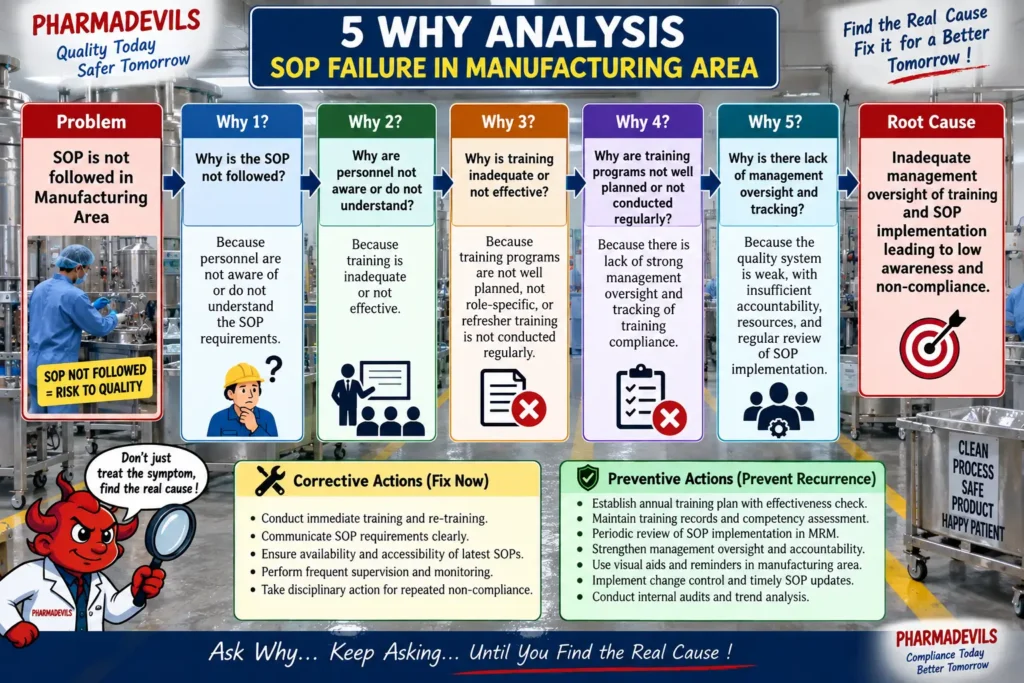
The analysis then extends to weaknesses in management oversight, accountability, and routine monitoring of SOP implementation, leading to a broader quality-system gap. The probable root cause is therefore linked to insufficient management control over training and SOP compliance. Appropriate CAPA may include immediate retraining, ensuring current SOP availability, competency assessment, regular supervision, internal audits, SOP effectiveness review, and management monitoring. These actions help reduce recurrence and strengthen GMP compliance in the manufacturing area.
4. Fishbone Analysis for SOP Failure:
The Fishbone Analysis diagram presents a structured method for identifying the potential causes of SOP failure in a pharmaceutical manufacturing area. The causes are grouped into six major categories: Man, Machine, Method, Material, Measurement, and Environment.
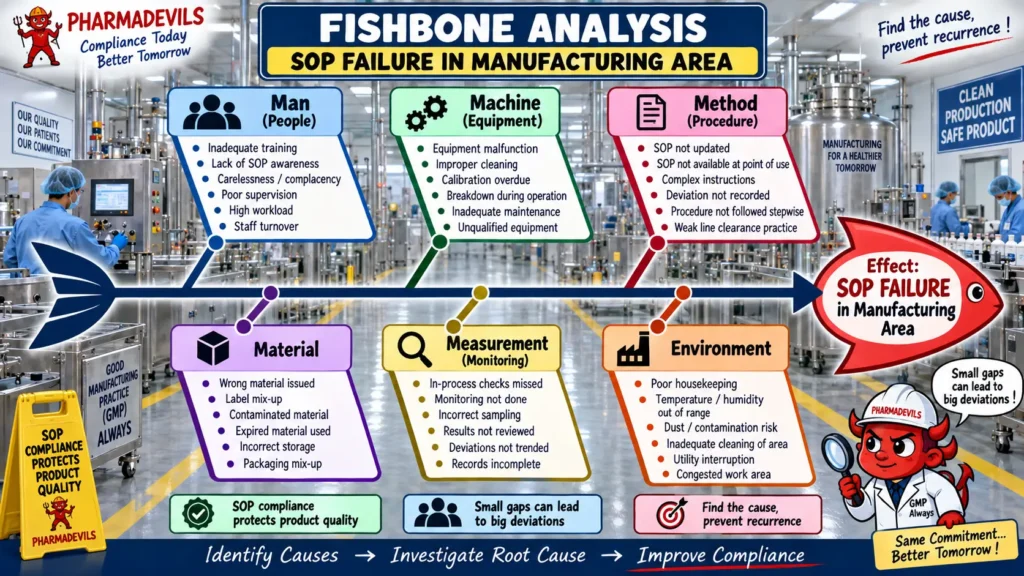
Under Man, factors include inadequate training, lack of SOP awareness, carelessness, poor supervision, and high workload. Machine causes include equipment malfunction, improper cleaning, overdue calibration, inadequate maintenance, and unqualified equipment. Method covers outdated or unavailable SOPs, complex instructions, weak line clearance, and procedures not followed stepwise. Material factors include wrong material issuance, mix-ups, contamination, expired materials, and improper storage. Measurement includes missed in-process checks, incorrect sampling, incomplete records, and poor monitoring. Environment covers poor housekeeping, temperature/humidity excursions, contamination risk, inadequate cleaning, and utility interruptions. This analysis helps identify probable root causes, supports investigation, and guides effective CAPA to prevent recurrence and improve GMP compliance.
5. Fault Tree Analysis for SOP Failure:
The Fault Tree Analysis (FTA) diagram provides a structured evaluation of potential causes leading to SOP failure in the pharmaceutical manufacturing area. The top event, “SOP Failure in Manufacturing Area,” is linked through logical gates to major contributing events such as personnel not following the SOP, ineffective or unavailable procedures, equipment/facility-related issues, and inadequate management control.
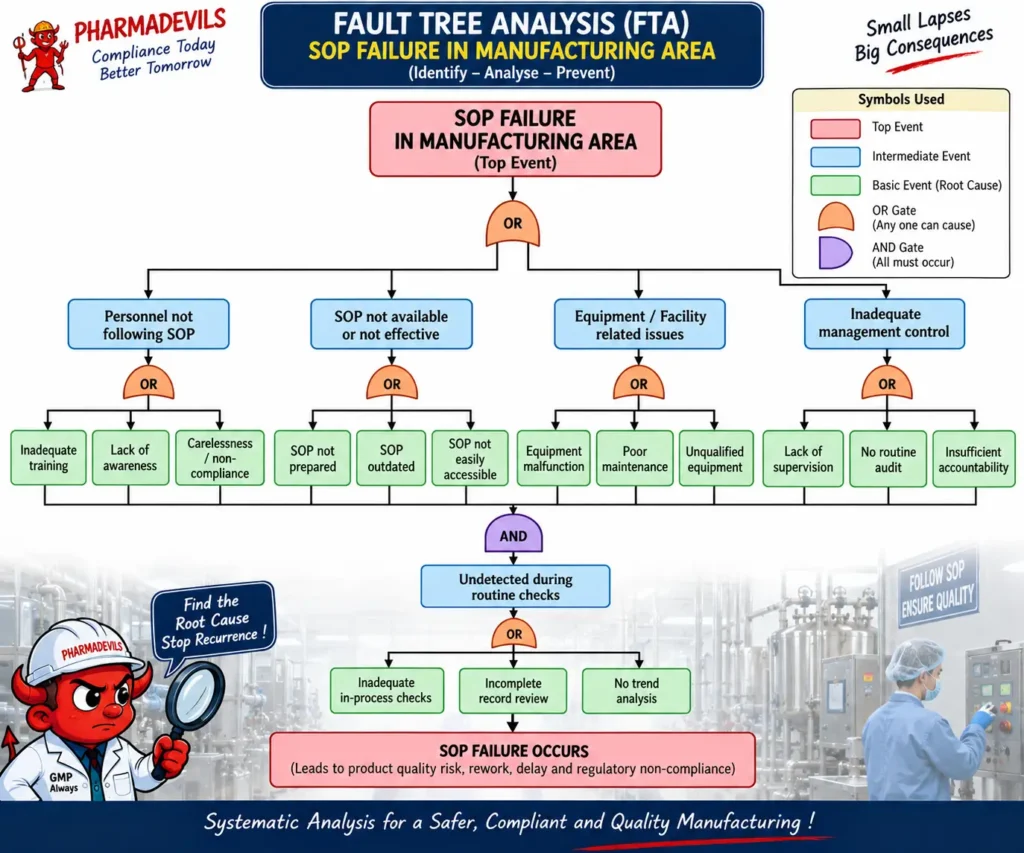
The analysis further identifies basic root causes including inadequate training, lack of awareness, carelessness, outdated or inaccessible SOPs, equipment malfunction, poor maintenance, unqualified equipment, insufficient supervision, weak auditing, and lack of accountability. The diagram also highlights failures in routine detection, such as inadequate in-process checks, incomplete record review, and lack of trend analysis. FTA helps systematically trace how individual failures can combine to cause SOP non-compliance, product-quality risks, rework, operational delays, and regulatory observations, supporting effective root-cause investigation and CAPA.
Questions & Answers – Traces of Teepol of Rinse/Swab Sample SOP
- Q: What is the objective of this SOP?
A: To define the procedure for determination of traces of Teepol in rinse and swab samples. - Q: Where is this SOP applicable?
A: It is applicable to testing of Teepol traces in rinse and swab samples in the Quality Control laboratory. - Q: Who is responsible for execution of the SOP?
A: The QC Chemist is responsible for execution of the procedure. - Q: Who is responsible for effective implementation of the SOP?
A: QC Manager, Lab QA Manager, and Head-QA/QC are responsible for effective implementation. - Q: How much Teepol is weighed for preparation of the standard solution?
A: 140 mg of Teepol is weighed into a 100 mL volumetric flask. - Q: How is the Teepol standard solution prepared?
A: Dissolve 140 mg Teepol and make up to 100 mL with water; dilute 10 mL of this solution to 100 mL, then further dilute 5.0 mL to 50 mL with water. - Q: How is the rinse sample prepared for glassware?
A: Add 10 mL water to the glassware, swirl it, collect the rinse, and determine the Teepol content. - Q: How is a pipette sampled?
A: Drain 10 mL of water through the pipette, collect the rinse, and determine the Teepol content. - Q: At what wavelength is Teepol absorbance measured?
A: The absorbance is measured at 223 nm. - Q: What is used as the blank during analysis?
A: Water is used as the blank. - Q: In which unit is the Teepol result calculated?
A: The result is calculated as traces of Teepol in ppm. - Q: What is the specified Limit of Detection in the SOP?
A: The Limit of Detection is 2.0 ppm. The SOP identifies this as the analytical detection limit; it does not separately state an acceptance limit in the provided text. - Q: Who provides training on this SOP?
A: The Manager – Quality Control is designated as the trainer. - Q: Who are the trainees and what is the training duration?
A: Quality Control personnel are the trainees, and the training period is half an hour. - Q: What annexure is provided with the SOP?
A: Annexure-I – Rinse Water/Swab Intimation Slip/Analysis Report. - Q: What details are recorded by Production in Annexure-I?
A: Department, equipment name and number, product and batch details, previous product details, and equipment-clean/readiness status are recorded. - Q: What is recorded by the QC Chemist in Annexure-I?
A: Visual inspection status, rinse-water collection details, analysis details, identification result, and whether the equipment is released or not released for the next batch.
Reference Guidelines:
- WHO Technical Report Series No. 1019, Annex 3 – GMP: Guidelines on Validation, Appendix 3: Cleaning Validation. WHO specifically recognizes residues of cleaning agents/detergents as potential contaminants and states that cleaning validation should demonstrate removal of product, detergent, and microbial residues to acceptable levels. (World Health Organization)
WHO GMP Guidelines on Validation - US FDA – Guide to Inspections: Validation of Cleaning Processes. FDA specifically states that residues from cleaning processes, including detergents and solvents, should be removed and that sampling procedures, analytical methods, method sensitivity, and scientifically justified residue limits should be addressed. (U.S. Food and Drug Administration)
FDA Validation of Cleaning Processes - EU GMP – EudraLex Volume 4, Annex 15: Qualification and Validation. Annex 15 provides GMP expectations for lifecycle qualification and validation and includes requirements applicable to cleaning validation and scientifically justified acceptance criteria. (Public Health)
EU GMP EudraLex Volume 4 - PIC/S PI 006 – Recommendations on Qualification and Validation. The cleaning-validation section addresses removal of cleaning-agent residues, previous-product residues, and microbial contaminants. (PIC/S) As of 12 September 2026, PI 006-3 remains the applicable version; the newly published PI 006-4 is scheduled to enter into force on 1 October 2026. (PIC/S)
- WHO TRS 1033, Annex 2 – Points to Consider When Including Health-Based Exposure Limits (HBELs) in Cleaning Validation. This is useful when establishing scientifically justified residue acceptance criteria rather than treating an analytical LOD such as 2.0 ppm as automatically equivalent to a cleaning acceptance limit. (World Health Organization)