







1. Introduction – SOP for Movement of Finish Good:
The SOP for Movement of Finish Good establishes a controlled procedure for the safe handling and transfer of finished pharmaceutical products within the manufacturing facility. It applies to finished goods such as tablets and liquid products and is intended to prevent product damage, mix-ups, contamination, and improper handling during movement from one location to another. The SOP assigns responsibility to Production personnel for execution and to Production management and QA/QC for effective implementation. Finished-good shippers are required to be properly arranged on pallets and moved carefully. The SOP specifies that finished goods should not be stacked higher than 7 feet and that precautions must be taken to avoid damage during transfer. If packed products fall during packing or conveyor movement, they must be collected and subjected to 100% checking in the presence of QA. Acceptable products are repacked and documented in the BPR, while damaged blisters, strips, or bottles are segregated in labeled polybags for further handling. Proper implementation of this SOP helps maintain product quality, packaging integrity, traceability, GMP compliance, and controlled movement of finished goods throughout production and transfer activities.
Skip to PDF content2. Flow Diagrma – SOP for Movement of Finish Good:
The SOP for Movement of Finish Good describes the controlled method for transferring packed finished products safely from the production or packing area to the designated finished goods storage location. Finished goods such as tablets and liquid products are arranged properly in shippers and placed securely on pallets before movement. The SOP requires personnel to handle the packed products carefully to prevent crushing, breakage, contamination, or other damage during transportation. Shippers should not be stacked higher than 7 feet on pallets.
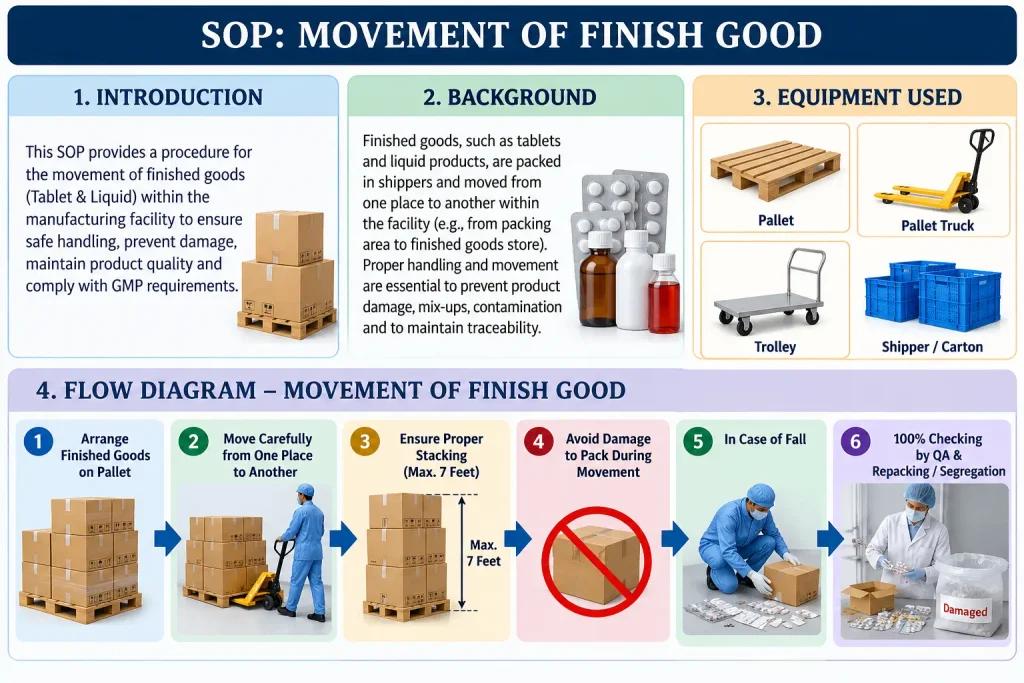
If any finished product falls during packing, conveyor operation, or transfer, it must be collected under QA supervision and subjected to 100% checking. Acceptable blisters, strips, or bottles are repacked and documented in the Batch Packing Record, whereas damaged units are segregated in labeled polybags for further handling or de-foiling. Following this SOP supports safe product movement, packaging integrity, traceability, GMP compliance, and prevention of mix-ups or product damage.
3. Benefits of Following SOP – Movement of Finish Good:
Following the SOP for Movement of Finish Good ensures that packed pharmaceutical products are transferred safely and systematically from the production or packing area to the finished goods area. Proper arrangement of shippers on pallets and careful movement help prevent damage to cartons, blisters, strips, bottles, and other packed products. The SOP also specifies that finished goods should not be stacked above 7 feet, reducing the possibility of collapsing stacks or packaging damage during handling.
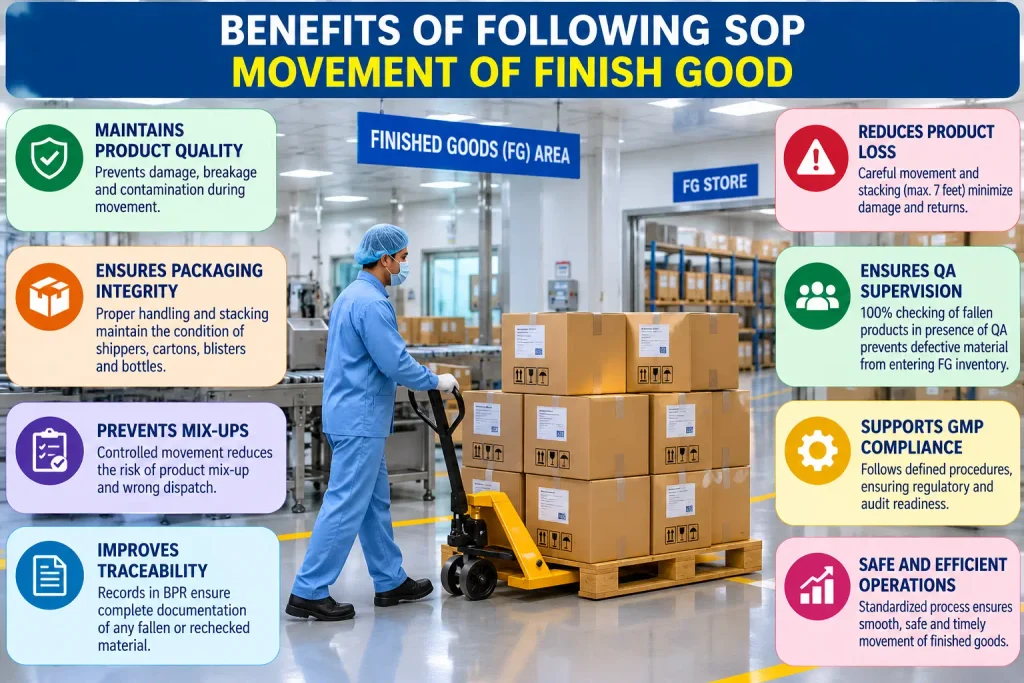
The procedure provides additional control when any finished product falls during packing, conveyor operation, or transfer. Such products are collected and subjected to 100% checking in the presence of QA. Acceptable units are returned for final packing and recorded in the BPR, while damaged units are segregated in labeled polybags for further handling. Thus, implementation of this SOP supports product quality, packaging integrity, proper segregation, traceability, reduced product loss, controlled handling, and GMP-compliant movement of finished goods.
4. Brainstorming for SOP Failure – Movement of Finish Good:
The Brainstorming Analysis for SOP Failure – Movement of Finish Good identifies possible causes that may lead to improper handling, damage, mix-ups, or loss of control during transfer of finished pharmaceutical products. The SOP requires finished goods shippers to be properly arranged on pallets, moved carefully, protected from damage, and not stacked higher than 7 feet.
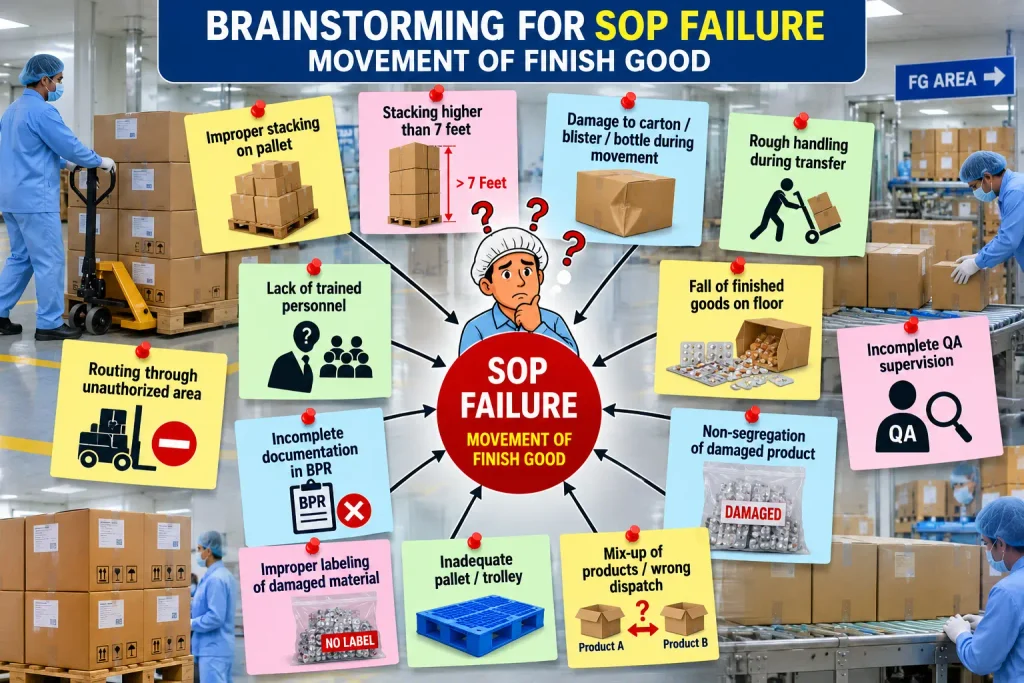
Potential failure causes include improper pallet stacking, excessive stacking height, rough handling, damaged cartons or bottles, inadequate pallets or trolleys, insufficiently trained personnel, weak QA supervision, incomplete BPR documentation, poor labeling of damaged material, non-segregation of defective products, and product mix-ups during movement. If finished goods fall during packing or conveyor movement, the SOP requires collection and 100% checking in the presence of QA, with acceptable units repacked and damaged units segregated appropriately. This brainstorming exercise helps the organization recognize vulnerable points in finished-good movement so that suitable controls, training, supervision, documentation, segregation, and handling practices can be strengthened to prevent recurrence of SOP failures.
5. 5-Why Analysis for SOP Failure – Movement of Finish Good:
The 5-Why Analysis for SOP Failure – Movement of Finish Good is used to identify the underlying reason for failures such as finished goods cartons falling, becoming damaged, or being mishandled during transfer. The analysis begins with the immediate problem and repeatedly asks “Why?” until the fundamental cause is identified. A typical sequence may show that cartons fell because they were not properly arranged or secured on the pallet. Improper arrangement may be linked with excessive stacking height or unstable loading. The SOP specifically requires that finished goods shippers be arranged properly on pallets, moved carefully, and not stacked higher than 7 feet.
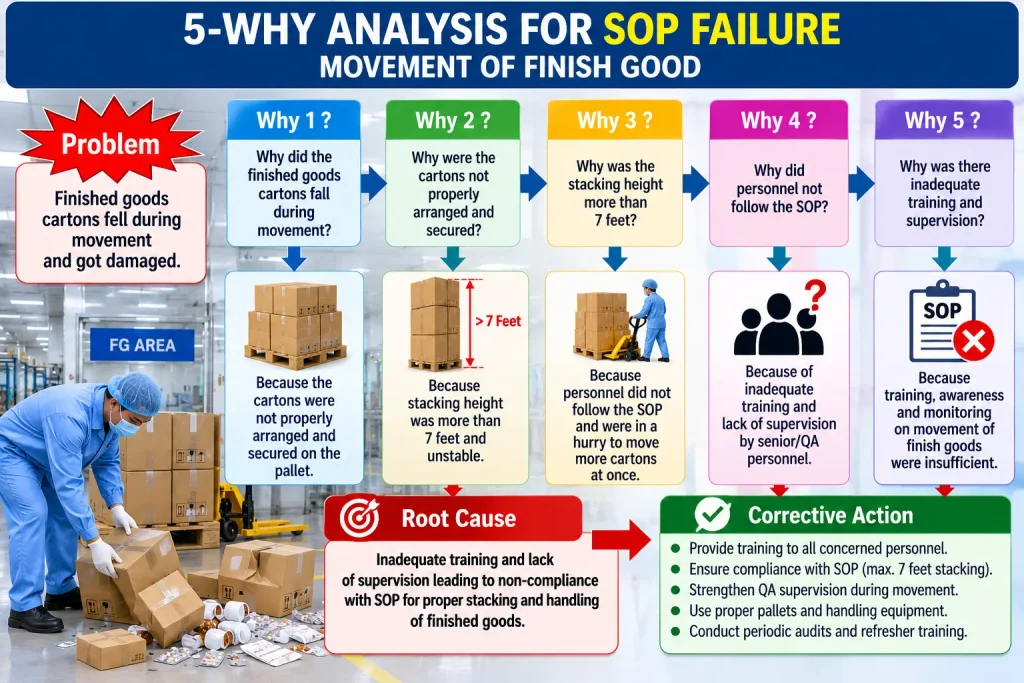
Further analysis may identify insufficient adherence to the procedure, inadequate training, or lack of effective supervision as contributing factors. The SOP assigns responsibility for execution to Production personnel and for effective implementation to Production management and QA/QC. The 5-Why approach therefore helps identify the root cause and supports actions such as refresher training, stronger supervision, compliance with stacking limits, correct pallet use, and routine monitoring to prevent recurrence.
6. Fishbone Analysis for SOP Failure – Movement of Finish Good:
The Fishbone Analysis for SOP Failure – Movement of Finish Good helps identify the possible causes that may lead to damaged, dropped, or improperly handled finished goods during transfer. The causes can be grouped under major categories such as Man, Machine, Material, Method, Environment, and Measurement. Under Man, possible causes include inadequate training, rough handling, failure to follow the SOP, carelessness, and insufficient supervision. Under Machine, unsuitable trolleys, pallet trucks, conveyor problems, or poor equipment condition may contribute to failure. Material-related causes may include damaged cartons, poor sealing, incorrect labeling, unstable packaging, or unsuitable pallet size.
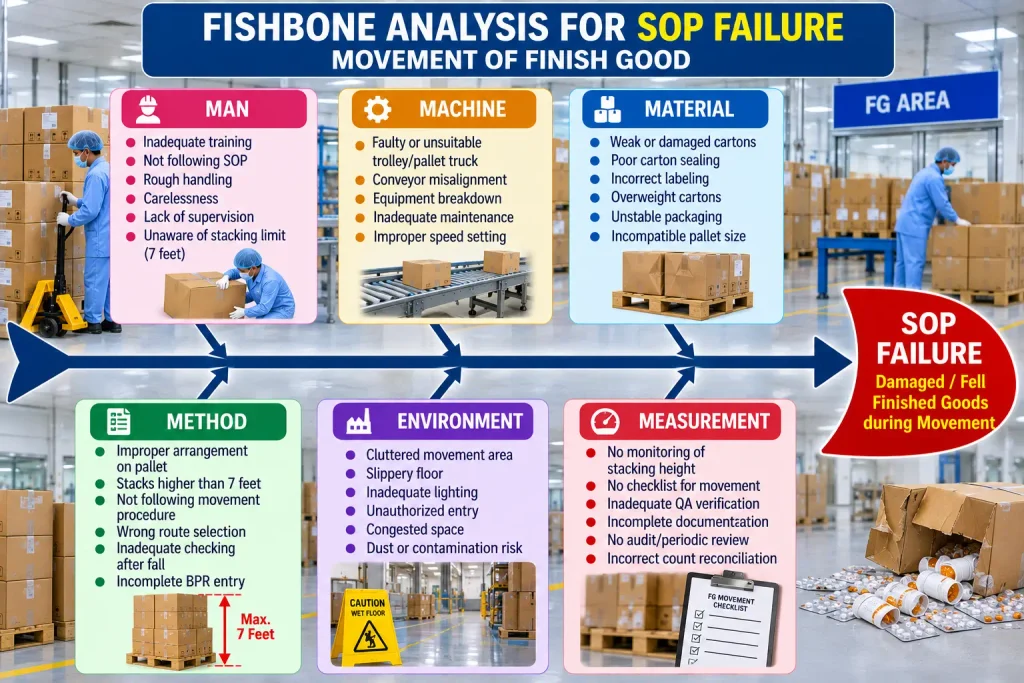
Method-related causes include improper pallet arrangement, stacking above the specified 7-foot limit, incorrect movement practices, and incomplete BPR entries. The SOP specifically requires careful movement, proper pallet arrangement, and prevention of packaging damage. Environmental issues such as slippery floors, congested movement areas, or inadequate lighting may also contribute. Measurement and control failures may include poor QA verification, inadequate monitoring, and incomplete documentation. Where finished goods fall, the SOP requires collection and 100% checking in the presence of QA, with damaged material segregated appropriately. This analysis supports systematic identification of contributing causes so that suitable corrective and preventive actions can be implemented.
7. Fault Tree Analysis for SOP Failure – Movement of Finish Good:
The Fault Tree Analysis for SOP Failure – Movement of Finish Good is used to systematically identify the possible events that can lead to failure during transfer of finished pharmaceutical products. The top event may be defined as finished goods becoming damaged, falling from the pallet, or being incorrectly handled during movement. The fault tree can divide the top event into major contributing branches such as improper pallet stacking, excessive stacking height, unstable pallets, rough handling by personnel, unsuitable movement equipment, inadequate verification, and incomplete documentation. The SOP requires finished goods shippers to be arranged properly on pallets, moved carefully, protected from damage, and not stacked above 7 feet.
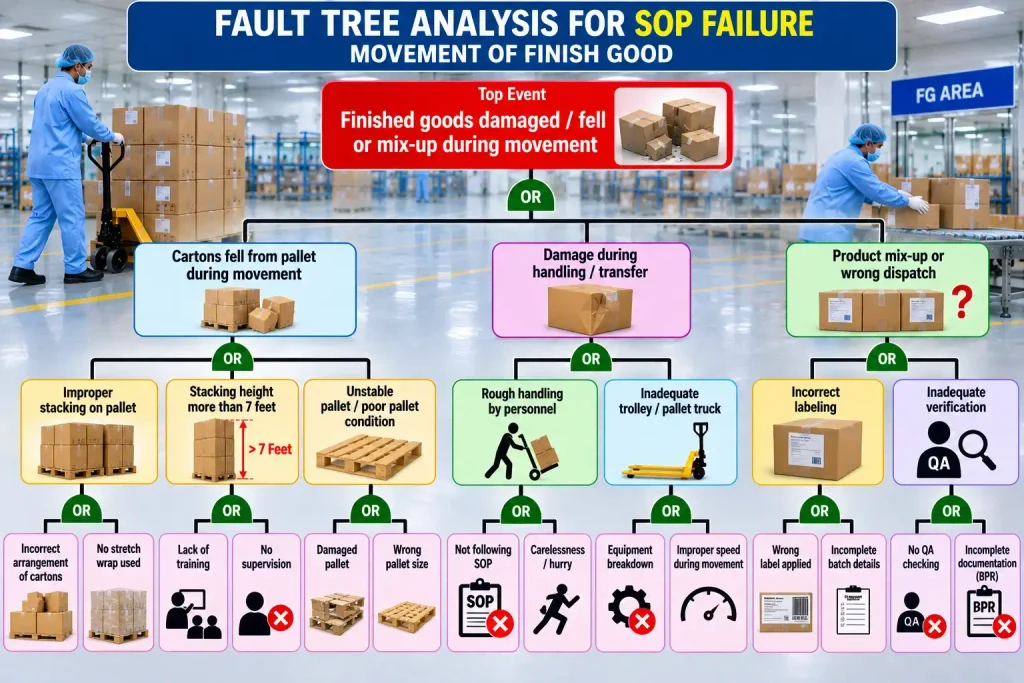
Where products fall during packing or conveyor movement, the procedure requires collection in the presence of QA, 100% checking, repacking of acceptable units, segregation of damaged blisters, strips, or bottles, and appropriate recording in the BPR. Thus, Fault Tree Analysis helps trace SOP failure from the final undesirable event back to individual basic causes, making it easier to establish targeted corrective and preventive actions.
8. Impact Assessment for SOP Failure – Movement of Finish Good:
The Impact Assessment for SOP Failure – Movement of Finish Good evaluates the consequences that may arise when finished products are dropped, damaged, mishandled, or incorrectly controlled during transfer. The SOP requires careful movement of shippers, proper pallet arrangement, protection of packs from damage, and stacking of finished goods not higher than 7 feet. Failure to follow these requirements can affect product quality through damaged cartons, blisters, strips, or bottles. It may also create a risk of contamination or loss of packaging integrity. Where finished products fall during packing or conveyor movement, the SOP requires collection under QA supervision, 100% checking, repacking of acceptable units, segregation of damaged units, and appropriate BPR documentation.
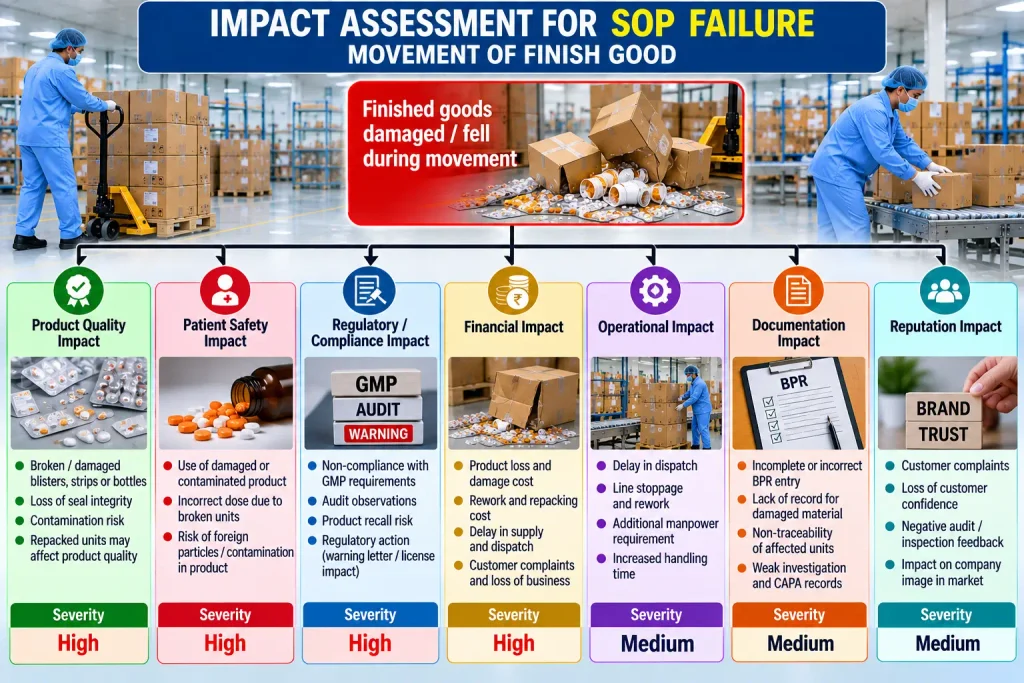
The impact can further extend to operational delays, product loss, additional inspection or repacking activity, incomplete documentation, and possible GMP compliance concerns. The SOP also states that damaged or fallen shippers after transfer to the finished goods store should be handled through the incident handling procedure. Therefore, impact assessment helps determine the seriousness of an SOP failure and supports timely containment, investigation, documentation, corrective action, and prevention of recurrence.
CAPA for SOP Failure – Movement of Finish Good
The Corrective and Preventive Action (CAPA) for SOP Failure – Movement of Finish Good is intended to correct observed handling failures and prevent their recurrence during transfer of packed finished products. Typical failures may include cartons falling from pallets, damaged shippers, improper stacking, inadequate handling, or incomplete documentation.As an immediate corrective action, fallen or damaged finished goods should be collected and checked in the presence of QA. The SOP requires 100% checking of affected tablets, bottles, blisters, or strips, with acceptable units returned for final packing and damaged units segregated in labeled polybags. The corresponding details should be recorded in the BPR.
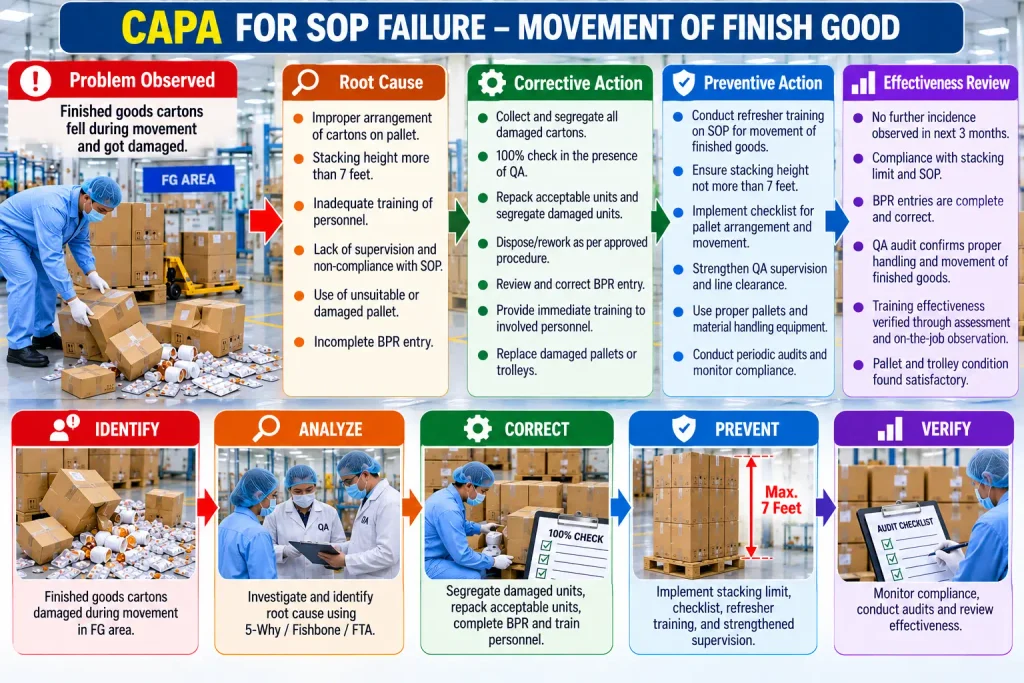
Preventive actions should focus on reinforcing the SOP requirements for proper pallet arrangement, careful movement, protection from damage, and maintaining the stacking height within the specified 7-foot limit. Additional preventive measures may include refresher training, stronger production and QA supervision, routine checking of pallets and movement equipment, and periodic review of compliance. Effectiveness can be verified through observation of finished-goods handling, review of BPR entries, and confirmation that similar incidents have not recurred.
Questions & Answers – SOP for Movement of Finish Good:
- What is the objective of this SOP?
The objective is to lay down a procedure for the movement of finished goods. - Where is this SOP applicable?
It is applicable to the handling and movement of finished goods for tablet and liquid products. - Who is responsible for execution of the SOP?
The Officer/Chemist–Production and concerned Production personnel are responsible for execution. - Who is responsible for effective implementation of the SOP?
The AGM–Production and Head–QA/QC are responsible for effective implementation. - How should finished-goods shippers be arranged?
All finished-goods shippers should be arranged properly on a pallet before movement. - What precaution should be taken during movement of finished goods?
Finished goods should be moved carefully from one place to another to avoid damage to the packed product. - What is the maximum stacking height of finished-goods shippers?
The SOP specifies that finished-goods shippers should not be stacked higher than 7 feet on pallets. - What should be done if finished goods fall on the floor during packing or conveyor movement?
The fallen finished goods should be collected through a helper in the presence of QA personnel. - What checking is required for fallen finished goods?
Cartons containing tablets or bottles should be subjected to 100% checking in the presence of QA. - What should be done with acceptable blisters, strips, or bottles after checking?
Correct units should be collected in the shipper for final packing, and the details should be recorded in the BPR. - How should damaged blisters or bottles be handled?
Damaged blisters or bottles should be collected and kept in a labeled polybag. - What should be done with accumulated damaged blisters or strips?
They should be handled through the respective de-foiling procedure and the required record should be completed. - What should be done if a shipper is damaged or falls after transfer to the finished-goods store?
It should be handled through the incident handling procedure. - What does BPR stand for?
BPR stands for Batch Packing Record. - Why is proper movement of finished goods important?
Based on the controls described in the SOP, proper movement helps prevent pack damage, supports proper segregation of damaged units, ensures QA involvement, and maintains documented handling through the BPR.
Reference Guideline – Movement of Finish Good:
- In-House Procedure / Internal SOP – used as the official reference for the movement, handling, checking, segregation, and documentation of finished goods.