







1. Introduction to Ofloxacin Tablets IP 200 mg – Batch Manufacturing Record (BMR):
Ofloxacin Tablets IP 200 mg are film-coated oral solid dosage forms containing Ofloxacin, a broad-spectrum fluoroquinolone antibiotic used in the treatment of susceptible bacterial infections. Ofloxacin acts by inhibiting bacterial DNA gyrase and topoisomerase IV, enzymes essential for bacterial DNA replication and multiplication. The Batch Manufacturing Record (BMR) for Ofloxacin Tablets IP 200 mg is a comprehensive GMP documentation system designed to ensure consistent product quality, safety, traceability, and compliance with established manufacturing procedures. Each film-coated tablet contains Ofloxacin IP 200 mg, along with pharmaceutical excipients such as lactose, maize starch, microcrystalline cellulose, croscarmellose sodium, magnesium stearate, sodium starch glycolate, talc, and colloidal silicon dioxide. The manufacturing process involves raw material dispensing, sifting, binder preparation, wet granulation, drying, sizing, blending, lubrication, tablet compression, and subsequent processing and packaging as specified in approved manufacturing instructions. Critical process parameters, including mixing time, drying temperature, granule moisture content, tablet weight, hardness, friability, and disintegration, are monitored to maintain consistent product quality. The BMR also includes equipment identification, line clearance, in-process quality checks, yield reconciliation, deviation documentation, and Quality Assurance verification. Proper execution and documentation of each manufacturing stage help ensure that Ofloxacin Tablets IP 200 mg meet established specifications and applicable pharmaceutical quality standards.
Skip to PDF content2. Manufacturing Process Flow Diagram for Ofloxacin Tablets IP 200 mg:
The manufacturing process flow diagram of Ofloxacin Tablets IP 200 mg illustrates the sequential operations involved in producing film-coated tablets under Good Manufacturing Practices (GMP). The process begins with raw material dispensing, where Ofloxacin IP and approved excipients are accurately weighed and verified according to the Batch Manufacturing Record (BMR). The dispensed materials undergo sifting to remove lumps and achieve uniform particle distribution. A starch paste binder is prepared using purified water, followed by wet granulation in a Rapid Mixer Granulator (RMG). The wet granules are dried in a Fluid Bed Dryer (FBD) under controlled temperature and moisture conditions.
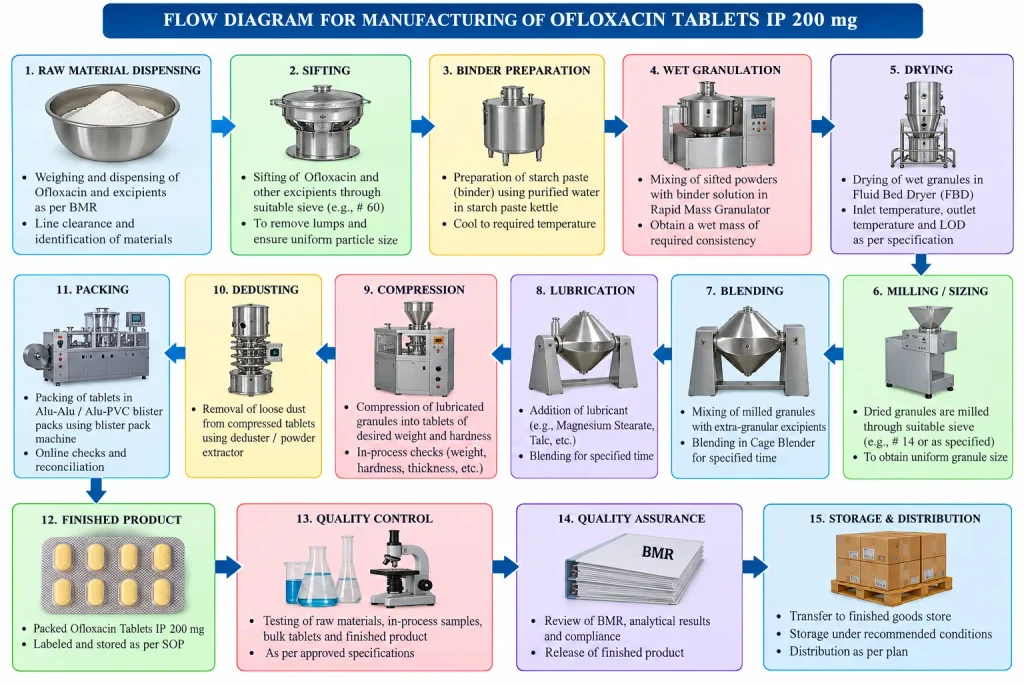
After drying, the granules undergo milling and sizing to obtain consistent particle size. The sized granules are blended with specified excipients and lubricated using magnesium stearate, talc, and other approved ingredients. The lubricated granules are compressed into tablets using a rotary compression machine. In-process quality checks include tablet weight, hardness, thickness, friability, and disintegration. The tablets undergo subsequent approved processing and packaging operations. Finished products are subjected to Quality Control testing, batch documentation review, yield reconciliation, and Quality Assurance release before transfer to finished goods storage.
This systematic manufacturing flow ensures process consistency, product traceability, regulatory compliance, and adherence to established quality specifications.
3. Critical Process Parameters (CPP) and Critical Quality Attributes (CQA) of Ofloxacin Tablets IP 200 mg:
The Critical Process Parameters (CPP) and Critical Quality Attributes (CQA) of Ofloxacin Tablets IP 200 mg play an important role in ensuring consistent manufacturing performance, product quality, safety, and compliance with Good Manufacturing Practices (GMP).
Critical Process Parameters (CPP) are manufacturing variables that require appropriate monitoring and control because variations may affect the quality of the finished tablets. Important process parameters include sifting mesh size, binder preparation conditions, granulation time, impeller and chopper speeds, drying temperature, and granule moisture content. During granulation, proper mixing and binder distribution help achieve uniform granule formation. The Batch Manufacturing Record specifies Fluid Bed Dryer inlet temperatures of 60–70°C, outlet temperatures of 30–40°C, and granule loss on drying (LOD) of 2.2–2.8% w/w at 105°C. Blending time, lubrication, compression force, and machine speed also require control to achieve consistent tablet characteristics.
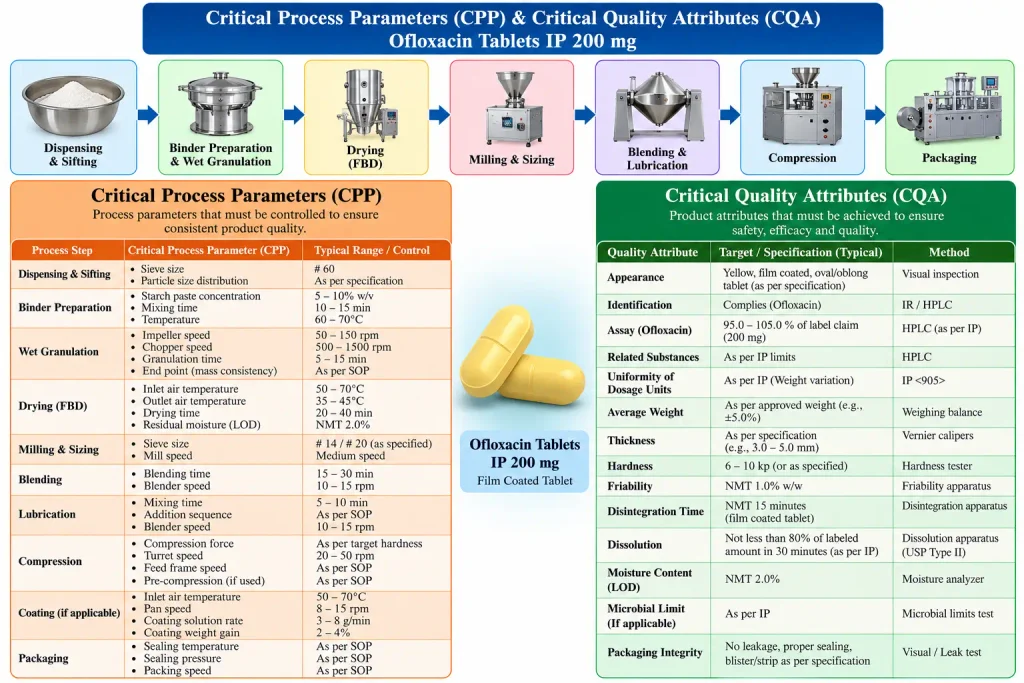
Critical Quality Attributes (CQA) are physical, chemical, biological, or microbiological properties that must remain within approved specifications. Important quality attributes include appearance, identification, assay, content uniformity, dissolution, related substances, tablet weight, hardness, thickness, friability, and disintegration. In-process testing, Quality Control analysis, and Quality Assurance review help verify that manufacturing operations consistently produce tablets meeting established acceptance criteria. Effective monitoring of CPPs and evaluation of CQAs support product consistency, process validation, batch traceability, and regulatory compliance throughout the manufacturing lifecycle.
Note: The CPP and CQA limits shown in the infographic are illustrative unless confirmed against the approved BMR, validated process, and applicable IP specifications.