






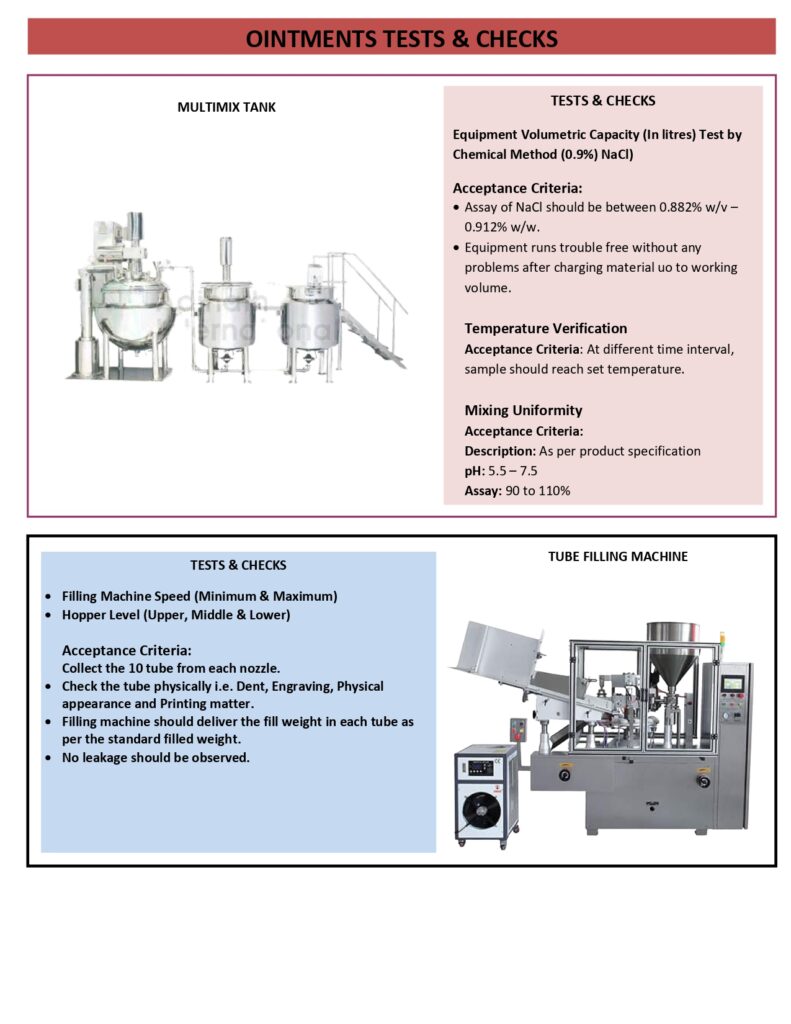

OINTMENT TESTS & CHECKS IN PHARMA
Ointments are semi-solid preparations applied to skin, eye, or mucosa. In pharma, each batch undergoes specific quality control tests to ensure safety, efficacy and patient acceptability.
1. Appearance & Identification
- Appearance: Check colour, odour, homogeneity, absence of lumps, grittiness or phase separation.
- Identification: Confirms the presence of active ingredient(s) using suitable chemical or instrumental methods.
2. Assay & Content Uniformity
- Assay: Measures the actual drug content against label claim (usually 90–110%).
- Content uniformity: Ensures even distribution of drug throughout the base so each dose is consistent.
3. pH (for water-containing Ointments)
- Ensures skin/ocular compatibility and stability. Extreme pH may irritate skin or degrade the drug.
4. Viscosity & Rheology
- Assessed using viscometers/rheometers.
- Ensures the ointment is neither too stiff nor too runny and maintains consistency during storage and use.
5. Spreadability & Extrudability
- Spreadability: How smoothly the ointment spreads on the skin.
- Extrudability: Ease of coming out from tube under normal pressure.
6. Particle Size / Grittiness
- Critical for ophthalmic and dermatological ointments to avoid irritation and scratching.
7. Microbial Limits / Sterility
- Sterility required for ophthalmic and certain topical preparations.
- Microbial limit tests for non-sterile ointments to ensure acceptable bioburden.
8. In Vitro Release / Permeation (where applicable)
- Measures drug release rate from the base, supporting therapeutic performance.
9. Stability Studies
- Evaluate physical, chemical, and microbiological stability under ICH conditions to assign shelf life and storage conditions.
These tests together ensure the ointment is safe, effective, stable, and patient-friendly before it reaches the market.