



Brief Description
This SOP describes the standardized procedure for the operation and cleaning of the Sampling Booth used for liquid-material sampling in the Quality Control Department. It defines the responsibilities of QC personnel for execution and of QC/QA management for effective implementation. The procedure covers cleaning of the sampling area, routine cleaning of the booth, safe power isolation before cleaning, daily cleaning with a dry cloth, and operation of the light and blower. It also requires investigation of abnormal equipment sounds and proper shutdown after completion of work. Type A cleaning is performed at the start and end of the shift or when required, while Type B cleaning is performed during raw-material changeover and after maintenance of contact parts. The SOP also specifies personnel training, document distribution, and use of a Sampling Booth Log Card to record LAF operation, sampling times, material, quantity, batch number, operator, and checker details.
Skip to PDF content1. Flow Diagram:
The flow diagram presents the systematic sequence for operation and cleaning of the Sampling Booth used for liquid-material sampling. The process begins by switching off the equipment and disconnecting the power supply before cleaning. The sampling area is cleaned using 0.1% v/v Teepol solution and 2.5% v/v Dettol or Savlon solution, followed by documentation in the area cleaning and sanitization record.
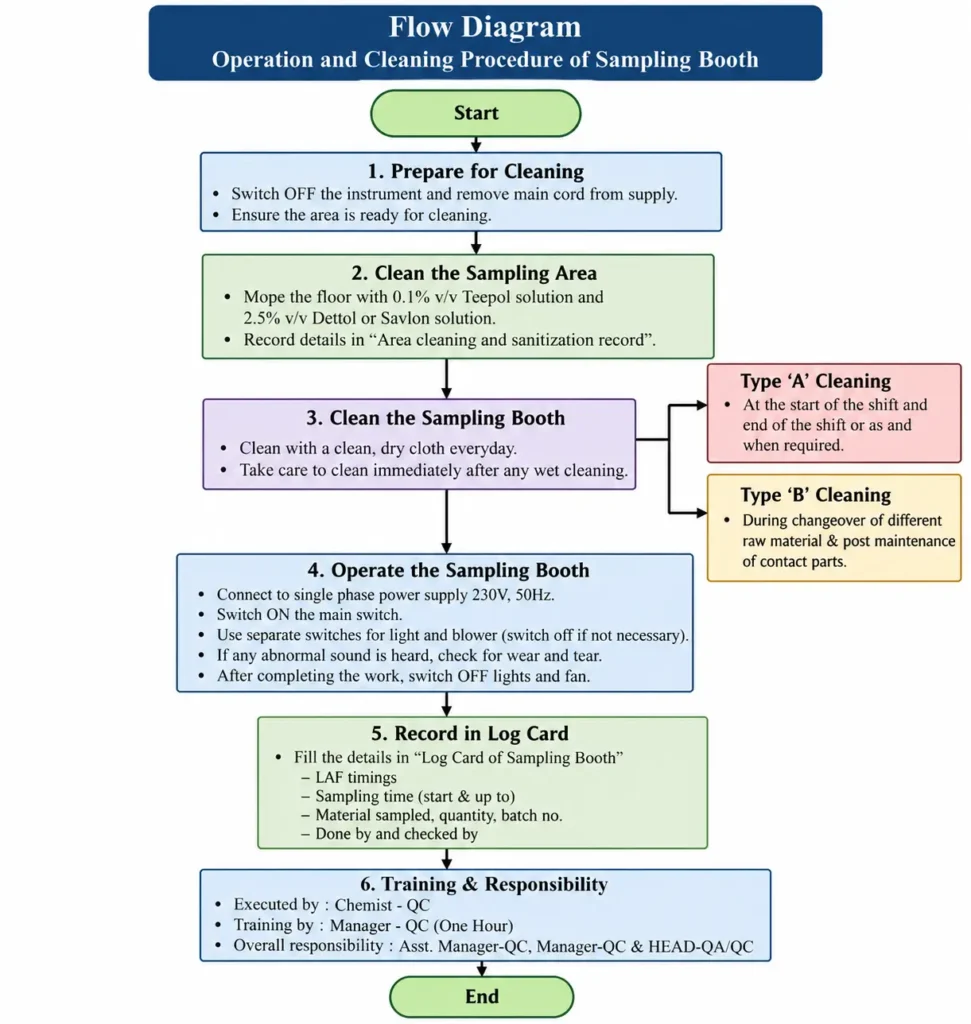
The sampling booth is cleaned with a clean, dry cloth and follows two cleaning categories: Type A cleaning at the start and end of the shift or when required, and Type B cleaning during material changeover or after maintenance of contact parts. For operation, the booth is connected to a 230 V, 50 Hz single-phase supply, with the light and blower operated as required. After sampling, operational and sampling details are recorded in the Sampling Booth Log Card, ensuring traceability, accountability, and controlled equipment use.
2. Brainstorming for SOP Failure:
The brainstorming diagram illustrates the major potential causes that can lead to SOP failure or ineffective SOP implementation in a pharmaceutical manufacturing area. The central problem, “SOP Failure in MFG Area,” is surrounded by contributing factors related to people, procedures, equipment, management, communication, and the working environment.
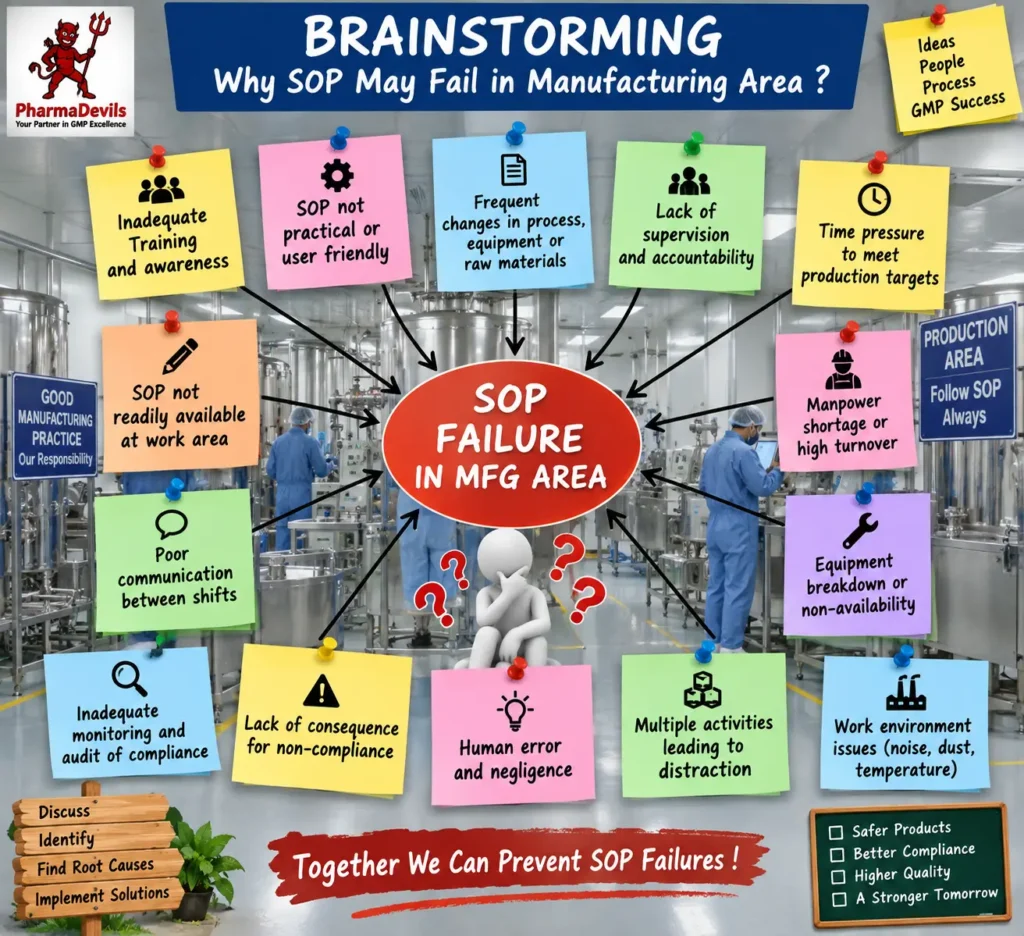
Key causes include inadequate training and awareness, SOPs that are difficult to understand or unavailable at the workplace, frequent process or equipment changes, weak supervision, production time pressure, manpower shortages, equipment breakdowns, poor shift communication, inadequate compliance monitoring, human error, distractions, and unfavorable workplace conditions. The diagram is intended to support cross-functional brainstorming during deviation investigations, CAPA discussions, and GMP compliance reviews. By identifying and grouping possible causes before determining the actual root cause, the team can develop suitable corrective and preventive actions to improve SOP compliance, product quality, operational control, and manufacturing reliability.
3. 5-Why Analysis for SOP Failure:
The 5-Why analysis identifies the underlying reasons for SOP failure in the manufacturing area by progressively questioning why the approved procedure was not followed. The analysis starts with the immediate issue: the operator did not follow the SOP correctly. It then explores contributing factors such as insufficient awareness, inadequate or ineffective training, lack of refresher training, poor supervisory monitoring, and weak accountability.
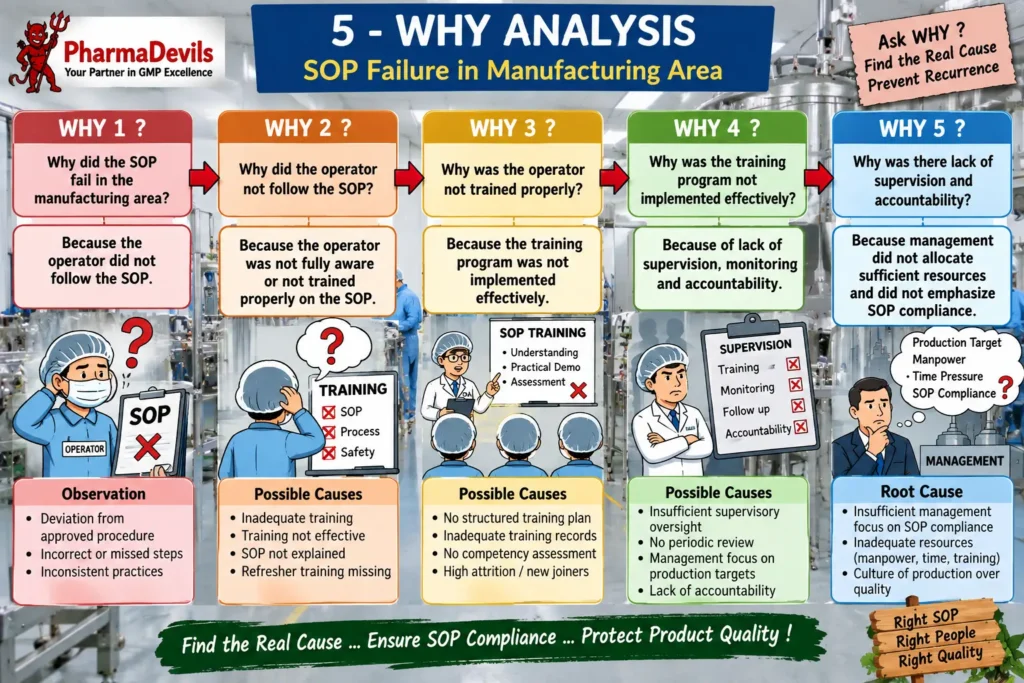
Further questioning indicates that ineffective implementation of the training program and inadequate management focus may contribute to repeated SOP non-compliance. The analysis therefore highlights possible systemic causes such as insufficient manpower, time pressure, inadequate competency assessment, weak follow-up, and greater emphasis on production targets than procedural compliance.This 5-Why approach helps the investigation team move beyond the immediate human error and identify the actual root cause, enabling suitable CAPA such as improved training, competency evaluation, stronger supervision, periodic SOP review, and enhanced management oversight.
4. Fishbone Analysis for SOP Failure:
The Fishbone Analysis diagram identifies the major categories of causes that can contribute to SOP failure in a pharmaceutical manufacturing area. The potential causes are grouped under key headings such as People, Method, Machine, Material, Environment, Management, Measurement, and Communication.
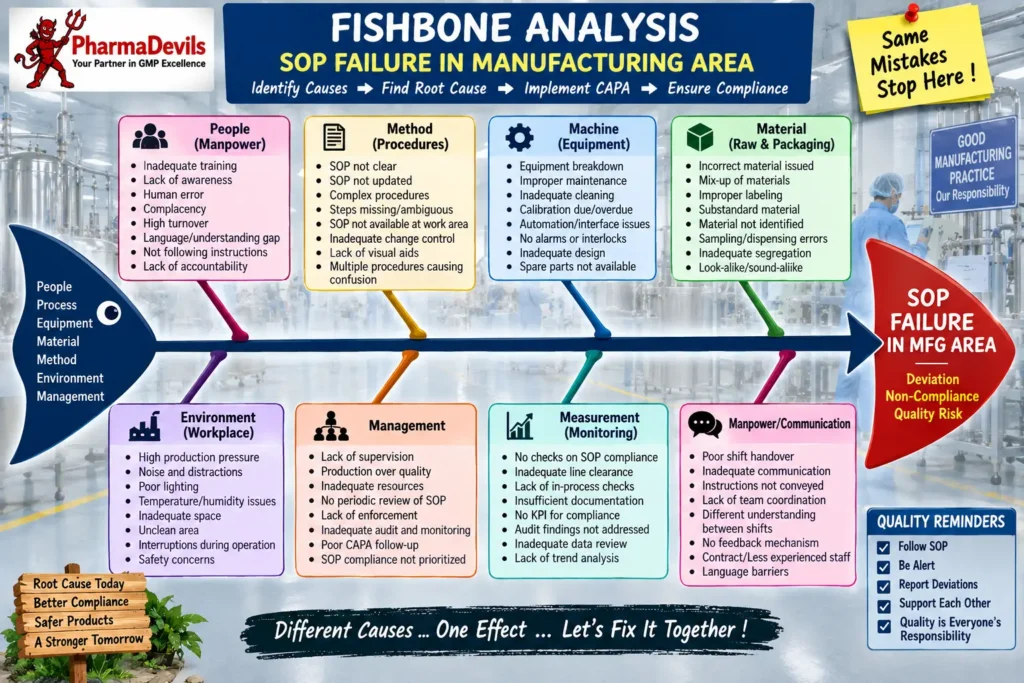
Examples include inadequate training, unclear or outdated SOPs, equipment breakdowns, improper maintenance, material mix-ups, poor labeling, workplace distractions, production pressure, weak supervision, insufficient compliance monitoring, and poor shift handover. These factors may lead to deviations, non-compliance, inconsistent practices, and increased product-quality risk.The diagram helps investigation teams systematically evaluate all possible contributing factors instead of focusing only on operator error. It supports structured root cause analysis, deviation investigation, CAPA development, training improvement, and GMP compliance monitoring, ultimately helping to strengthen procedural adherence, product quality, and operational control in the manufacturing area.
5. Fault Tree Analysis for SOP Failure:
The Fault Tree Analysis diagram shows a structured evaluation of how SOP failure in the manufacturing area can occur through multiple contributing events. The top event, “SOP Failure in Manufacturing Area,” is linked through logical gates to major failure pathways such as operator non-compliance, ineffective or unavailable SOPs, inadequate supervision and monitoring, and external or environmental pressures.
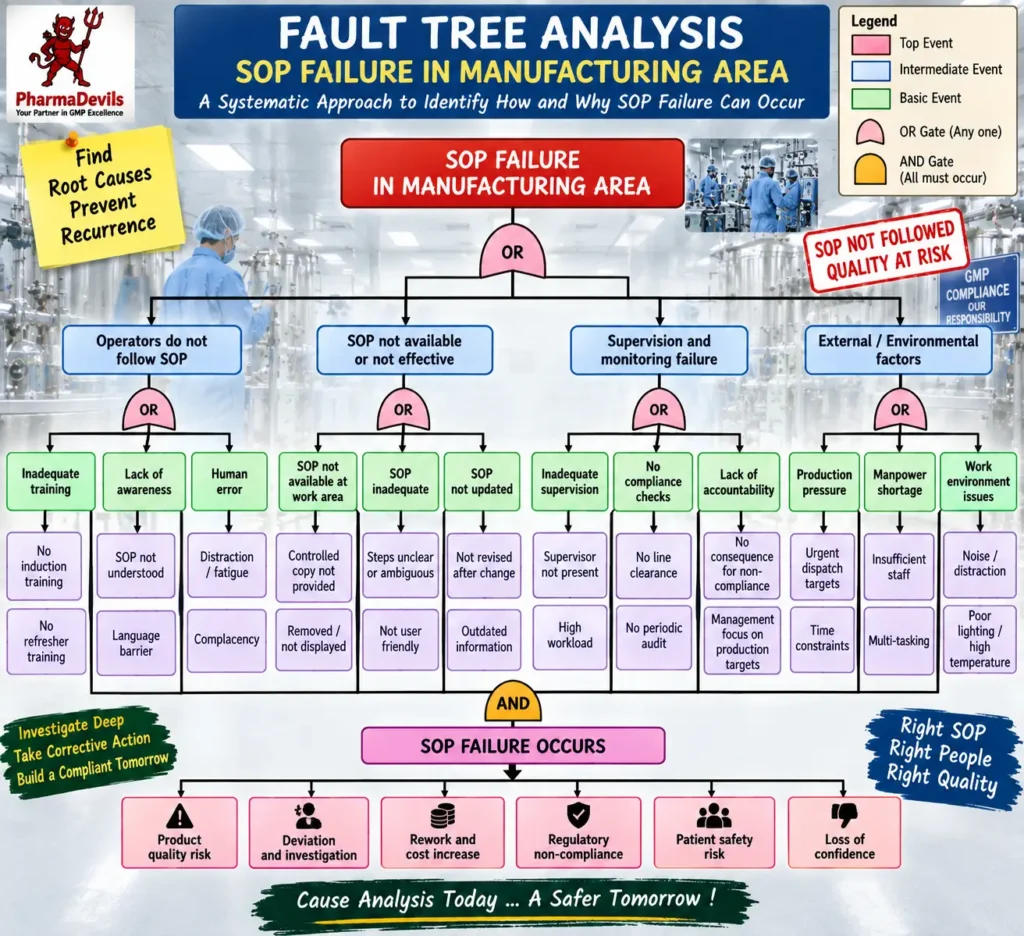
Each pathway is further broken down into basic causes including inadequate training, lack of awareness, human error, unclear or outdated procedures, poor supervision, absence of compliance checks, weak accountability, production pressure, manpower shortage, and unsuitable workplace conditions. The analysis helps identify combinations of failures that may result in SOP non-compliance and associated consequences such as product-quality risk, deviations, investigation, rework, regulatory non-compliance, patient-safety concerns, and loss of confidence. It supports systematic root-cause investigation and development of effective CAPA to prevent recurrence.
Questions & Answers – SOP for Operation and Cleaning of Sampling Booth
- Q: What is the objective of this SOP?
A: To describe the procedure for operation and cleaning of the Sampling Booth used for liquid sampling. - Q: Which equipment is covered under this SOP?
A: The SOP applies to the Sampling Booth, manufactured by Airtech, model ACS-SB-3’×3’. - Q: Who is responsible for execution of the SOP?
A: The Chemist-QC is responsible for executing the procedure. - Q: Who is responsible for effective implementation of the SOP?
A: The Asst. Manager-QC, Manager-QC, and Head-QA/QC are responsible for effective implementation. - Q: How should the sampling-area floor be cleaned?
A: The floor should be mopped with 0.1% v/v Teepol solution and 2.5% v/v Dettol or Savlon solution. - Q: Where should sampling-area cleaning be documented?
A: Cleaning details should be recorded in the Area Cleaning and Sanitization Record. - Q: What safety precaution should be taken before cleaning the Sampling Booth?
A: The equipment should be switched off and the main power cord removed from the electrical supply. - Q: How frequently should general cleaning of the Sampling Booth be performed?
A: The booth should be cleaned every day with a clean, dry cloth. - Q: What should be done after wet cleaning?
A: Precaution should be taken to clean the equipment immediately after wet cleaning. - Q: What electrical supply is required for operating the Sampling Booth?
A: The equipment is connected to a single-phase 230 V, 50 Hz power supply. - Q: Which separate controls are provided on the Sampling Booth?
A: Separate switches are provided for the light and blower, which may be switched off when not required. - Q: What action should be taken if abnormal sound is observed?
A: The unit should be checked for possible wear and tear. - Q: What should be done after completion of sampling work?
A: The lights and fan should be switched off after completing the work. - Q: When is Type A cleaning performed?
A: Type A cleaning is performed at the start and end of the shift or whenever required. - Q: When is Type B cleaning performed?
A: Type B cleaning is carried out during changeover of different raw materials and after maintenance of contact parts. - Q: Who provides training for this SOP?
A: The Manager-QC is designated as the trainer, while Chemist-QC personnel are the trainees. - Q: What is the specified training duration?
A: The training period is one hour. - Q: What record is maintained for Sampling Booth operation?
A: Annexure-I: Log Card of Sampling Booth is maintained. - Q: What details are recorded in the Sampling Booth Log Card?
A: It records date, LAF start/off time, sampling start/end time, material sampled, material status, sampled quantity, batch number, operator, and checker details. - Q: Why is the Sampling Booth Log Card important?
A: Based on the fields provided in the SOP, it supports traceability of booth operation and sampling activities by documenting times, material, quantity, batch, performer, and checker information.
Reference Guidelines:
- WHO Technical Report Series No. 929, Annex 4 – Guidelines for Sampling of Pharmaceutical Products and Related Materials. This is directly relevant to pharmaceutical sampling practices, sampling controls, and prevention of contamination during sampling. (World Health Organization)
WHO TRS 929 Annex 4 - WHO TRS 1052, Annex 4 – Good Practices for Pharmaceutical Quality Control Laboratories (2024). Useful for QC laboratory quality systems, personnel, premises, equipment, documentation, and handling of samples. (World Health Organization)
WHO Good Practices for Pharmaceutical QC Laboratories - EU GMP, EudraLex Volume 4 – Annex 8: Sampling of Starting and Packaging Materials. Relevant to representative sampling, sampling plans, material controls, and prevention of contamination during sampling. (Public Health)
- EU GMP, EudraLex Volume 4 – Chapter 3: Premises and Equipment; Chapter 5: Production; Chapter 6: Quality Control. These chapters support appropriate premises/equipment, written procedures, controlled handling of materials, sampling, and QC activities. (Public Health)
EU GMP Volume 4 - 21 CFR Part 211.67 – Equipment Cleaning and Maintenance. Requires written cleaning and maintenance procedures, assigned responsibilities, cleaning schedules, protection of clean equipment, inspection before use, and maintenance of records. (Legal Information Institute)
- 21 CFR Part 211.80 and 211.84 – Components, Containers and Closures. These sections require written sampling procedures and representative sampling, including measures to prevent contamination during opening, sampling, and resealing of material containers. (Legal Information Institute)
- Indian Drugs Rules – Schedule M / GMP Requirements. CDSCO requirements provide for a separate sampling area for active raw materials and excipients, or equivalent controls to prevent contamination, cross-contamination, and mix-up. CDSCO inspection guidance also addresses maintenance of the sampling area, reverse LAF where applicable, sampling tools, and sampling-booth logbooks. (CDSCO)