







1. Introduction – SOP for Operation, Cleaning and Storage of Class Marking Assembly:
The Standard Operating Procedure for Operation, Cleaning and Storage of Klass Marking Assembly describes the controlled method for issuing, operating, cleaning, checking, and storing the Klass marking assembly used in the Production/Packing area. The assembly consists of components such as a hand-operated plastic roller, ink sponge roller, rubber mat, alphabets, numbers (0–9), and symbols. As per the packing work order, the Klass marking assembly is issued from the Packing Head. The required rubber mat is fixed on the plastic roller, permanent marker ink is applied to the ink roller, and the ink is spread uniformly. Before actual use, an impression is taken on a white sheet and approved by IPQA. After completion of the activity, the marking mat is dismantled, cleaned using 70% IPA/Thinner, dried with a lint-free cloth, packed in a polybag with status identification, and stored securely under lock and key. Proper records of issuance, usage, cleaning, return, and integrity are maintained to ensure traceability and GMP compliance.
Skip to PDF content2. Flow Diagram – Operation, Cleaning and Storage of Klass Marking Assembly:
The Operation, Cleaning and Storage of Klass Marking Assembly procedure describes the controlled sequence for use and management of the Klass marker in the Production/Packing area. The process starts with issuance of the Klass marking assembly as per the packing work order. The required rubber mat is fixed onto the plastic roller, permanent marker ink is applied to the ink roller, and the ink is spread uniformly over the marking surface. An impression is then taken on a white sheet and approved by IPQA before actual use.
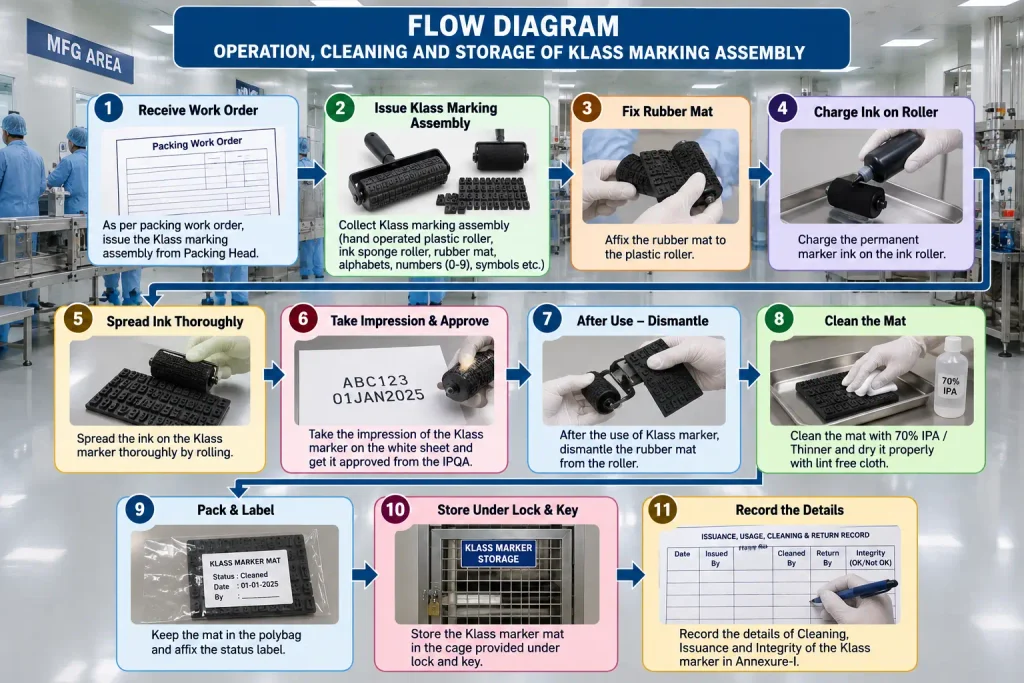
After completion of marking activity, the rubber mat is dismantled and cleaned using 70% IPA or thinner, followed by proper drying with a lint-free cloth. The cleaned mat is kept in a polybag, identified with an appropriate status label, and stored in the designated cage under lock and key. Details of issuance, cleaning, return, and integrity are recorded in the prescribed annexure to maintain traceability and GMP control.
2. Benefits of Following SOP – Operation, Cleaning and Storage of Klass Marking Assembly:
Following the SOP for Operation, Cleaning and Storage of Klass Marking Assembly helps ensure controlled, consistent, and traceable marking activities in the Production/Packing area. Proper issuance of the Klass marker against the packing work order reduces the possibility of unauthorized or incorrect use. Verification of the impression on a white sheet and approval by IPQA before use helps confirm the correctness and legibility of the required marking.
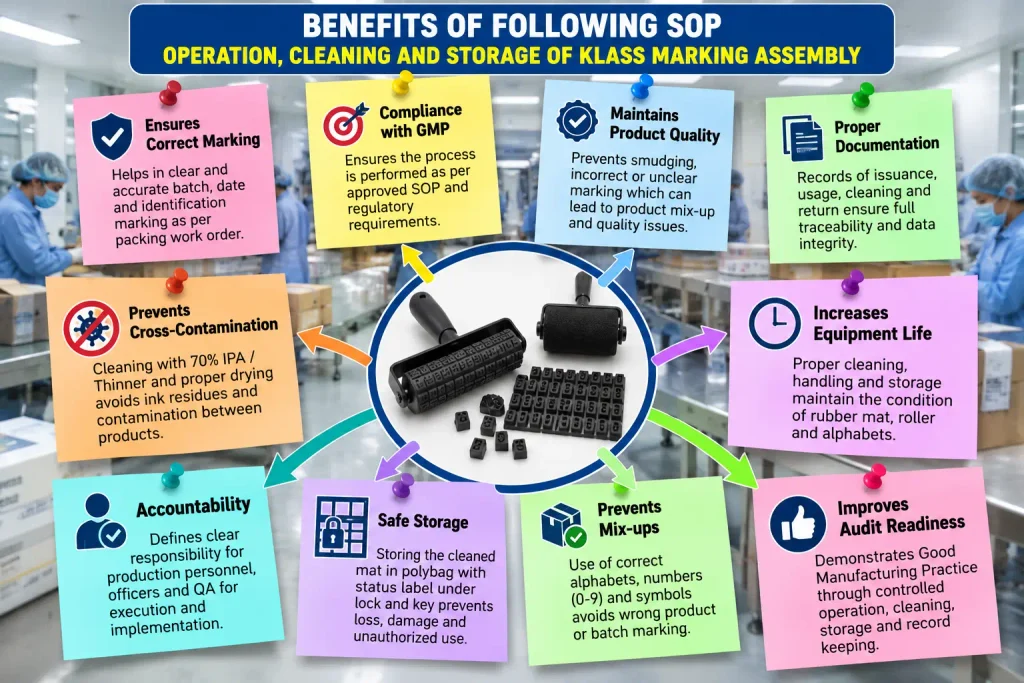
Proper dismantling and cleaning of the rubber mat with 70% IPA or thinner, followed by drying with a lint-free cloth, helps keep the marking components clean and suitable for reuse. Keeping the cleaned mat in a labeled polybag and storing it under lock and key improves identification, protection, and control. Recording issuance, cleaning, return, and integrity details provides complete traceability and supports GMP documentation requirements.
3. Brainstorming Analysis for SOP Failure – Operation, Cleaning and Storage of Klass Marking Assembly:
The Brainstorming Analysis for SOP Failure – Operation, Cleaning and Storage of Klass Marking Assembly identifies potential causes that may lead to incorrect operation, poor marking quality, inadequate cleaning, improper storage, or loss of traceability. Possible failures include issuance of the wrong Klass marker, missing or damaged alphabets and symbols, improper fixing of the rubber mat, incorrect quantity of ink, uneven ink spreading, unclear impressions, and failure to obtain IPQA approval before use. These points directly relate to the operating controls described in the SOP.
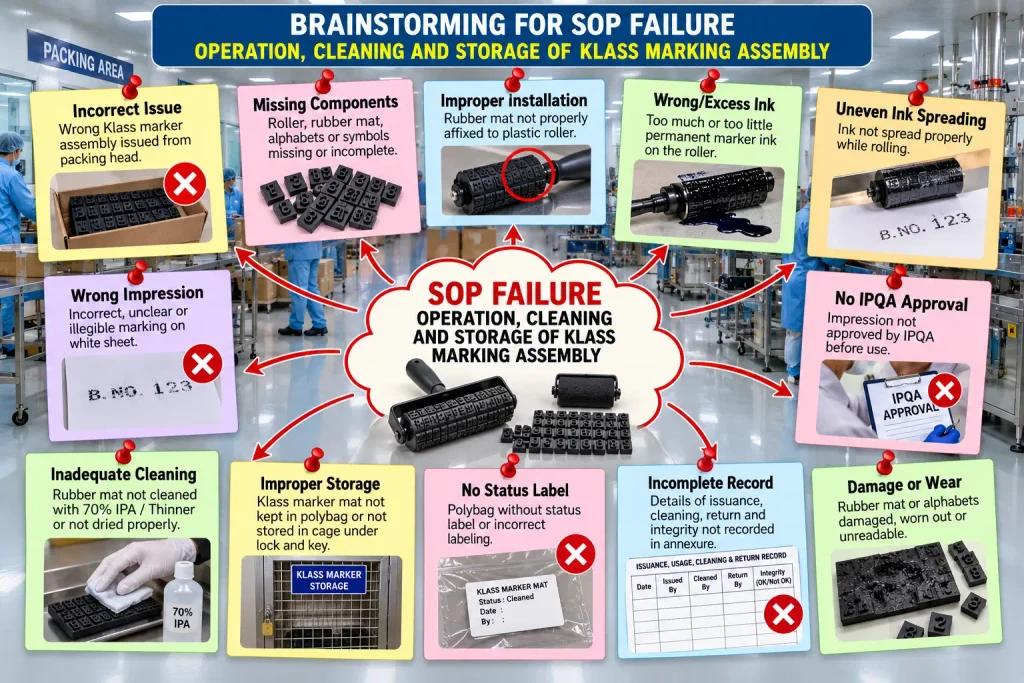
Additional causes include inadequate cleaning with 70% IPA or thinner, incomplete drying, missing status labels, improper storage outside the designated locked cage, and incomplete recording of issuance, cleaning, return, or integrity details. Such failures can affect marking accuracy, component condition, traceability, and GMP compliance.
4. 5-Why Analysis for SOP Failure – Operation, Cleaning and Storage of Klass Marking Assembly:
The 5-Why Analysis for SOP Failure – Operation, Cleaning and Storage of Klass Marking Assembly is used to identify the underlying causes behind failures in marking, cleaning, storage, approval, and documentation activities. Typical problems include unclear or incorrect marking, missing alphabets or symbols, failure to obtain IPQA approval, improper cleaning of the rubber mat, missing status labels, incorrect storage, and incomplete records.The analysis traces these failures from the immediate cause to the deeper system-level cause. For example, poor marking may result from uneven ink application, which can be linked to improper operator technique, inadequate training, weak supervision, and ineffective competency management. Similarly, improper cleaning or storage can arise from lack of procedural understanding, insufficient verification, and weak monitoring controls.
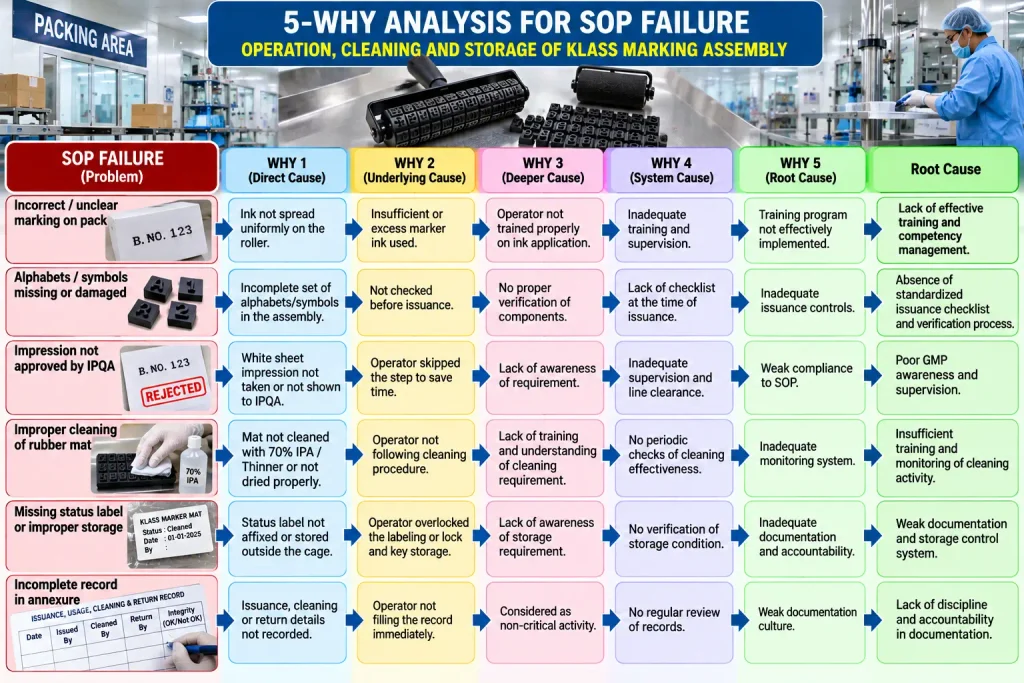
The SOP requires the impression to be approved by IPQA before use and specifies cleaning with 70% IPA/Thinner, proper drying, status labeling, locked storage, and recording of issuance, cleaning, return, and integrity details. Overall, the 5-Why approach helps identify root causes so that suitable CAPA can be implemented to strengthen training, verification, supervision, documentation, and GMP compliance.
5. Fault Tree Analysis for SOP Failure – Operation, Cleaning and Storage of Klass Marking Assembly:
The Fault Tree Analysis for SOP Failure – Operation, Cleaning and Storage of Klass Marking Assembly evaluates how multiple operational and control failures can lead to the top event of incorrect, unclear, or non-approved Klass marking on the pack. Major contributing branches include incorrect operation of the Klass marker, failure to obtain IPQA approval before use, inadequate cleaning of the rubber mat, improper storage, and incomplete recording in the prescribed annexure. Operational failures may result from improper assembly, missing or damaged characters, loose fitting, incorrect ink quantity, or uneven ink spreading. The SOP specifically requires the rubber mat to be fixed to the roller, permanent marker ink to be applied and spread properly, and an impression to be taken on a white sheet for IPQA approval before use.
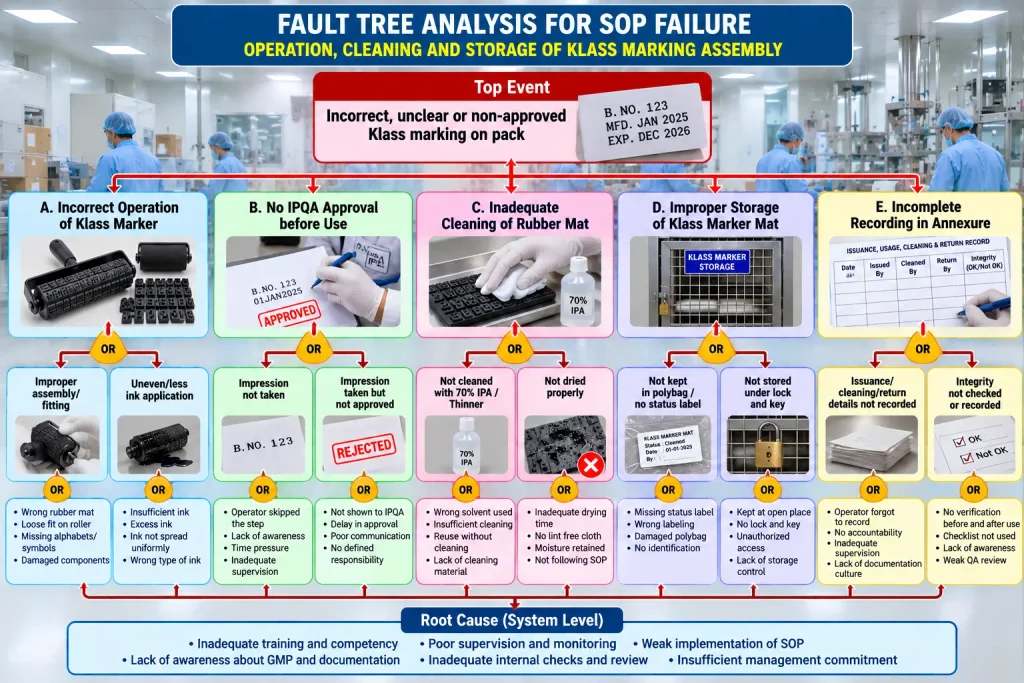
Cleaning and storage failures can occur when the mat is not cleaned with 70% IPA/Thinner, not dried properly with a lint-free cloth, not placed in a labeled polybag, or not stored under lock and key. Incomplete documentation of issuance, cleaning, return, and integrity can further weaken traceability. The analysis therefore highlights system-level root causes such as inadequate training, weak supervision, poor SOP compliance, insufficient documentation control, and ineffective internal review.
6. Fishbone Analysis for SOP Failure – Operation, Cleaning and Storage of Klass Marking Assembly:
The Fishbone Analysis for SOP Failure – Operation, Cleaning and Storage of Klass Marking Assembly evaluates possible causes of incorrect, unclear, or non-approved Klass marking by grouping them under six major categories: Man, Machine, Material, Method, Measurement, and Environment. Under Man, potential causes include inadequate training, poor SOP awareness, incorrect operating technique, failure to follow cleaning steps, and insufficient supervision. Machine-related causes may include loose fitting of the rubber mat, damaged rollers, poor alignment, or missing alphabets and symbols.
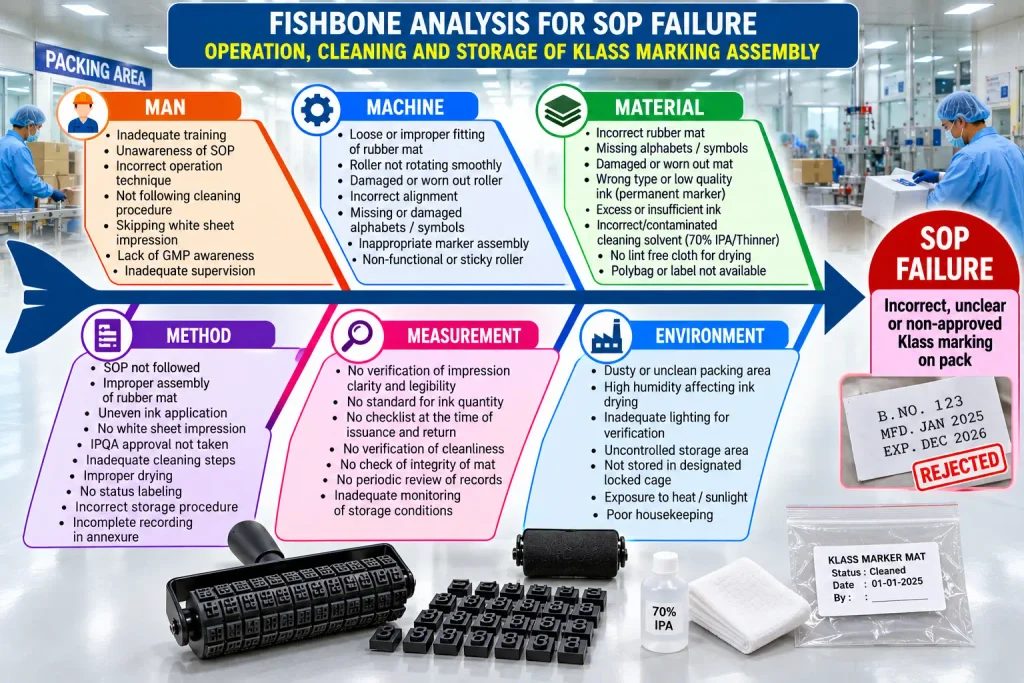
Material-related causes include use of an incorrect or damaged rubber mat, unsuitable ink, insufficient or excessive ink, contaminated cleaning solvent, or absence of lint-free cloth and labeling materials. Method-related failures include improper assembly, uneven ink application, skipping the white-sheet impression, failure to obtain IPQA approval, inadequate cleaning, improper drying, incorrect storage, and incomplete documentation. Measurement and verification failures may involve lack of checks for impression clarity, cleanliness, integrity, issuance, and return. Environmental factors can include poor housekeeping, uncontrolled storage conditions, inadequate lighting, or conditions that may affect ink drying.The SOP specifically requires correct assembly, uniform ink application, white-sheet impression approval by IPQA, cleaning with 70% IPA/Thinner, proper drying, labeled storage under lock and key, and recording of issuance, cleaning, return, and integrity
7. Impact Assessment for SOP Failure – Operation, Cleaning and Storage of Klass Marking Assembly:
The Impact Assessment for SOP Failure – Operation, Cleaning and Storage of Klass Marking Assembly evaluates the possible consequences of not following the approved procedure during issuance, operation, cleaning, storage, and documentation of the Klass marker. Incorrect assembly, improper ink application, unclear impressions, or failure to obtain IPQA approval can result in incorrect or illegible marking on packing material. Failure to clean the rubber mat properly with 70% IPA/Thinner, inadequate drying, missing status labeling, or improper storage can affect the condition and suitability of the marking assembly for subsequent use. The SOP also requires the cleaned mat to be stored in a polybag and kept in the designated cage under lock and key.
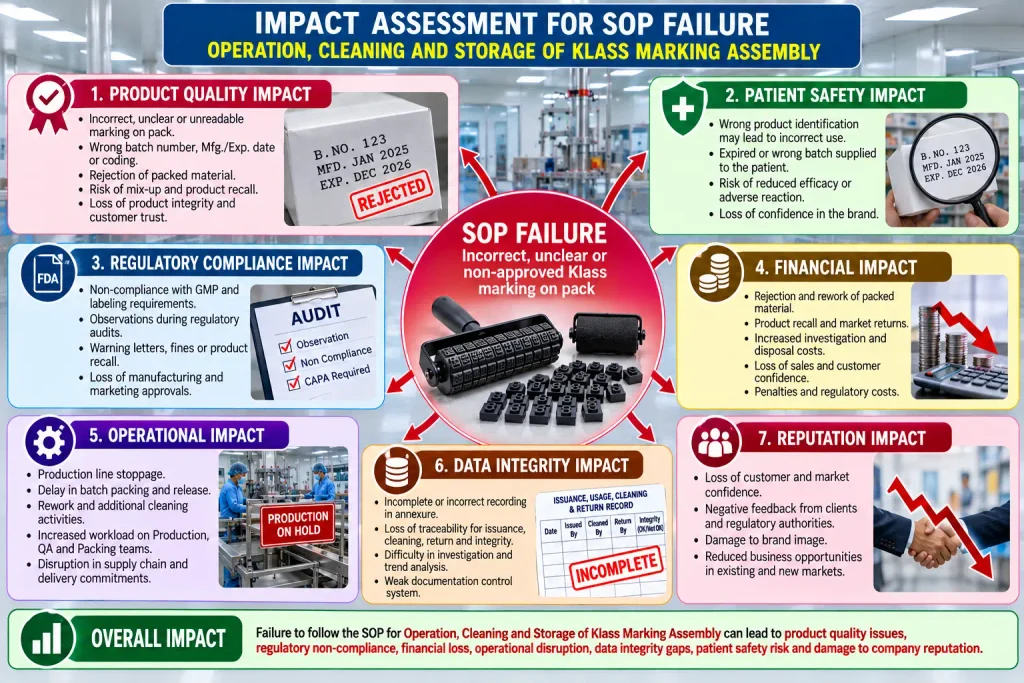
Incomplete recording of issuance, usage, cleaning, return, and integrity can reduce traceability and weaken documentation control. SOP failure may lead to packing errors, rejection or rework, batch release delays, investigation and CAPA requirements, regulatory observations, documentation gaps, financial loss, and damage to customer confidence. Proper implementation of the SOP therefore supports product identification, GMP compliance, traceability, and controlled packing operations.
8. Corrective and Preventive Action (CAPA) for SOP Failure – Operation, Cleaning and Storage of Klass Marking Assembly:
The Corrective and Preventive Action (CAPA) for SOP Failure – Operation, Cleaning and Storage of Klass Marking Assembly is intended to eliminate observed failures and prevent their recurrence during marking, cleaning, storage, and documentation activities. Corrective actions may include rechecking unclear or incorrect impressions, cleaning and reassembling the Klass marker, replacing damaged or missing alphabets or symbols, repeating the white-sheet impression, and obtaining IPQA approval before use. The SOP requires the rubber mat to be properly fitted, ink to be spread uniformly, and the impression to be approved by IPQA prior to use. For cleaning-related failures, the mat should be cleaned using 70% IPA/Thinner, dried with a lint-free cloth, and replaced if damaged. For storage failures, the cleaned mat should be packed in a polybag, provided with a status label, and stored in the designated cage under lock and key.
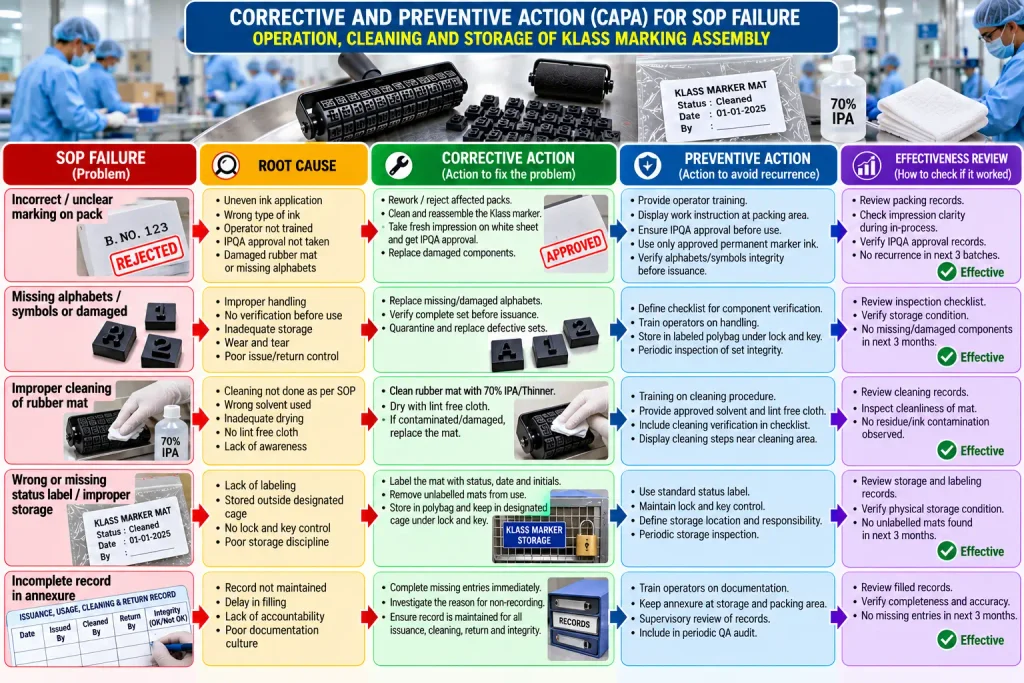
Preventive actions should focus on operator training, component verification before issuance, standardized checklists, supervision, periodic inspection of the marker set, proper labeling, and timely documentation. Records of issuance, cleaning, return, and integrity should be reviewed for completeness. can be performed by checking subsequent records, confirming legible and approved impressions, verifying proper storage and labeling, and ensuring that the same failure does not recur during a defined monitoring period.
Questions & Answers – Operation, Cleaning and Storage of Klass Marking Assembly:
Q1. What is the objective of this SOP?
Answer: The objective is to lay down the procedure for the operation, cleaning, and storage of the Klass Marking Assembly.
Q2. Who is responsible for execution of this SOP?
Answer: Concerned Production personnel and the Officer/Chemist-Production are responsible for execution of the SOP.
Q3. What components are included in the manual Klass marking assembly?
Answer: It consists of a hand-operated plastic roller, ink sponge roller, rubber mat, alphabets, numbers 0–9, and symbols.
Q4. How is the Klass marking assembly issued?
Answer: It is issued from the Packing Head as per the applicable packing work order.
Q5. What should be done before applying the marking on packing material?
Answer: An impression of the Klass marker should be taken on a white sheet and approved by IPQA before use.
Q6. How should ink be applied to the Klass marker?
Answer: Permanent marker ink should be charged onto the ink roller and spread thoroughly over the Klass marker by rolling.
Q7. What should be done with the Klass marker after use?
Answer: The Klass mat should be dismantled from the roller before cleaning.
Q8. Which cleaning agent is specified for the Klass marker mat?
Answer: The SOP specifies 70.0% IPA or Thinner for cleaning the mat.
Q9. How should the mat be dried after cleaning?
Answer: It should be dried properly using a lint-free cloth.
Q10. How should the cleaned Klass marker mat be stored?
Answer: It should be kept in a polybag, provided with a status label, and stored in the designated cage under lock and key.
Q11. What details are required to be recorded?
Answer: Details related to cleaning, issuance, and integrity of the Klass marker are required to be recorded in Annexure-I.
Q12. What is Annexure-I used for?
Answer: Annexure-I is the Issuance, Usage, Cleaning & Return Record of Klass-Marker.
Q13. What is Annexure-II used for?
Answer: Annexure-II is the Klass-Marker Status Record
Q14. What does IPQA stand for?
Answer: IPQA stands for In Process Quality Assurance.
Q15. What is the main GMP benefit of following this SOP?
Answer: Following the SOP supports correct marking, controlled cleaning and storage, component integrity, documentation, traceability, and prevention of unauthorized or incorrect use of the Klass marking assembly.
Reference Guidelines – Operation, Cleaning and Storage of Klass Marking Assembly:
- WHO Good Manufacturing Practices (GMP) for Pharmaceutical Products
- EU Guidelines for Good Manufacturing Practice – EudraLex Volume 4
- PIC/S Guide to Good Manufacturing Practice for Medicinal Products, PE 009
- Schedule M of the Drugs Rules, 1945 – Good Manufacturing Practices and Requirements of Premises, Plant and Equipment for Pharmaceutical Products
- US FDA 21 CFR Part 211 – Current Good Manufacturing Practice for Finished Pharmaceuticals, particularly controls relating to equipment, labeling/packaging operations, records, and documentation.
- Approved site procedures for line clearance, packaging operations, equipment cleaning, labeling control, status identification, documentation practices, and equipment/storage control.