







Brief Description
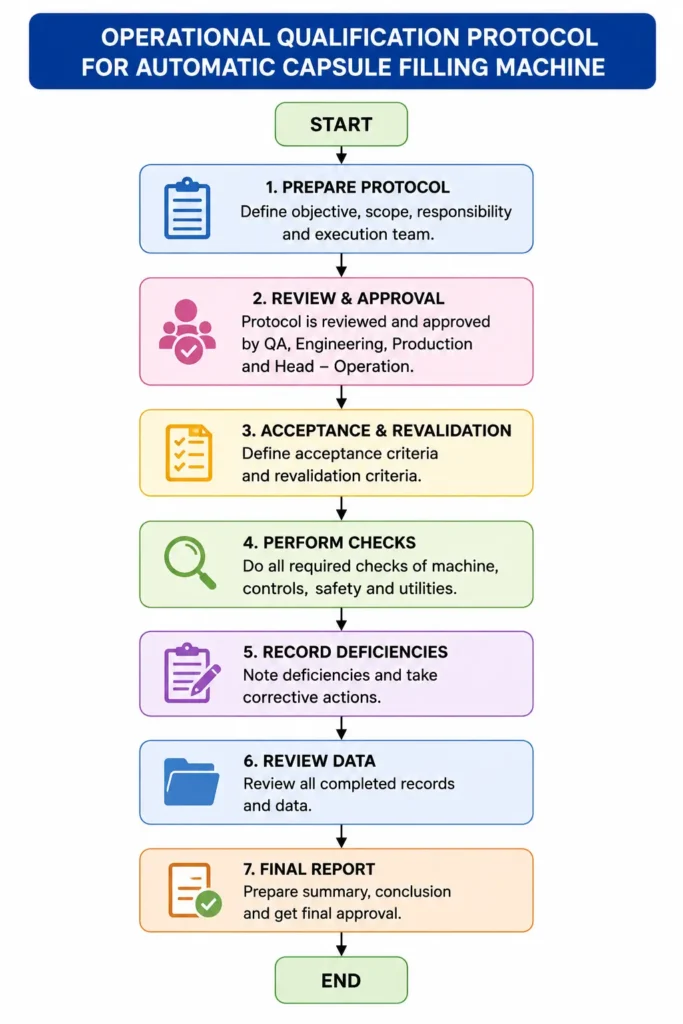
The Operational Qualification (OQ) Protocol for the Automatic Capsule Filling Machine is prepared to verify that the machine operates properly according to its design specifications and defined requirements. The protocol covers the objective, purpose, scope, responsibilities, acceptance criteria, and revalidation requirements. It includes detailed checks of important machine parts such as the turret, hopper, loader, powder filling system, capsule locking system, and ejection assembly. Functional checks are performed for the control panel, vacuum pump, blower, motors, brake, alarms, and safety interlocks. Supporting utilities such as electricity and compressed air are also verified. The protocol includes calibration verification, SOP verification, personnel training, deficiency and corrective action records, and annexures. The machine is considered qualified when all required tests meet the specified acceptance criteria and any deficiencies are properly resolved. Finally, the qualification report is reviewed and approved by Production, Engineering, Quality Assurance, and authorized management personnel.
Impact Assessment
The Operational Qualification of the Automatic Capsule Filling Machine is important to ensure that the machine works properly, safely, and consistently. The assessment covers the possible impact of machine operation on product quality, capsule filling, safety, and process performance. Proper checking of the machine components, control panel, alarms, interlocks, vacuum system, blower, and supporting utilities helps reduce the risk of machine failure. Calibration and functional checks help ensure that the machine operates within the required specifications. Verification of SOPs and training of personnel also reduces the chance of incorrect operation. Any deficiency found during qualification is recorded and suitable corrective action is taken before final approval. If major changes or breakdowns affect machine performance, revalidation may be required. Successful completion of the OQ provides documented evidence that the machine is operating as intended and is suitable to proceed for the next qualification stage.
Critical Process Parameters (CPP) and Critical Quality Attributes (CQA)
Based on the OQ protocol for the Automatic Capsule Filling Machine, the following parameters and quality attributes are relevant to machine operation.
| Critical Process Parameters (CPP) | Critical Quality Attributes (CQA) |
|---|---|
| Powder flow and uniform distribution | Capsule fill weight / weight variation |
| Tamping operation | Proper capsule filling |
| Vacuum level and vacuum operation | Proper cap and body separation |
| Compressed air pressure | Proper capsule locking |
| Capsule loading and separation | Capsule closing length |
| Capsule locking pin alignment | No denting or telescoping |
| Ejection pin operation | No crushed or damaged capsules |
| Machine functional operation | Proper capsule ejection |
| Safety interlocks and alarms | Rejection rate within specified limit |
| Electrical supply and utilities | Overall capsule appearance and integrity |
Note: The protocol specifically verifies capsule weight variation, closing length, capsule defects, rejection level, vacuum, compressed air, machine functions, and safety features. These are therefore the main parameters/attributes supported by the document.
FMEA – Automatic Capsule Filling Machine
The following FMEA is prepared based on the OQ protocol and covers major machine functions, possible failures, their effects, causes, and controls.
Scoring: Severity (S), Occurrence (O), Detection (D): 1 = Low/Good, 10 = High/Poor. RPN = S × O × D.
| S. No. | Process / Function | Possible Failure | Effect | Possible Cause | Existing Control | S | O | D | RPN |
|---|---|---|---|---|---|---|---|---|---|
| 1 | Capsule Loading | Capsule not loaded properly | Empty/missing capsule | Loader malfunction | Functional check | 6 | 3 | 3 | 54 |
| 2 | Capsule Separation | Cap and body not separated | Improper filling | Vacuum failure | Vacuum check | 7 | 3 | 3 | 63 |
| 3 | Powder Filling | Improper powder filling | Weight variation | Poor powder flow/tamping | Weight check | 8 | 4 | 3 | 96 |
| 4 | Tamping | Improper tamping | Low/high fill weight | Incorrect setting | Functional verification | 7 | 3 | 4 | 84 |
| 5 | Capsule Closing | Capsule not properly locked | Leakage/open capsule | Locking pin misalignment | Closing check | 8 | 3 | 3 | 72 |
| 6 | Capsule Ejection | Capsule damaged during ejection | Damaged capsule | Ejection pin misalignment | Ejection check | 7 | 3 | 3 | 63 |
| 7 | Vacuum System | Low vacuum | Improper separation/filling | Vacuum leakage/pump problem | Vacuum alarm/interlock | 7 | 3 | 2 | 42 |
| 8 | Compressed Air | Low air pressure | Machine malfunction | Utility failure | Air pressure verification | 7 | 3 | 2 | 42 |
| 9 | Safety Interlock | Interlock fails | Operator/batch safety risk | Sensor/interlock failure | Interlock testing | 9 | 2 | 3 | 54 |
| 10 | Control Panel | Control function fails | Machine stops or operates incorrectly | PLC/control fault | Control panel verification | 8 | 2 | 3 | 48 |
| 11 | Rejection System | Defective capsules not rejected | Defective product may proceed | Sensor/ejection failure | Rejection check | 8 | 3 | 3 | 72 |
| 12 | Machine Operation | Excessive machine-related rejection | Reduced yield/product quality | Mechanical or operational problem | Rejection monitoring | 7 | 3 | 3 | 63 |
Conclusion: The FMEA identifies powder filling, tamping, capsule closing, and rejection as important areas requiring effective control. The OQ protocol provides functional checks, alarm/interlock checks, utility verification, weight checks, capsule closing checks, and rejection checks to reduce these risks.
Questions and Answers
Q1. What is the purpose of the OQ protocol?
Answer: The purpose is to verify and document that the Automatic Capsule Filling Machine operates properly according to its specified requirements.
Q2. What is the scope of the protocol?
Answer: The scope covers the Operational Qualification of the Automatic Capsule Filling Machine before proceeding to Performance Qualification.
Q3. Who is responsible for executing the qualification?
Answer: The execution team consists of personnel from Production, Engineering, and Quality Assurance.
Q4. What are the main acceptance criteria?
Answer: The machine shall comply with the designed specifications and the required supporting utilities shall be available.
Q5. When is revalidation required?
Answer: Revalidation is required after major changes affecting performance, major breakdown maintenance, or as per the scheduled revalidation date.
Q6. What major machine functions are verified?
Answer: Capsule loading, separation, powder filling, capsule locking, ejection, vacuum, blower, auger, motors, and control panel functions are verified.
Q7. What safety features are checked?
Answer: Emergency stop, door interlock, air-pressure interlock, vacuum-pressure interlock, password protection, and motor overload protection are checked.
Q8. What utilities are verified?
Answer: Electrical supply and compressed air supply are verified.
Q9. What records are included in the OQ?
Answer: Calibration records, functional checks, SOP verification, training records, deficiency/corrective action records, annexures, and the final qualification report are included.
Q10. What is the final outcome of the OQ?
Answer: Successful completion of the OQ provides documented evidence that the machine is operating satisfactorily and can proceed to the next qualification stage.