






1. Introduction:
The Batch Manufacturing Record (BMR) for Paracetamol, Aceclofenac & Serratiopeptidase Tablets provides a documented and controlled framework for the manufacturing, in-process monitoring, coating, yield reconciliation, and release-related activities associated with this combination tablet formulation. Each film-coated tablet contains Paracetamol IP 325 mg, Aceclofenac IP 100 mg, and Serratiopeptidase IP 15 mg, equivalent to 30,000 enzymatic units. The BMR is designed to ensure that every manufacturing activity is performed consistently and is properly recorded. It includes requirements for raw-material dispensing, equipment and area cleanliness, line clearance, material identification, weighing verification, environmental conditions, and authorized handling of any deviation from the approved procedure. Manufacturing activities covered in the document include sifting, binder preparation, wet granulation, drying, wet milling, final drying, grading, blending, lubrication, compression, dedusting, film-coating solution preparation, coating, sorting, and final yield reconciliation. The process is supported by defined equipment such as vibro sifters, rapid mixer granulators, fluid bed dryers, multimills, cage blenders, compression machines, coating pans, and associated in-process testing instruments. Critical in-process controls include tablet weight, thickness, hardness, disintegration time, friability, temperature, and relative humidity. These checks help ensure uniformity and process consistency throughout compression and coating. Overall, this BMR establishes traceability, accountability, and systematic documentation of all manufacturing stages, thereby supporting consistent batch processing and effective Quality Assurance oversight.
Skip to PDF content2. Manufacturing Flow Diagram:
The manufacturing flow diagram for Paracetamol, Aceclofenac & Serratiopeptidase Film-Coated Tablets illustrates the sequential processing stages followed from raw material dispensing to the finished packed product. The process begins with dispensing and sifting of raw materials, where materials are verified for identity, quantity, expiry, and appropriate sieve requirements. The sifted materials are then processed through binder preparation and wet granulation. A starch-based binder is prepared and added to the dry mix in the Rapid Mass Granulator to obtain a suitable wet mass. The wet granules are dried in a Fluid Bed Dryer, followed by sizing or milling to achieve the required granule characteristics.
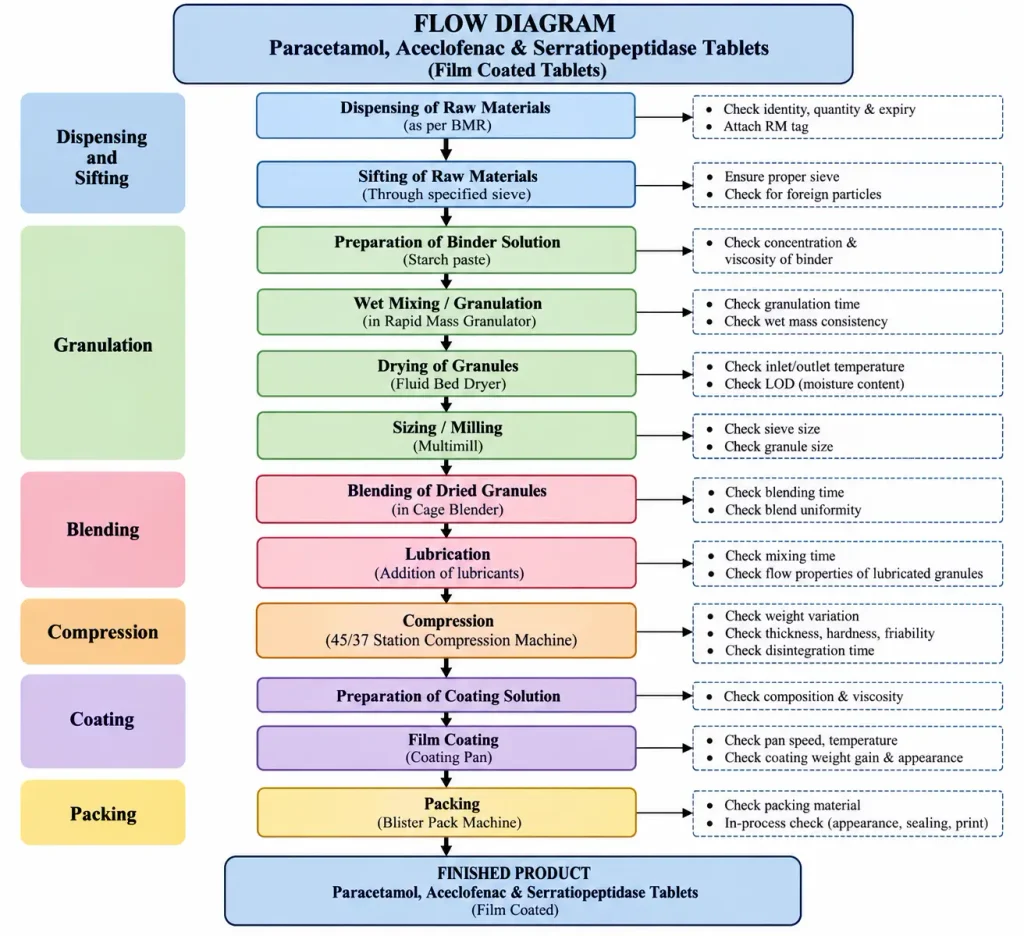
The dried and sized granules are subsequently subjected to blending and lubrication. Lubricants and other specified excipients are incorporated under controlled blending conditions before transferring the lubricated granules for compression. During compression, critical parameters such as tablet weight, thickness, hardness, friability, and disintegration time are monitored. The compressed tablets are then subjected to film coating, followed by sorting, reconciliation, and transfer for packing. The complete flow supports systematic process control, traceability, and consistent product quality throughout manufacturing.
3. Critical Process Parameters and Critical Quality Attributes:
The Critical Process Parameters (CPPs) and Critical Quality Attributes (CQAs) for Paracetamol, Aceclofenac & Serratiopeptidase Film-Coated Tablets are essential for maintaining consistent manufacturing performance and finished-product quality. The major manufacturing stages include dispensing, sifting, binder preparation, wet granulation, drying, sizing, blending, lubrication, compression, film coating, and packing. During granulation, key CPPs include mixing time, binder addition, wet mass consistency, drying temperature, drying duration, and final moisture content. The BMR specifies final drying at an inlet temperature of 60–70°C, product outlet temperature of 30–40°C, and granule LOD of 1.8–2.6% w/w. During blending and lubrication, controlled blending time and lubricant incorporation are important for maintaining uniformity and acceptable granule properties.
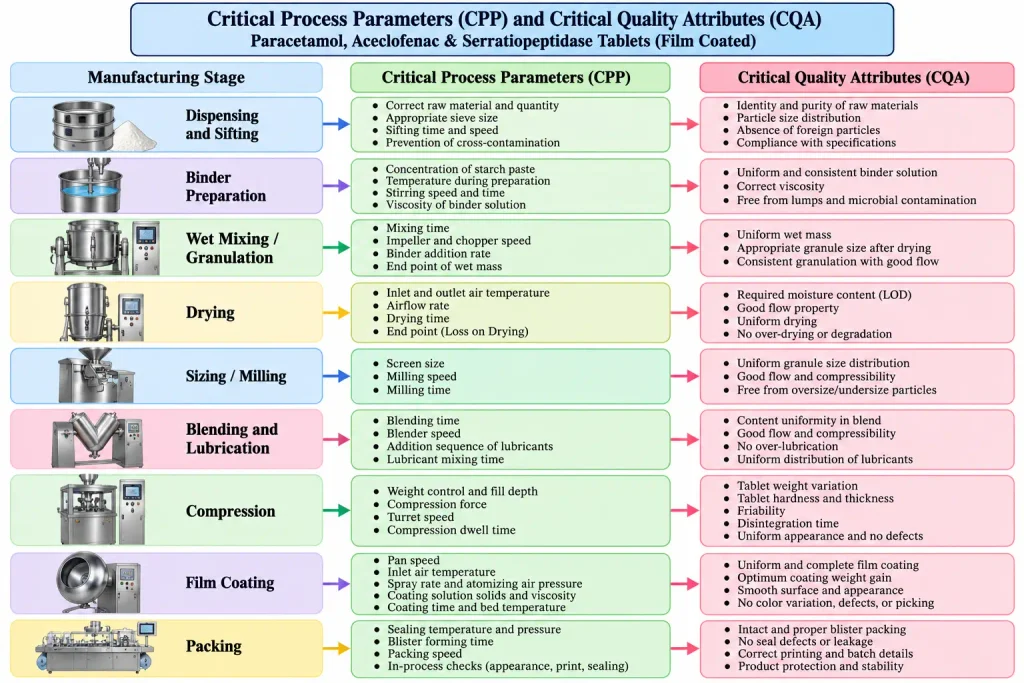
Compression CQAs include tablet weight, thickness, hardness, friability, disintegration time, appearance, temperature, and humidity. The BMR defines an average tablet weight of 722 mg, thickness of 5.40–5.80 mm, hardness NLT 89.6 N, friability NMT 1%, and disintegration time NMT 15 minutes. During film coating, parameters such as pan speed, temperature, spraying conditions, coating time, and final appearance are monitored to ensure uniform, defect-free coated tablets. These CPPs and CQAs collectively support batch consistency, process control, and product quality.