





1. Brief Description:
The Performance Qualification (PQ) Protocol for the Capsule Hand Filling Machine is prepared to provide documented evidence that the equipment performs consistently and meets predetermined acceptance criteria during routine operation. The machine is installed in the Hard Gelatin Capsule Section and is designed for filling powders, granules, pellets, or tablets into hard gelatin capsules of different sizes.
Before starting PQ, Design Qualification, Installation Qualification, Operational Qualification, and relevant operation, cleaning, and preventive maintenance SOPs must be available and approved. Performance is evaluated using drug product by checking capsule size, empty capsule weight, fill-weight uniformity, average filled capsule weight, locking length, disintegration time, capsule denting, and pin holes. All results must comply with product-specific limits. Any deviation or change observed during qualification is documented, evaluated by Quality Assurance, and considered before the final conclusion and recommendation.
Skip to PDF content2. Flow Diagram:
The flow diagram explains the Performance Qualification (PQ) process for the Capsule Hand Filling Machine in a simple step-by-step sequence. The process starts by confirming that all pre-qualification requirements, including DQ, IQ, OQ, operation and cleaning SOPs, and preventive maintenance SOPs, are completed and approved.
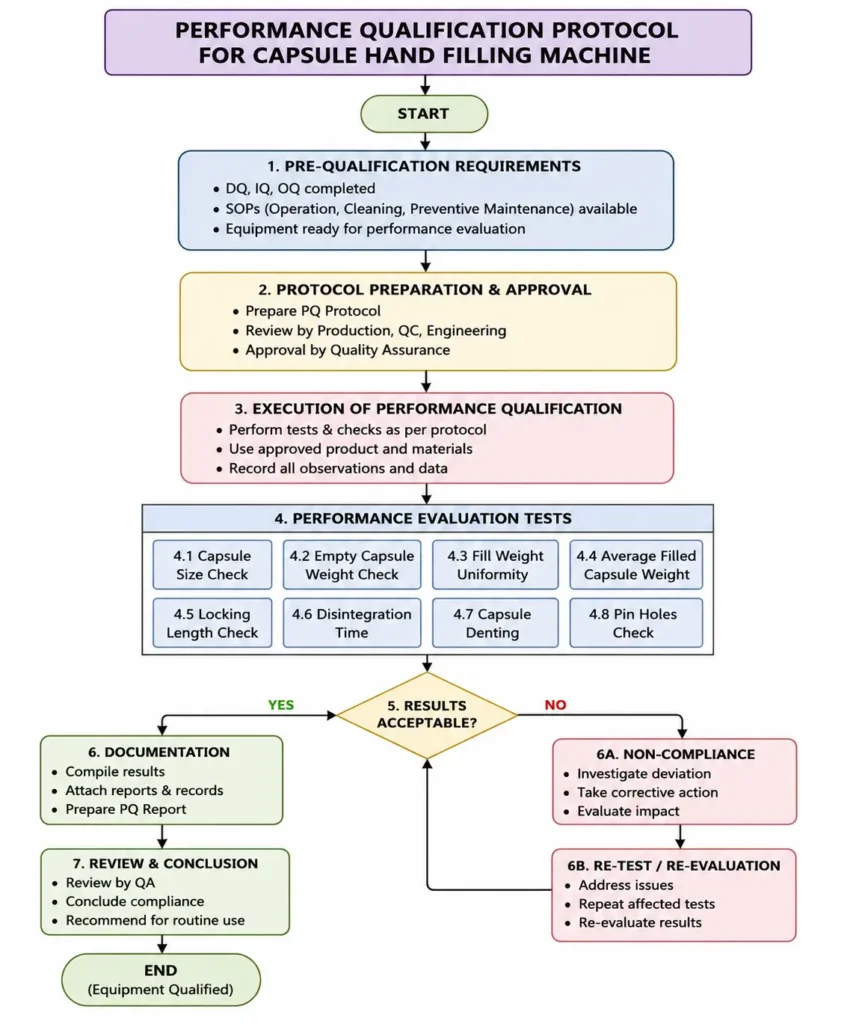
After preparation and approval of the PQ protocol, the qualification activity is executed using the approved product. Machine performance is evaluated by checking capsule size, empty capsule weight, fill weight uniformity, average filled capsule weight, locking length, disintegration time, capsule denting, and pin holes. If the results meet the acceptance criteria, the observations are compiled, reviewed, and a final conclusion and recommendation are prepared. If any result is unacceptable, the deviation is investigated, its impact is assessed, corrective action is taken, and affected tests are repeated before final qualification.
3. Critical Process Parameters & Critical Quality Attributes:
The protocol does not explicitly classify parameters as CPPs and CQAs. However, based on the performance checks and acceptance criteria defined for the Capsule Hand Filling Machine, the following parameters can be considered important for PQ evaluation.
| Critical Process Parameters / Key Process Controls | Critical Quality Attributes |
|---|---|
| Capsule size selected for filling | Correct capsule size |
| Quantity of material filled into each capsule | Uniformity of fill weight |
| Capsule body and cap locking operation | Proper locking length |
| Filling and handling of capsules during operation | Absence of capsule denting |
| Machine handling during filling/closing | Absence of pin holes |
| Consistent filling operation | Average filled capsule weight within limit |
| Proper distribution of fill material | Uniformity of filled capsule weight |
| Correct capsule closing and assembly | Acceptable physical appearance |
| Proper processing of filled capsules | Satisfactory de-dusting and polishing |
| Consistent capsule filling and closing | Disintegration time within product specification |
Important CQAs
The main quality attributes specifically evaluated during PQ are:
- Uniformity of fill weight
- Average weight of filled capsules
- Uniformity of filled capsule weight
- Locking length
- Disintegration time
- Physical appearance
- Capsule denting
- Pin holes
- De-dusting and polishing conditions
These attributes help demonstrate that the Capsule Hand Filling Machine can consistently produce properly filled capsules meeting predetermined product requirements.
4. Impact Assessment:
The Performance Qualification of the Capsule Hand Filling Machine is important to confirm that the equipment continues to perform consistently after its change of location. The protocol specifically identifies change of location as the reason for qualification and requires completion of DQ, IQ, OQ, and relevant operation, cleaning, and preventive maintenance SOPs before PQ execution. Any improper equipment performance may affect capsule quality, particularly fill weight uniformity, average filled capsule weight, locking length, disintegration time, capsule denting, pin holes, physical appearance, de-dusting, and polishing. These parameters are therefore evaluated during PQ against product-specific acceptance criteria. If any deviation or non-compliance is observed, it must be documented and reported to the Head QA. QA evaluates its impact on machine operation and performance before a final conclusion is made. Successful PQ provides documented assurance that the machine is suitable for routine use and can consistently meet defined product requirements.
5. Questions & Answers:
1. What is the objective of Performance Qualification for the Capsule Hand Filling Machine?
The objective is to provide documented evidence that the machine performs according to defined operational parameters, meets predetermined acceptance criteria, and operates consistently within its operating range.
2. Where is the Capsule Hand Filling Machine installed?
The machine is installed in the Hard Gelatin Capsule Section.
3. What is the reason for carrying out this Performance Qualification?
The stated reason for qualification is change of location of the equipment.
4. Which qualifications must be completed before PQ?
Design Qualification (DQ), Installation Qualification (IQ), and Operational Qualification (OQ) must be completed before starting PQ.
5. Which SOPs should be available before PQ?
The SOP for Operation & Cleaning and the SOP for Preventive Maintenance of the Capsule Hand Filling Machine should be prepared and available.
6. Which departments are involved in Performance Qualification?
Quality Assurance, Production, Quality Control, and Engineering are involved in reviewing, coordinating, monitoring, and supporting PQ activities.
7. What product-related parameters are checked during PQ?
Checks include capsule size, empty capsule weight, fill weight uniformity, average filled capsule weight, locking length, disintegration time, capsule denting, and pin holes.
8. What are the acceptance criteria for filled capsules?
The observed filled-capsule parameters must comply with the limits specified for the respective product, including weight-related parameters, physical appearance, denting, pin holes, de-dusting, polishing, and disintegration time.
9. How often should the equipment be requalified?
The protocol specifies requalification once every two years, after a major breakdown or major modification, and after a change of location.
10. What should be done if a deviation occurs during PQ?
The deviation should be documented and reported to the Head QA. QA should assess its impact on machine operation and performance before the final conclusion is made.
11. What should be done if a change control is required during PQ?
The change should be documented and reported to Head QA, who evaluates its impact on machine operation and performance before finalizing the conclusion.
12. How is the final PQ conclusion made?
The conclusion should clearly state whether acceptance criteria were achieved, describe any deviations and investigations, and support the final recommendation made by representatives of the concerned departments.