







1. Brief Description:
The Post Risk Analysis for the Automatic Vertical Round Bottle Sticker Labeling Machine (Cepha Block) evaluates equipment-related risks after qualification and during its intended use in powder oral dosage manufacturing. The machine is designed for labeling round bottles at approximately 100–120 containers per minute, depending on product and label size. The assessment follows the FMEA methodology in line with ICH Q9 and evaluates potential failure modes using Severity, Occurrence, Detection, and Risk Priority Number (RPN). Key areas assessed include design and installation qualification, reference-document availability, MOC verification, calibration, operational checks, safety features, equipment controls, cleaning, machine speed, and change control. Risks are classified as Critical, Major, Moderate, or Minor, with CAPA required for RPN values above 25. The report also includes risk-control measures, post-action review, summary, conclusion, and final approval by Head-QA.
Skip to PDF content2. Flow Diagram:
The flow diagram presents the systematic Post Risk Analysis process for Automatic Measuring Cup Placement (Cepha Block) using the Failure Mode and Effects Analysis (FMEA) methodology. The process begins by defining the equipment, objective, scope, and risk-assessment approach. The multidisciplinary team includes Quality Assurance, Production, Quality Control, Engineering, and Store, with ICH Q9 used as a key reference.
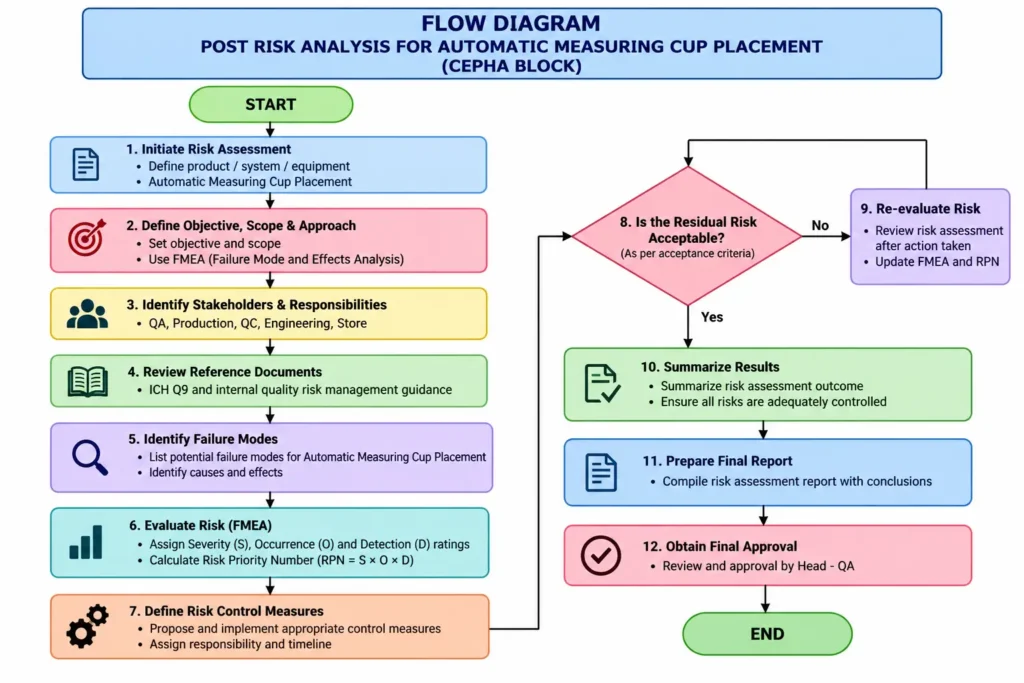
Potential failure modes, their causes, and possible effects are identified and evaluated by assigning Severity (S), Occurrence (O), and Detection (D) ratings. The Risk Priority Number (RPN = S × O × D) is then used to determine the risk level and need for control measures. Risks requiring improvement are controlled through appropriate corrective actions and subsequently re-evaluated. The final stage includes review of residual risk, preparation of the risk-assessment summary and conclusion, documentation of control measures, and final approval by Head-QA, confirming that identified risks are adequately controlled.
3. Brainstorming – Post Risk Analysis for Automatic Measuring Cup Placement (Cepha Block) Not Prepared:
The Post Risk Analysis for Automatic Measuring Cup Placement (Cepha Block) is intended to verify that risks associated with the equipment remain adequately controlled after installation, operation, performance, and safety considerations have been assessed. The approved methodology specified in the document is FMEA (Failure Mode and Effects Analysis), with participation from Quality Assurance, Engineering, Production, Quality Control, and Store.
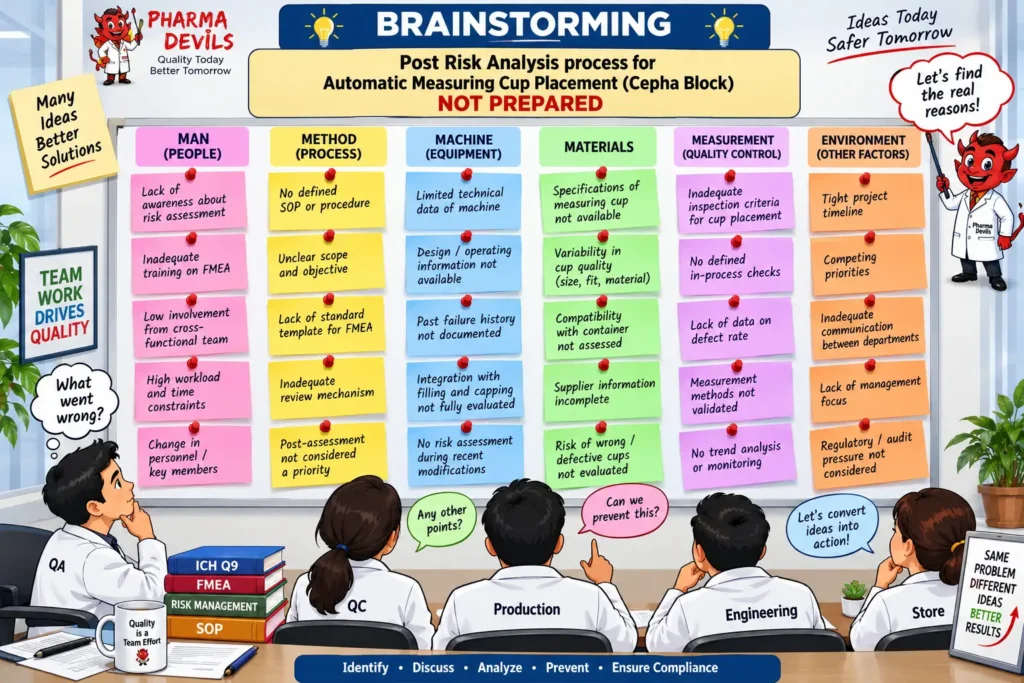
If the post-risk analysis is not prepared, identified failure modes may not be formally reassessed, residual risks may remain undocumented, and the effectiveness of existing control measures may not be demonstrated. This can result from inadequate FMEA knowledge, unclear responsibility, incomplete technical information, insufficient cross-functional involvement, or lack of timely review. The FMEA process requires evaluation of Severity, Occurrence, Detection, and RPN, followed by suitable risk-control actions where required. Therefore, the post-risk analysis should be completed, reviewed, documented, and approved to provide evidence that remaining risks are acceptable and adequately controlled.
4. 5-Why Analysis – Post Risk Analysis Not Done:
The 5-Why Analysis identifies the underlying reasons why the Post Risk Analysis for Automatic Measuring Cup Placement (Cepha Block) was not completed. The analysis starts with the immediate issue—post-risk analysis was not planned or initiated—and progressively examines contributing causes such as unclear responsibility, weak cross-functional communication, absence of a defined SOP or timeline, and inadequate implementation of the risk-management system. The concerned functions for the risk assessment include Quality Assurance, Production, Quality Control, Engineering, and Store.
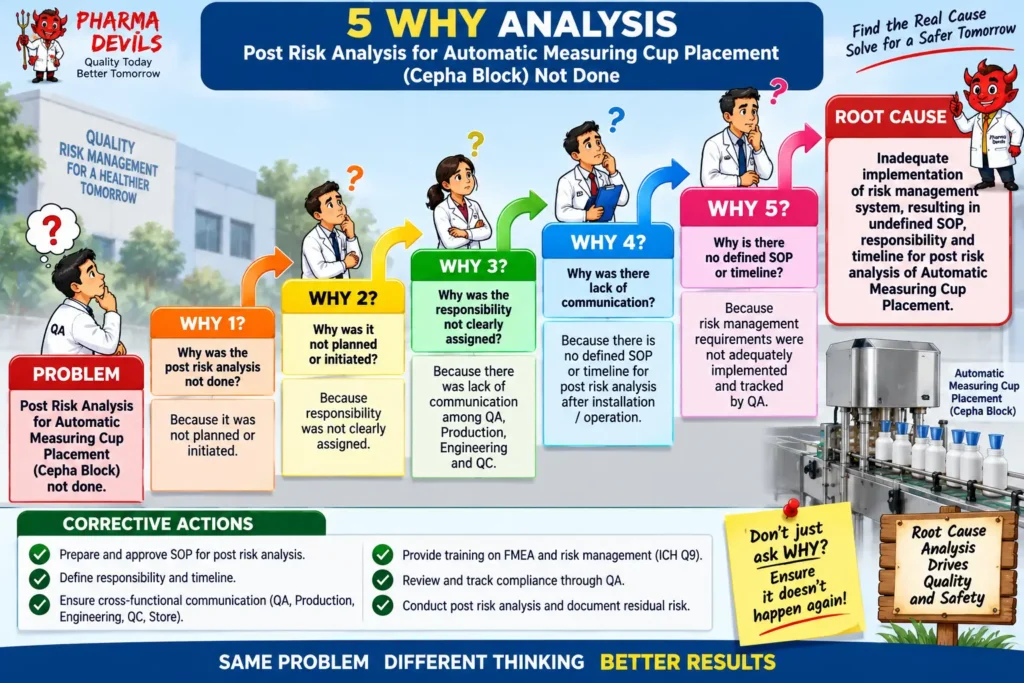
The root cause is concluded as insufficient implementation and tracking of the post-risk assessment process by QA. Corrective actions include establishing a defined procedure and timeline, assigning responsibilities, strengthening communication between departments, providing FMEA/risk-management training, conducting the pending post-risk analysis, and documenting residual risk. This approach helps ensure that equipment-related risks are formally reviewed and controlled.
5. Heat Map (FMEA) Post Risk Analysis for Automatic Vertical Round Bottle Sticker Labelling Machine Not Done:
The Post Risk Analysis for the Automatic Vertical Round Bottle Sticker Labelling Machine is required to confirm that risks identified during design, installation, operation, performance, and routine use remain adequately controlled. If the post-risk analysis is not completed, residual risks related to incorrect label placement, missing labels, label misalignment, wrong label application, sensor malfunction, speed variation, bottle handling, rejection-system failure, and operator error may remain unidentified or undocumented.
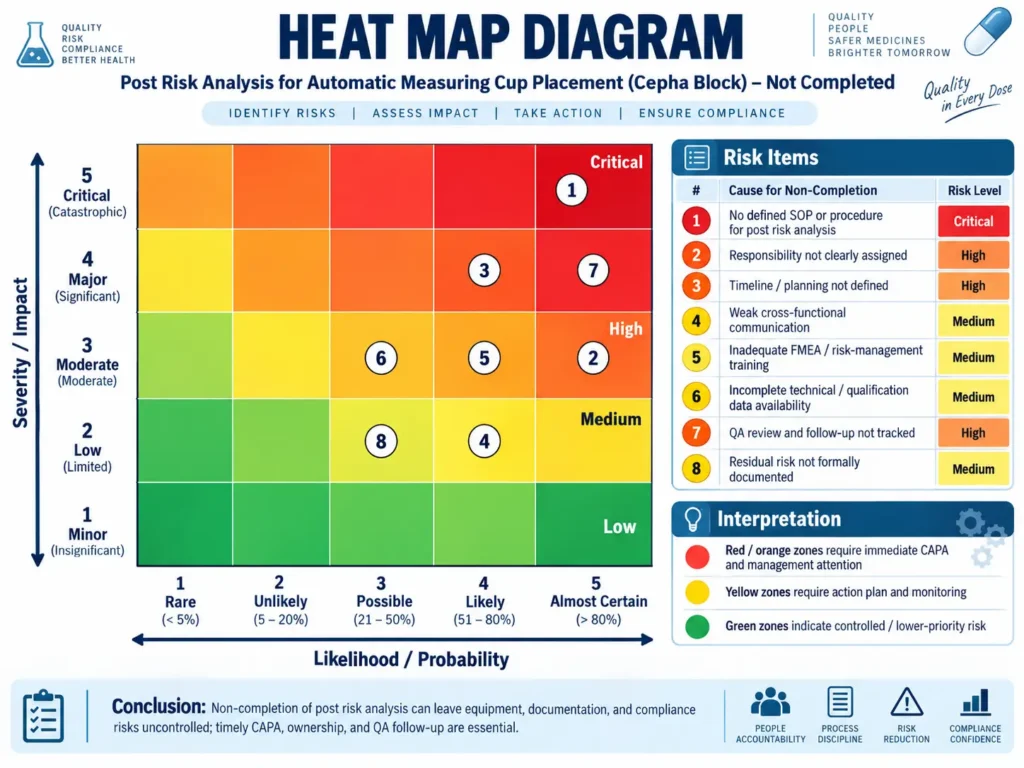
Non-completion may also result in inadequate evaluation of existing control measures and lack of evidence that the machine continues to operate within acceptable GMP requirements. The assessment should review potential failure modes using a suitable risk-management tool such as FMEA, evaluate Severity, Occurrence, and Detection, calculate the RPN, and identify any additional CAPA where required. Completion of the post-risk analysis helps ensure label accuracy, traceability, product identification, process reliability, patient safety, and regulatory compliance.
Critical Process Parameters (CPP) & Critical Quality Attributes (CQA)
Automatic Vertical Round Bottle Sticker Labelling Machine
| Critical Process Parameters (CPP) | Purpose / Risk if Not Controlled |
|---|---|
| Machine / conveyor speed | Controls synchronization and consistent label application |
| Label dispensing speed | Prevents label stretching, wrinkles, or incorrect placement |
| Bottle spacing / feed rate | Ensures one bottle is presented correctly at the labelling station |
| Label sensor sensitivity | Ensures accurate detection and dispensing of each label |
| Product/bottle sensor sensitivity | Detects bottle presence and initiates label application |
| Label position setting | Maintains specified label location on the bottle |
| Dispensing delay / timing | Synchronizes bottle movement with label release |
| Applicator roller / belt pressure | Ensures proper adhesion without damaging the bottle or label |
| Applicator belt speed | Prevents skewing and supports uniform wrapping |
| Label web tension | Prevents label misfeeding, tearing, or wrinkling |
| Bottle guide / alignment setting | Maintains correct bottle orientation during labelling |
| Coding / printing parameters, where applicable | Ensures batch number, Mfg./Exp. date and other variable data are correctly printed |
| Reject system setting | Removes bottles with missing or unacceptable labels |
| Machine interlock / alarm settings | Prevents operation under abnormal or unsafe conditions |
Critical Quality Attributes
| Critical Quality Attributes (CQA) | Expected Requirement |
|---|---|
| Correct label | Approved label corresponding to the correct product and batch |
| Label presence | Every acceptable bottle shall have the required label |
| Label position | Label applied within the approved positional specification |
| Label alignment | Label should be straight, properly centered and not skewed |
| Label adhesion | Label firmly adhered without lifting or peeling |
| Wrinkle-free application | No unacceptable wrinkles, folds, bubbles or creases |
| Label integrity | No torn, damaged or mutilated labels |
| Printed information accuracy | Batch No., Mfg. Date, Exp. Date, MRP, etc. correct, where applicable |
| Print legibility | Variable and fixed information clear and readable |
| Barcode / 2D code readability | Code correctly printed and scannable, where applicable |
| Product identity | Label information matches the packed product |
| Bottle appearance | Bottle not damaged, scratched or deformed during labelling |
| Rejection effectiveness | Missing, wrongly labelled or defective units reliably rejected |
| Traceability | Label and coding information provides correct batch identification |
Questions & Answers:
- Q: What is the purpose of the post risk analysis?
A: To assess risks associated with the Automatic Vertical Round Bottle Sticker Labeling Machine after qualification and confirm that the system can consistently support product quality and safety. - Q: Which risk assessment methodology is used?
A: FMEA — Failure Mode and Effects Analysis. - Q: Which guideline is referenced for the risk assessment?
A: ICH Q9 – Quality Risk Management. - Q: Which departments are responsible for the assessment?
A: Quality Assurance, Engineering, Production, Quality Control, and Store. - Q: What is the approximate labeling capacity of the machine?
A: Approximately 100–120 containers per minute, depending on product and label size. - Q: Which parameters are used to calculate the Risk Priority Number?
A: Severity (S), Occurrence (O), and Detection (D); RPN = S × O × D. - Q: When is an RPN classified as Critical?
A: An RPN of 76 or above is classified as Critical and requires CAPA. - Q: What is the Major-risk RPN range?
A: 51–75, and CAPA is required. - Q: What happens if Design Qualification documentation is inadequate?
A: The equipment may not function as intended, cGMP requirements may not be met, safety requirements may be unclear, and major components may be missed. - Q: What control is specified for inadequate DQ documentation?
A: URS preparation by experienced personnel and DQ verification by QA, Engineering, and the user department against the URS. - Q: What risk is associated with inadequate Installation Qualification documentation?
A: Inadequate installation may result, affecting proper equipment performance. - Q: What is the risk if MOC verification is not performed during IQ?
A: Product contamination may occur. The document records an RPN of 56 for this risk. - Q: What is the risk if calibrated measuring instruments are unavailable?
A: Installation may be improper and the equipment may not perform as intended. - Q: What happens if IQ is not completed before OQ?
A: OQ cannot proceed. - Q: What may happen if adequate safety features are not provided?
A: An accident may occur. - Q: What is the risk if equipment control-function verification is not performed?
A: The equipment may not function as desired. - Q: What is the risk if the machine is not cleaned properly?
A: Product contamination may occur. - Q: What control is available for machine speed?
A: The activity is to be performed by trained personnel according to the SOP. - Q: What is reviewed after actions are taken?
A: Action taken, Severity, Occurrence, Detectability, RPN, and remarks are reviewed. - Q: Who gives final approval to the risk assessment report?
A: Head-QA provides the final approval after the identified risks and control measures have been reviewed and found acceptable.