





1. Introduction:
The Batch Manufacturing Record (BMR) of Povidone-Iodine Solution IP serves as a comprehensive guideline to ensure consistency, quality, and compliance in pharmaceutical production. This document outlines the step-by-step process, beginning with raw material requisition, equipment clearance, and environmental controls, followed by detailed manufacturing instructions. Povidone-Iodine, a widely used antiseptic, is formulated at 5% w/v concentration, providing 0.5% available iodine, with purified water as the main diluent. The BMR emphasizes adherence to Good Manufacturing Practices (GMP), safety precautions, and strict monitoring of parameters such as pH, temperature, and yield. The record highlights the importance of line clearance, equipment cleanliness, and verification of raw material quantities to prevent cross-contamination and ensure product integrity. Each stage, from dispensing to homogenization, pH adjustment, and final bulk transfer, is documented with checks by production and quality assurance teams. The process ensures that the final product is a dark brown, clear solution free from foreign matter, meeting the required specifications. By maintaining detailed records of operations, in-process checks, and deviations, the BMR not only guarantees product quality but also provides traceability and accountability. This structured approach safeguards patient safety while supporting regulatory compliance in pharmaceutical manufacturing.
Skip to PDF content2. Flow Diagram:
The Flow Diagram of Povidone-Iodine Solution Manufacturing Process visually represents each stage of production, ensuring clarity and compliance with pharmaceutical standards. The process begins with Raw Material Requisition, where all ingredients such as Povidone-Iodine, Glycerine, PEG-6000, Sodium Bicarbonate, and Purified Water are verified and dispensed according to the batch record. Next, Line Clearance and Equipment Cleaning ensure that the area and tools are free from contaminants.
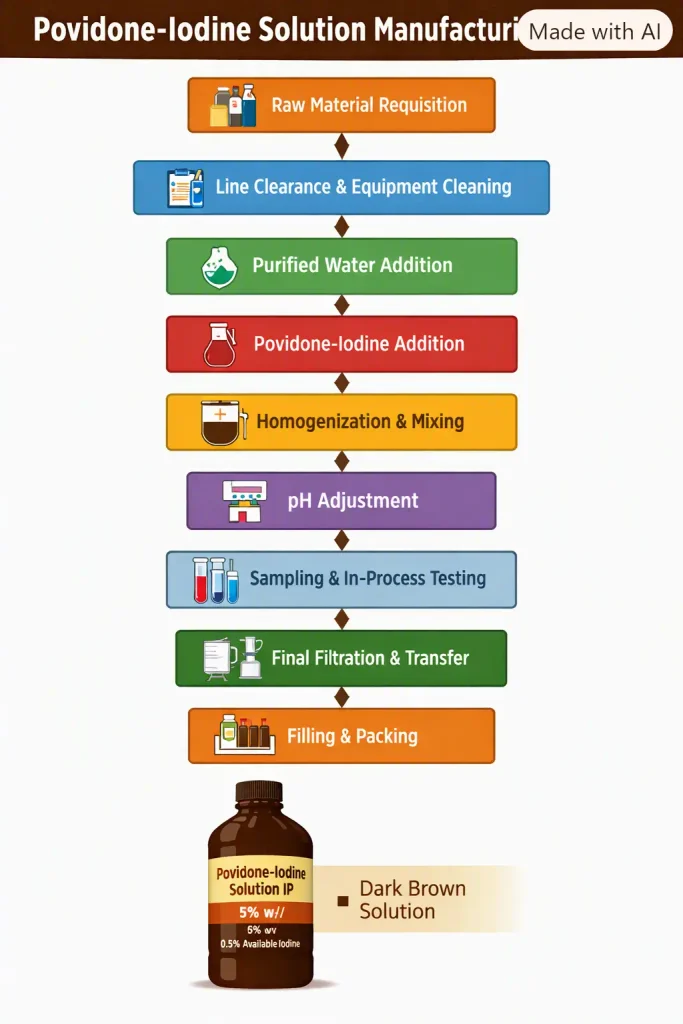
Following this, Purified Water Addition initiates the formulation, succeeded by Povidone-Iodine Addition and Homogenization & Mixing, which create a uniform solution. The pH Adjustment step is critical to maintain the product within the specified range of 4.5–5.5. Afterward, Sampling and In-Process Testing confirm the solution’s quality and consistency. The process concludes with Final Filtration & Transfer into stainless steel containers and Filling & Packing of the finished product. This systematic flow ensures that the final output — a dark brown, clear antiseptic solution — meets all quality assurance parameters, maintaining efficacy and safety for medical use.
3. CPP and CQA:
The CPP and CQA Diagram for Povidone-Iodine Solution IP illustrates the vital relationship between process control and product quality in pharmaceutical manufacturing. CPP (Critical Process Parameters) represent the key operational conditions that must be monitored and maintained to ensure consistent product output. These include pH level (4.5–5.5), mixing speed, temperature, addition sequence, filtration process, and batch size & timing. Each parameter directly influences the chemical stability, clarity, and uniformity of the solution.
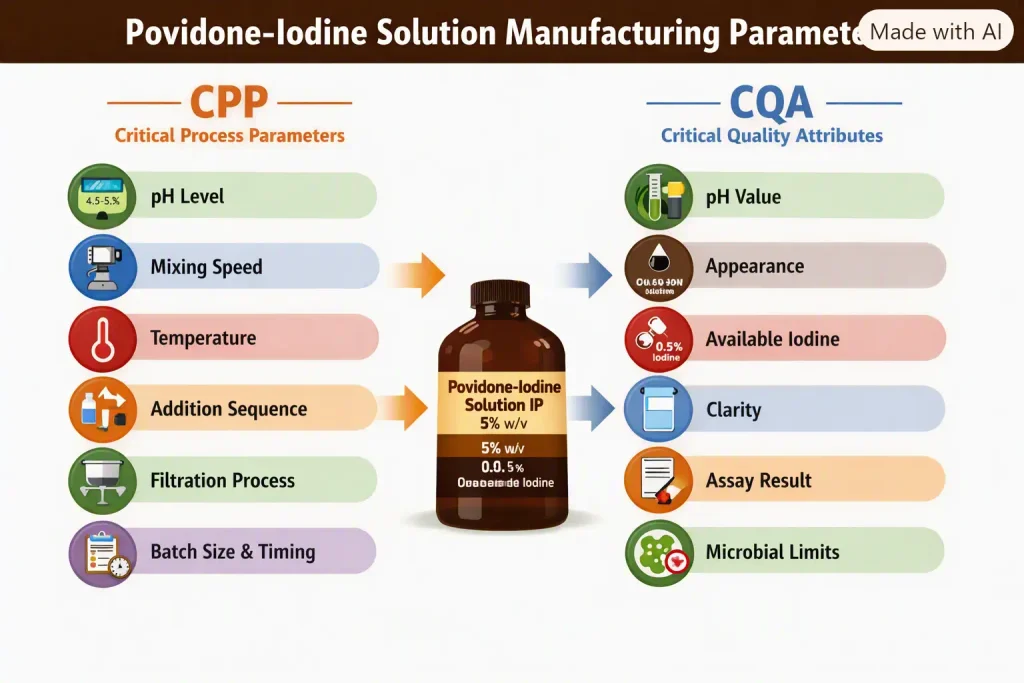
On the other hand, CQA (Critical Quality Attributes) define the measurable characteristics that determine the product’s final quality. These include appearance (dark brown clear solution), available iodine content (0.5%), clarity, assay results, and microbial limits. Maintaining these attributes ensures the antiseptic’s effectiveness and safety. Together, CPP and CQA form a robust framework for Quality by Design (QbD), ensuring that every batch of Povidone-Iodine Solution meets regulatory standards and therapeutic expectations. This visual representation highlights how precise control of process parameters leads to reliable and high-quality pharmaceutical outcomes.