







1. Introduction to Povidone-Iodine Solution IP – Batch Manufacturing Record (BMR):
Povidone-Iodine Solution IP is a widely used antiseptic preparation containing povidone-iodine, an iodine-releasing complex known for its broad-spectrum antimicrobial activity against bacteria, fungi, viruses, and certain other microorganisms. It is commonly used for skin antisepsis, wound cleansing, and preparation of the skin before medical and surgical procedures, as directed in the approved product labeling. The Batch Manufacturing Record (BMR) for Povidone-Iodine Solution IP provides a systematic and documented procedure for manufacturing the solution in accordance with Good Manufacturing Practices (GMP) and applicable quality standards. As specified in the attached BMR, the formulation contains Povidone-Iodine IP 5% w/v, equivalent to 0.5% w/v available iodine, along with purified water and formulation ingredients such as glycerine, PEG-6000, and sodium bicarbonate. The manufacturing process includes raw material dispensing, equipment and area clearance, dissolution of povidone-iodine, controlled mixing, pH adjustment, addition of excipients, final volume adjustment, and in-process quality control testing. Critical quality checks include the solution’s appearance, pH, homogeneity, and absence of visible foreign matter. The expected physical appearance is a dark brown, clear solution. The BMR also includes provisions for recording manufacturing activities, equipment identification, material verification, processing times, quality assurance checks, yield reconciliation, and batch documentation. Proper implementation of this BMR supports product consistency, traceability, regulatory compliance, and reproducible manufacturing quality, ensuring that each batch is manufactured and documented under established pharmaceutical quality systems.
Skip to PDF content1. Flow Diagram – Manufacturing Process of Povidone-Iodine Solution IP (BMR):
The manufacturing flow diagram of Povidone-Iodine Solution IP illustrates the sequential steps involved in the preparation, processing, quality control, and handling of the antiseptic solution in accordance with Good Manufacturing Practices (GMP).The process begins with line clearance, equipment cleaning, and verification of raw materials, including Povidone-Iodine IP, Purified Water IP, Glycerine, PEG-6000, and Sodium Bicarbonate. Initially, purified water is transferred into the manufacturing vessel, followed by the addition of povidone-iodine under continuous stirring and homogenization until a clear solution is obtained. Sodium bicarbonate solution is subsequently prepared and added for pH adjustment. PEG-6000 and glycerine are separately dissolved in purified water and incorporated into the bulk solution with controlled mixing.
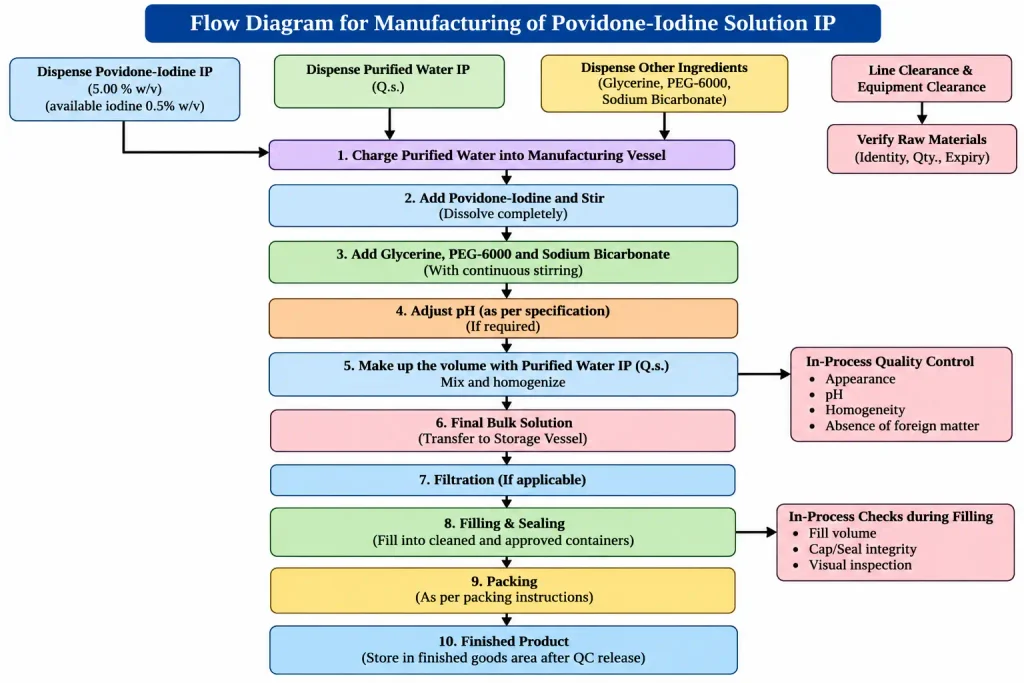
The final volume is adjusted using Purified Water IP, followed by mixing to obtain a homogeneous solution. In-process quality control checks include verification of pH, physical appearance, homogeneity, and absence of visible foreign particles. The finished bulk should appear as a dark brown, clear solution. Following satisfactory quality checks, the bulk solution is transferred into a stainless steel storage vessel. Subsequent filling, sealing, packing, and finished-product release activities are performed according to approved procedures. This flow diagram supports process standardization, batch traceability, quality assurance, and GMP compliance throughout the manufacturing operation.
2. Critical Process Parameters (CPP) and Critical Quality Attributes (CQA) of Povidone-Iodine Solution IP:
Critical Process Parameters (CPP) and Critical Quality Attributes (CQA) are essential elements in the manufacturing and quality assurance of Povidone-Iodine Solution IP. Their identification and effective control help ensure consistent product quality, safety, and compliance with Good Manufacturing Practices (GMP).
Critical Process Parameters (CPP)
The manufacturing process involves several important parameters, including raw material dispensing accuracy, purified water quality, mixing time, stirring conditions, temperature control, pH adjustment, and final volume adjustment. Povidone-iodine must be properly dissolved in purified water through controlled stirring and homogenization to obtain a uniform solution. Sodium bicarbonate is used for pH adjustment, while PEG-6000 and glycerine are incorporated according to the manufacturing procedure.

The attached BMR specifies a pH acceptance limit of 4.50–5.50, mixing periods of 15–30 minutes at specified stages, and a final batch volume adjustment to 10 litres. These parameters require appropriate monitoring and documentation. Their formal classification as CPPs should be supported by process risk assessment and validation.
Critical Quality Attributes (CQA)
The important quality attributes of Povidone-Iodine Solution IP include:
- Appearance: Dark brown, clear solution free from visible foreign matter.
- Available Iodine: The labeled concentration is 0.5% w/v.
- pH: Compliance with the approved product specification.
- Homogeneity: Uniform distribution of ingredients throughout the solution.
- Assay and Identity: Compliance with applicable approved specifications.
- Microbial Quality: Compliance with relevant microbiological requirements.
- Stability: Maintenance of acceptable product quality throughout the approved shelf life.
Importance of CPP and CQA Monitoring
Effective control of process parameters and verification of quality attributes help prevent manufacturing deviations, product inconsistencies, and quality failures. The integration of CPP and CQA monitoring into the Batch Manufacturing Record (BMR) supports process reproducibility, quality risk management, batch traceability, and regulatory compliance.
Note: The infographic includes illustrative values for certain operating conditions and quality attributes. These should not be treated as validated acceptance limits. The approved BMR, current IP monograph, finished-product specifications, and process validation data must govern actual manufacturing and release decisions.