






1. Introduction – Precaution to Be Taken in the Event of Power Breakdown:
The “Precaution to Be Taken in the Event of Power Breakdown” SOP provides a systematic procedure for protecting pharmaceutical products, in-process materials, equipment, and controlled manufacturing conditions during an unexpected interruption of electrical power. The procedure is applicable to Production personnel and describes the immediate precautions to be followed during a power failure. During a power breakdown, unnecessary movement should be avoided. If the interruption continues for more than 10 minutes, the temperature and humidity of the affected area should be checked and recorded in the Batch Manufacturing Record, and containers containing materials under processing should be properly covered. The SOP also provides specific precautions for wet granulation, coating operations, and liquid filling. After restoration of power, equipment and utilities are restarted in a controlled manner, including operation of the AHU before resuming manufacturing activities. For prolonged interruption in liquid filling, product sampling and QC confirmation may be required before filling is restarted. Following this SOP helps maintain product quality, environmental control, process continuity, GMP compliance, and protection of in-process materials during power-failure situations.
Skip to PDF content2. Flow Diagram – Precaution to Be Taken in the Event of Power Breakdown:
The SOP “Precaution to Be Taken in the Event of Power Breakdown” describes the actions required to protect product quality, in-process materials, equipment, and manufacturing conditions during an unexpected power failure. The procedure requires personnel to avoid unnecessary movement during the breakdown. If the failure exceeds 10 minutes, area temperature and humidity should be checked and recorded in the Batch Manufacturing Record, and containers containing material under processing should be covered,
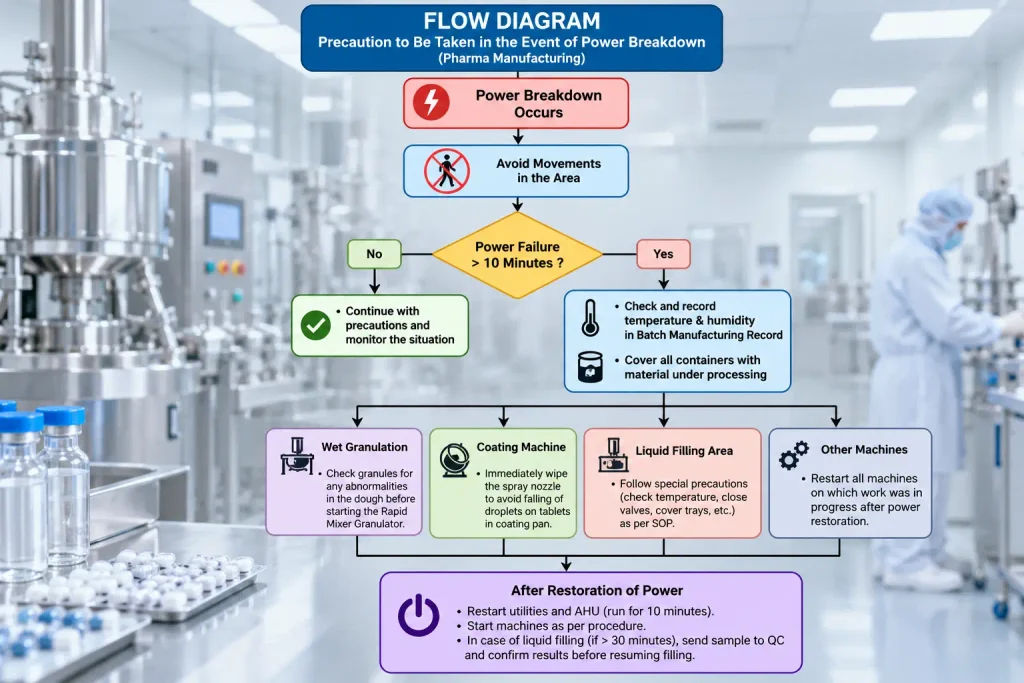
Specific precautions are defined for wet granulation, coating, and liquid filling operations. Granules should be checked for abnormalities before restarting the Rapid Mixer Granulator, while the coating spray nozzle should be wiped to prevent droplets from falling on tablets For liquid filling, temperature monitoring, closure of valves and trays, controlled re-entry, restarting utilities and AHU, recirculation of suspension, and QC testing after prolonged interruption are required before production resumes.
3. Benefits of Following SOP – Precaution to Be Taken in the Event of Power Breakdown:
Following the SOP “Precaution to Be Taken in the Event of Power Breakdown” helps ensure that pharmaceutical manufacturing activities remain controlled and that in-process materials are protected during an unexpected interruption of electrical power. The SOP requires restriction of unnecessary movement, monitoring of temperature and humidity during extended power failure, and proper covering of materials under processing.
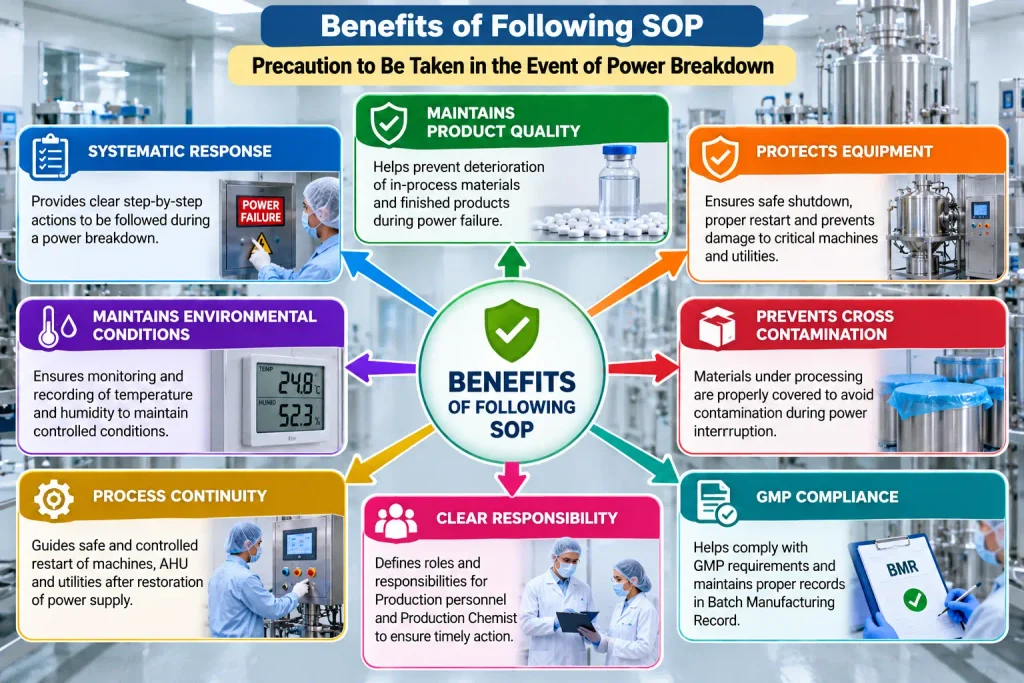
The procedure also provides equipment-specific precautions for wet granulation, coating, and liquid filling operations. These controls help reduce the risk of product deterioration, contamination, abnormal processing conditions, and equipment-related problems, After restoration of power, the SOP guides personnel to restart utilities, operate the AHU before resuming work, restart processing equipment in a controlled manner, and perform additional QC verification when required.following this SOP supports product quality, environmental control, equipment protection, process continuity, proper documentation, defined responsibilities, and GMP compliance during power breakdown situations.
4. Brainstorming for SOP Failure – Precaution to Be Taken in the Event of Power Breakdown:
The brainstorming analysis for the SOP “Precaution to Be Taken in the Event of Power Breakdown” identifies possible causes that may lead to ineffective control during an electrical power failure. The SOP requires personnel to restrict unnecessary movement, monitor temperature and humidity when the failure exceeds 10 minutes, protect in-process materials, and restart equipment in a controlled manner after power restoration. Potential failure causes include lack of operator awareness, delayed action, improper communication, incomplete monitoring, failure to cover materials, equipment restart errors, loss of utilities, and inadequate documentation. Special attention is required for wet granulation, coating, and liquid filling operations because interruption may affect granule condition, spray-nozzle performance, suspension quality, and filling suitability,
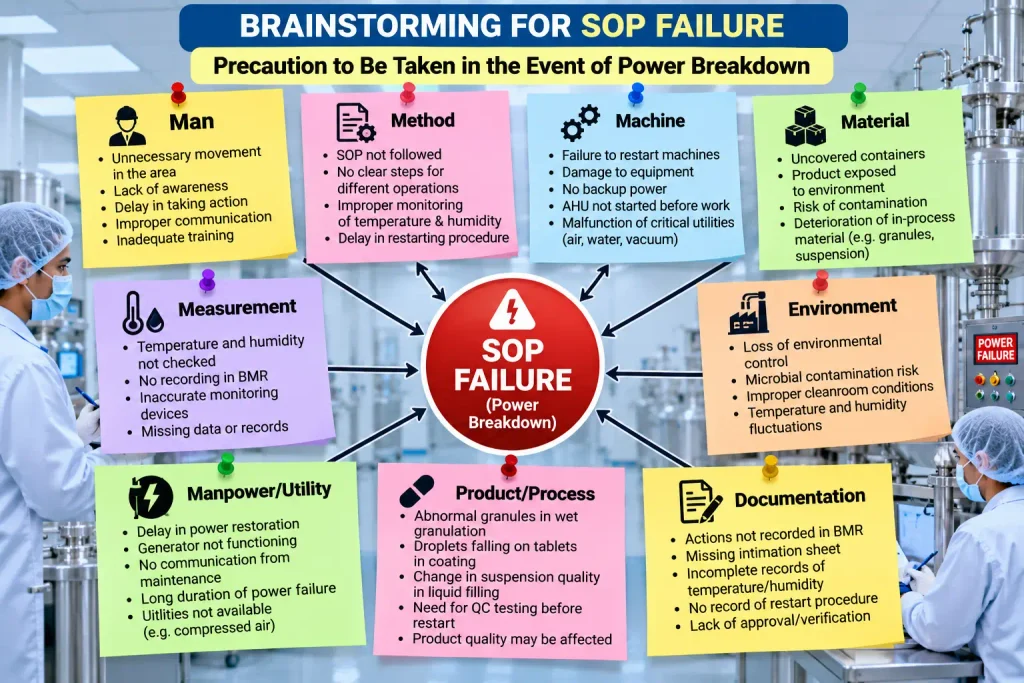
For prolonged interruption in liquid filling, the SOP requires controlled restoration of utilities, AHU operation, recirculation of suspension, and QC testing when specified before filling is resumed. Brainstorming these potential failures helps identify weaknesses in manpower, method, machine, material, measurement, environment, utilities, process control, and documentation, allowing appropriate preventive actions to be established before an actual power-breakdown event occurs.
5. 5-Why Analysis for SOP Failure – Precaution to Be Taken in the Event of Power Breakdown:
The 5-Why Analysis for failure of the SOP “Precaution to Be Taken in the Event of Power Breakdown” helps identify the underlying reasons why required precautions may not be followed during a power interruption. The SOP requires personnel to avoid unnecessary movement, monitor temperature and humidity when the failure exceeds 10 minutes, protect materials under processing, and follow defined restart precautions after power restoration.
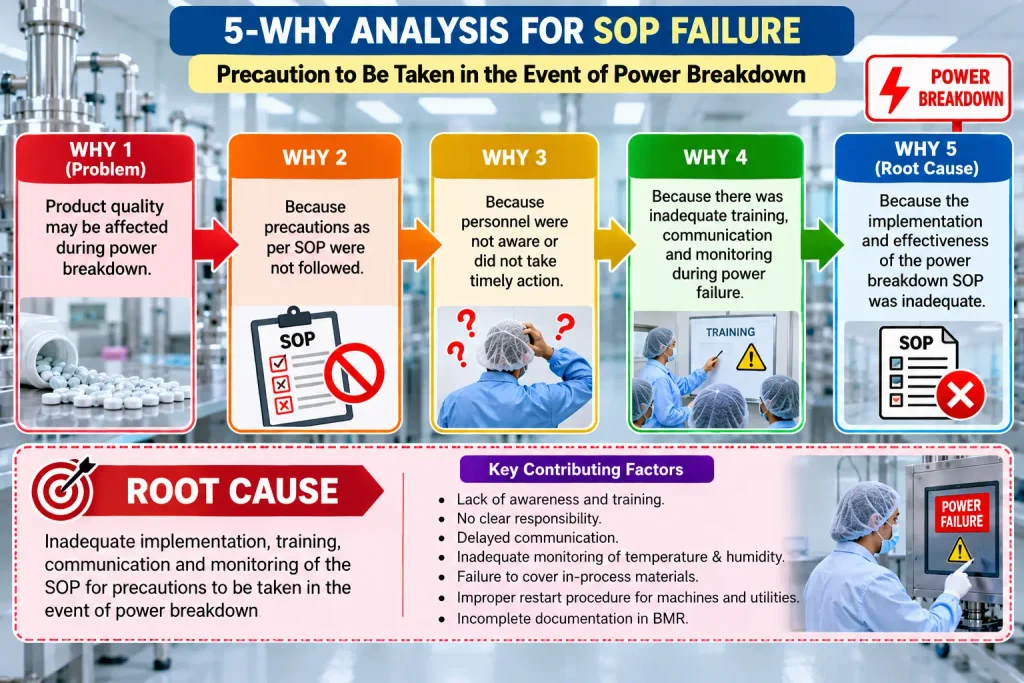
The analysis starts with the problem that product quality may be affected during a power breakdown. This may occur because specified SOP precautions were not followed, personnel did not take timely action, or there was insufficient awareness, communication, training, or monitoring. These weaknesses can lead to delayed environmental checks, uncovered in-process materials, improper machine restart, or incomplete documentation.The SOP gives additional controls for liquid filling, including temperature monitoring, closure of trays and valves during prolonged failure, restarting the AHU before resuming work, recirculation of suspension, and QC testing when power is not restored within the specified period. Therefore, the probable root cause of SOP failure is inadequate implementation and effectiveness of the procedure, supported by insufficient training, communication, monitoring, and compliance verification. The 5-Why analysis helps management establish focused CAPA to prevent recurrence.
6. Fishbone Analysis for SOP Failure – Precaution to Be Taken in the Event of Power Breakdown:
The Fishbone Analysis for failure of the SOP “Precaution to Be Taken in the Event of Power Breakdown” is used to identify the different categories of causes that may contribute to ineffective control during a power interruption. The SOP requires personnel to avoid unnecessary movement, monitor temperature and humidity when the failure exceeds 10 minutes, protect in-process materials, and restart operations in a controlled manner after restoration of power. The analysis considers possible causes related to Man, Method, Machine, Material, Measurement, Environment, Utilities, and Documentation. Examples include inadequate training, delayed response, failure to follow the procedure, equipment restart problems, uncovered materials, absence of temperature and humidity monitoring, loss of environmental control, delayed utility restoration, and incomplete recording in the Batch Manufacturing Record.
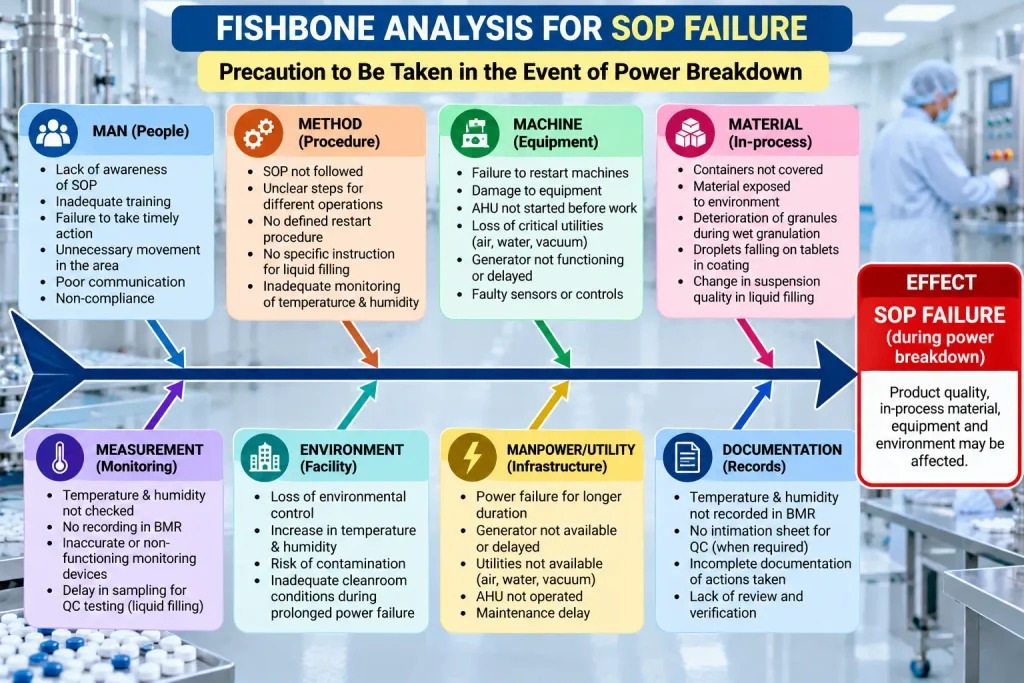
Special attention is required for wet granulation, coating, and liquid filling because power interruption may affect granule condition, spray nozzle performance, suspension quality, and continuation of the filling process. The SOP further requires controlled restart of utilities and AHU, recirculation of suspension, and QC confirmation after prolonged interruption where applicable. Therefore, the Fishbone Analysis helps systematically identify potential causes of SOP failure so that suitable corrective and preventive actions can be established to protect product quality, equipment, process conditions, and GMP compliance.
7. Fault Tree Analysis for SOP Failure – Precaution to Be Taken in the Event of Power Breakdown:
The Fault Tree Analysis (FTA) for the SOP “Precaution to Be Taken in the Event of Power Breakdown” evaluates how different failures can combine to affect product quality, in-process materials, equipment, and controlled manufacturing conditions during a power interruption. The SOP requires personnel to avoid unnecessary movement, monitor temperature and humidity during prolonged failure, protect materials under processing, and restart equipment in a controlled manner after power restoration. The top event is failure to adequately control the manufacturing process during a power breakdown. This may occur due to personnel not taking timely action, equipment or utilities not being properly managed, in-process materials not being protected, or environmental conditions not being maintained.
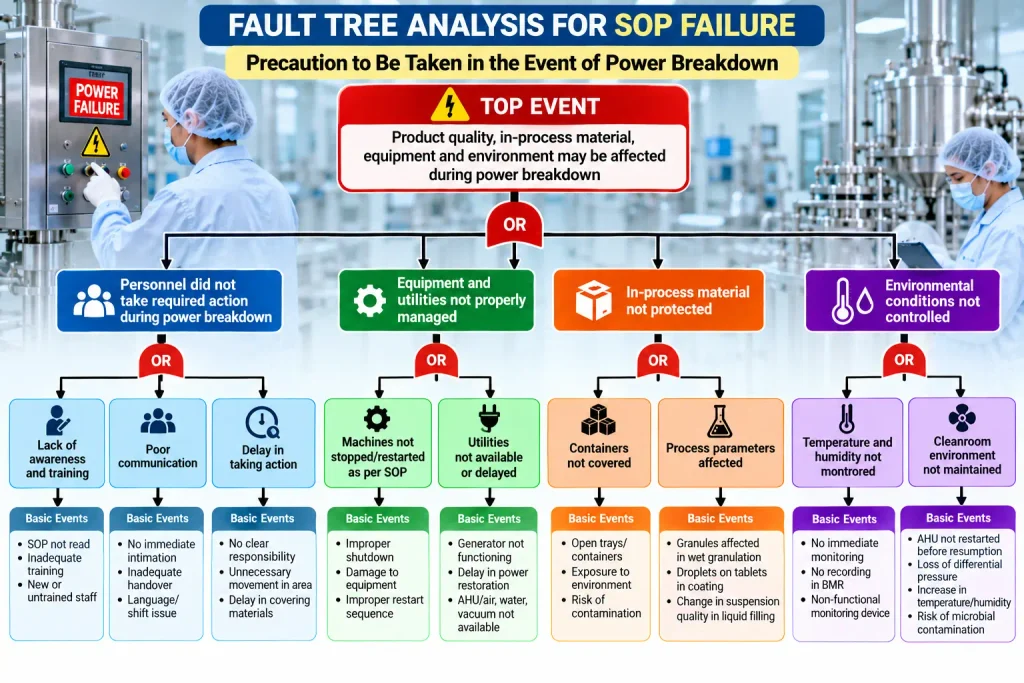
Basic events may include lack of training or awareness, poor communication, delayed action, improper machine restart, delayed utility restoration, uncovered containers, abnormal granules, coating spray issues, suspension-quality changes, and failure to monitor or document temperature and humidity. The SOP specifically requires special precautions for wet granulation, coating, and liquid filling operations. After power restoration, the SOP requires utilities and AHU to be restarted appropriately, the suspension to be recirculated, and QC confirmation to be obtained where the defined interruption period is exceeded. FTA helps identify the individual and combined failure pathways that can lead to SOP failure and supports development of effective CAPA, training, monitoring, documentation, and preventive controls.
8. Impact Assessment – Precaution to Be Taken in the Event of Power Breakdown:
The Impact Assessment for the SOP “Precaution to Be Taken in the Event of Power Breakdown” evaluates the possible consequences if required precautions are not followed during an electrical power interruption. The SOP specifically requires restricted movement, monitoring of temperature and humidity during extended failure, covering of materials under processing, and controlled restart of equipment after power restoration.
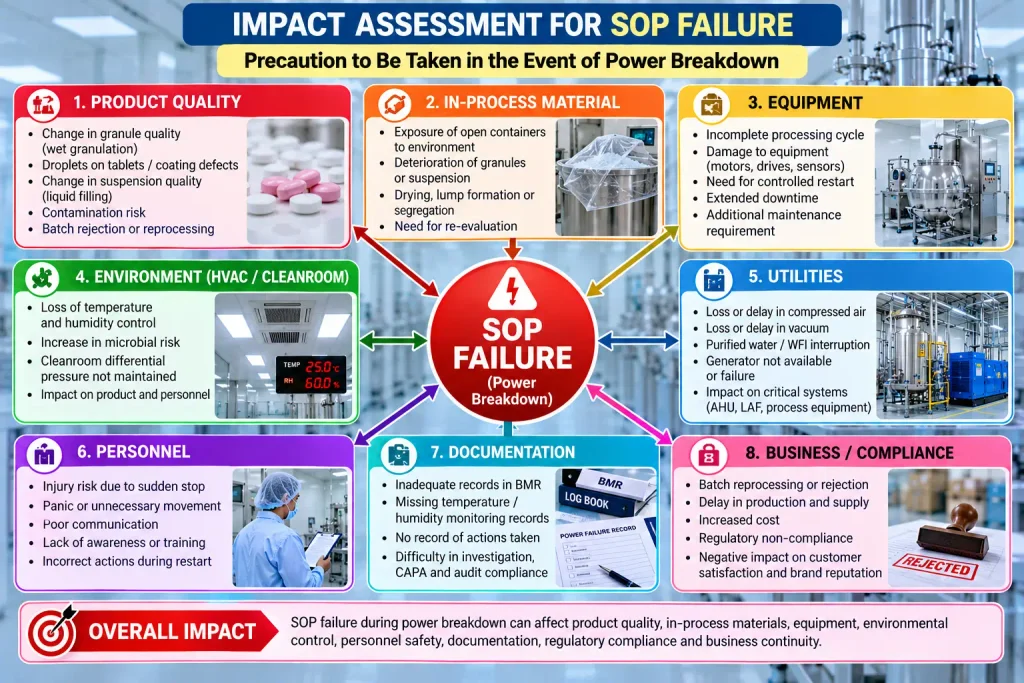
Failure to follow these controls can affect product quality, in-process materials, equipment, environmental conditions, utilities, personnel activities, and documentation. Wet granulation may show abnormalities in granules, coating operations may be affected by spray-nozzle droplets, and liquid filling may require additional controls because suspension conditions can change during prolonged interruption. The SOP also requires the AHU to be operated before work resumes, suspension to be recirculated, and QC testing to be performed when the specified interruption period is exceeded. Therefore, inadequate implementation of this SOP may result in product-quality risk, process disruption, delayed production, equipment-related issues, incomplete records, additional testing, and possible batch rejection or reprocessing, depending on the duration and impact of the power breakdown.
9. CAPA for SOP Failure – Precaution to Be Taken in the Event of Power Breakdown:
The Corrective and Preventive Action (CAPA) for failure of the SOP “Precaution to Be Taken in the Event of Power Breakdown” should focus on restoring control immediately and preventing recurrence. The SOP requires personnel to avoid unnecessary movement, monitor temperature and humidity during prolonged power failure, cover in-process materials, and restart equipment and utilities in a controlled manner. Corrective actions may include reviewing the incident, assessing the impact on product and in-process material, checking and documenting environmental conditions, protecting exposed materials, ensuring proper restart of machines and utilities, and performing QC testing where required before resuming filling operations. For liquid filling, the SOP specifies restart of utilities and AHU, recirculation of suspension, and QC confirmation when the defined interruption period is exceeded.
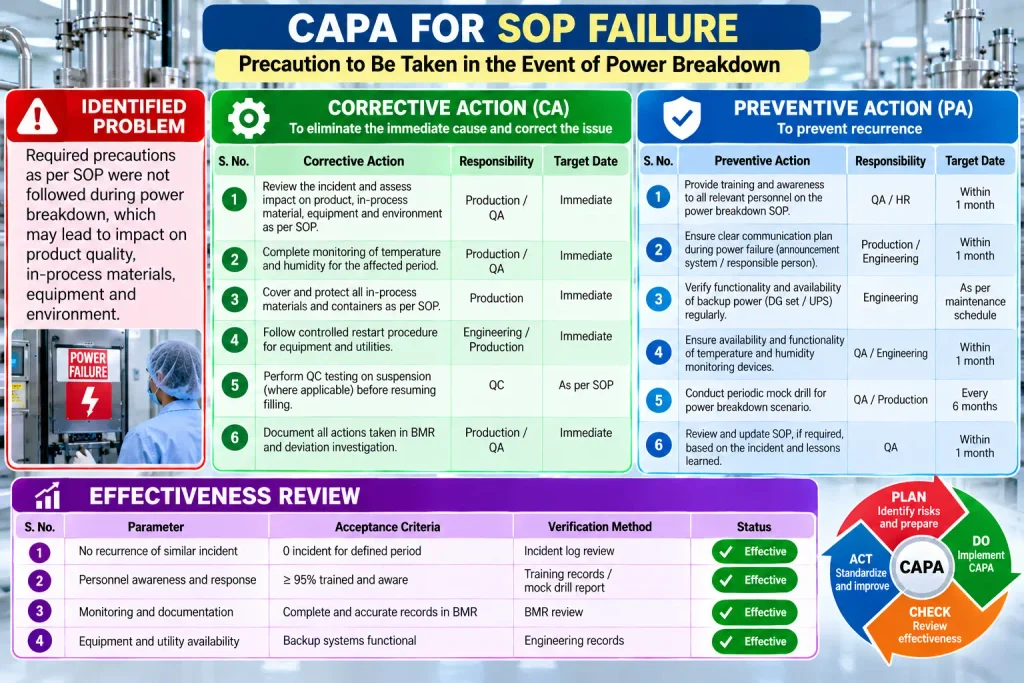
Preventive actions should include retraining concerned personnel, ensuring clear communication during power failure, periodic verification of backup power and utility systems, checking the availability and functionality of temperature and humidity monitoring devices, and conducting periodic mock drills. The SOP should also be reviewed after any significant incident to determine whether procedural improvements are required.The effectiveness review should confirm that similar incidents have not recurred, personnel are trained and able to respond correctly, environmental monitoring and documentation are complete, and backup systems remain functional. This CAPA approach helps strengthen product protection, process continuity, equipment safety, documentation compliance, and GMP control during future power-breakdown events.
Questions & Answers – Precaution to Be Taken in the Event of Power Breakdown:
- What is the objective of this SOP?
The objective is to describe the precautions to be taken during a power breakdown in the production area. - Who is responsible for implementation of this SOP?
Concerned Production personnel and the Production Chemist are responsible for preparation and execution of the SOP. - What should personnel do immediately during a power breakdown?
Unnecessary movement should be avoided in the affected area. - What should be done if the power failure exceeds 10 minutes?
Temperature and humidity should be checked and recorded in the Batch Manufacturing Record, and all containers containing material under processing should be covered. - What precaution is required for wet granulation?
Granules should be checked for abnormalities in the dough before restarting the Rapid Mixer Granulator. - What should be done in case of a coating machine?
The spray nozzle should be wiped immediately to prevent droplets from falling on tablets present in the coating pan. - What should be monitored in the liquid filling area during power failure?
The temperature of the suspension vessel should be checked and recorded in the Batch Manufacturing Record every 10 minutes. - What action is required if power failure persists for more than 30 minutes in the liquid filling area?
Open trays should be covered, the bottom valve of the mixing vessel should be closed, and compressed air should be shut off. - When should manufacturing and filling personnel leave the area?
They should leave when the Maintenance Department confirms that the power failure is expected to continue for a longer period. - What should be done after restoration of power?
Personnel should re-enter the manufacturing and filling area, ensure required utilities are ON, and start the AHU before resuming work. - How long should the AHU run before work resumes?
The AHU should run for about 10 minutes before resumption of work. - What should be done with the suspension after power restoration?
The stirrer should be started, the bottom valve opened, the homogenizer started, and the suspension should be recirculated for about 5 minutes. - When is QC testing required before restarting filling?
If power is not restored within 30 minutes, a suspension sample should be sent to Quality Control for content testing, and results should be confirmed before restarting filling. - What backup provision is mentioned in the SOP?
The SOP states that a diesel generator backup is available and restores power within approximately 60 seconds in case of external power failure. - Why is proper documentation important during a power breakdown?
The SOP specifically requires recording of temperature and humidity in the Batch Manufacturing Record, ensuring that the event and related controls are documented.
Reference Guidelines – Precaution to Be Taken in the Event of Power Breakdown:
- WHO Good Manufacturing Practices (GMP) – requirements for maintaining controlled manufacturing conditions, utilities, equipment, documentation, and protection of in-process materials.
- EU Guidelines for Good Manufacturing Practice, EudraLex Volume 4 – particularly requirements related to premises, equipment, production controls, documentation, and prevention of contamination.
- PIC/S Guide to Good Manufacturing Practice for Medicinal Products (PE 009) – controls for pharmaceutical production areas, utilities, equipment operation, environmental conditions, and deviation handling.
- Schedule M of the Drugs Rules, India – GMP requirements for pharmaceutical premises, equipment, manufacturing controls, documentation, utilities, and environmental conditions.
- ICH Q9 – Quality Risk Management – useful for evaluating risks arising from power failure and determining appropriate controls and CAPA.
- ICH Q10 – Pharmaceutical Quality System – applicable to deviation management, CAPA, change management, training, and continual improvement.
- Site-specific SOPs for HVAC operation, DG/UPS operation, utility restoration, deviation handling, environmental monitoring, equipment restart, and batch documentation should also be cross-referenced where applicable.