







1. Introduction – Preparation of Batch Manufacturing and Batch Packing Records:
The Preparation of Batch Manufacturing and Batch Packing Records (BMR/BPR) is an essential pharmaceutical documentation activity used to provide complete, controlled, and traceable instructions for the manufacture and packing of every product batch. The SOP establishes a standardized system for preparing, reviewing, approving, numbering, and maintaining BMR and BPR documents. According to the SOP, each batch is manufactured according to the approved BMR and packed according to the approved BPR, with these records being prepared on the basis of the Master Formula Record and Master Packing Record. Production personnel are responsible for preparation of the BMR/BPR, while Production Head/QA personnel review the records and the Quality Assurance Head provides final approval and ensures implementation of the defined system. Properly prepared batch records support GMP compliance, product consistency, data traceability, reconciliation, accountability, and documented evidence that manufacturing and packing activities were performed according to approved procedures. The SOP also defines formats for BMR and BPR preparation, including manufacturing, dispensing, reconciliation, packing, overprinting, verification, release, and revision-history information.
Skip to PDF content2. Flow Diagram – Preparation of Batch Manufacturing and Batch Packing Records:
The SOP on Preparation of Batch Manufacturing and Batch Packing Records describes the controlled procedure for preparing, reviewing, approving, numbering, and maintaining BMR and BPR documents used during pharmaceutical manufacturing and packing operations. The procedure specifies that the Batch Manufacturing Record (BMR) and Batch Packing Record (BPR) are prepared on the basis of the approved Master Formula Record and Master Packing Record.
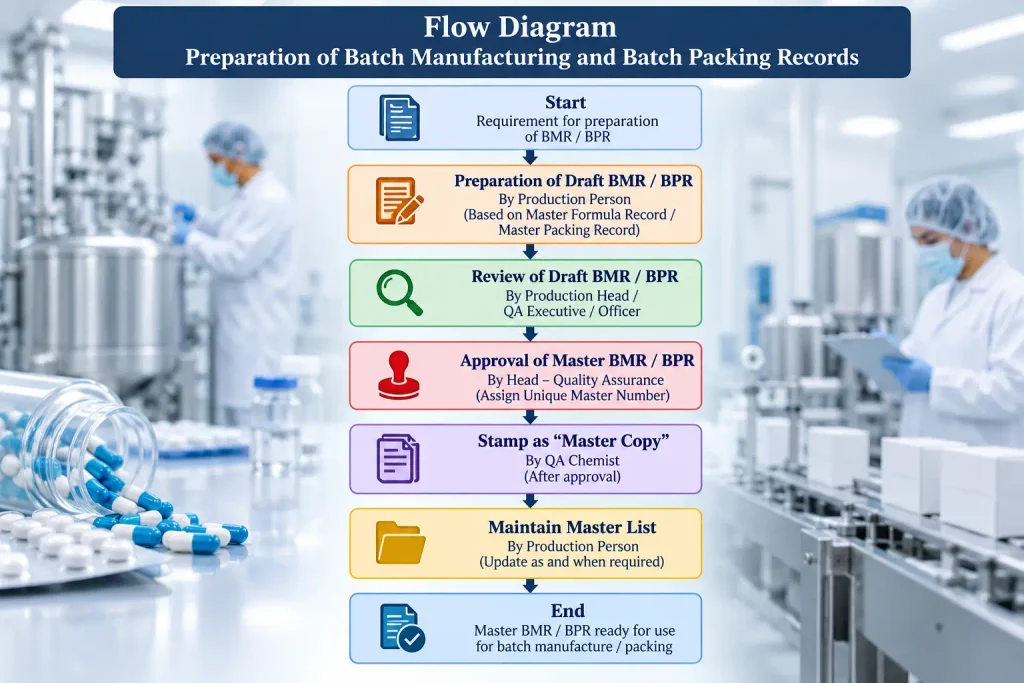
Production personnel are responsible for preparing the records, while Production Head/QA personnel review them and the Head of Quality Assurance provides final approval. After review, a unique master BMR/BPR number is assigned, and approved records are controlled as master copies. The SOP also requires maintenance and updating of a master list of BMR/BPR numbers. The defined BMR format covers areas such as raw-material dispensing, calculations, equipment, manufacturing process, reconciliation, and revision history, while the BPR format includes packing records, packing-material dispensing, overprinting details, packing process, reconciliation, verification, release, and revision history.
3. Benefits of Following SOP for Preparation of Batch Manufacturing and Batch Packing Records:
Following the SOP for Preparation of Batch Manufacturing and Batch Packing Records ensures that BMR and BPR documents are prepared through a defined and controlled system. The SOP assigns clear responsibilities for preparation, checking, review, approval, and implementation of the records, which improves accountability and document control.

The BMR and BPR are prepared on the basis of the Master Formula Record and Master Packing Record, helping maintain consistency in manufacturing and packing instructions. A unique numbering system and maintained master list support proper identification, traceability, and control of approved records.The approved formats also ensure inclusion of important information such as dispensing, equipment, manufacturing process, reconciliation, packing, overprinting, verification, release, and revision history. This supports systematic documentation, easier review, improved traceability, and better readiness for internal and regulatory assessment.
4. Brainstorming for SOP Failure in Preparation of Batch Manufacturing and Batch Packing Records:
Brainstorming for failure of the SOP on Preparation of Batch Manufacturing and Batch Packing Records is used to identify possible weaknesses that can affect the accuracy, control, review, approval, and traceability of BMR and BPR documents. The SOP requires Production personnel to prepare BMR/BPR, Production Head or QA personnel to review them, and the Head of Quality Assurance to approve them. Potential failure points may include preparation of records without reference to the approved Master Formula Record or Master Packing Record, incorrect or duplicate master numbering, inadequate review, incomplete approval, failure to stamp the approved document as “Master Copy,” and failure to maintain or update the master list of BMR/BPR numbers. These risks are directly related to the controls described in the SOP.
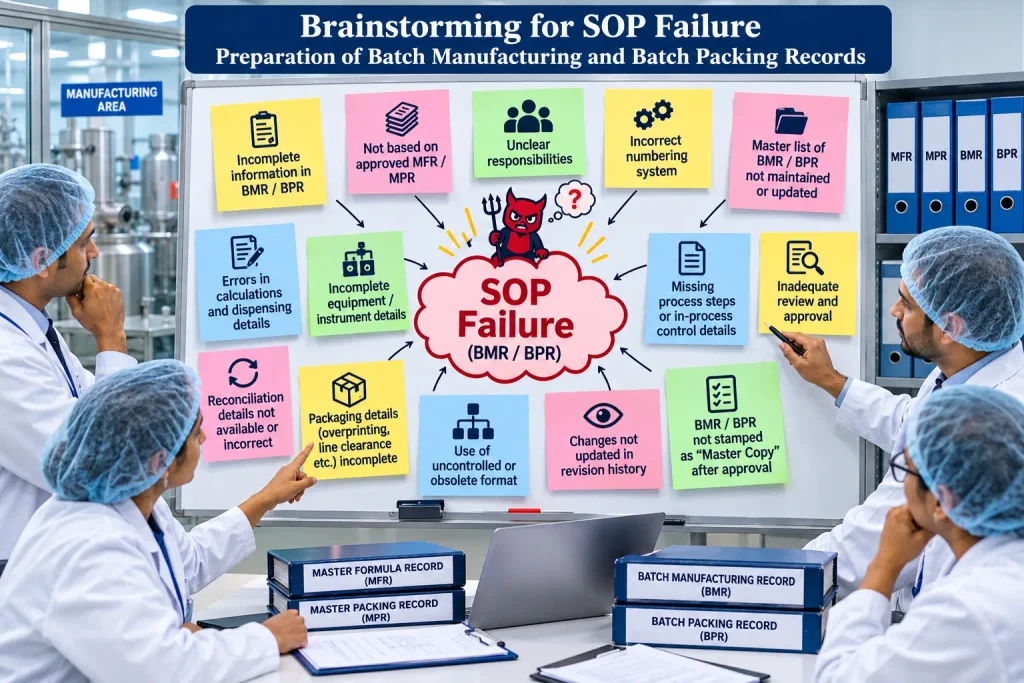
Brainstorming should also consider missing or incomplete BMR/BPR content such as dispensing details, calculations, equipment information, manufacturing steps, reconciliation, packing process, overprinting information, verification, release, and revision history. Identifying these potential failures helps the organization strengthen document control, assign accountability, and reduce the risk of incomplete or incorrectly prepared batch records.
5. 5-Why Analysis for SOP Failure in Preparation of Batch Manufacturing and Batch Packing Records:
The 5-Why Analysis for SOP Failure in Preparation of Batch Manufacturing and Batch Packing Records is used to identify the underlying causes of errors or weaknesses in BMR/BPR preparation and control. Possible problems include incomplete BMR/BPR content, incorrect or duplicate master numbers, inadequate review or approval, failure to stamp approved records as “Master Copy,” and poor maintenance of the master BMR/BPR list. These issues are directly related to controls required by the SOP for preparation, review, numbering, approval, and record maintenance.
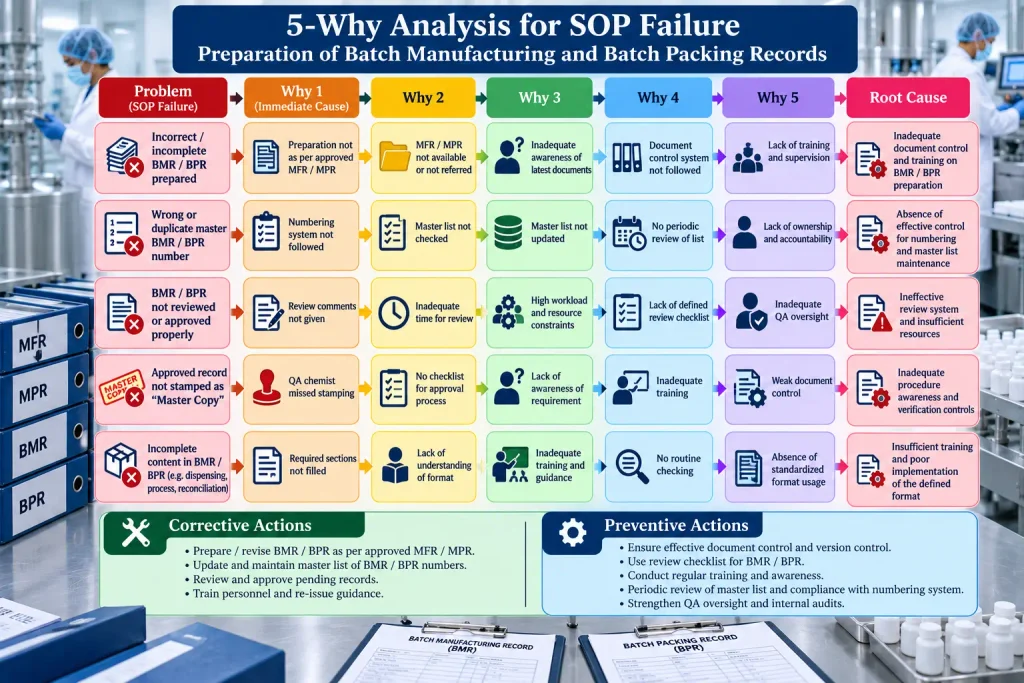
By repeatedly asking “Why?”, the investigation can trace these failures to contributing causes such as insufficient awareness, inadequate training, weak document control, lack of defined review checks, poor accountability, or ineffective implementation of the approved format. The SOP requires BMR/BPR to be based on the Master Formula Record and Master Packing Record and defines responsibilities for preparation, review, and approval.The analysis therefore helps identify suitable corrective and preventive actions, such as strengthening review controls, maintaining updated master lists, improving personnel training, and ensuring only approved and properly controlled BMR/BPR documents are used.
6. Fishbone Analysis for SOP Failure in Preparation of Batch Manufacturing and Batch Packing Records:
The Fishbone Analysis for SOP Failure in Preparation of Batch Manufacturing and Batch Packing Records helps identify and organize the possible causes that can lead to errors, omissions, or loss of control in BMR/BPR preparation. The SOP requires BMR and BPR to be prepared from approved master records, reviewed by Production/QA, approved by the Head of Quality Assurance, and controlled through an assigned numbering system and master-copy status.
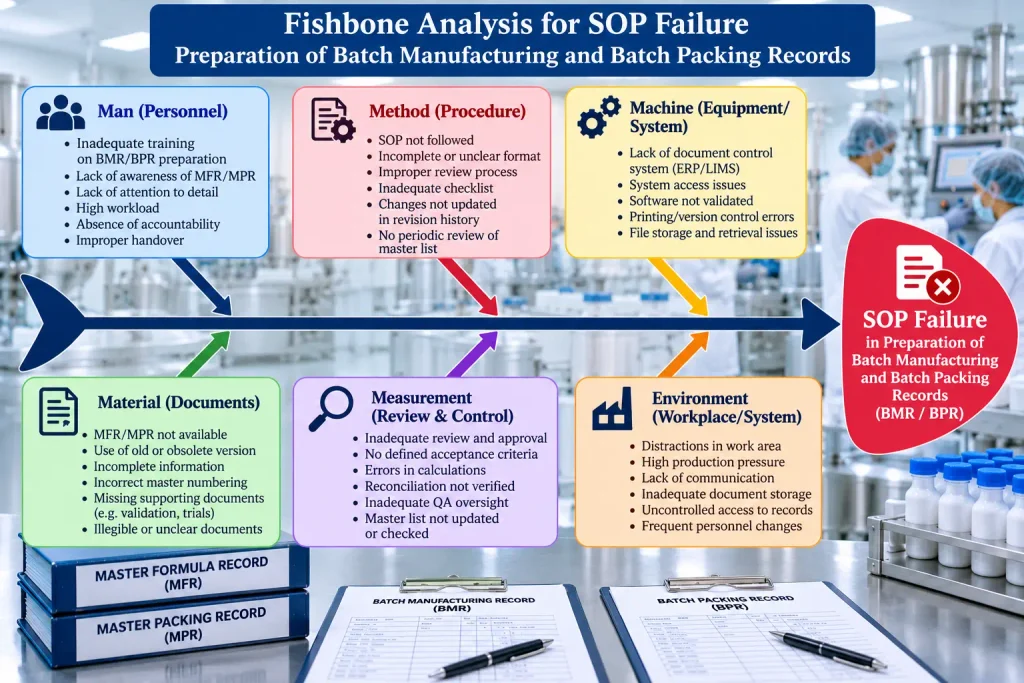
Potential causes may be grouped under Man, Method, Machine/System, Material/Documents, Measurement/Review & Control, and Environment. These may include inadequate training, failure to follow the approved procedure, use of obsolete or incomplete records, incorrect numbering, weak review and approval, missing reconciliation or process information, and poor maintenance of the master BMR/BPR list. The SOP specifically requires the master list to be maintained and updated and defines QA review and final approval Using this analysis helps teams visually connect individual weaknesses to the overall SOP failure and supports selection of suitable CAPA to strengthen documentation accuracy, traceability, accountability, and GMP compliance.
7. Fault Tree Analysis for SOP Failure in Preparation of Batch Manufacturing and Batch Packing Records:
The Fault Tree Analysis for SOP Failure in Preparation of Batch Manufacturing and Batch Packing Records is used to systematically identify the combinations of causes that may result in incorrect, incomplete, or uncontrolled BMR/BPR preparation. The SOP requires BMR and BPR to be prepared from the approved Master Formula Record and Master Packing Record, followed by defined review and approval activities. The main failure branches may include preparation from incorrect or unavailable master documents, inadequate review and approval, incorrect or duplicate numbering, failure to maintain the master list, and incomplete BMR/BPR content. The SOP specifically requires unique master numbering, maintenance of the master BMR/BPR list, QA review, Head-QA approval, and stamping of approved records as “Master Copy.”
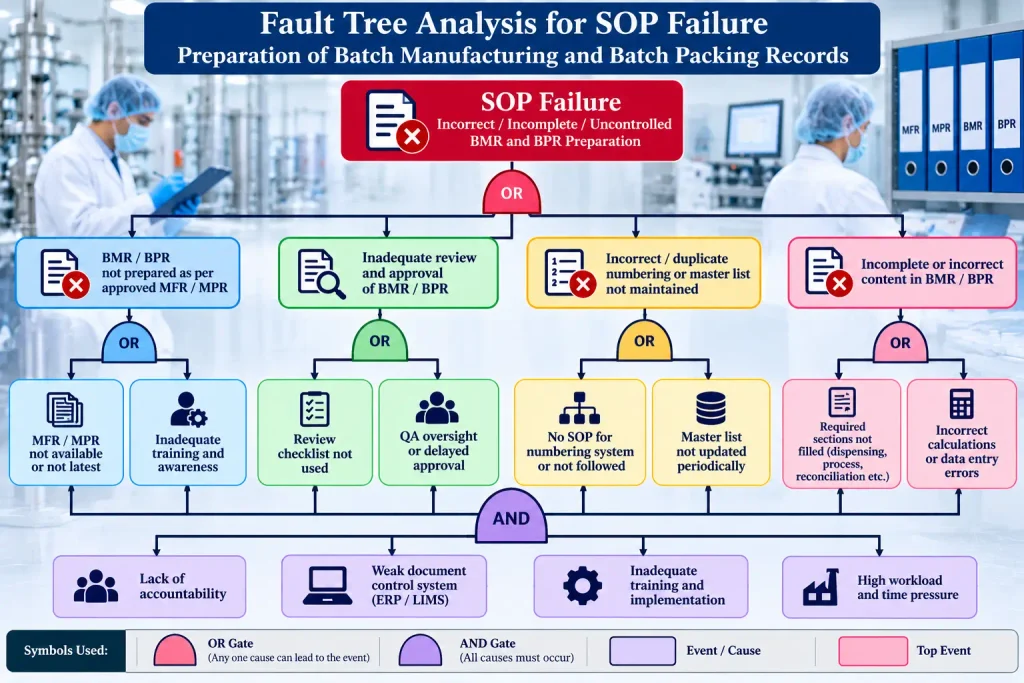
Fault Tree Analysis helps connect these immediate failures with deeper contributing factors such as weak accountability, insufficient training, ineffective document control, poor implementation, or excessive workload. By identifying how individual and combined failures can lead to the top event, the analysis supports selection of focused CAPA to improve document control, traceability, review effectiveness, and compliance.
8. Impact Assessment for SOP Failure in Preparation of Batch Manufacturing and Batch Packing Records:
The Impact Assessment for SOP Failure in Preparation of Batch Manufacturing and Batch Packing Records evaluates how deficiencies in BMR/BPR preparation and control may affect product quality, compliance, documentation, and manufacturing operations. The SOP requires batch records to be prepared from the approved Master Formula Record and Master Packing Record and to undergo defined review and approval before use. Potential failures include incorrect or duplicate numbering, inadequate review and approval, incomplete batch-record content, failure to maintain the master BMR/BPR list, and improper control of approved master copies. The SOP specifically requires unique numbering, maintenance of the master list, QA review, Head-QA approval, and “Master Copy” control.
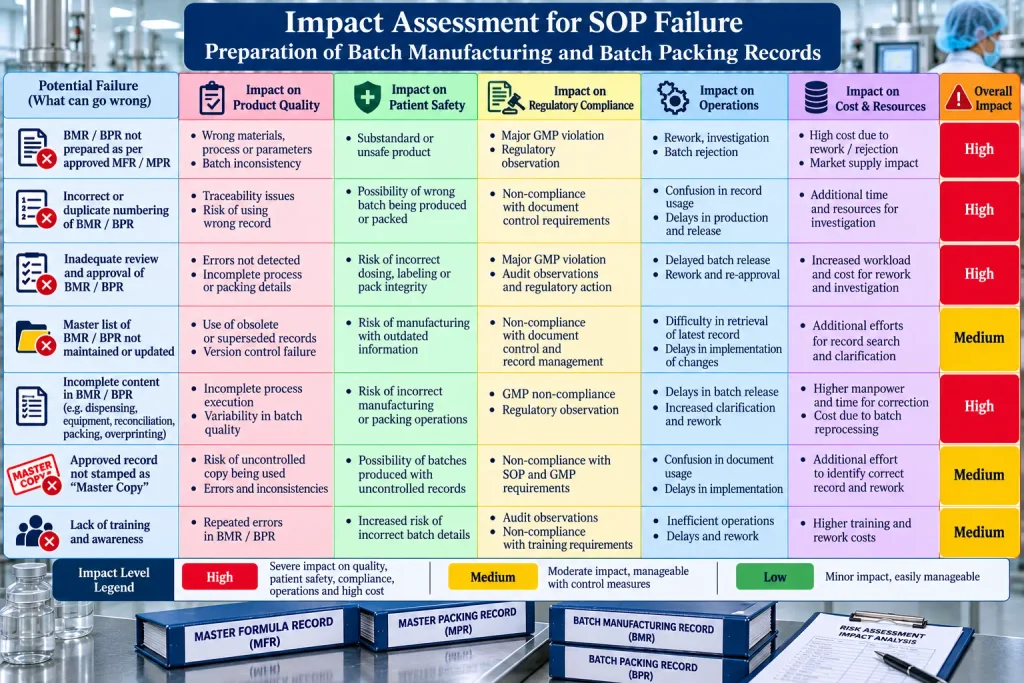
Such failures can result in loss of traceability, use of incorrect or outdated instructions, incomplete manufacturing or packing documentation, delayed batch review, additional investigation and rework, and potential GMP non-compliance. Assessing the severity of each failure helps prioritize corrective and preventive actions and strengthens document control, accountability, batch consistency, and audit readiness.
9. CAPA for SOP Failure in Preparation of Batch Manufacturing and Batch Packing Records:
The Corrective and Preventive Action (CAPA) for SOP Failure in Preparation of Batch Manufacturing and Batch Packing Records is intended to eliminate identified documentation failures and prevent their recurrence. Typical failures may include preparation of BMR/BPR without reference to the approved Master Formula Record or Master Packing Record, incorrect numbering, inadequate review and approval, incomplete batch-record content, failure to maintain the master list, and failure to control the approved record as a “Master Copy.” The SOP requires defined preparation, review, approval, numbering, and master-copy controls for BMR/BPR documentation.
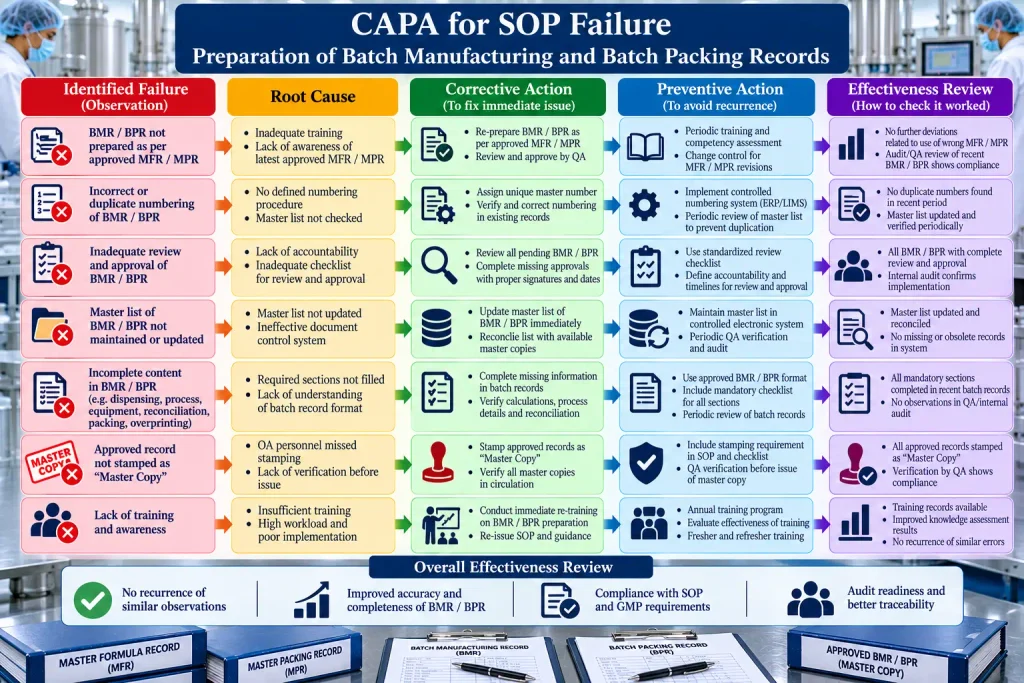
Corrective actions should address the immediate deficiency by correcting or re-preparing affected records, completing missing review or approval, updating the master list, and ensuring approved records are properly controlled. Preventive actions should strengthen training, document-control practices, periodic verification, review checklists, accountability, and control of master numbering. The SOP specifically requires the master BMR/BPR list to be maintained and updated, QA review to be performed, Head-QA approval to be obtained, and approved records to be stamped as “CAPA effectiveness can then be verified through periodic QA review, internal audit, checking for recurrence of similar errors, confirmation of correct numbering and master-list maintenance, and review of recently prepared BMR/BPR records for completeness and compliance.
Questions & Answers – Preparation of Batch Manufacturing and Batch Packing Records:
- What is the objective of this SOP?
The objective is to define the procedure for preparation of Batch Manufacturing Records and Batch Packing Records. - Who is responsible for preparation of BMR/BPR?
Production personnel are responsible for preparation of the BMR and BPR. - Who is responsible for checking or reviewing the BMR/BPR?
The Production Head/Asst. Manager QA is responsible for checking and reviewing the - Who gives final approval to the BMR/BPR?
The Quality Assurance Head approves the BMR/BPR and ensures implementation of the system defined in the SOP. - On what basis are BMR and BPR prepared?
They are prepared based on the Master Formula Record and Master Packing Record. - How are BMR/BPR prepared for new products?
For new products, the BMR/BPR are prepared based on the Master Formula Record and trial batches. - When is a unique master BMR/BPR number assigned?
After QA receives and reviews the draft BMR/BPR, a unique master number is assigned to each master batch record. - What is the Master BMR numbering system for tablet products?
The SOP defines the tablet Master BMR numbering format as “/MFR/T-NNN-00”, where T represents Tablet, NNN represents the serial number, and 00 represents the version number. - What is the Master BPR numbering system for tablets and liquids?
The SOP specifies FPT-001 for Finished Product Tablet and FPL-001 for Finished Product Liquid, with the numeric portion representing the serial number. - Who maintains the Master List of BMR/BPR numbers?
Production personnel are responsible for preparing and maintaining the Master List, which should be updated whenever required. - What is checked during approval of BMR/BPR?
QA reviews the draft BMR/BPR, provides comments where required, assigns the master number, and forwards it to Head QA for review and approval. - What is done after the BMR/BPR is approved?
After approval by Head QA, QA personnel stamp the approved document as - What major sections are included in the BMR format?
The BMR format includes attached records, general instructions, equipment/instrument list, raw-material dispensing, calculation sheet, reconciliation, manufacturing process, granulation reconciliation, and revision histor - What major sections are included in the BPR format?
The BPR format includes packing record, dispensing of packing material, overprinting details, packing process, reconciliation of packing material, verification and release, and revision history. - Why is proper preparation of BMR/BPR important?
Based on this SOP, proper preparation ensures that manufacturing and packing activities are performed using approved, reviewed, numbered, and controlled batch records with defined responsibilities and traceability.
Reference Guidelines – Preparation of Batch Manufacturing and Batch Packing Records:
For external regulatory alignment, commonly applicable guidelines include WHO GMP, PIC/S Guide to GMP, EU GMP Part I – Chapter 4 (Documentation), US FDA 21 CFR Part 211, especially requirements related to master production and control records, batch production and control records, and document review, as well as ICH Q7 where relevant to GMP documentation systems. These external references are not specifically listed in the uploaded SOP, but they are commonly used to support GMP expectations for controlled batch manufacturing and packing documentation.