







1. Introduction – SOP for Batch Manufacturing & Packing Record Review:
The SOP for Batch Manufacturing & Packing Record Review establishes a documented and systematic procedure for the Quality Assurance (QA) department to review completed Batch Manufacturing Records (BMR) and Batch Packing Records (BPR) before batch release. Its primary objective is to ensure that all manufacturing and packing activities have been properly recorded, reviewed, verified, and completed in accordance with approved procedures. The SOP also defines QA responsibilities for timely batch-record review so that product release is supported by complete and accurate documentation. The review includes verification of record legibility and accuracy, sequential processing times, authorized corrections, deviation recording, material issuance and reconciliation, equipment and area cleanliness, QA line clearance, operator details, in-process controls, yields, QC reports, and batch-summary authorization. Effective implementation of this SOP helps maintain data integrity, traceability, GMP compliance, product quality, and documented evidence that each batch has been manufactured and packed under controlled conditions prior to release.
Skip to PDF content2. Flow Diagram – SOP for Batch Manufacturing & Packing Record Review:
The flow diagram describes the systematic review of Batch Manufacturing Records (BMR) and Batch Packing Records (BPR) by the Quality Assurance department before batch release. The process starts with receipt of completed batch records along with supporting documents such as work orders and QC reports. QA then performs general checks for completeness, legibility, accuracy, sequential processing entries, authorized corrections, and proper recording of deviations. The review further covers work-order verification, equipment and area cleanliness records, line clearance, operator details, in-process control timings, material reconciliation, stage-wise yields, QC reports, and batch-summary authorization.
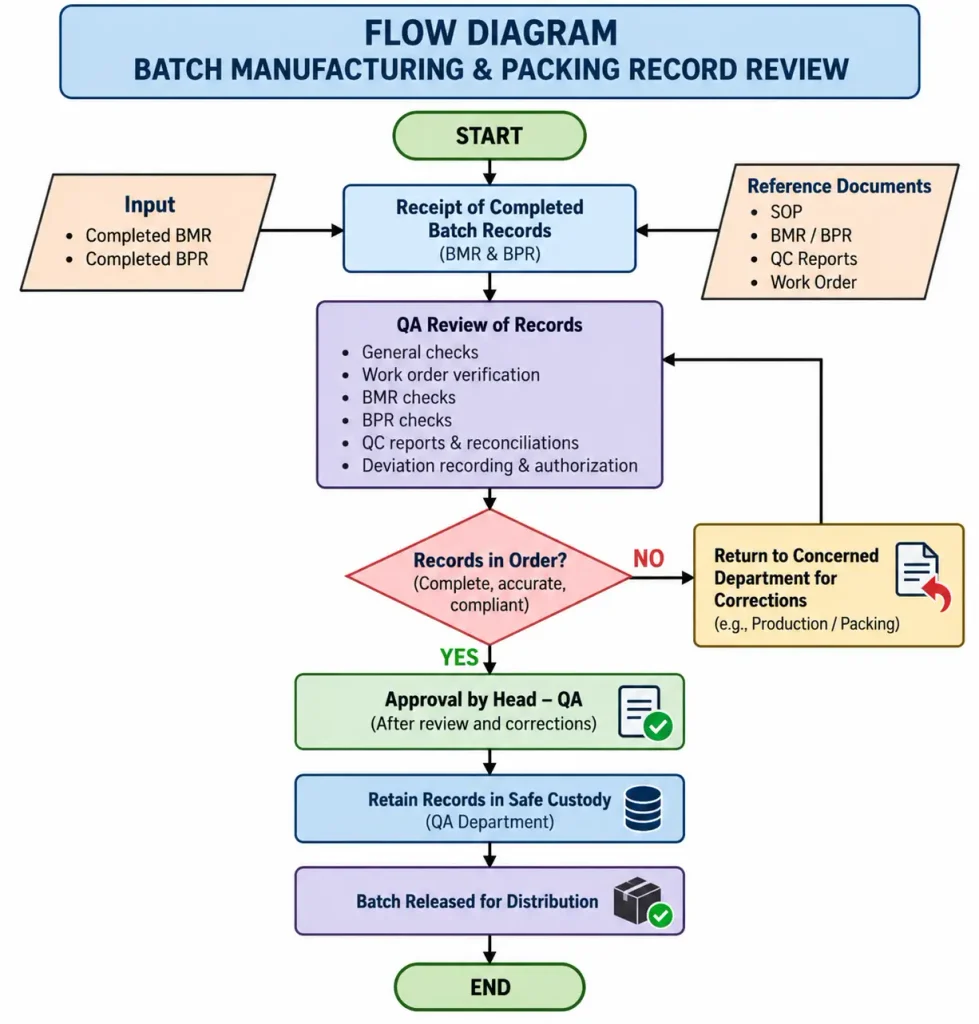
For packing records, similar checks are performed for packing materials, quantities, AR numbers, cleanliness, line clearance, reconciliation, and deviations. Any discrepancies are returned for correction and re-review. After satisfactory completion, the batch record is approved by the Head of Quality Assurance and retained under QA custody.
3. Benefits of Following SOP for Batch Manufacturing & Packing Record Review:
The diagram highlights the key benefits of consistently following the SOP for Batch Manufacturing & Packing Record Review. Proper review helps ensure that batch records are complete, accurate, legible, sequential, and properly authorized, while deviations and corrections are appropriately documented before product release. It also supports verification of work orders, material issuance, equipment and area cleanliness, line clearance, operator entries, in-process controls, reconciliation, yields, and QC reports. These checks improve traceability, accountability, and early identification of documentation or process discrepancies.
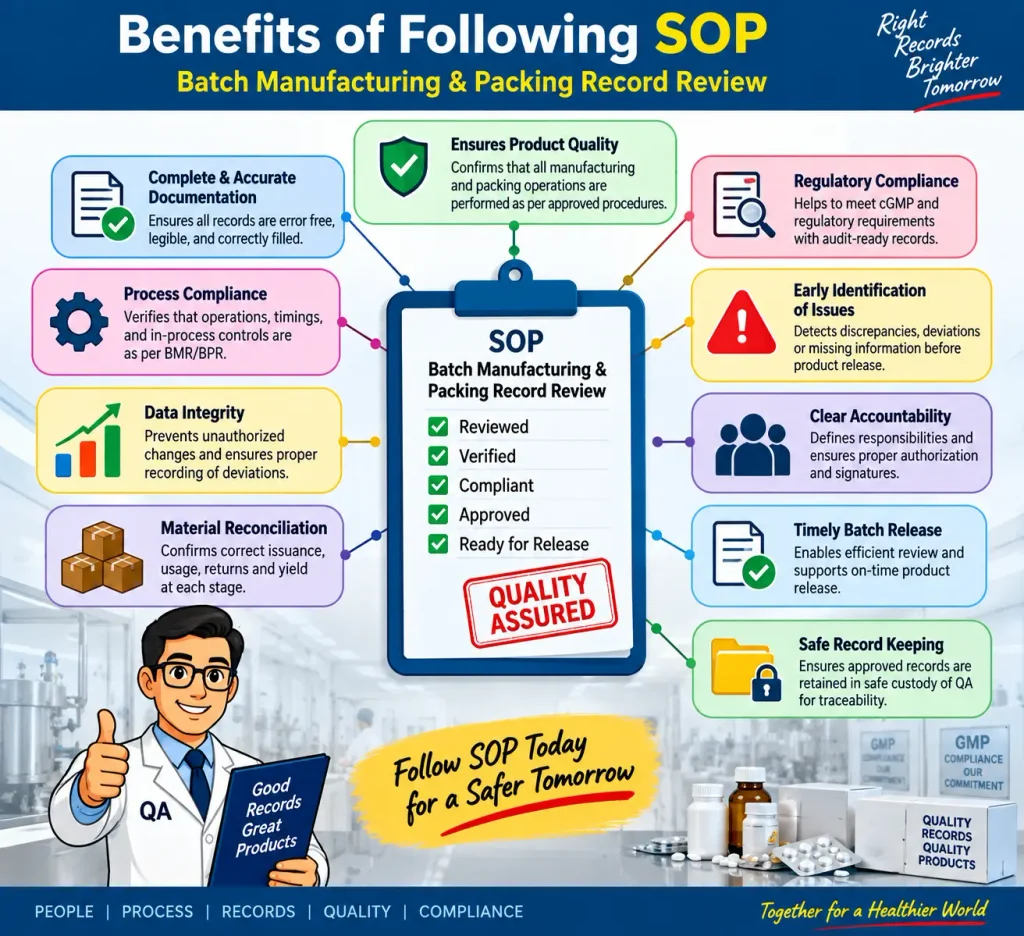
Following the SOP also facilitates an organized and timely batch-review process, supports QA approval before release, and ensures that completed batch records are retained under safe QA custody for future reference and traceability. Overall, effective SOP implementation strengthens documentation control, product-quality assurance, and disciplined batch-release practices.
4. Brainstorming for SOP Failure: Batch Manufacturing & Packing Record Review:
The brainstorming diagram identifies possible causes for failure in implementing the SOP for Batch Manufacturing & Packing Record Review. It focuses on documentation and review problems such as incomplete records, illegible or incorrect entries, non-sequential process timings, unauthorized corrections, and deviations that are not properly recorded or assessed. These issues directly relate to the SOP’s general review requirements for accuracy, legibility, sequencing, authorized corrections, and deviation assessment.
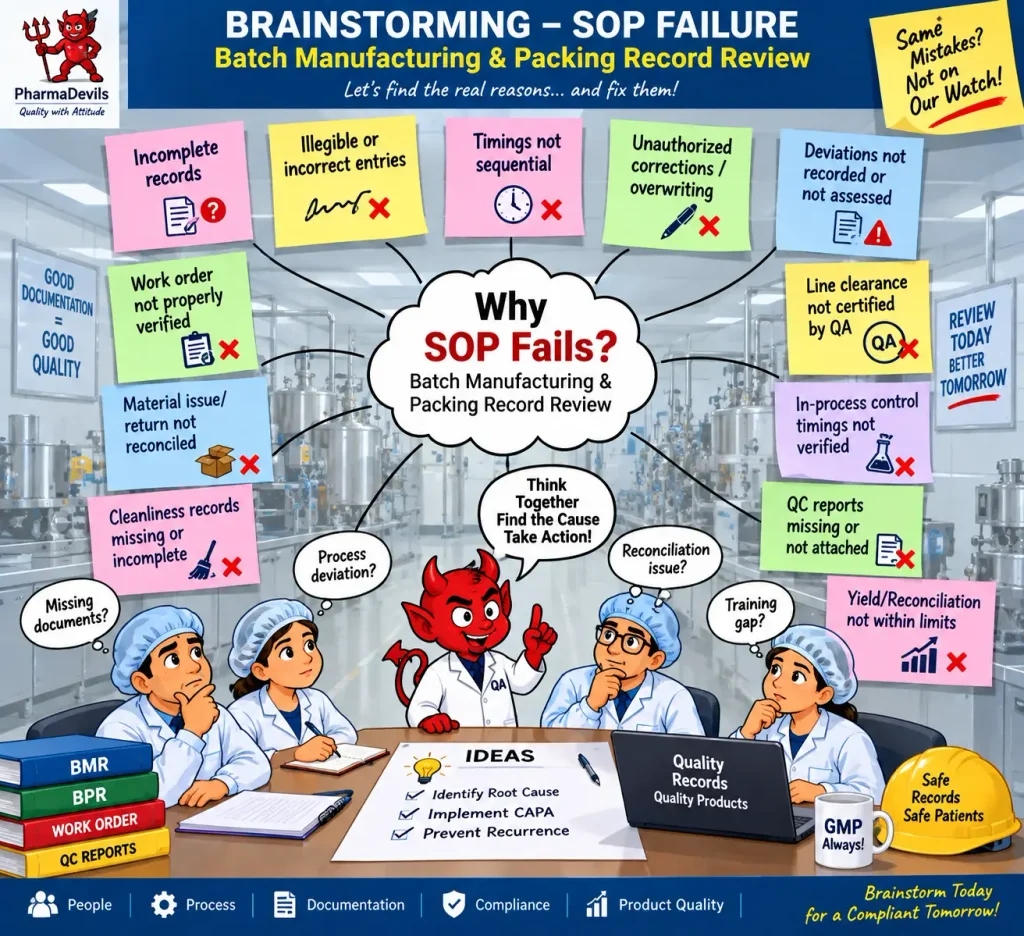
The diagram also highlights inadequate work-order verification, missing cleanliness records, unverified line clearance, material reconciliation problems, incorrect in-process control timings, missing QC reports, and yield or reconciliation outside established limits. These are key BMR/BPR review points defined in the SOP. Brainstorming helps the QA team collectively identify probable causes, prioritize investigation areas, implement suitable CAPA, strengthen training, and prevent recurrence of batch-record review failures.
5. 5-Why Analysis for SOP Failure: Batch Manufacturing & Packing Record Review:
The 5-Why Analysis for SOP Failure – Batch Manufacturing & Packing Record Review diagram demonstrates a structured method for identifying the underlying cause of deficiencies observed during batch-record review. The analysis begins with the problem of incomplete or incorrect batch records and progressively asks “Why?” to trace the issue through improper recording of details, insufficient understanding of SOP requirements, inadequate training, ineffective training control, and weak accountability. The SOP itself requires QA to verify that records are accurate, legible, sequential, properly corrected, and that deviations are appropriately documented and assessed before batch release. It also requires verification of cleanliness records, line clearance, operator details, in-process controls, reconciliation, yields, QC reports, and deviation authorization.
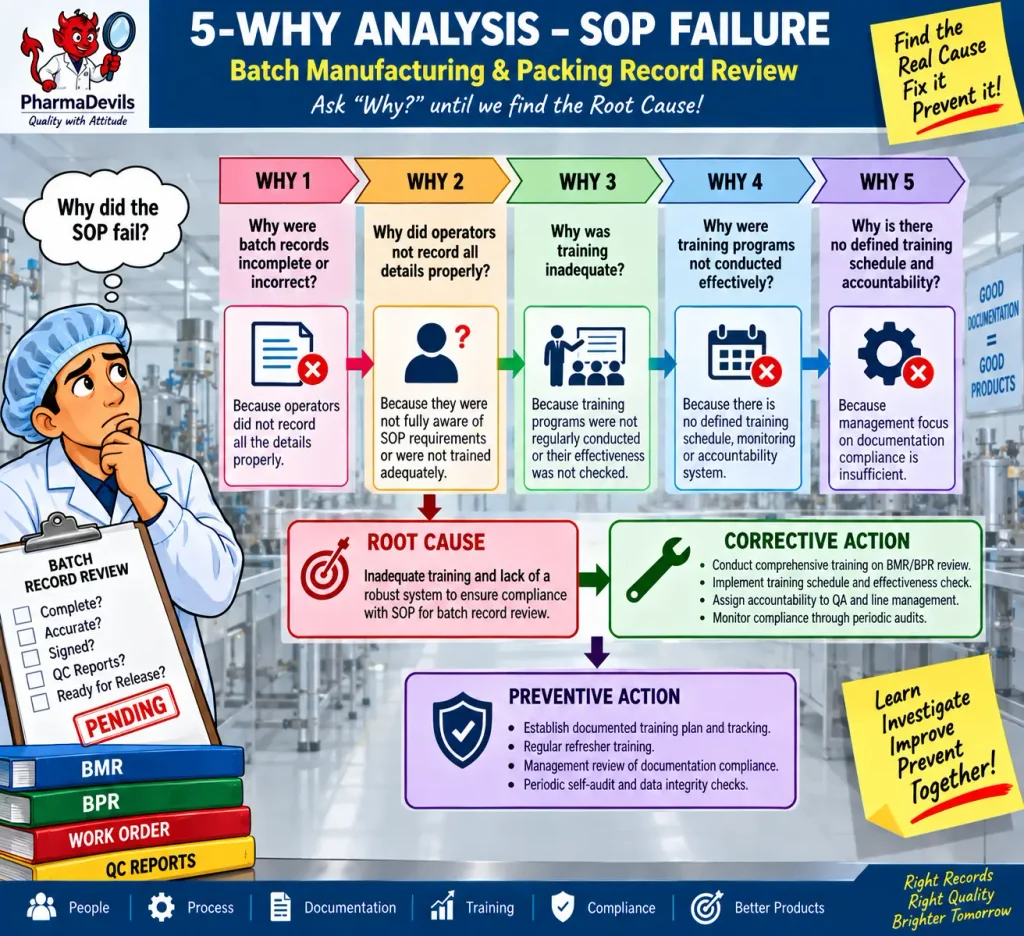
The 5-Why diagram helps convert an observed documentation failure into an actionable root-cause investigation. Once the probable root cause is identified, appropriate corrective and preventive measures such as targeted training, defined responsibilities, periodic review, and stronger documentation controls can be established to reduce recurrence and improve the effectiveness of BMR/BPR review and batch-release documentation.
6. Fishbone Analysis for SOP Failure: Batch Manufacturing & Packing Record Review:
The Fishbone Analysis for SOP Failure – Batch Manufacturing & Packing Record Review diagram presents potential causes of ineffective batch-record review under six major categories: Personnel, Procedure, Documentation, Training, QA/Control, and Management/System. The analysis helps organize possible causes so that the investigation does not focus only on the immediate documentation error. Key causes shown include incomplete entries, missing signatures, poor awareness of SOP requirements, skipped review steps, unauthorized corrections, missing BMR/BPR information, absent QC reports, inadequate training, delayed QA review, improper verification of reconciliation or yield, and insufficient supervision. These themes align with the SOP requirements for accurate and legible records, authorized corrections, deviation assessment, line clearance, in-process control verification, reconciliation, yields, and QC-report review.
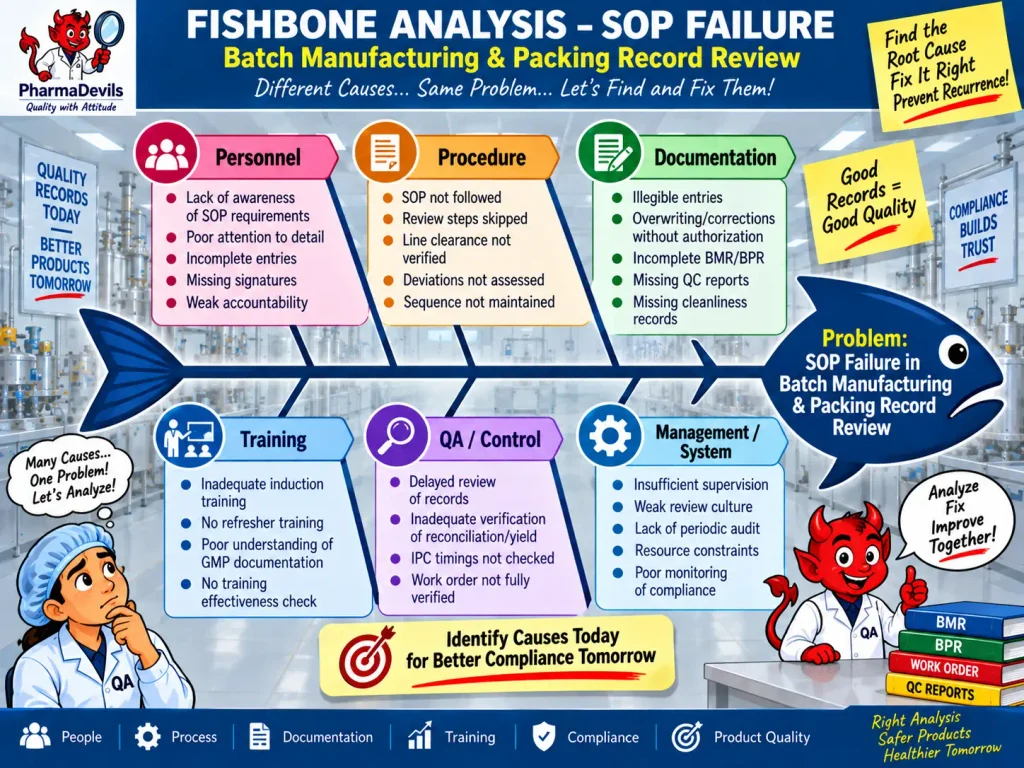
Using the fishbone approach enables the QA team to identify contributing factors systematically, determine the most probable root causes, and establish suitable corrective and preventive actions to strengthen BMR/BPR review, documentation control, compliance, and product-release assurance.
7. Fault Tree Analysis for SOP Failure: Batch Manufacturing & Packing Record Review:
The Fault Tree Analysis for SOP Failure – Batch Manufacturing & Packing Record Review diagram systematically breaks down the main failure into several contributing branches, including documentation failure, review-procedure failure, QA verification failure, training/personnel failure, and management/system failure. This approach helps visualize how multiple individual weaknesses can combine to cause ineffective batch-record review. The identified faults include incomplete or illegible BMR/BPR entries, unauthorized corrections, missing QC reports, unverified work orders, skipped review steps, unassessed deviations, unverified line clearance, inadequate reconciliation and yield review, insufficient training, weak accountability, and poor compliance monitoring. These causes align with the SOP requirements for accurate records, authorized corrections, deviation assessment, cleanliness verification, line clearance, in-process control, reconciliation, yield checks, and QC report review.
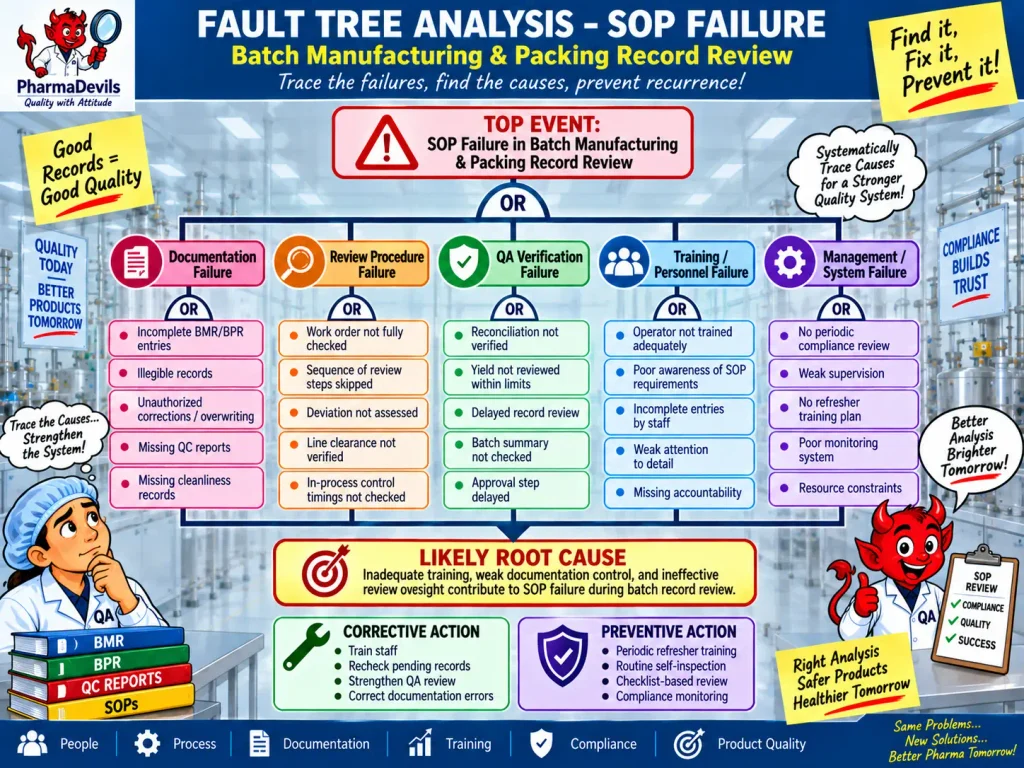
The fault tree helps identify the most likely combinations of failures leading to SOP non-compliance. It supports focused root-cause investigation and development of corrective and preventive actions such as improved training, stronger QA review, checklist-based verification, periodic compliance monitoring, and better documentation control.
8. Impact Assessment for SOP Failure: Batch Manufacturing & Packing Record Review:
The Impact Assessment for SOP Failure – Batch Manufacturing & Packing Record Review diagram illustrates the possible consequences of an ineffective or incomplete review of BMR/BPR records. The SOP requires QA to verify record accuracy, legibility, sequential processing, authorized corrections, deviation assessment, line clearance, in-process controls, reconciliation, yields, and QC reports before batch approval. Failure to perform these checks properly can affect product quality, data integrity, regulatory compliance, operational efficiency, and timely batch release. Inadequate review may allow documentation errors, unassessed deviations, incorrect reconciliation, or incomplete QC information to remain unresolved. It can also lead to additional investigation, rework, delayed release, increased workload, and reduced confidence in the documentation system.
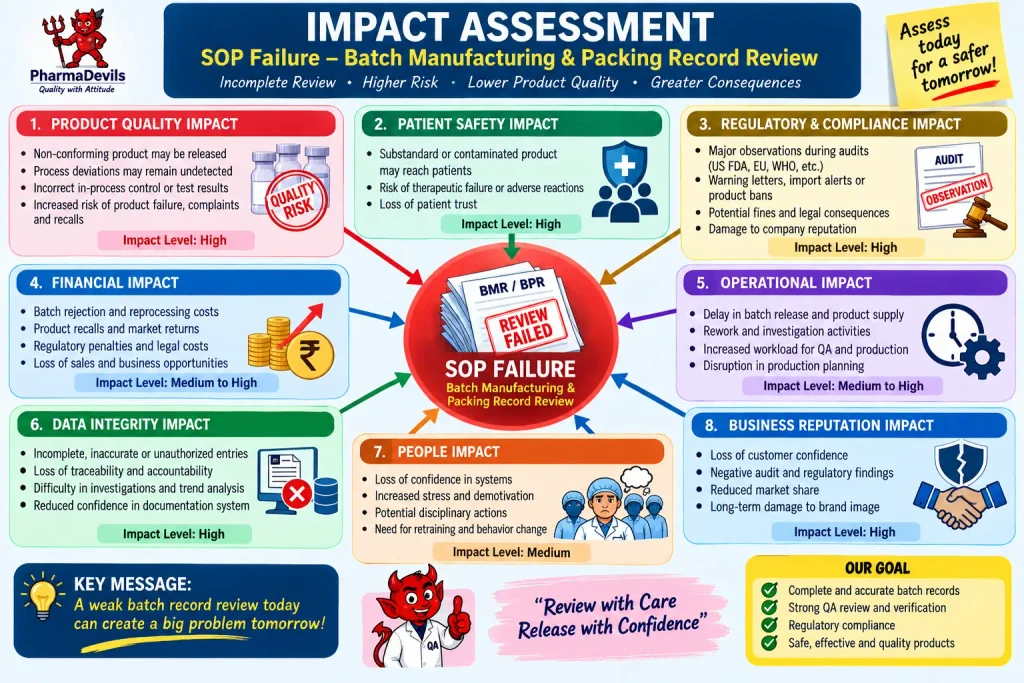
The assessment emphasizes that careful and complete QA review is essential before final approval. According to the SOP, completed and corrected batch records are approved by the Head of Quality Assurance and retained under safe QA custody. Proper implementation therefore supports reliable records, traceability, compliance, and controlled product release.
9. Risk Heat Map for SOP Failure: Batch Manufacturing & Packing Record Review:
The Risk Heat Map for SOP Failure – Batch Manufacturing & Packing Record Review evaluates potential failures according to their likelihood and severity so that the most critical risks can be prioritized for action. The diagram uses a 5×5 matrix with scores ranging from 1 to 25, where green represents low risk, yellow medium risk, orange high risk, and red very high risk. Key risks shown include incomplete or incorrect batch records, deviations not recorded or assessed, missing QC reports, improper reconciliation and yield review, unauthorized corrections, and inadequate QA review. These risks directly relate to the SOP requirements for complete and accurate records, authorized corrections, deviation assessment, line clearance, reconciliation, yield verification, and QC report review.
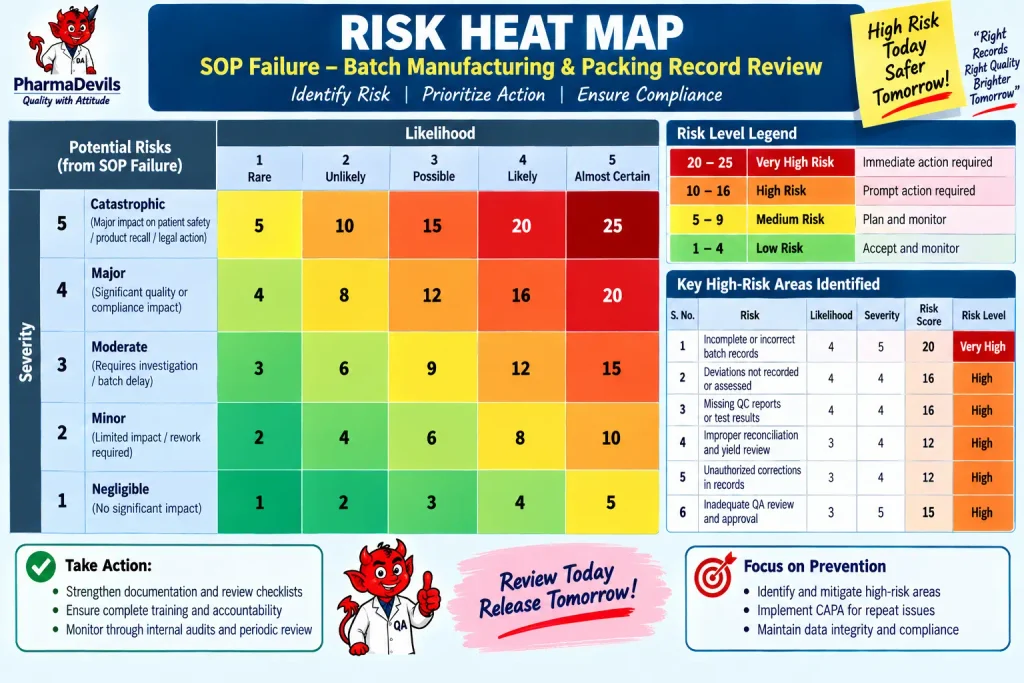
The heat map helps QA identify which failures require immediate or prompt corrective action. It supports prioritization of CAPA, strengthening of review checklists, improved training and accountability, periodic internal audits, and continued monitoring to maintain data integrity, compliance, product quality, and reliable batch release decisions.
10. Pareto Chart for SOP Failure: Batch Manufacturing & Packing Record Review:
The Pareto Chart for SOP Failure – Batch Manufacturing & Packing Record Review is used to prioritize the major causes that can contribute to ineffective BMR/BPR review. The diagram ranks potential issues such as incomplete or incorrect batch records, deviations not properly recorded or assessed, missing QC reports, improper reconciliation and yield review, unauthorized corrections, inadequate QA review, and incomplete line-clearance documentation. These failure areas correspond to the SOP requirements for legible and accurate records, authorized corrections, deviation assessment, line clearance, in-process control verification, reconciliation, yield checks, and review of QC reports.
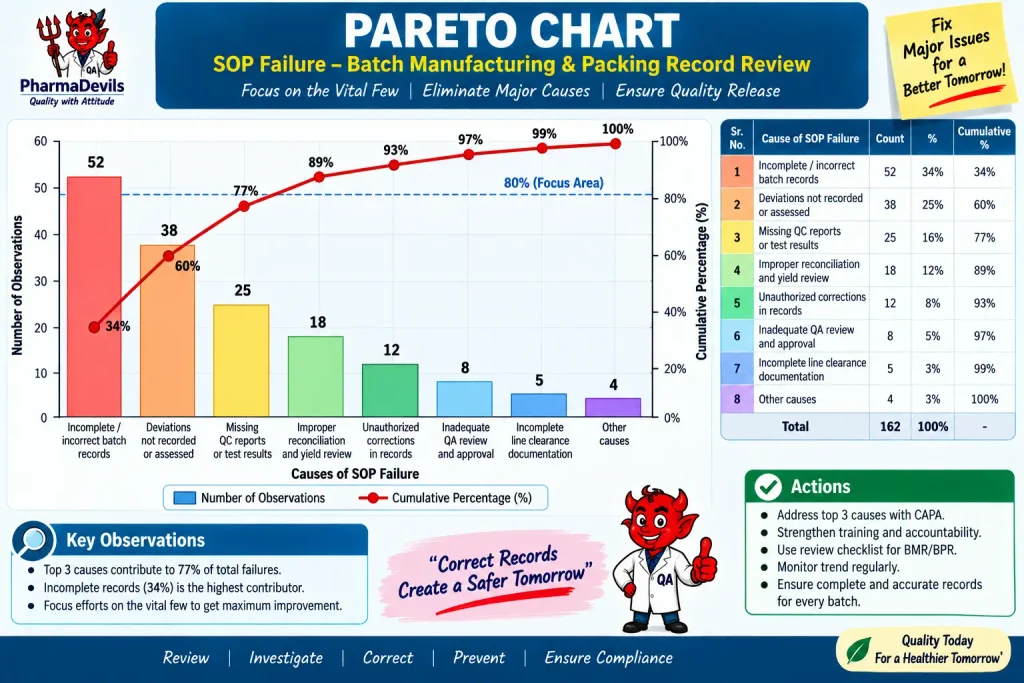
The cumulative percentage line demonstrates the Pareto principle, helping QA focus CAPA on the few causes contributing most to repeated failures. The numerical counts and percentages shown in the illustration are example values for training and visualization and are not derived from the attached SOP. In practice, actual deviation, audit, or batch-review data should be used to generate the Pareto analysis and monitor improvement over time.
Questions & Answers – SOP for Batch Manufacturing & Packing Record Review:
- Q: What is the objective of this SOP?
A: To provide a documented procedure defining the points to be checked by Quality Assurance during batch-record review. - Q: What is the scope of this SOP?
A: It assigns responsibilities to QA for timely review of batch records to support batch product release. - Q: Who is responsible for executing the SOP?
A: Executive/Officer–QA is responsible for execution of the SOP. - Q: Who is responsible for effective implementation of the SOP?
A: Asst. Manager–QA and Head–QA/QC are responsible for effective implementation. - Q: What general characteristics should batch records have?
A: Records should be error-free, tidy, legible, and accurate. - Q: How should process timings be recorded?
A: The timings of each process should be sequential with the procedure described in the BMR/BPR. - Q: How should overwriting or cancellation of an entry be handled?
A: Any overwriting or cancellation should be signed by the responsible officer. - Q: How should a process deviation be handled during batch-record review?
A: The deviation should be mentioned in the batch summary sheet, and QA should assess its impact on product quality before release. - Q: What should QA verify in the work order?
A: QA should verify authorization and signatures, item code/AR number, gross/tare/net weight calculations, excess issues or returns, weighing/checking signatures, and material issue/receipt signatures. - Q: What cleanliness-related checks are required in the BMR?
A: Cleanliness records for equipment and areas should be entered, previous-product details should be available, and cleanliness should be confirmed by signature. - Q: Who should certify line clearance?
A: QA should certify line clearance for all applicable operations. - Q: What operational information should be reviewed in the BMR?
A: Operation timings, operator names, second-person checks for critical operations, and appropriate timing of in-process controls should be verified. - Q: What should be checked regarding reconciliation and yield?
A: Input/output material reconciliation and final product yield at each stage should be checked to ensure they are within specified limits. - Q: What key points are reviewed in the BPR?
A: QA reviews packing material quantities and AR numbers, cleanliness records, previous-product details, line clearance, operator information, critical-operation checks, in-process control timings, reconciliation, packing-stage yield, QC reports, and deviation authorization. - Q: Who approves the complete batch record after review and corrections?
A: The complete batch record is approved by the Head of Quality Assurance after review and correction. - Q: Where are approved batch records retained?
A: They are retained in the safe custody of the Quality Assurance department. - Q: What abbreviations are defined in the SOP?
A: The SOP defines QA, QC, BMR, A.R. No., SOP, Qty., and NA. - Q: How is the SOP distributed?
A: A controlled copy is distributed to the Quality Assurance department, while the master copy is maintained by the Head of Department–Quality Assurance.
Reference Guideline – SOP for Batch Manufacturing & Packing Record Review:
The SOP itself relies operationally on documents such as the BMR/BPR, work order, QC reports, batch summary sheet, reconciliation records, line-clearance records, and deviation documentation during review.