







1. Introduction – Procedure for Recovery and Reprocessing:
The Procedure for Recovery and Reprocessing establishes a controlled system for handling products or intermediates that do not meet specified requirements during different stages of pharmaceutical manufacturing. The SOP covers recovery and reprocessing of materials such as blends, granules, core tablets, coated tablets, liquid products, and ointments. It defines reprocessing as the repetition of a previously established manufacturing step and requires such activity to be exceptional, scientifically justified, risk-assessed, documented, and authorized by Quality Assurance. The procedure emphasizes that reprocessing must not adversely affect the quality, safety, or compliance of the final product. Reprocessing may proceed only when applicable specifications can still be achieved through a defined and authorized procedure following evaluation of the associated risks. The SOP also requires proper documentation of all reprocessing activities. A formal Batch Reprocessing Request is initiated by Production and evaluated by the QA Head. Following risk assessment, QA provides authorization, and a deviation is raised and approved before execution. The SOP further requires identification of the reprocessed batch and accelerated stability testing to confirm continued product quality.
Skip to PDF content2. Flow Diagram – Procedure for Recovery and Reprocessing:
The Procedure for Recovery and Reprocessing defines the controlled approach for handling a batch or intermediate product that requires repetition of an already established manufacturing step. Reprocessing is treated as an exceptional activity and must be performed only after proper evaluation and authorization by Quality Assurance.The SOP covers different manufacturing stages including blend, granules, core tablets, coated tablets, liquids, and ointments. Depending on the stage, reprocessing may be considered for parameters such as assay, loss on drying, appearance, hardness, thickness, average weight, pH, viscosity, clarity, consistency, and homogeneity.
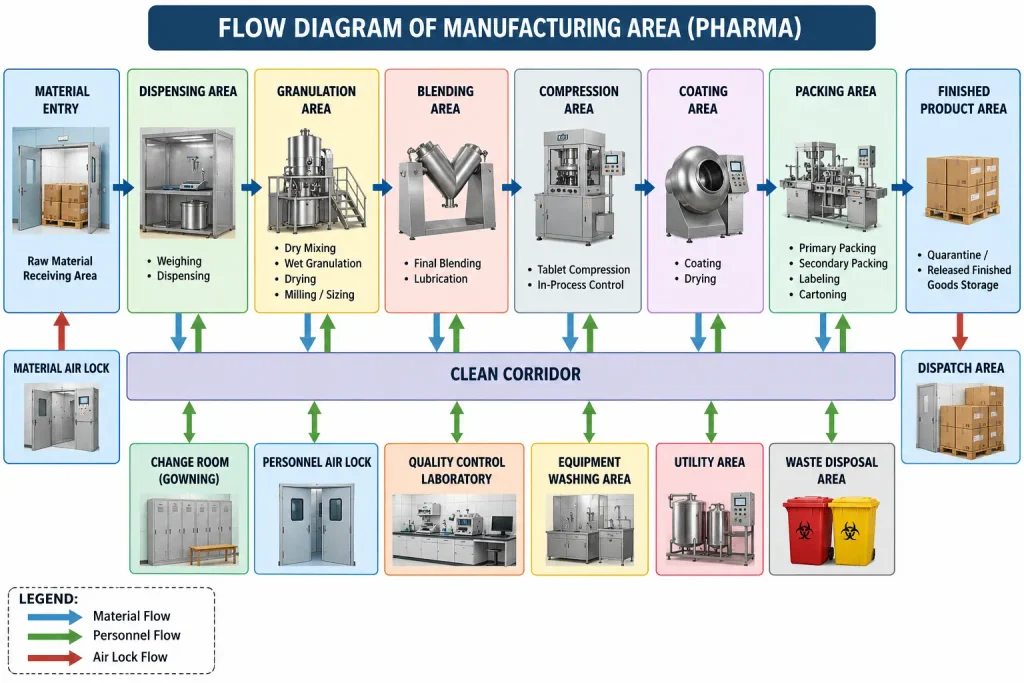
A formal Batch Reprocessing Request is initiated by Production and evaluated by the QA Head. Reprocessing is authorized only after assessment of product quality, safety, and associated risks, followed by deviation approval and appropriate batch identification. The reprocessed batch is also required to undergo accelerated stability testing.
3. Benefits of Following SOP – Procedure for Recovery and Reprocessing:
Following the Procedure for Recovery and Reprocessing ensures that any reprocessing activity is performed in a controlled, documented, risk-assessed, and QA-authorized manner. The SOP requires reprocessing to be exceptional and permits it only when the quality of the final product is not adversely affected and applicable specifications can still be achieved. The procedure helps maintain product quality and patient safety by defining suitable stages and parameters where reprocessing may be considered, including blend, granules, core tablets, coated tablets, liquids, and ointments.
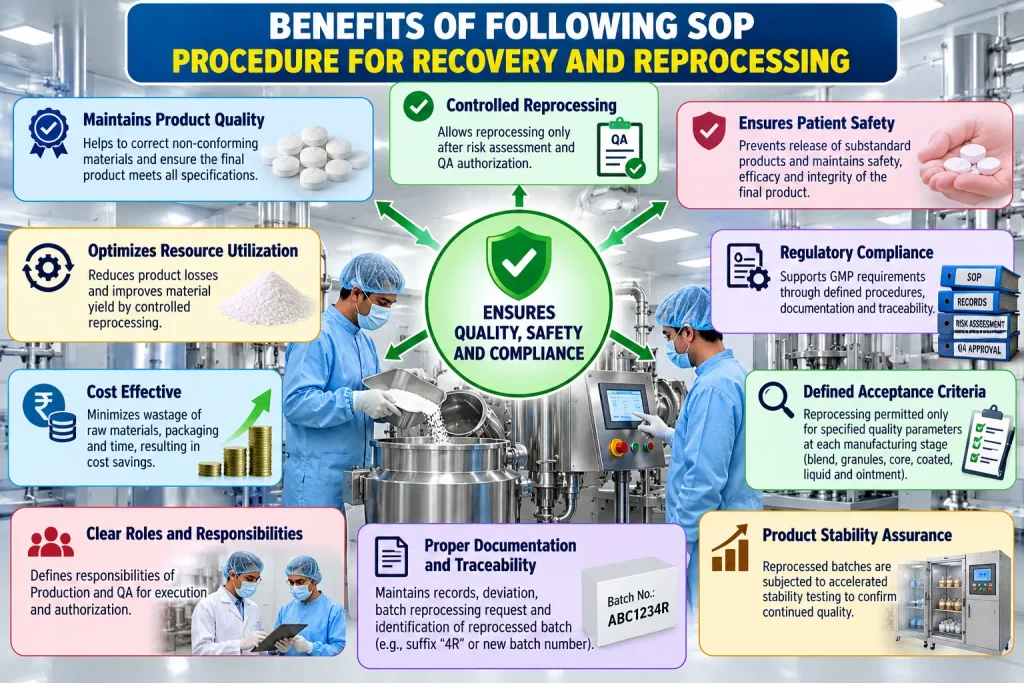
It also improves traceability and compliance through the Batch Reprocessing Request, QA evaluation, risk assessment, deviation approval, and specific identification of reprocessed batches. Reprocessed batches are further subjected to accelerated stability testing to provide additional assurance of continued product quality. overall, adherence to this SOP supports consistent decision-making, defined responsibilities, regulatory compliance, controlled use of materials, reduced avoidable losses, and reliable documentation throughout the recovery and reprocessing process.
4. Brainstorming Analysis for SOP Failure – Procedure for Recovery and Reprocessing:
The Brainstorming Analysis for SOP Failure – Procedure for Recovery and Reprocessing identifies possible causes that may result in improper or uncontrolled reprocessing activities. Key failure factors may arise from personnel, methods, materials, equipment, measurement, environment, documentation, responsibilities, process parameters, and quality compliance. The SOP requires reprocessing to be exceptional, performed through a defined procedure, supported by risk assessment, and authorized by QA. Failure to obtain QA approval, inadequate assessment of product quality and safety, poor documentation, or deviation from the approved reprocessing method can therefore lead to significant SOP failure.
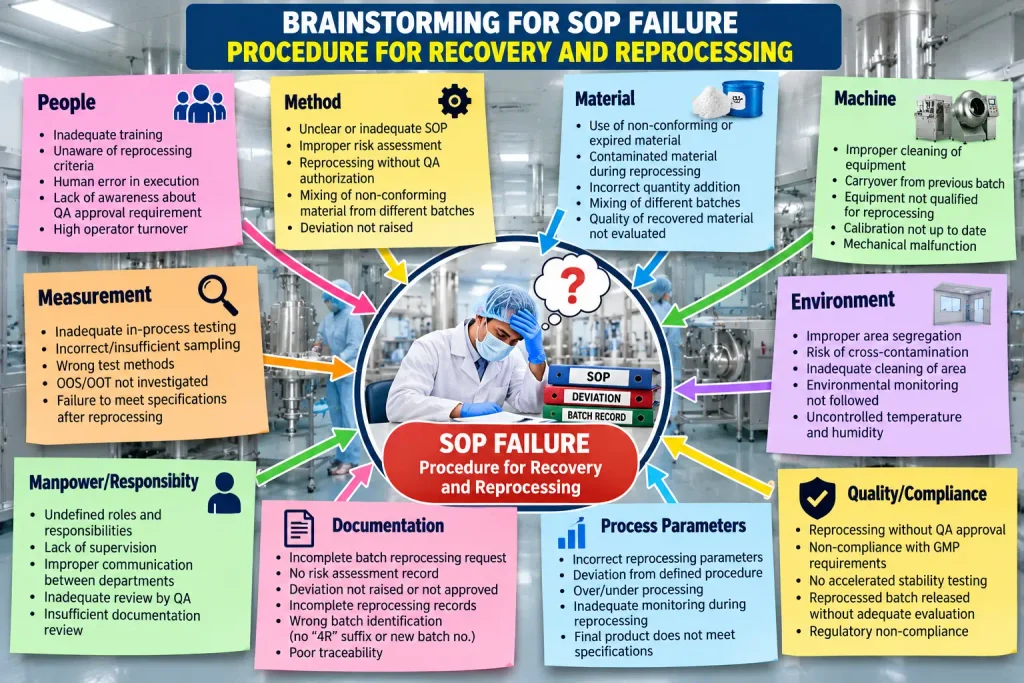
Potential issues also include incomplete Batch Reprocessing Requests, insufficient investigation of failure causes, incorrect identification of reprocessed batches, inadequate monitoring, and failure to perform accelerated stability testing. The SOP specifically requires Production initiation, QA evaluation, risk assessment, deviation approval, proper batch identification, and accelerated stability testing. This brainstorming analysis helps identify weaknesses at an early stage so that suitable CAPA, training, supervision, documentation controls, and QA oversight can be implemented to prevent recurrence and maintain product quality and compliance.
5. 5-Why Analysis for SOP Failure – Procedure for Recovery and Reprocessing:
The 5-Why Analysis for SOP Failure – Procedure for Recovery and Reprocessing is used to identify the underlying reasons for improper or unauthorized reprocessing activities. The analysis may begin with a failure such as reprocessing being carried out without proper approval or without following the defined procedure.Why 1: Reprocessing was performed without proper QA authorization and risk assessment.Why 2: The required Batch Reprocessing Request was not prepared properly or remained incomplete.Why 3: Production personnel were not fully aware of the required information and procedural controls. Why 4: SOP training, communication, and supervisory follow-up were inadequate or ineffective.Why 5: Management oversight, training effectiveness review, and coordination between Production and QA were insufficient.
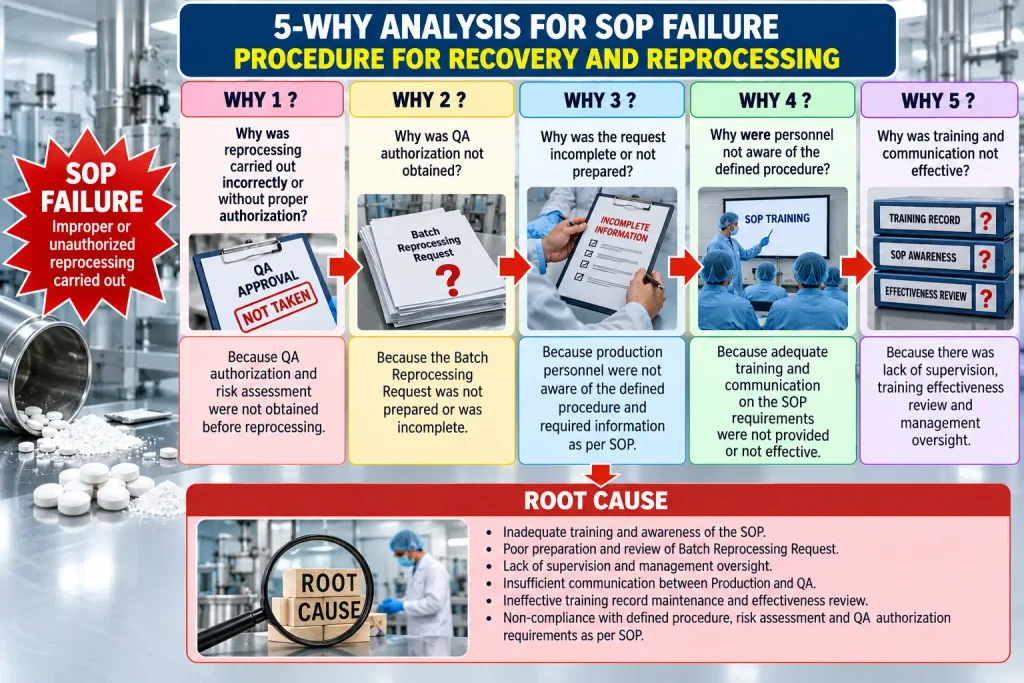
The SOP specifically requires a Batch Reprocessing Request to be initiated by Production, evaluated by the QA Head, supported by risk assessment, and authorized before reprocessing. It also requires a deviation to be raised and approved by QA. Therefore, the probable root causes are inadequate SOP awareness, incomplete documentation, weak supervision, ineffective communication between Production and QA, and failure to comply with the defined authorization and risk-assessment process. The 5-Why approach helps identify these systemic weaknesses so that appropriate CAPA can be established to prevent recurrence.
6. Fishbone Analysis for SOP Failure – Procedure for Recovery and Reprocessing:
The Fishbone Analysis for SOP Failure – Procedure for Recovery and Reprocessing is used to systematically identify the possible causes that may lead to ineffective, incorrect, or unauthorized reprocessing activities. The potential causes can be grouped under Man, Method, Material, Machine, Measurement, Environment, and Documentation. Personnel-related causes may include inadequate SOP training, poor awareness of reprocessing requirements, human error, or weak communication between Production and QA. Method-related causes may include failure to follow the approved procedure, incomplete Batch Reprocessing Requests, absence of risk assessment, or failure to raise an approved deviation. These are important because the SOP requires Production to initiate the request, QA to assess product quality and safety, and QA authorization after risk assessment.
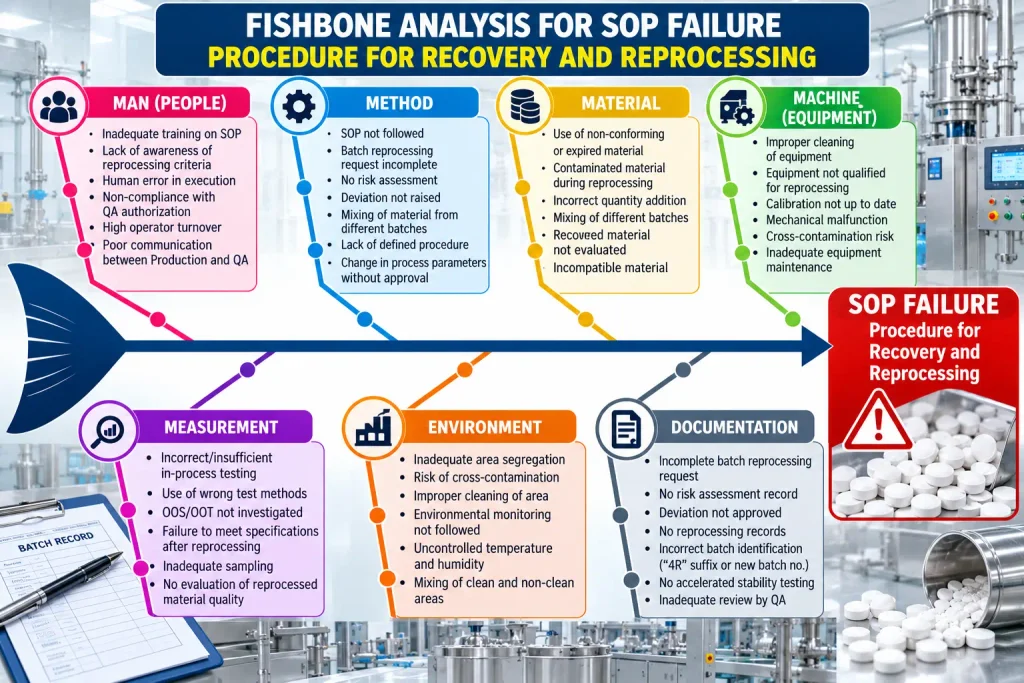
Material, equipment, measurement, and environmental factors can also contribute to SOP failure if they affect the ability of the reprocessed product to meet specifications. The SOP permits reprocessing only when final product quality is not adversely affected and specifications can still be met through an authorized procedure. Documentation failures such as incomplete records, improper batch identification, or failure to perform accelerated stability testing can reduce traceability and compliance. The SOP specifically requires documented reprocessing records, appropriate batch identification, and accelerated stability testing of the reprocessed batch.
7. Fault Tree Analysis for SOP Failure – Procedure for Recovery and Reprocessing:
The Fault Tree Analysis for SOP Failure – Procedure for Recovery and Reprocessing evaluates how different individual failures can combine and result in improper or unauthorized reprocessing. The top event is SOP Failure, which may arise from lack of authorization and risk assessment, incorrect execution of the reprocessing process, failure of the reprocessed product to meet specifications, or inadequate documentation and traceability. The SOP requires reprocessing to be exceptional, supported by a defined procedure, and authorized by QA only after assessment of the associated risks. Therefore, failures such as an incomplete Batch Reprocessing Request, missing QA authorization, absent risk assessment, or unapproved deviation can directly contribute to the top event.
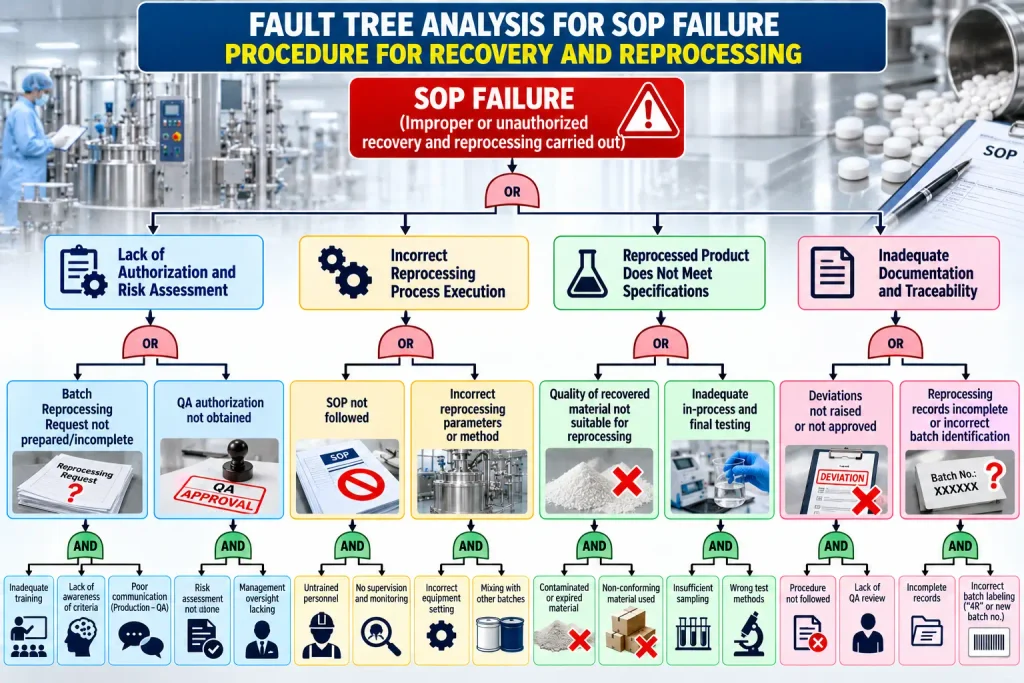
Process-related branches may include failure to follow the approved method, use of incorrect reprocessing parameters, insufficient testing, or use of unsuitable recovered material. The SOP states that reprocessing is permitted only when final product quality is not adversely affected and the required specifications can still be met. Documentation-related failures may include incomplete reprocessing records, incorrect batch identification, or lack of stability follow-up. The SOP requires proper records, defined identification of reprocessed batches, and accelerated stability testing.
8. Impact Assessment for SOP Failure – Procedure for Recovery and Reprocessing:
The Impact Assessment for SOP Failure – Procedure for Recovery and Reprocessing evaluates the potential consequences of performing recovery or reprocessing activities without following the approved procedure. Such failure can directly affect product quality, patient safety, regulatory compliance, documentation, traceability, and overall manufacturing control.The SOP requires reprocessing to be exceptional and permits it only when the final product quality is not adversely affected, specifications can still be met, and the activity is performed through a defined and authorized procedure after assessment of the associated risks.
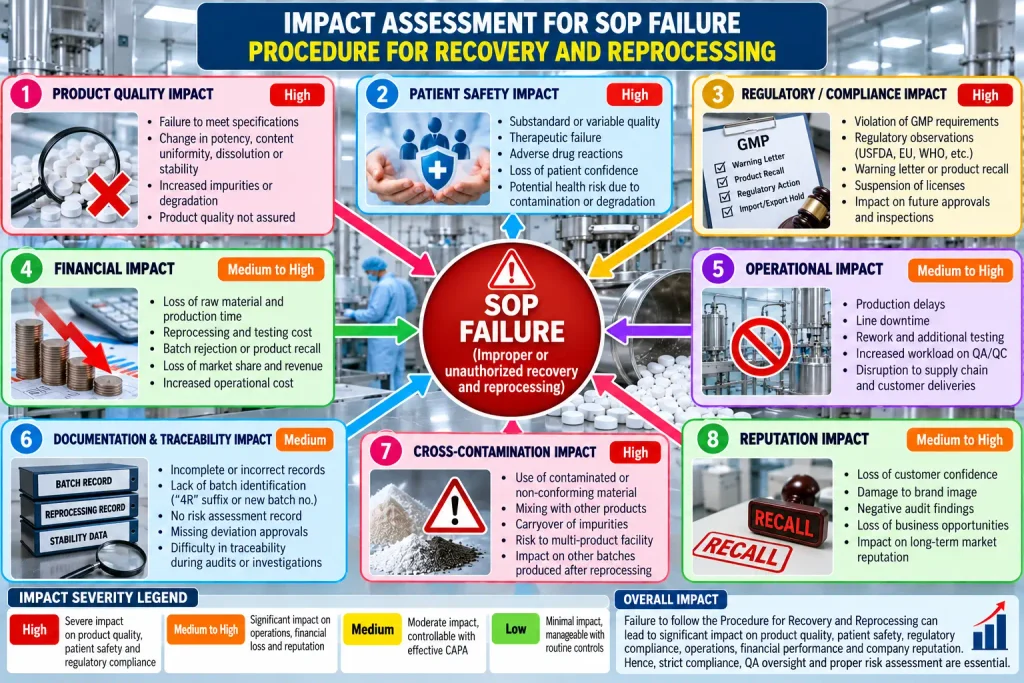
Failure to follow these controls may result in unsuitable reprocessing, inconsistent product characteristics, incomplete investigation, or inadequate assurance that the reprocessed batch continues to meet requirements. The procedure therefore requires a Batch Reprocessing Request, QA evaluation, risk assessment, QA authorization, and approved deviation before execution. Documentation and traceability can also be affected if reprocessing records are incomplete or batch identification is not properly controlled. The SOP requires specific identification of the reprocessed batch and accelerated stability testing to provide continued assurance of product quality.
9. CAPA for SOP Failure – Procedure for Recovery and Reprocessing:
The CAPA for SOP Failure – Procedure for Recovery and Reprocessing is intended to eliminate the immediate cause of non-compliance and prevent recurrence of improper or unauthorized reprocessing activities. Corrective actions should focus on stopping any unapproved reprocessing, initiating the required deviation, evaluating the affected material or batch, completing the Batch Reprocessing Request, and obtaining QA authorization before further processing. The SOP requires Production to initiate the reprocessing request, QA to evaluate product quality and safety, and QA Head to authorize reprocessing after risk assessment.
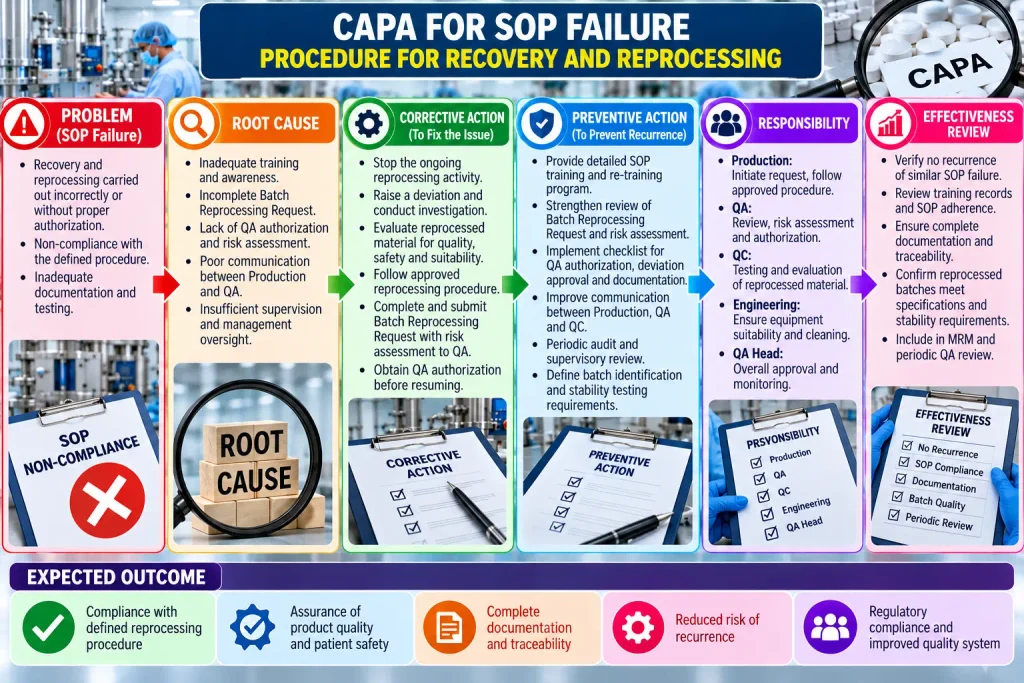
Preventive actions should strengthen SOP training, Production–QA communication, supervisory review, documentation controls, and verification of risk assessment and approval requirements before reprocessing begins. Reprocessing should remain exceptional and must be performed only through a defined and authorized procedure when final product quality is not adversely affected and specifications can still be met. The effectiveness of CAPA should be verified through review of reprocessing records, deviation documentation, QA approvals, batch identification, compliance with the approved procedure, and recurrence trends. The SOP also requires appropriate identification of reprocessed batches and accelerated stability testing, which should be included in the effectiveness review.
Questions & Answers – Procedure for Recovery and Reprocessing:
1. What is the objective of the SOP for Recovery and Reprocessing?
The objective is to define the procedure for recovery and reprocessing of pharmaceutical products in a controlled manner.
2. What manufacturing stages are covered under this SOP?
The SOP covers recovery and reprocessing of blend, granules, core tablets, coated tablets, liquids, and ointments at different manufacturing stages.
3. Who is responsible for execution of the SOP?
Concerned Production personnel are responsible for execution, while the heads of concerned departments are responsible for effective implementation.
4. What is reprocessing?
Reprocessing is normally the repetition of one of the previous steps already defined in the manufacturing process.
5. Is reprocessing a routine activity?
No. Reprocessing of a non-conforming intermediate or finished product is considered an exceptional activity and must be authorized by QA.
6. Under what conditions can reprocessing be permitted?
Reprocessing can be permitted only when final product quality is not adversely affected, specifications can still be met, and the activity is performed through a defined and authorized procedure after risk assessment.
7. What is the difference between reprocessing and reworking according to this SOP?
Reprocessing is the repetition of an existing manufacturing step, whereas reworking introduces a new step that is not defined in the standard manufacturing process. The SOP states that reworking of non-conforming intermediate or finished product is not permitted.
8. Can non-conforming material from an earlier batch be recovered into another batch?
No. The SOP specifically states that recovery of non-conforming material from earlier batches into another batch is not permitted.
9. For which parameters may blend or granules be reprocessed?
The SOP allows reprocessing of blend or granules when they do not meet assay requirements or loss on drying/moisture content.
10. For which parameters may core tablets be considered for reprocessing?
Core tablets may be considered for reprocessing for physical parameters such as appearance, hardness, thickness, diameter/length, average weight, and uniformity in weight.
11. What parameters are specified for coated-tablet reprocessing?
The SOP lists appearance, average weight, and uniformity in weight.
12. What parameters are specified for liquid-product reprocessing?
For liquid products, the SOP lists pH, viscosity, clarity, and appearance.
13. What parameters are specified for ointment reprocessing?
For ointments, the SOP lists consistency, viscosity, and homogeneity.
14. Who initiates the Batch Reprocessing Request?
The Head of Production initiates the Batch Reprocessing Request and describes the proposed reprocessing procedure.
15. Who evaluates and authorizes the reprocessing request?
The QA Head evaluates the request with respect to product quality and safety and authorizes reprocessing after risk assessment.
16. Is a deviation required for reprocessing?
Yes. Production must raise a deviation related to the reprocessing, and it must be approved by the QA Head.
17. How is a reprocessed batch identified?
The SOP specifies use of the suffix “4R” with the batch number for identification and also states that a new batch number shall be assigned when reprocessing is required.
18. Is stability testing required for a reprocessed batch?
Yes. The SOP requires the reprocessed batch to be subjected to accelerated stability testing.
19. What information is included in the Batch Reprocessing Request?
The annexure includes details such as product name, batch number, batch size, manufacturing and expiry dates, manufacturing stage, reasons for failure, probable causes, and the proposed reprocessing method.
20. Why is QA involvement important in recovery and reprocessing?
QA involvement ensures that the proposed reprocessing method, associated risks, product quality, safety, documentation, and authorization are reviewed before the activity is performed.
Reference Guidelines – Procedure for Recovery and Reprocessing:
- WHO Good Manufacturing Practices for Pharmaceutical Products – requirements for handling deviations, non-conforming materials, reprocessing, documentation, and QA authorization.
- EU Guidelines for Good Manufacturing Practice, EudraLex Volume 4, Part I, Chapter 5 – Production – includes expectations for reprocessing and recovery to be exceptional, authorized, risk-assessed, and documented.
- US FDA 21 CFR Part 211 – Current Good Manufacturing Practice for Finished Pharmaceuticals, particularly provisions covering production and process controls, reprocessing, investigations, and batch records.
- PIC/S Guide to Good Manufacturing Practice for Medicinal Products, PE 009, Part I – Chapter 5 – guidance concerning recovery, reprocessing, process control, and prevention of quality risks.
- ICH Q9 – Quality Risk Management – applicable for evaluating risks associated with proposed reprocessing activities.
- ICH Q10 – Pharmaceutical Quality System – supports deviation management, CAPA, change management, management oversight, and continual improvement.
- Schedule M of the Drugs Rules, India – Good Manufacturing Practices and Requirements of Premises, Plant and Equipment for Pharmaceutical Products – applicable GMP expectations for Indian pharmaceutical manufacturing.
- Approved Master Formula Record, Batch Manufacturing Record, Specifications, Validation Documents and Internal Quality Procedures – should also be considered before authorizing any batch-specific reprocessing activity.