






1. Introduction – Procedure for Working in Manufacturing Area:
The “Procedure for Working in Manufacturing Area” establishes the basic GMP requirements and working practices that personnel must follow while performing manufacturing and packing activities in a pharmaceutical facility. The SOP applies to both manufacturing and packing areas and assigns responsibility to Production personnel, Production Chemists, and the Production Manager for proper execution and implementation. The procedure emphasizes that access to manufacturing areas shall be restricted to authorized personnel, and employees must understand their assigned responsibilities before entering process areas. Personnel are required to follow approved gowning, de-gowning, and hygiene procedures. Equipment, rooms, and containers must display appropriate status labels, while environmental conditions such as temperature, relative humidity, and differential pressure must be checked before operations begin.The SOP also requires verification of area and equipment cleanliness, daily calibration of weighing balances, adherence to approved Batch Manufacturing/Production Records, completion of in-process checks, and proper documentation in equipment usage and cleaning logbooks.
Skip to PDF content2. Flow Diagram – Procedure for Working in Manufacturing Area:
The “Procedure for Working in Manufacturing Area” defines the controlled sequence to be followed by personnel during pharmaceutical manufacturing activities. Entry into the manufacturing area is restricted to authorized personnel, who must follow the approved gowning, de-gowning, and personnel hygiene requirements before entering the process area.
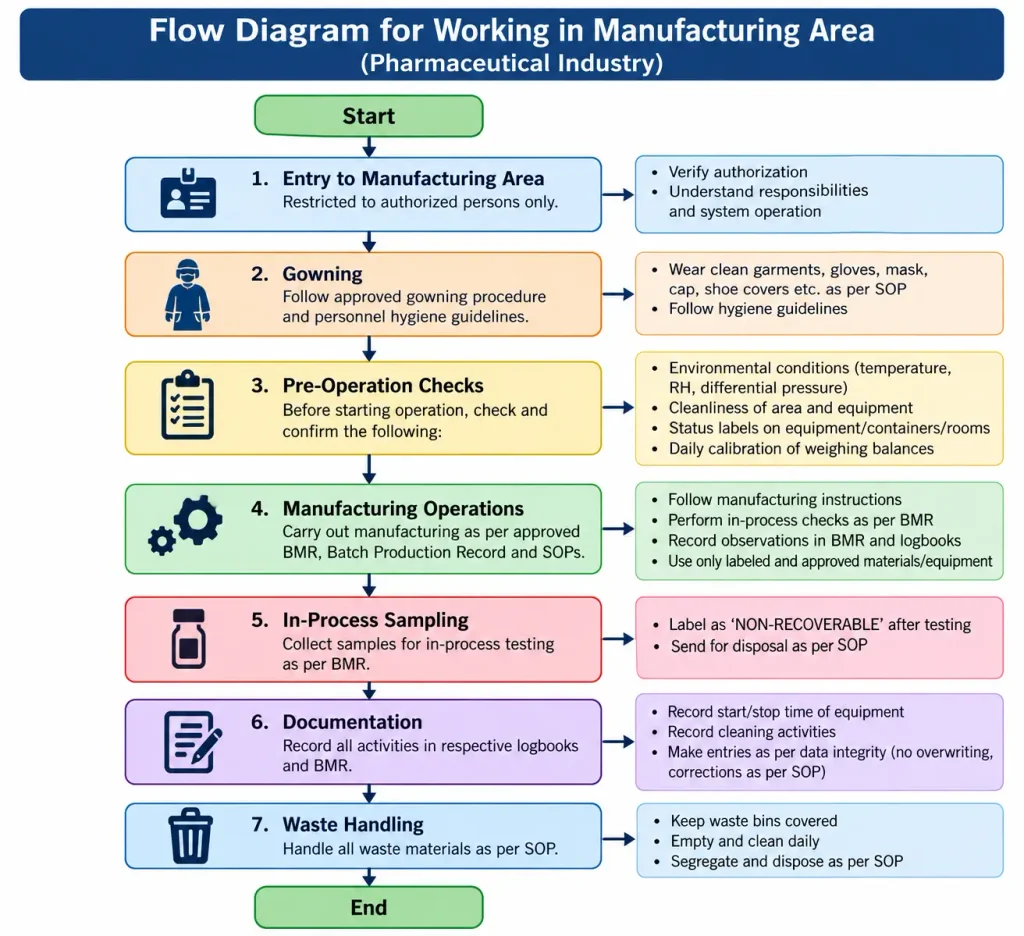
Before starting any manufacturing operation, personnel shall verify the cleanliness of the area and equipment, environmental conditions, equipment and room status labels, and calibration status of weighing balances. Manufacturing activities shall then be performed according to the approved Batch Manufacturing Record, Batch Production Record, and applicable SOPs. In-process checks shall be performed and documented in the respective batch records. Equipment operation and cleaning times shall also be entered in the relevant logbooks. Non-recoverable materials and waste shall be properly identified, segregated, and disposed of according to approved procedures.
3. Benefits of Following SOP – Procedure for Working in Manufacturing Area:
Following the “Procedure for Working in Manufacturing Area” helps ensure that manufacturing and packing activities are performed in a controlled, consistent, and GMP-compliant manner. The SOP requires authorized entry, proper gowning, personnel hygiene, equipment and area status identification, and verification of environmental conditions before starting operations.
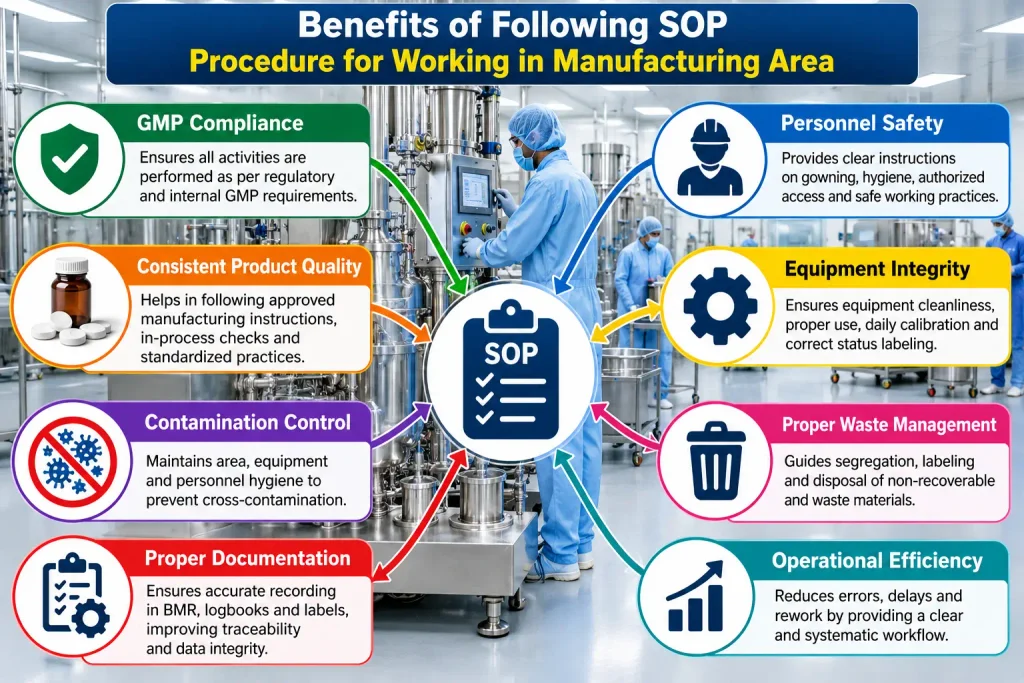
Compliance with the procedure supports consistent product quality and contamination control by ensuring cleanliness of equipment and manufacturing areas, use of approved batch instructions, and completion of required in-process checks.Proper recording of equipment operation, cleaning activities, logbook entries, and batch information also strengthens traceability and documentation control. The SOP further promotes personnel safety, equipment integrity, proper waste management, and operational efficiency through controlled access, appropriate labeling, maintenance status identification, covered waste bins, use of clean garments and gloves, and defined handling of materials and containers.
4. Brainstorming Analysis for SOP Failure – Procedure for Working in Manufacturing Area:
Brainstorming for failure of the “Procedure for Working in Manufacturing Area” helps identify possible causes that may lead to non-compliance during pharmaceutical manufacturing and packing activities. Potential failures include unauthorized entry, improper gowning or personnel hygiene, failure to verify temperature, relative humidity and differential pressure, inadequate area or equipment cleanliness, missing status labels, and use of an uncalibrated weighing balance. These points are directly related to the controls required before and during manufacturing operations. Other possible causes include not following BMR/BPR instructions, incomplete in-process checks, incorrect or missing logbook entries, improper handling of non-recoverable materials, and inadequate waste segregation.
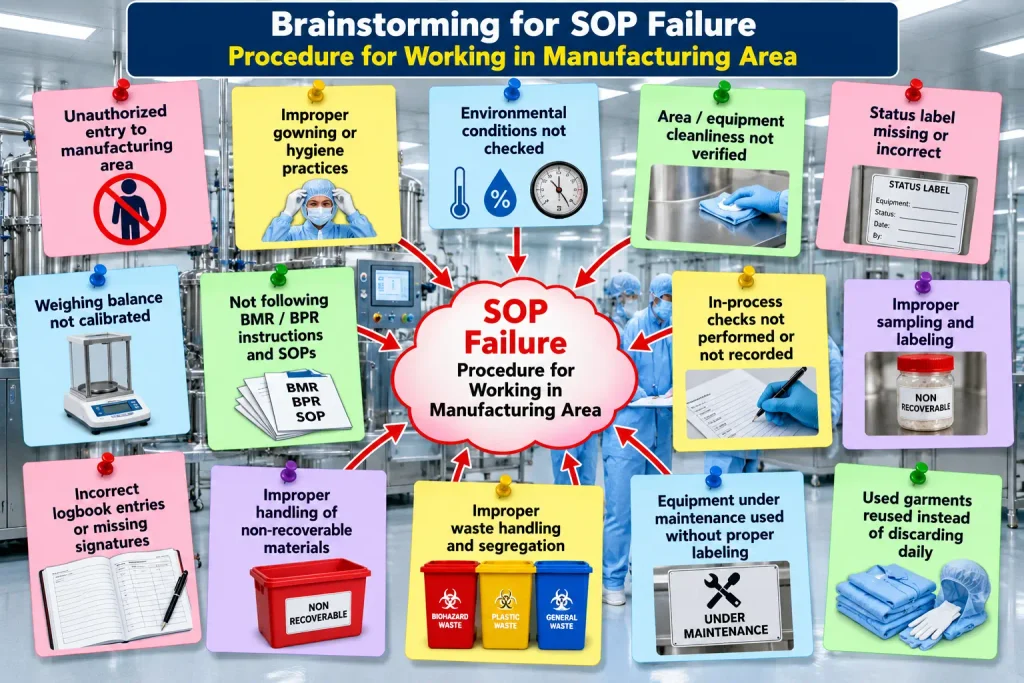
The SOP also requires proper maintenance labeling, daily replacement of used garments, glove use for personnel in direct product contact, covered waste bins, and clear identification of materials, containers, and equipment. Failure in any of these controls may increase the risk of mix-up, contamination, documentation errors, product-quality impact, and GMP non-compliance.
5. 5-Why Analysis for SOP Failure – Procedure for Working in Manufacturing Area:
The 5-Why Analysis for failure of the “Procedure for Working in Manufacturing Area” is used to identify the underlying causes of non-compliance during manufacturing activities. The SOP requires authorized entry, proper understanding of assigned responsibilities, approved gowning and hygiene practices, verification of environmental conditions, equipment and area cleanliness, calibration of balances, and adherence to BMR/BPR instructions.
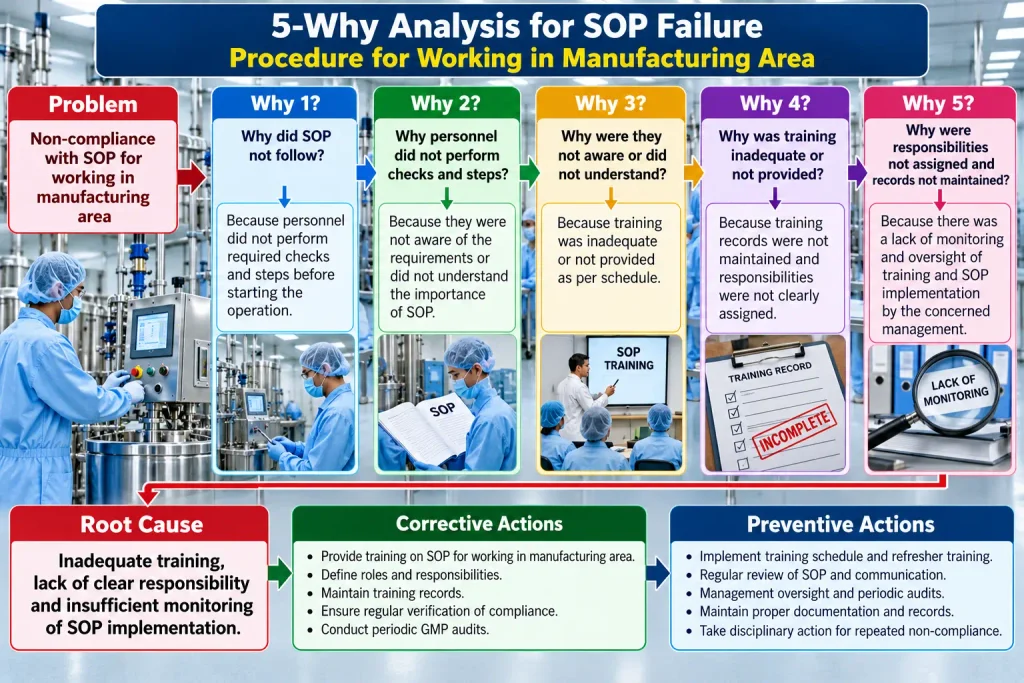
The analysis may begin with the problem that personnel failed to follow required manufacturing-area controls. The first cause may be that required checks or procedural steps were not performed. This can further be linked to inadequate awareness or understanding of SOP requirements, insufficient training, unclear assignment of responsibilities, or weak monitoring of implementation. The SOP itself assigns execution responsibility to Production personnel and Production Chemists, while the Production Manager is responsible for effective implementation.Therefore, the likely root causes identified through the 5-Why approach are inadequate training, unclear accountability, and insufficient supervisory monitoring.
6. Fishbone Analysis for SOP Failure – Procedure for Working in Manufacturing Area:
The Fishbone Analysis for failure of the “Procedure for Working in Manufacturing Area” helps identify and organize the possible causes of non-compliance under major categories such as Man, Machine, Method, Material, Measurement, Environment, and Management. The SOP requires authorized entry, proper gowning and hygiene, verification of environmental conditions, area and equipment cleanliness, appropriate status labeling, balance calibration, and adherence to approved manufacturing instructions.
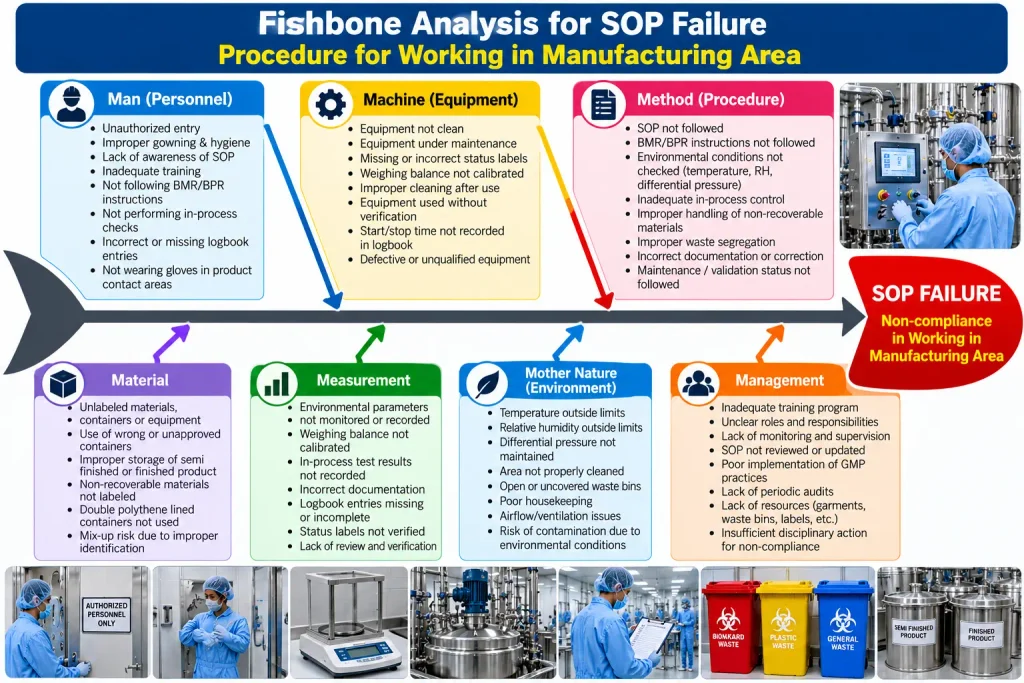
Under Man, causes may include inadequate training, poor awareness, improper gowning, or missed in-process checks. Machine factors may include unclean equipment, maintenance issues, missing status labels, or uncalibrated balances. Method failures can involve non-adherence to SOPs, BMR/BPR instructions, documentation requirements, or waste-handling procedures. The SOP also requires proper labeling and identification of materials, containers, and equipment, as well as controlled storage of semi-finished and bulk finished products. Measurement and Environment causes may include failure to monitor temperature, relative humidity, differential pressure, calibration status, or in-process results. Management causes can include inadequate supervision, unclear responsibilities, weak training control, and insufficient compliance monitoring.
7. Fault Tree Analysis for SOP Failure – Procedure for Working in Manufacturing Area:
The Fault Tree Analysis for failure of the “Procedure for Working in Manufacturing Area” identifies how different basic and intermediate failures can combine to cause the top event: non-compliance while working in the manufacturing area. The SOP requires controlled entry, proper understanding of responsibilities, approved gowning and hygiene, correct status labeling, verification of environmental conditions, cleanliness checks, calibration of balances, and compliance with BMR/BPR and applicable SOPs.
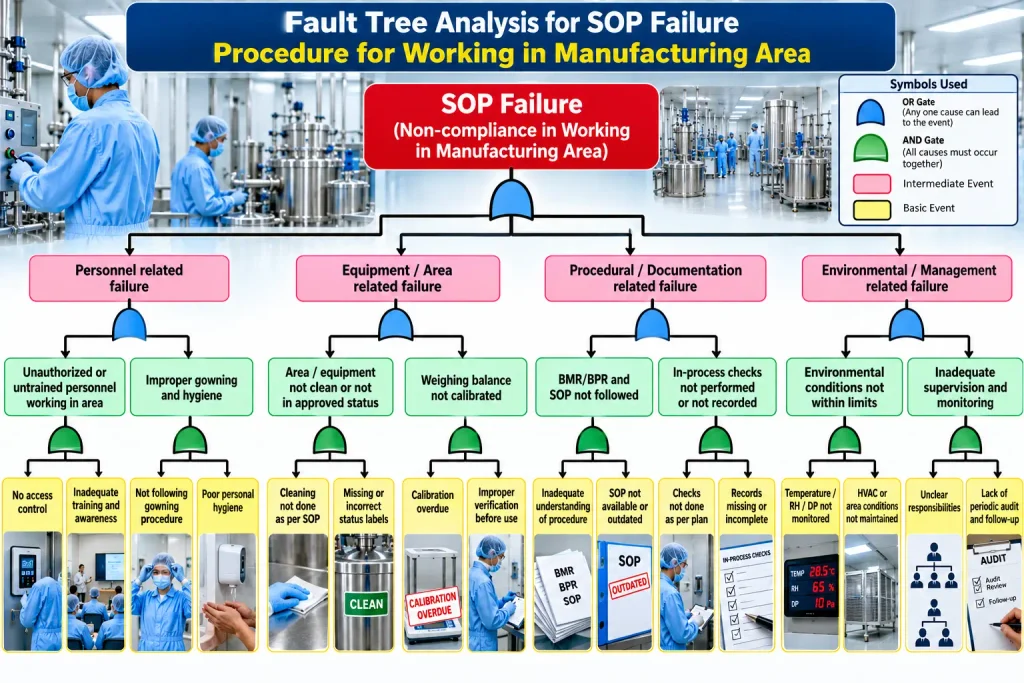
The fault tree can be divided into major branches such as personnel-related failure, equipment/area-related failure, procedural/documentation failure, and environmental or management failure. Personnel-related causes may include unauthorized entry, inadequate training, improper gowning, or poor hygiene. Equipment and area failures may include inadequate cleaning, incorrect status labels, or uncalibrated weighing balances. Procedural failures may arise from not following BMR/BPR instructions, missing in-process checks, or incomplete records. Environmental and management failures may involve failure to monitor temperature, relative humidity, and differential pressure, inadequate supervision, or unclear responsibility for implementation. The SOP specifically assigns execution responsibility to Production personnel and Production Chemists, with the Production Manager responsible for effective implementation.
8. Impact Assessment for SOP Failure – Procedure for Working in Manufacturing Area:
The Impact Assessment for failure of the “Procedure for Working in Manufacturing Area” evaluates the potential consequences of non-compliance on product quality, patient safety, GMP compliance, documentation, and manufacturing operations. The SOP requires controlled access, proper gowning and hygiene, verification of environmental conditions, equipment and area cleanliness, correct status labeling, balance calibration, and compliance with approved batch instructions. Failures such as unauthorized entry, improper gowning, unclean equipment, missed environmental checks, or incorrect status labeling may increase the risk of contamination, mix-ups, and uncontrolled manufacturing conditions. Failure to calibrate weighing balances or follow BMR/BPR instructions may lead to incorrect processing, inaccurate quantities, batch failure, or rejection.
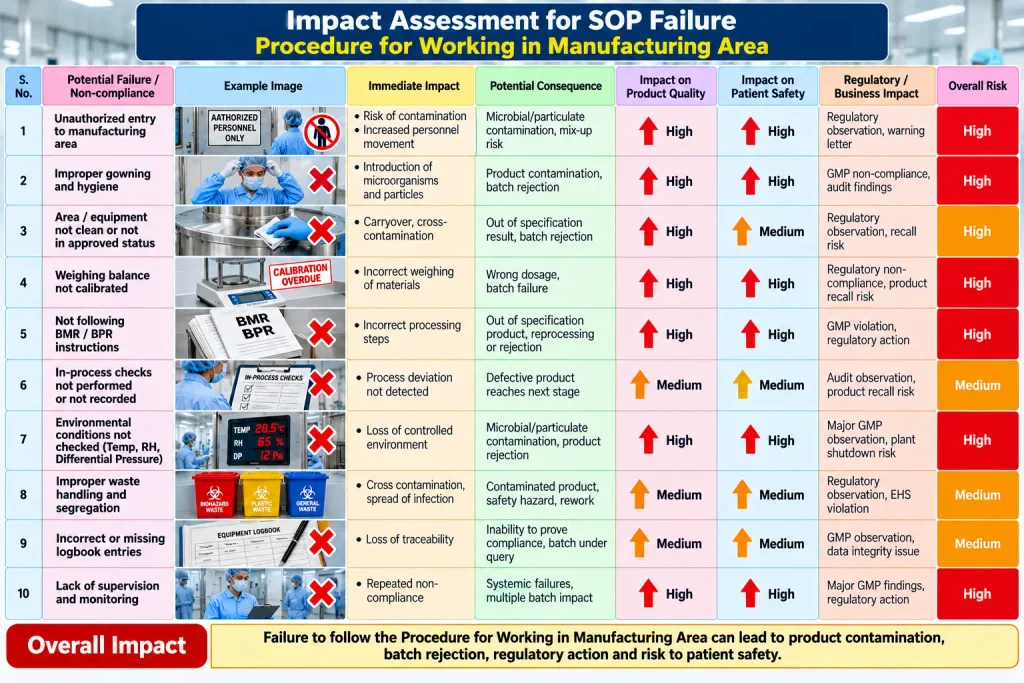
Incomplete in-process checks, missing logbook entries, and improper handling of non-recoverable or waste materials can reduce traceability and weaken GMP control. The SOP specifically requires recording of equipment operation and cleaning activities and controlled handling of non-recoverable materials.
9. Corrective and Preventive Action (CAPA) for SOP Failure – Procedure for Working in Manufacturing Area:
The CAPA for failure of the “Procedure for Working in Manufacturing Area” is intended to correct identified non-compliances and prevent their recurrence during pharmaceutical manufacturing and packing activities. The SOP requires controlled entry, proper gowning and hygiene, verification of environmental conditions, area and equipment cleanliness, correct status labeling, balance calibration, adherence to BMR/BPR instructions, in-process checks, and proper documentation.
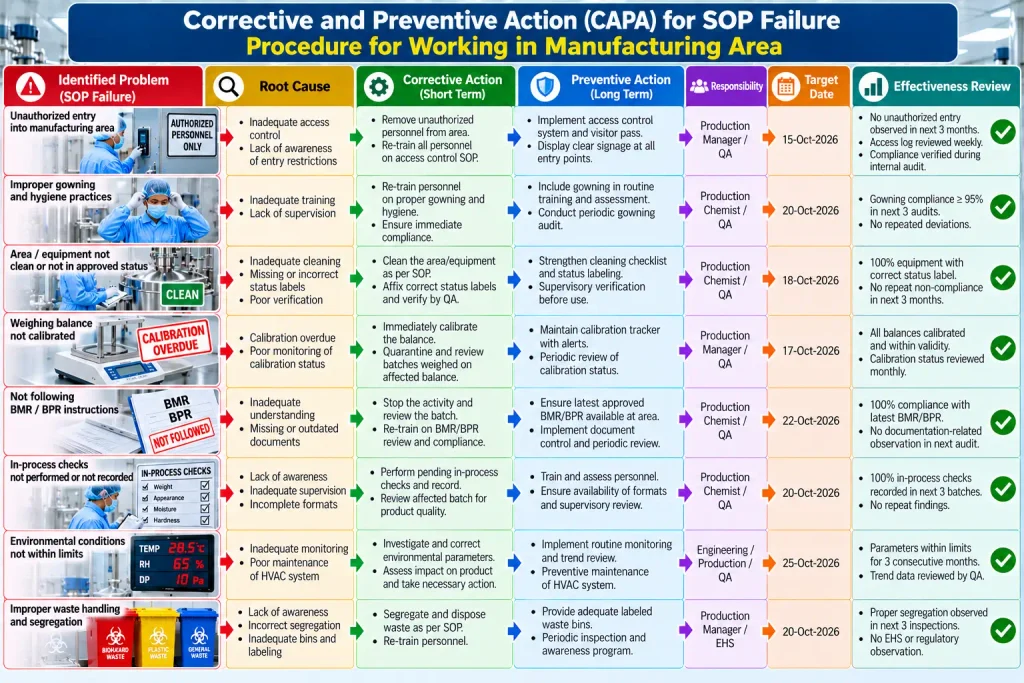
Corrective actions may include removing unauthorized personnel, retraining employees, cleaning and correctly labeling equipment, calibrating overdue balances, completing missed in-process checks, correcting environmental deviations, and ensuring proper waste segregation. Where documentation or logbook entries are incomplete, the affected records should be reviewed and corrected according to the approved documentation procedure. Preventive actions should focus on routine refresher training, strengthened access control, supervisory verification, calibration tracking, periodic review of BMR/BPR availability, scheduled environmental monitoring, cleaning verification, and regular GMP compliance audits. The SOP also requires maintenance labeling, daily use of fresh garments, glove use during direct product contact, covered waste bins, and proper identification of materials and equipment.
Questions & Answers – Procedure for Working in Manufacturing Area:
Q1. What is the objective of the SOP “Procedure for Working in Manufacturing Area”?
Answer: The objective is to describe the procedure to be followed while working in the manufacturing area.
Q2. What is the scope of this SOP?
Answer: The SOP covers working practices in both the Manufacturing and Packing areas.
Q3. Who is responsible for execution of this SOP?
Answer: Concerned Production personnel and Production Chemists are responsible for execution of the SOP.
Q4. Who is responsible for effective implementation of this SOP?
Answer: The Manager-Production and designated responsible personnel are responsible for effective implementation.
Q5. Who is allowed to enter the manufacturing area?
Answer: Entry is restricted to authorized personnel only.
Q6. What should personnel know before entering the process area?
Answer: Personnel should understand their responsibilities and have knowledge of the system operation relevant to their position.
Q7. What gowning and hygiene requirements should be followed?
Answer: Personnel must follow the approved gowning and de-gowning procedure and applicable personnel hygiene guidelines.
Q8. What status identification is required in the manufacturing area?
Answer: Equipment, containers, and rooms must carry duly filled status labels as per the applicable SOP.
Q9. Which environmental conditions should be checked before starting operations?
Answer: Temperature, relative humidity, and differential pressure should be checked and confirmed within acceptance limits before operation.
Q10. What should be done if environmental conditions are outside the acceptance limits?
Answer: The concerned person should be informed so that necessary action can be taken before continuing the operation.
Q11. What should be checked before starting manufacturing activity?
Answer: The cleanliness of the manufacturing area and equipment should be verified before starting the operation.
Q12. How often should weighing balances be calibrated according to this SOP?
Answer: Weighing balances should be calibrated daily as per the applicable SOP.
Q13. Which documents should be followed during manufacturing?
Answer: Manufacturing instructions given in the Batch Manufacturing Record, Batch Production Record, and applicable SOPs should be followed.
Q14. Who performs in-process checks?
Answer: Operators, concerned Production Chemists, and In-Process Quality Assurance personnel perform the required in-process checks and record them in the BMR.
Q15. How should samples used for in-process testing be handled?
Answer: After testing, samples should be placed in a container labeled “NON-RECOVERABLE” for disposal.
Q16. What equipment-related information must be recorded?
Answer: The start and stop times of equipment operation and cleaning should be recorded in the relevant equipment usage and cleaning logbook.
Q17. How are non-recoverable materials handled?
Answer: They should be appropriately labeled and sent for destruction after approval from the Quality Assurance Manager.
Q18. What precautions apply to equipment under maintenance?
Answer: The concerned area or equipment should carry a duly signed maintenance label from Engineering and Production.
Q19. What status label is required during validation activities?
Answer: A “Validation In Progress” status label should be displayed on the equipment or system while validation is being performed.
Q20. What are the requirements for used garments and gloves?
Answer: Used garments should be discarded daily, fresh and clean garments should be worn the next day, and personnel coming into direct contact with the product should wear gloves.
Q21. How should waste bins be maintained?
Answer: Waste bins should remain covered and should be emptied and cleaned daily as per the applicable SOP.
Q22. What is required before starting packing operations after a product or batch changeover?
Answer: Line clearance of the packing line should be taken before starting operations.
Q23. What should be verified before starting coding operations?
Answer: Coding details should be approved by Production and Quality Assurance personnel, and the approved specimen should be attached to the Batch Packing Record.
Q24. What defects should be checked during tablet blister inspection?
Answer: The SOP lists defects such as broken tablets, chipped tablets, mottling, capping, black spots, powder in blister, foreign matter, double tablets, and deformed blisters.
Q25. Why is this SOP important in pharmaceutical manufacturing?
Answer: Based on the controls defined in the SOP, it supports disciplined manufacturing practices through controlled access, hygiene, environmental monitoring, equipment cleanliness, labeling, in-process checks, documentation, waste handling, and packing controls.
Reference Guidelines – Procedure for Working in Manufacturing Area:
- Good Manufacturing Practices (GMP) – General GMP requirements applicable to controlled pharmaceutical manufacturing and packing activities.
- Entry and Exit Procedure – For controlled movement of authorized personnel into and out of manufacturing areas.
- Labeling Procedure in Manufacturing Area – For identification and status labeling of rooms, equipment, containers, and materials.
- Collection and Disposal of Waste and Rejected Material from Plant – For segregation, labeling, handling, and disposal of waste and rejected materials.
- Document Entries Procedure – For proper recording and correction of entries in GMP documents and logbooks.
- Cleaning and Sanitization of Manufacturing Area – For maintaining manufacturing-area cleanliness and hygienic conditions.
- Zero Reading and Calibration of Weighing Scale – For ensuring weighing balances are verified and calibrated before use.
- Handling and Usage of Stereos – For controlled use, collection, and destruction of printing stereos used during packing operations.
- Procedure During Start-Up, Breaks, Closing and Shutdown in Manufacturing Area – For controlled management of manufacturing activities during operational transitions.
- Handling of Defective Blisters/Strips/Containers from Secondary Packing – For appropriate handling of defective packaging units.
- Transfer of Finished Goods to Finished Goods Store – For controlled movement of packed products to the finished-goods storage area.