






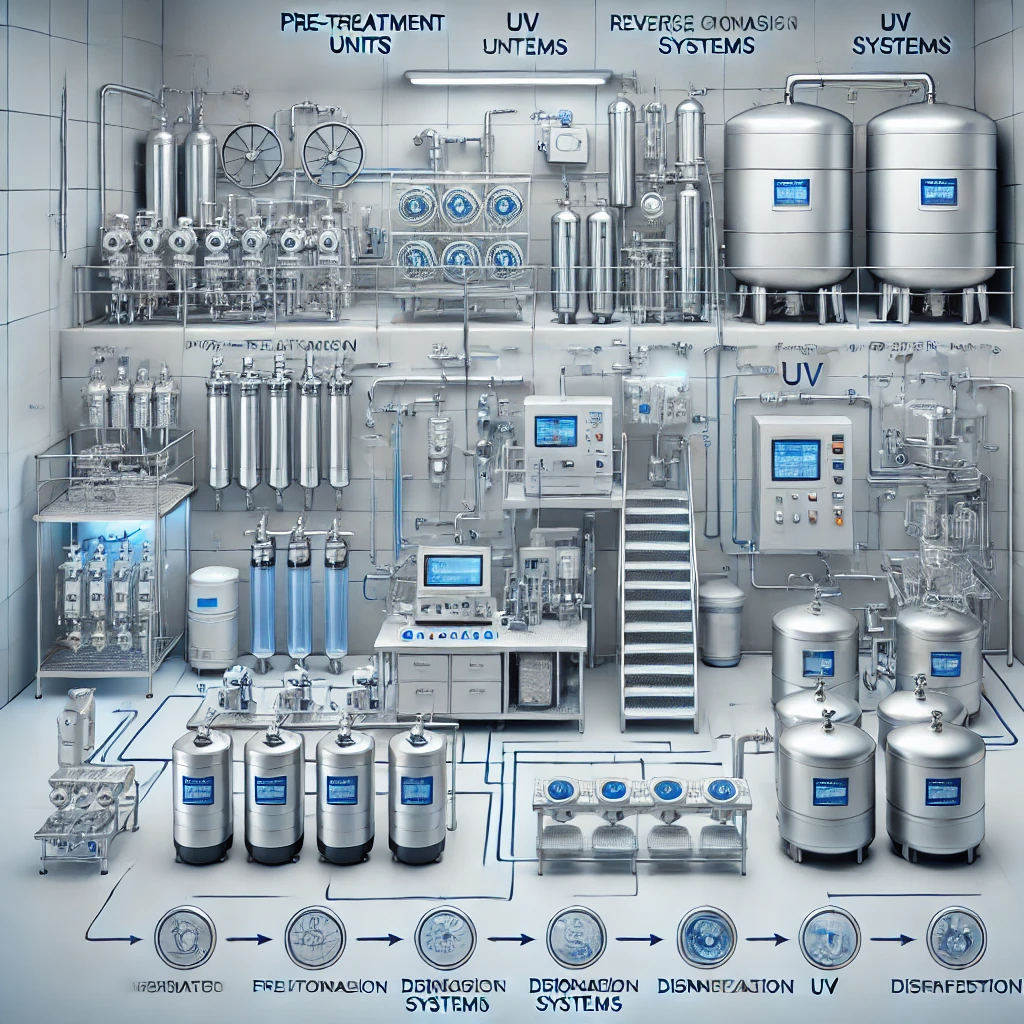
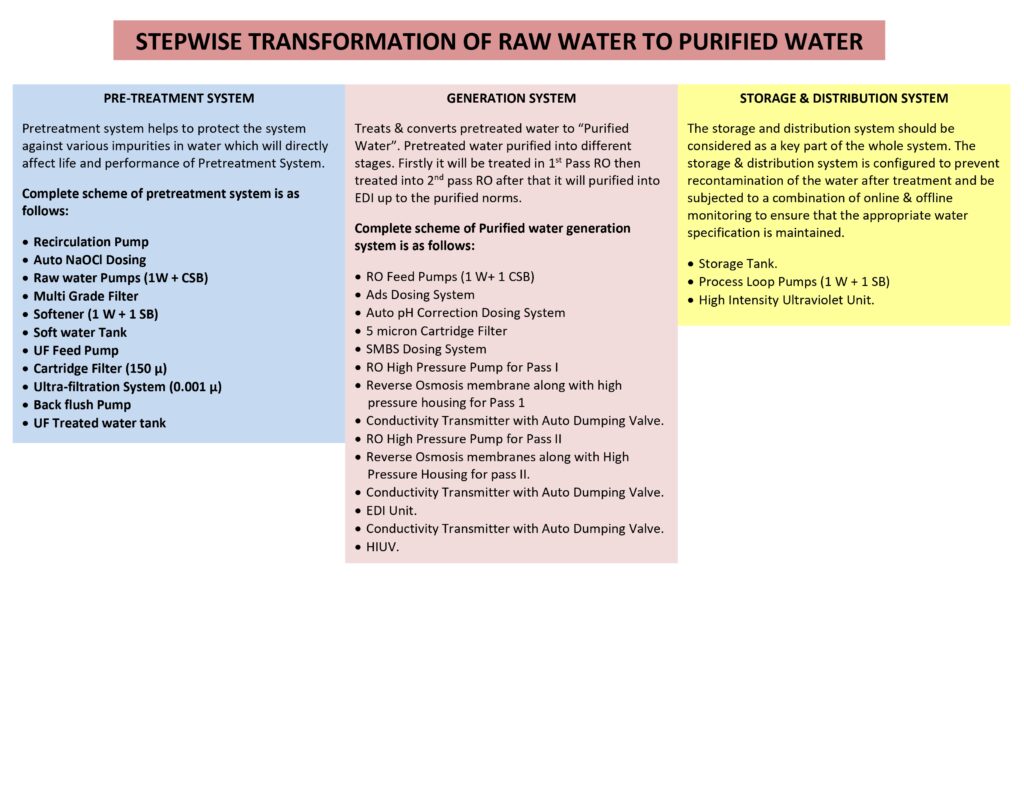
Here’s a practical, end-to-end overview of a Purified Water (PW) system in pharma: pre-treatment → generation → storage → distribution—what each stage does, typical equipment, and key GMP controls.
1) Pre-treatment (protect the RO/EDI and stabilize feed quality)
Purpose: reduce hardness, chlorine, suspended solids, organics, and fouling risks so the generation step is reliable.
Common train (typical order):
- Raw water tank / break tank (optional): buffers supply and isolates municipal pressure fluctuations.
- Multi-grade sand / media filter: removes turbidity and suspended solids.
- Activated carbon filter (ACF): removes free chlorine/chloramines and organics (protects RO membranes).
- Water softener (Na⁺ exchange): removes hardness (Ca/Mg) to prevent scaling.
- Chemical dosing (as needed):
- Antiscalant (if softener not used or in high scaling waters)
- SMBS (dechlorination, where carbon isn’t sufficient)
- pH adjustment (rare; depends on feed)
- Cartridge filter (5–1 µm): final particulate barrier before RO.
- Online instruments: pressure drop (ΔP) across filters, residual chlorine after ACF, flow, conductivity, SDI (optional).
GMP focus:
- Control carbon bed microbial growth (sanitization/steam/hot water where designed, defined changeout).
- Avoid “dead legs” and stagnant zones in pre-treatment piping.
- Trend ΔP and chlorine breakthrough to prevent RO damage.
2) Generation (produce PW to spec)
Purpose: remove dissolved salts/ions, organics, and microorganisms.
Typical generation options:
- Double-pass RO (2RO): strong, widely used baseline for PW.
- RO + EDI (electrodeionization): continuous polishing to low conductivity without chemical regeneration.
- UV (254 nm): reduces bioburden; often placed before storage or in loop.
- UV (185 nm) for TOC reduction: used to break down organics (often paired with 254 nm).
- Final membrane (UF/MF, optional): used where tighter microbial/endotoxin control is needed (more common in WFI systems).
Key controls:
- Online conductivity/resistivity (after RO/EDI and sometimes at multiple points)
- Flow, pressure, temperature
- RO performance: salt rejection, differential pressure, permeate conductivity trend
- Defined sanitization strategy for RO/EDI (hot water capable designs are preferred where feasible).
3) Storage (hold PW without letting it degrade)
Purpose: store PW hygienically and maintain quality between generation and use.
Typical storage design (sanitary):
- 316L SS tank, internal finish appropriate for pharma service
- Sloped bottom with full drain, minimal nozzles
- Spray ball for CIP / sanitization
- Hydrophobic sterilizing vent filter (0.2 µm) with integrity test program
- Level control, temperature monitoring (if heated loop), overflow/return arrangement
- Often designed for continuous recirculation to the distribution loop
Critical risks:
- Warm, stagnant water → biofilm formation.
- Poor vent filtration → microbial ingress.
- Long hold times → rising microbial counts/TOC.
4) Distribution (deliver PW to points of use, continuously controlled)
Purpose: keep water moving and sanitary all the way to user valves.
Typical loop features:
- Continuous recirculation loop (ring main), balanced returns
- Sanitary diaphragm valves, hygienic sample valves
- Point-of-use (POU) valves designed to minimize dead legs
- Velocity/turbulence sufficient to discourage biofilm (site-specific design)
- Heat sanitizable loop (hot PW) or chemical/ozone sanitization depending on philosophy
- Optional UV and final filter near critical POUs (used carefully—filters can become bioburden traps if not managed)
Instrumentation & monitoring:
- Online conductivity (often in return)
- TOC (online or periodic, depending on system criticality)
- Temperature (if hot loop)
- Routine sampling plan: incoming, generation outlet, tank, loop return, and representative POUs
- Microbial monitoring with alert/action limits and trending
Sanitization (make it a defined, repeatable program)
Common approaches:
- Hot water sanitization (robust, simple operations once designed)
- Ozone sanitization (effective at ambient temperature; needs ozone destruction before use)
- Chemical sanitization (e.g., peracetic acid/hydrogen peroxide blends) with validated rinse-out
Validation essentials (what auditors expect)
- Clear URS/DQ (intended use, required quality, capacity, materials)
- IQ/OQ/PQ with worst-case and seasonal feed variation considered
- Defined alert/action limits, deviation handling, and CAPA
- Strong trend review (conductivity, TOC, micro, sanitization records)
need to be elaborate about this complex system .
dear Whatsapp only