






1. Introduction for Risk Assessment for Microscope:
The Risk Assessment for Microscope evaluates potential hazards associated with microscope operation in pharmaceutical microbiology laboratories under GMP conditions. Using the 6M methodology and Failure Mode and Effects Analysis (FMEA), it identifies risks related to personnel, equipment, materials, methods, measurements, and environmental conditions. Major concerns include improper handling, calibration failures, sample contamination, inadequate cleaning, inaccurate observations, and documentation errors. Risk Priority Numbers (RPNs) help prioritize corrective and preventive measures. Recommended controls include operator training, validated SOPs, scheduled calibration, preventive maintenance, environmental monitoring, and proper documentation. These measures support reliable analytical results, regulatory compliance, product quality, and data integrity.
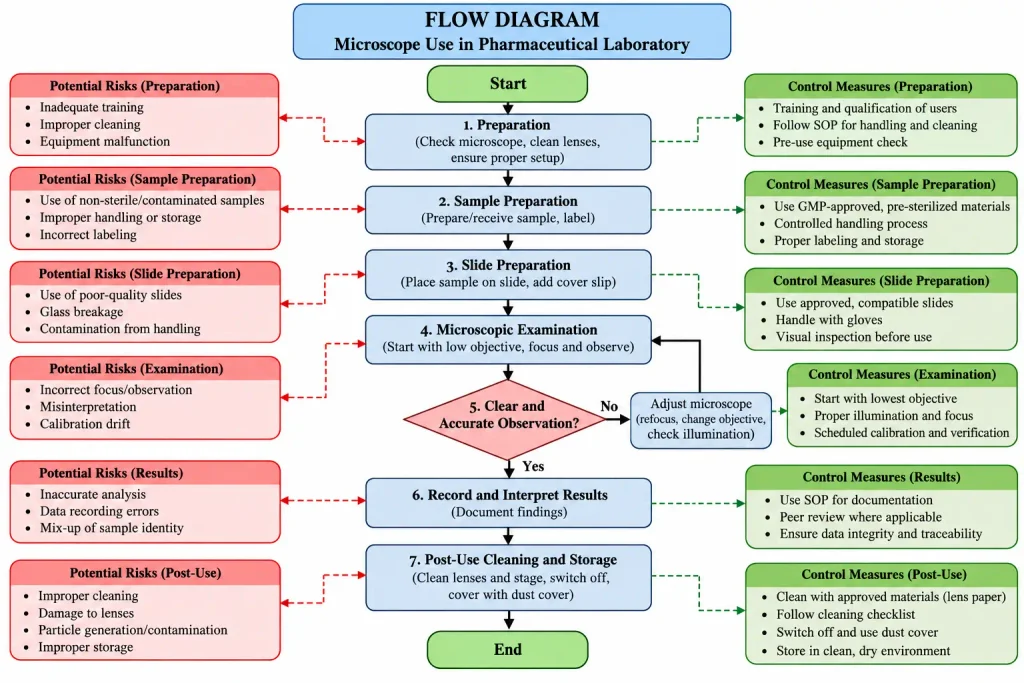
Skip to PDF content2. Flow Diagram – Risk Assessment for Microscope:
The Flow Diagram for Risk Assessment of Microscope illustrates the systematic process of microscope operation, identifying potential risks and corresponding control measures at each stage. It begins with equipment preparation, followed by sample preparation, slide preparation, microscopic examination, observation verification, result documentation, and post-use cleaning. Major risks include improper handling, contamination, calibration errors, inaccurate observations, and documentation failures. Preventive measures involve operator training, approved SOPs, equipment verification, proper illumination, GMP-compliant materials, and accurate recordkeeping. The diagram emphasizes corrective actions when observations are unclear, ensuring reliable microscopic analysis, data integrity, product quality, and compliance with pharmaceutical GMP requirements.
3. Brainstorming – Risk Assessment for Microscope:
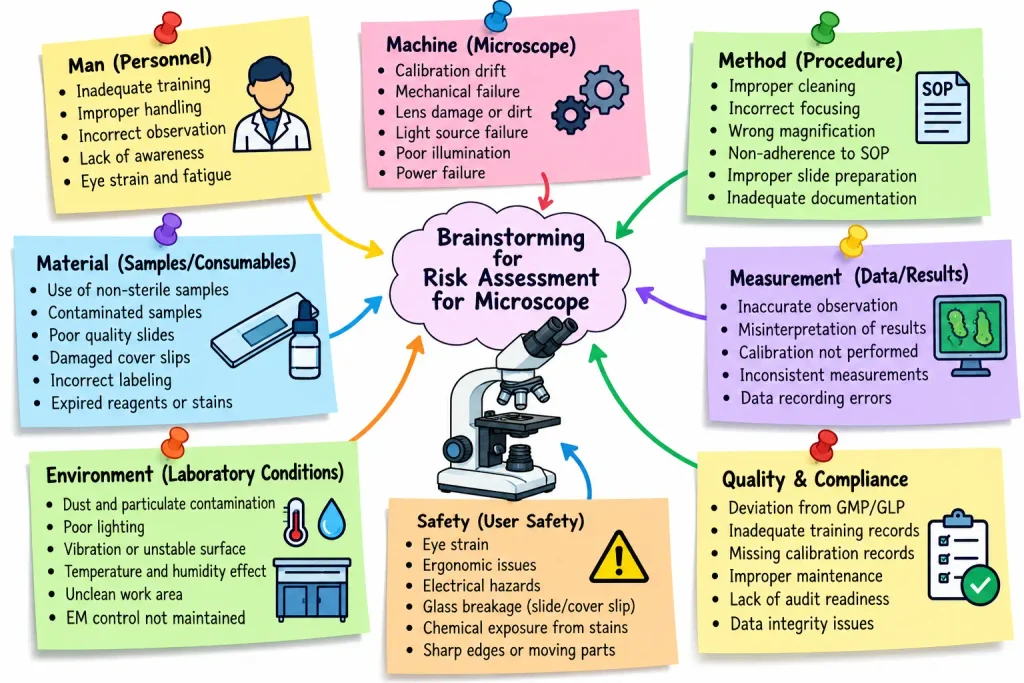
The Brainstorming Diagram for Risk Assessment of Microscope illustrates potential hazards associated with microscope operation in pharmaceutical microbiology laboratories. It categorizes risks into personnel, machine, materials, methods, measurements, environment, safety, and quality compliance. Major concerns include inadequate training, calibration failures, contaminated samples, improper cleaning, inaccurate observations, and environmental fluctuations. The brainstorming process encourages systematic identification of possible failure modes affecting analytical accuracy, operator safety, product quality, and data integrity. Identified hazards provide the foundation for further evaluation through FMEA, risk prioritization, and CAPA implementation. This structured approach supports effective risk control, GMP compliance, reliable laboratory operations, and continuous improvement.
4. 5 Why Analysis – Risk Assessment for Microscope:
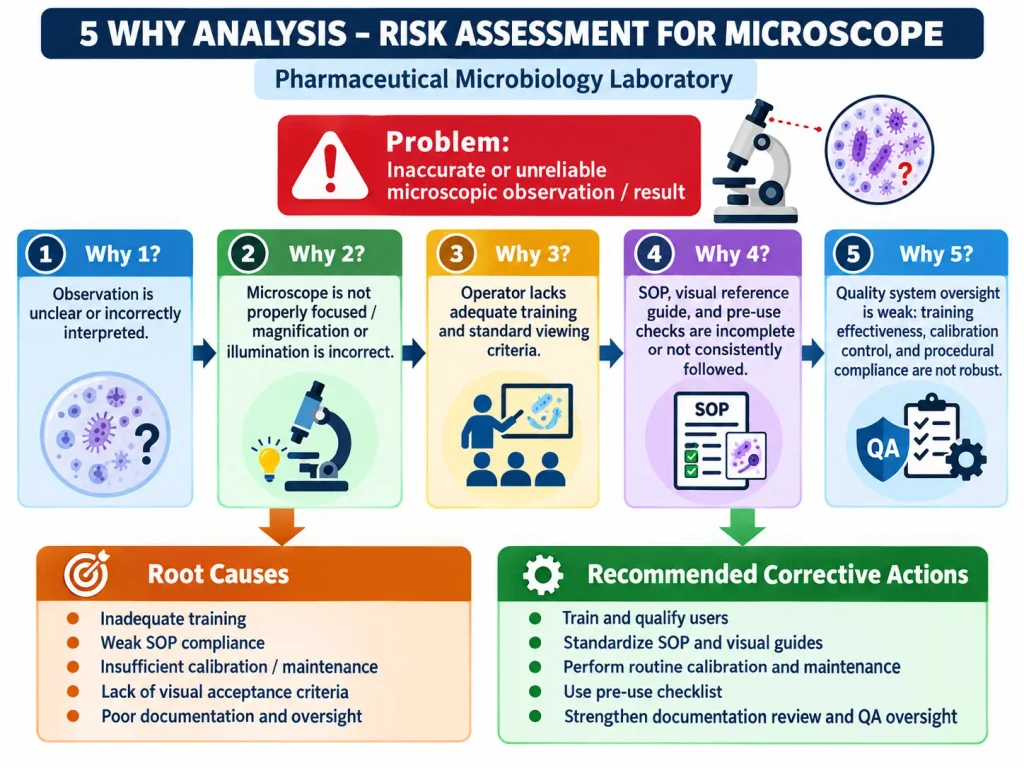
The 5 Why Analysis for Risk Assessment of Microscope systematically investigates the root causes of inaccurate or unreliable microscopic observations in pharmaceutical microbiology laboratories. The analysis identifies improper focusing, incorrect magnification, inadequate illumination, insufficient operator training, and ineffective SOP implementation as contributing factors. Further investigation highlights weaknesses in calibration, preventive maintenance, documentation, and quality oversight. Root causes include inadequate personnel qualification, missing visual acceptance criteria, and inconsistent procedural compliance. Recommended corrective and preventive actions include structured training, standardized SOPs, routine calibration, pre-use verification, and strengthened QA supervision. These controls improve analytical accuracy, data integrity, GMP compliance, and laboratory reliability.
5. Fishbone Analysis – Risk Assessment for Microscope:
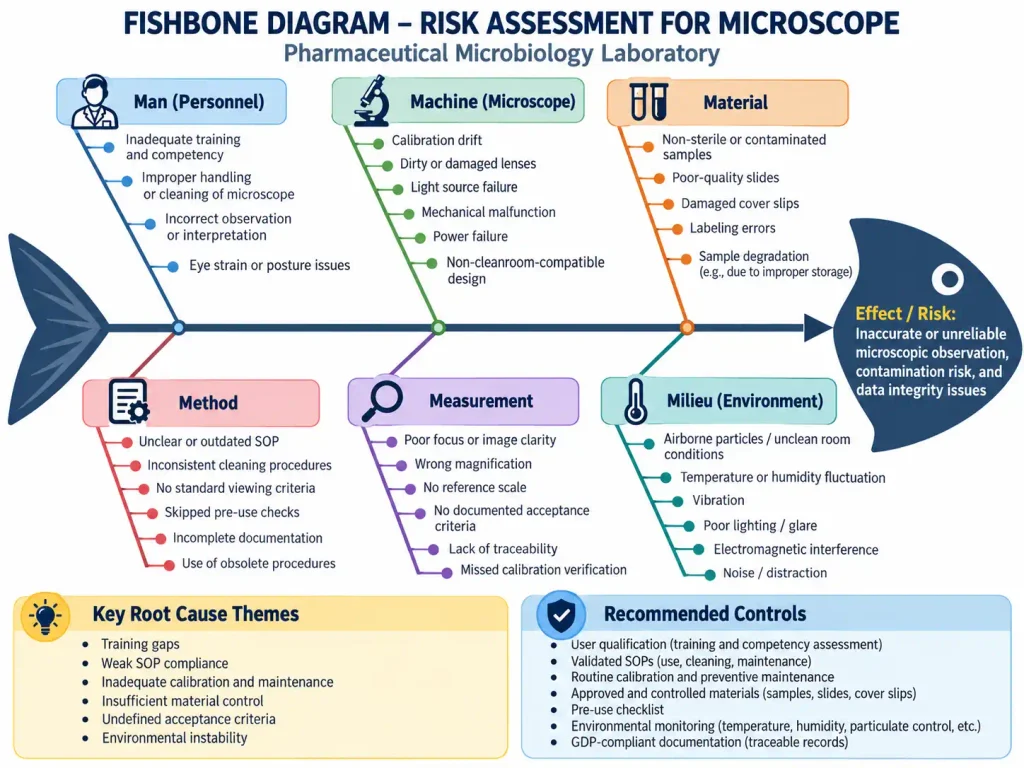
The Fishbone Diagram for Risk Assessment of Microscope systematically identifies potential causes of inaccurate microscopic observations, contamination, and data integrity issues in pharmaceutical microbiology laboratories. Using the 6M methodology, risks are categorized into Man, Machine, Material, Method, Measurement, and Milieu (Environment). Major contributing factors include inadequate training, calibration failures, contaminated samples, improper cleaning, incorrect magnification, and environmental fluctuations. The analysis highlights weaknesses in SOP compliance, preventive maintenance, material handling, and documentation practices. Recommended controls include personnel qualification, validated procedures, routine calibration, environmental monitoring, and traceable records. This structured approach strengthens GMP compliance, analytical reliability, product quality, and laboratory safety.
6. Fault Tree Analysis – Risk Assessment for Microscope
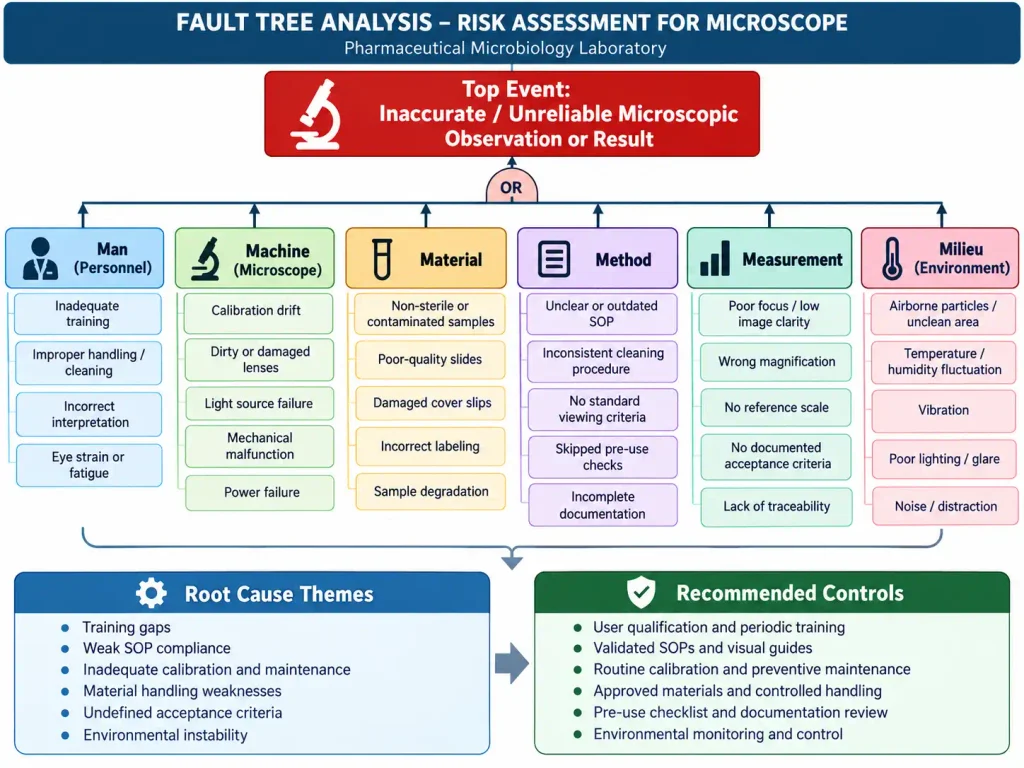
The Fault Tree Analysis (FTA) for Risk Assessment of Microscope systematically identifies potential causes of inaccurate or unreliable microscopic observations in pharmaceutical microbiology laboratories. The analysis uses an OR gate to connect failures associated with personnel, equipment, materials, methods, measurements, and environmental conditions. Major risks include inadequate training, calibration drift, contaminated samples, improper cleaning, incorrect magnification, and environmental fluctuations. Root causes involve weak SOP compliance, insufficient maintenance, poor documentation, and undefined acceptance criteria. Recommended controls include personnel qualification, validated SOPs, routine calibration, preventive maintenance, environmental monitoring, and traceable documentation to ensure analytical accuracy and GMP compliance.
7. Heat Map Analysis – Risk Assessment for Microscope:
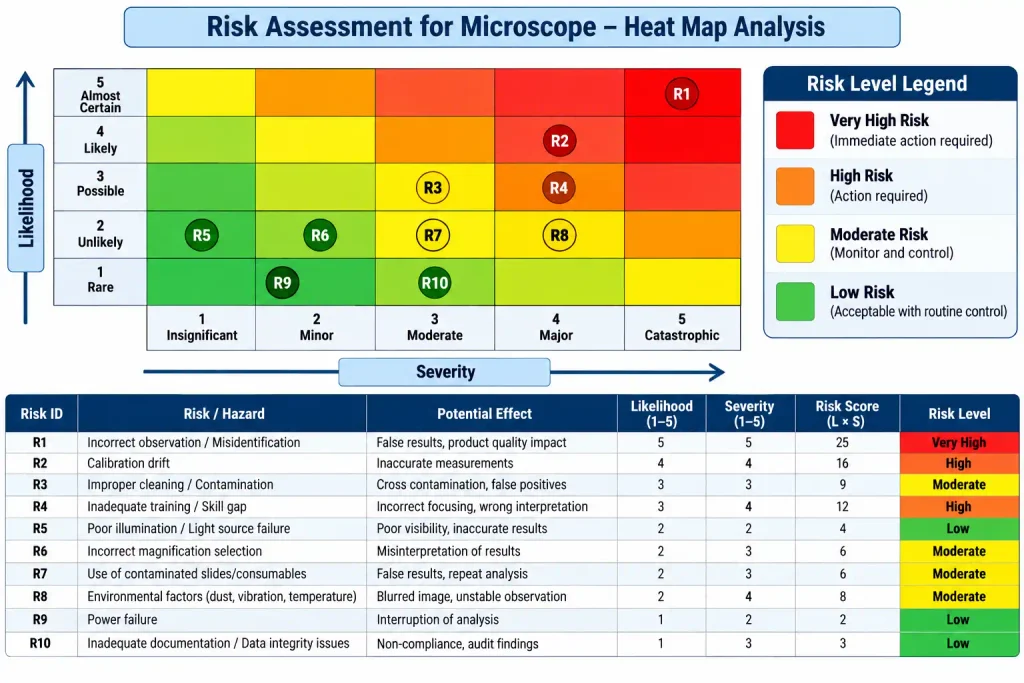
The Heat Map Analysis for Risk Assessment of Microscope visually represents potential hazards based on their severity and likelihood in pharmaceutical microbiology laboratories. Risks are classified into low, moderate, high, and very high categories using a color-coded matrix. Major concerns include inaccurate observations, calibration drift, improper cleaning, inadequate training, contaminated samples, and environmental fluctuations. High-risk conditions require corrective actions, while moderate and low risks demand appropriate monitoring and preventive controls. Recommended measures include routine calibration, personnel training, validated SOPs, environmental monitoring, and documentation review. This systematic approach supports risk prioritization, analytical reliability, GMP compliance, and continuous quality improvement.
8. Pareto Chart Analysis – Risk Assessment for Microscope:
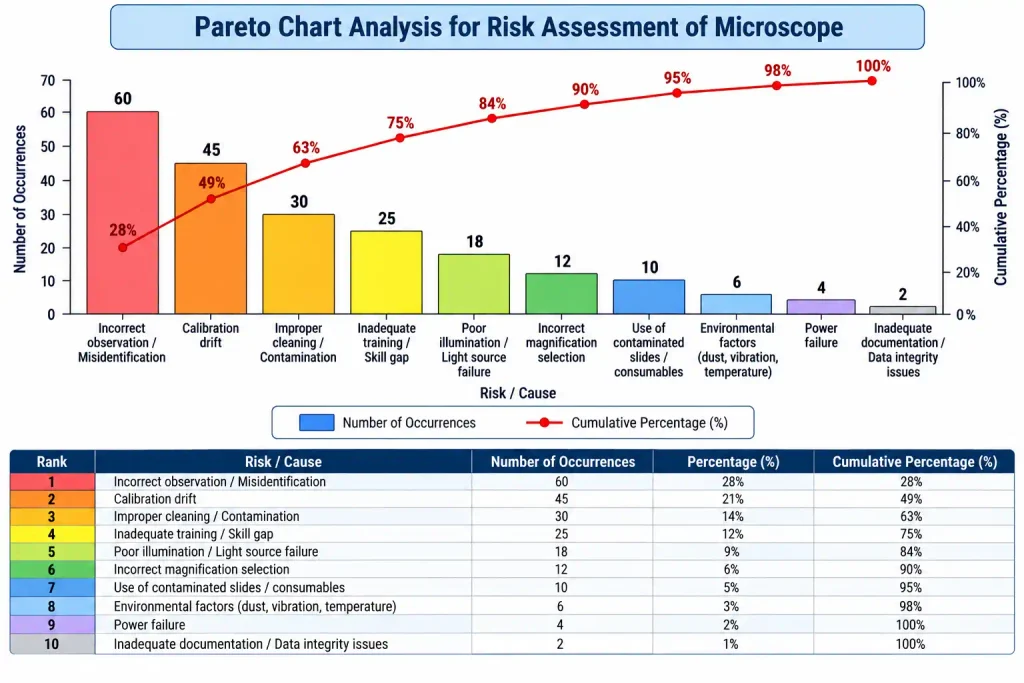
The Pareto Chart Analysis for Risk Assessment of Microscope illustrates the prioritization of potential failure causes affecting microscopic examination in pharmaceutical microbiology laboratories. The illustrative chart highlights incorrect observations, calibration drift, improper cleaning, inadequate training, and illumination failures as major contributors to analytical risks. Using the 80/20 Pareto principle, it identifies areas requiring focused corrective and preventive actions. Recommended controls include personnel qualification, routine calibration, standardized cleaning procedures, equipment maintenance, and documented verification. The analysis supports systematic risk reduction, improved analytical accuracy, GMP compliance, data integrity, and continuous quality improvement through effective monitoring and periodic review of laboratory operations.
9. Corrective Action and Preventive Action (CAPA) with Effectiveness Review – Risk Assessment for Microscope:
1. Objective
The objective of CAPA for Risk Assessment of Microscope is to identify, investigate, correct, and prevent potential failures associated with microscope operation in pharmaceutical microbiology laboratories. The CAPA process addresses risks identified through the 6M methodology, FMEA, 5 Why Analysis, Fishbone Analysis, Fault Tree Analysis, Heat Map, and Pareto Analysis.
The primary focus is to ensure accurate microscopic observations, prevent contamination, maintain equipment reliability, strengthen GMP compliance, and protect data integrity.
2. Corrective Action and Preventive Action Plan
The following CAPA plan is based on the risks identified in the uploaded assessment. Responsibilities and timelines are proposed for implementation and should be approved through the site’s Quality Management System.
| Risk / Observation | Corrective Action (CA) | Preventive Action (PA) | Responsibility |
|---|---|---|---|
| Inadequate operator training | Retrain operators on microscope handling, focusing, magnification, and interpretation. | Establish periodic training and competency assessment. | QC Microbiology / QA |
| Calibration drift | Remove affected microscope from service and perform calibration or repair. Assess affected results. | Implement calibration schedules, due-date alerts, and pre-use verification. | QC / Engineering |
| Improper microscope cleaning | Clean affected components using approved procedures and assess contamination risk. | Standardize cleaning SOPs and introduce cleaning checklists. | QC Microbiology |
| Contaminated samples or slides | Reject unsuitable samples or slides and repeat examination where justified. | Use approved materials, controlled sample handling, and defined storage conditions. | QC Microbiology |
| Incorrect magnification or focusing | Repeat examination using the correct objective lens and focusing procedure. | Provide visual reference guides and application-specific magnification requirements. | QC Microbiology |
| Inaccurate observations | Review questionable results and repeat analysis where scientifically justified. | Establish documented acceptance criteria, reference images, and competency verification. | QC / QA |
| Environmental fluctuations | Restore specified temperature, humidity, lighting, and vibration conditions. | Implement routine environmental monitoring and appropriate alert systems. | Engineering / QC |
| Incomplete documentation | Investigate missing records and document corrections according to GDP requirements. | Implement standardized logbooks, documentation training, and periodic reviews. | QC / QA |
| Equipment malfunction | Stop using defective equipment and arrange repair or replacement. | Implement preventive maintenance and pre-use inspection checklists. | Engineering / QC |
| Inadequate SOP compliance | Investigate procedural deviations and retrain affected personnel. | Implement periodic SOP compliance audits and document control reviews. | QA / QC |
3. CAPA Implementation Timeline
| Activity | Proposed Timeline | Responsible Department |
|---|---|---|
| Immediate containment and impact assessment | Within 24 hours of identification | QC / QA |
| Root cause investigation | Within 7 working days | QC / QA |
| CAPA identification and approval | Within 10 working days | QA |
| SOP revision and implementation | Within 30 calendar days | QC / QA |
| Training and competency evaluation | Within 30 calendar days | QC |
| Calibration and maintenance improvements | Within 30 calendar days | Engineering / QC |
| Effectiveness monitoring | 90 days after CAPA implementation | QA / QC |
| CAPA effectiveness review and closure | After completion of monitoring | QA |
Timelines are proposed targets, not requirements stated in the source document.
4. CAPA Effectiveness Review
Objective
To verify that implemented corrective and preventive actions effectively address the identified root causes and prevent recurrence of microscope-related failures.
Recommended effectiveness monitoring period: 90 days following implementation of the final CAPA action.
Effectiveness Verification Matrix
| Verification Parameter | Proposed Acceptance Criteria | Frequency |
|---|---|---|
| Operator training | 100% applicable operators trained and assessed as competent | At CAPA implementation and upon personnel changes |
| Calibration compliance | 100% calibrations completed within approved due dates | Monthly |
| Cleaning compliance | No critical cleaning-related deviations | Weekly |
| Microscope performance | All required pre-use checks satisfactory | Before each use |
| Analytical accuracy | No recurrence of errors attributable to identified CAPA root causes | Monthly |
| Environmental conditions | 100% recorded excursions investigated and assessed | Monthly |
| Documentation compliance | No critical GDP or data integrity deficiencies | Monthly |
| Equipment maintenance | 100% scheduled maintenance activities completed on time | Monthly |
| SOP compliance | No repeated critical procedural deviations | Monthly |
| CAPA recurrence | Zero recurrence of the same confirmed root cause | At 90 days |
These are suggested effectiveness criteria. They must be finalized according to site-specific procedures, instrument applications, and risk classification.
5. Effectiveness Review Procedure
- Day 0 – CAPA ImplementationConfirm completion of approved SOP revisions, calibration activities, personnel training, and required equipment improvements.
- Day 30 – Initial ReviewReview calibration records, equipment usage logs, cleaning records, training effectiveness, and deviations.
- Day 60 – Intermediate ReviewAssess recurrence trends, instrument performance, observation accuracy, environmental conditions, and compliance with approved procedures.
- Day 90 – Final Effectiveness ReviewEvaluate monitoring evidence against predetermined acceptance criteria, review recurring problems, and determine whether CAPA is effective.
- QA Approval and ClosureClose CAPA only when supporting evidence demonstrates that the identified root causes have been adequately controlled. Otherwise, extend monitoring or initiate additional investigation.
6. CAPA Effectiveness Review Report – Suggested Wording
CAPA Effectiveness Review – Risk Assessment for Microscope
Monitoring Period: 90 days following CAPA implementation
Review Parameters: Operator competency, equipment calibration, preventive maintenance, cleaning compliance, microscopic observation accuracy, environmental conditions, and documentation practices.
Effectiveness Review:
A 90-day effectiveness monitoring program shall be conducted following implementation of approved corrective and preventive actions. QA and QC shall review relevant training records, calibration certificates, preventive maintenance records, equipment usage logs, cleaning records, analytical observations, deviations, and environmental monitoring records.
The effectiveness review shall determine whether the implemented CAPA measures have adequately addressed the identified root causes, improved microscope performance, and prevented recurrence of related failures.
Acceptance Criteria: All predefined CAPA effectiveness criteria shall be met, with no recurrence of the confirmed root causes during the monitoring period.
Conclusion: CAPA effectiveness shall be classified as Effective, Partially Effective, or Ineffective based on documented evidence. Final CAPA closure shall be authorized by QA only after satisfactory verification of effectiveness.
CAPA Status: Pending effectiveness verification.
Reviewed By: QC Head / Designee
Approved By: QA Head / Designee
7. Reference Guidelines
- ICH Q9(R1) – Quality Risk Management.
- ICH Q10 – Pharmaceutical Quality System.
- EU GMP Chapter 1 – Pharmaceutical Quality System.
- EU GMP Chapter 4 – Documentation.
- 21 CFR 211.160 – General Requirements for Laboratory Controls.
- 21 CFR 211.194 – Laboratory Records.
Important: The uploaded microscope risk assessment identifies failure modes and recommends controls, but does not provide evidence of completed CAPAs or successful effectiveness verification. The above plan is therefore a proposed CAPA framework, not a record of completed implementation.
Final recommendation: Use a 90-day, risk-based CAPA effectiveness monitoring period, followed by documented QA review and approval before closure.
10. Questions and Answers – Risk Assessment for Microscope:
Q1. What is the purpose of Risk Assessment for Microscope?
Answer: The purpose is to identify, evaluate, and control potential risks associated with microscope operation in pharmaceutical microbiology laboratories. It helps ensure accurate observations, reliable analytical results, operator safety, and compliance with Good Manufacturing Practices (GMP).
Q2. What methodology is used for microscope risk assessment?
Answer: The assessment uses the 6M methodology and Failure Mode and Effects Analysis (FMEA). The six categories are Man, Machine, Material, Method, Measurement, and Mother Nature (Environment). These categories help systematically identify potential failure modes and their effects on laboratory operations.
Q3. What are the major risks associated with microscope operation?
Answer: Major risks include inadequate operator training, calibration drift, damaged lenses, improper cleaning, contaminated samples, incorrect magnification, poor illumination, environmental fluctuations, and incomplete documentation. These failures may affect analytical accuracy, product quality, and data integrity.
Q4. What is FMEA in microscope risk assessment?
Answer: Failure Mode and Effects Analysis (FMEA) is a systematic risk assessment technique used to identify possible equipment or process failures, evaluate their consequences, and prioritize appropriate control measures.
The Risk Priority Number is calculated as:
\[ RPN = Severity \times Occurrence \times Detection \]
The uploaded assessment uses a 1–10 scoring scale for each factor.
Q5. What are the highest-priority risks identified in the uploaded assessment?
Answer: Based on the documented FMEA scores, the highest RPN values include:
| Identified Risk | RPN |
|---|---|
| Subjective visual assessment due to missing acceptance criteria | 216 |
| Inadequate operator training | 192 |
| No standard viewing criteria | 192 |
| Improper microscope cleaning | 180 |
| Contaminated sample preparation | 180 |
| Improper cover slip handling | 180 |
These risks require prioritization according to the organization’s approved risk acceptance criteria.
Q6. How can calibration drift affect microscope performance?
Answer: Calibration drift may cause inaccurate measurements, incorrect size estimation, and unreliable analytical results. Scheduled calibration, status labeling, verification before use, and documented maintenance help control this risk.
Q7. Why is operator training important for microscope operation?
Answer: Proper training ensures that personnel understand microscope handling, focusing techniques, magnification selection, sample preparation, cleaning, and result interpretation. It reduces human errors and supports consistent laboratory performance.
Q8. What are the risks associated with improper microscope cleaning?
Answer: Improper cleaning may cause cross-contamination, damaged lenses, reduced image clarity, and inaccurate observations. An approved cleaning SOP, suitable lens-cleaning materials, and cleaning records are recommended controls.
Q9. How does incorrect magnification affect microscopic examination?
Answer: Incorrect magnification may lead to inaccurate estimation of microorganism size, missed defects, or misinterpretation of observations. Standardized magnification requirements and appropriate operator training help reduce these risks.
Q10. Why is environmental monitoring important for microscope operation?
Answer: Temperature, humidity, vibration, lighting, and airborne particles may influence microscope performance and sample integrity. Maintaining suitable environmental conditions helps minimize optical distortion, contamination, and analytical errors.
Q11. What is the purpose of 5 Why Analysis in microscope risk assessment?
Answer: The 5 Why technique investigates the underlying causes of identified problems by repeatedly asking why they occur. For inaccurate microscopic observations, possible causes include improper focusing, insufficient training, unclear procedures, and ineffective equipment controls.
Q12. What is the purpose of Fishbone Analysis?
Answer: Fishbone Analysis organizes potential causes of microscope-related failures into the six categories of the 6M methodology. It helps identify contributing factors involving personnel, equipment, materials, procedures, measurements, and environmental conditions.
Q13. What is Fault Tree Analysis (FTA)?
Answer: Fault Tree Analysis is a systematic method used to investigate combinations of failures that may contribute to an undesirable event, such as inaccurate microscopic observations. Logical gates connect potential contributing events, supporting root cause investigation and risk control.
Q14. What is the significance of Heat Map Analysis?
Answer: Heat Map Analysis provides a visual representation of risks according to their severity and likelihood. It helps classify hazards into risk categories and prioritize corrective or preventive actions.
The previously generated heat map uses illustrative scores and should not be treated as the original documented FMEA.
Q15. What is the purpose of Pareto Chart Analysis?
Answer: Pareto Analysis helps identify the most frequent or significant contributors to laboratory problems. It assists management in focusing corrective actions on the causes with the greatest impact. Pareto charts require reliable occurrence data; the previously generated chart used illustrative frequencies.
Q16. What corrective actions are recommended for microscope-related failures?
Answer: Corrective actions may include repairing or recalibrating defective microscopes, retraining personnel, reviewing inaccurate results, replacing damaged slides, correcting documentation deficiencies, and restoring suitable environmental conditions.
Q17. What preventive actions can reduce microscope-related risks?
Answer: Preventive actions include implementing approved SOPs, periodic training, routine calibration, preventive maintenance, pre-use inspection checklists, controlled sample handling, environmental monitoring, and periodic documentation reviews.
Q18. How should CAPA effectiveness be evaluated?
Answer: CAPA effectiveness should be verified by reviewing evidence such as calibration records, cleaning records, training assessments, equipment usage logs, deviations, and analytical performance.
A proposed 90-day effectiveness monitoring period may be adopted following QA approval. CAPA should be closed only when predefined acceptance criteria are satisfied and the actions have effectively addressed the identified root causes.
Q19. What documentation is required for GMP-compliant microscope operation?
Answer: Relevant documentation includes equipment identification and usage records, calibration certificates, preventive maintenance records, cleaning logs, approved SOPs, personnel training records, sample examination records, deviation reports, and CAPA records.
Q20. What is the overall conclusion of Risk Assessment for Microscope?
Answer: Microscope operation in pharmaceutical microbiology laboratories can be adequately controlled through appropriate personnel qualification, equipment calibration, validated or otherwise justified procedures, controlled laboratory conditions, and reliable documentation. Implementing risk-based controls helps protect analytical accuracy, product quality, data integrity, and GMP compliance.
11. Reference Guidelines – Risk Assessment for Microscope:
The following regulatory guidelines and international standards are applicable to the risk assessment, operation, calibration, cleaning, maintenance, and documentation of microscopes used in pharmaceutical microbiology and quality control laboratories.
1. International Regulatory Guidelines
| S. No. | Reference Guideline | Relevance to Microscope Risk Assessment |
|---|---|---|
| 1 | ICH Q9(R1) – Quality Risk Management | Provides principles for risk identification, analysis, evaluation, control, communication, and review using tools such as FMEA and FTA. |
| 2 | ICH Q10 – Pharmaceutical Quality System | Establishes expectations for CAPA, change management, continual improvement, and management oversight. |
| 3 | 21 CFR Part 211 – Current Good Manufacturing Practice | Establishes GMP requirements for laboratory controls, equipment maintenance, personnel training, and documentation. |
| 4 | EU GMP Chapter 3 – Premises and Equipment | Addresses equipment suitability, maintenance, cleaning, and the prevention of contamination. |
| 5 | EU GMP Chapter 4 – Documentation | Establishes documentation practices to ensure accurate, complete, traceable laboratory records. |
| 6 | EU GMP Chapter 6 – Quality Control | Provides requirements for laboratory procedures, testing, equipment, and analytical records. |
| 7 | EU GMP Annex 1 – Manufacture of Sterile Medicinal Products | Relevant when microscope activities affect sterile manufacturing or classified cleanroom operations. |
| 8 | ISO/IEC 17025:2017 – Testing and Calibration Laboratories | Provides requirements for laboratory competence, equipment control, method suitability, and technical records. |